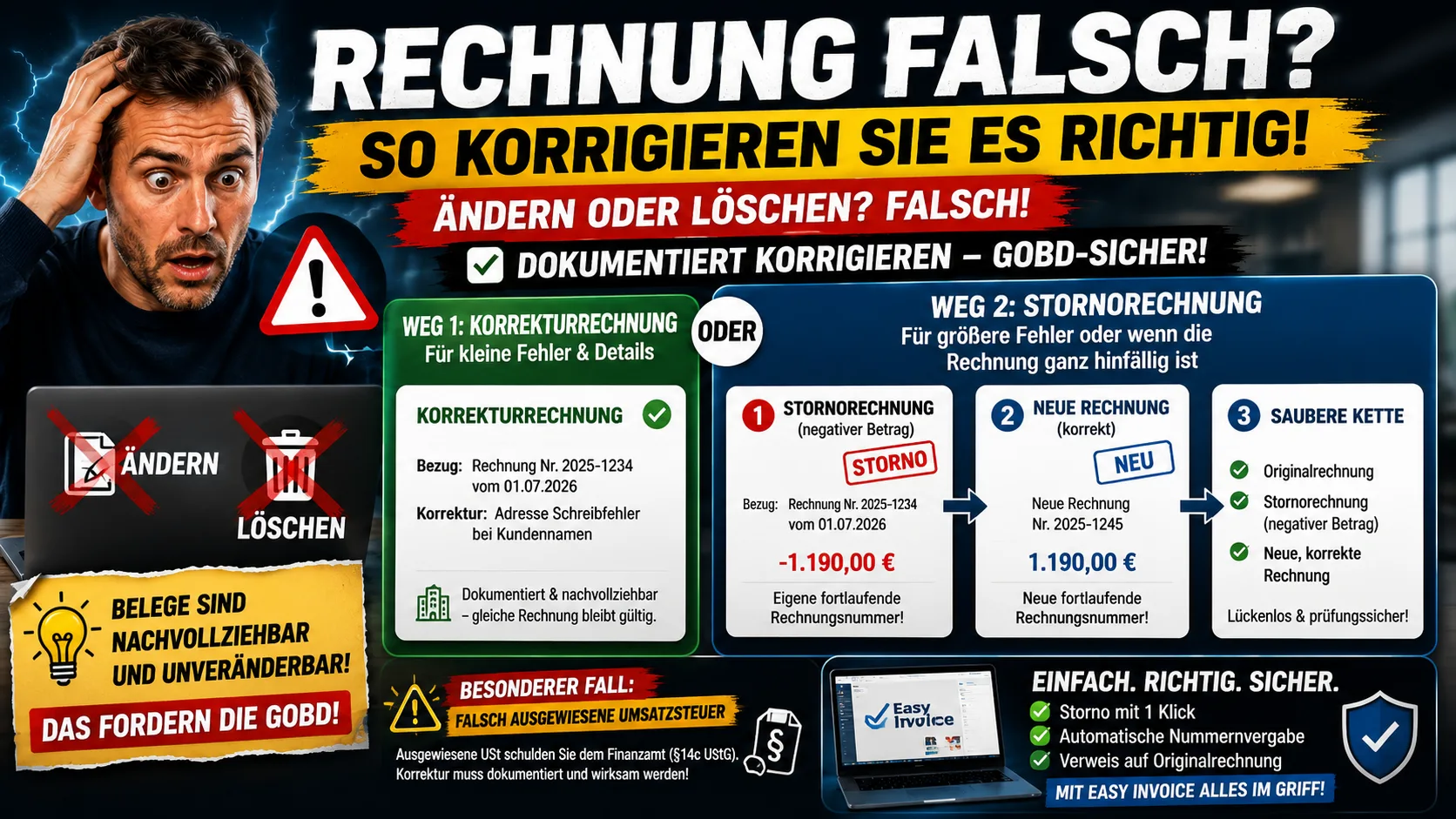
Wrong amount, a typo in the address, VAT stated by mistake: once the invoice is already with the customer, the first impulse is to open the file and change it quickly – or to delete it and write a new one. Both are the wrong way to go. Why, and how to do it properly, is what this article clarifies.
Why You May Not Simply Change an Invoice
As soon as an invoice is issued and sent, it counts as a document. Documents must be traceable and unalterable – that is required by the principles of proper bookkeeping (GoBD – German principles for the proper keeping and retention of books, records and documents in electronic form). Overwriting an already sent invoice after the fact, or deleting it without a trace, would break this traceability. If an audit comes, either a document is missing or two different versions of the same invoice number exist – both stand out negatively.
The solution is not to hide the error but to correct it in a documented way. There are two routes for this.
Route 1: The Correction Invoice (Invoice Correction)
The correction invoice is suitable for smaller errors, where the invoice amount is right or only one detail changes – for example a transposed number in the address, a wrong description of the service or a forgotten detail.
You do not write a completely new document but a correction document that clearly refers to the original invoice: with its invoice number and date, plus a statement of what is being corrected. The clear reference is what matters – the customer and the tax office must be able to see which invoice is being put right by it.
Route 2: The Cancellation Invoice
The cancellation invoice is the route for larger errors or when the invoice is void altogether – wrong amount, wrong recipient, issued twice, or the order fell through.
Here is how it runs cleanly:
- You create a cancellation invoice: in content a copy of the original invoice, but with a negative amount. It thereby cancels the original invoice arithmetically.
- The cancellation invoice gets its own sequential invoice number – not that of the original invoice.
- It refers to the original invoice (its number and date) so that the connection is clear.
- Then – if needed – you write a new, correct invoice, again with its own number.
In the end, three documents exist: the faulty original invoice, the cancellation invoice that offsets it, and the new correct invoice. It is exactly this unbroken chain that an audit expects. If it is not an error at all but a later refund to the customer, you do not need a cancellation – see creating a credit note.
Special Case: VAT Stated Incorrectly
An error with a weight of its own: if too much or unwarranted VAT was stated – for example as a small business, or with 19 instead of 7 percent – you initially owe the amount stated to the tax office (§ 14c UStG). This too can be corrected, but it is not enough to quietly change the figure: the correction must be documented and take effect towards the customer. In such cases it is worth a quick look with your tax adviser before the correction, so that the adjustment also takes hold for tax purposes.
The Convenient Way
The reason many break into a sweat when correcting is usually the numbering: cancellation with its own number, a reference to the original, a new invoice again with its own number – done by hand this is error-prone. Invoicing software takes exactly that off your hands: in Easy Invoice on office1.cloud you generate the cancellation invoice for an existing invoice at the click of a button, including the negative amount, the correct number and the reference to the original – the chain stays clean automatically.
How an invoice looks complete from the outset, so that it never comes to a correction in the first place, is shown in our guide to writing an invoice.
_This article gives a general overview and is no substitute for tax advice. What matters is your specific individual case; when in doubt, your tax adviser can help._
Handle invoices more easily
Easy Invoice combines quotes, invoices and customer management in the cloud.
Try Easy InvoiceRead next
 Invoicing & Accounting
Instalment agreement with customers: template and rules
Your customer asks whether they can pay the invoice in three instalments. Before you agree, two things matter: the tax office will not wait, and your favour legally becomes a loan.
 Invoicing & Accounting
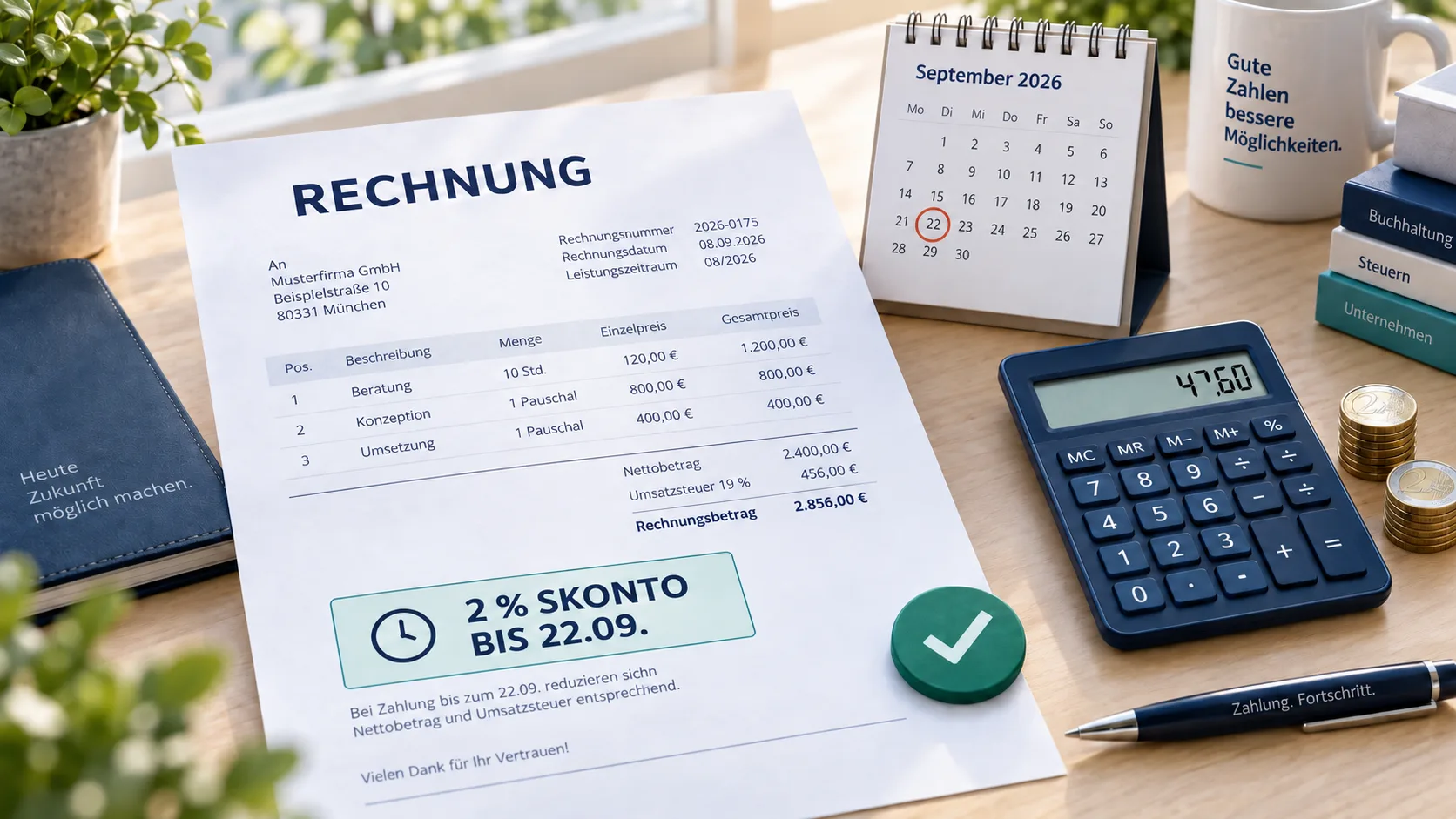
Cash Discount on an Invoice: Wording, Deadline and VAT
A client deducts a cash discount even though they paid far too late – and looking at your invoice, you realise your wording never settled the point.
 Invoicing & Accounting
Invoicing Without a Trade License in Germany: Allowed, With a Limit
A client wants an invoice, but you haven't registered a trade. You may still write one – the real question is when a favor turns into an obligation.