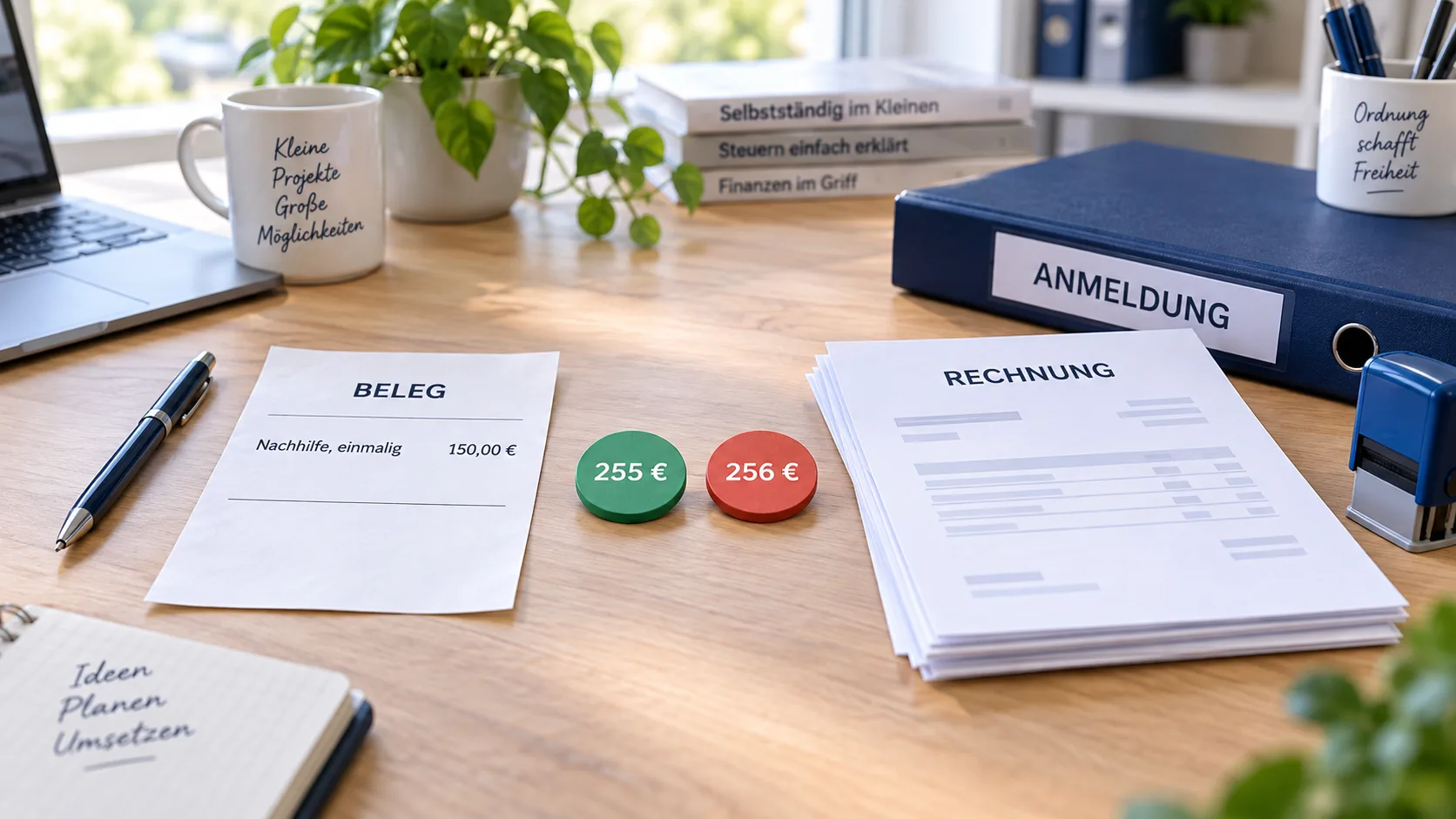
Yes, you may write an invoice in Germany even without a trade license (Gewerbeschein). No law ties the right to charge for a service, and to write down what it was for, to a registration. What matters is a different question: does it stay a one-off, or does it repeat? For a one-off service, a tax-free threshold of 256 euros a year applies; below that, nothing happens for tax purposes. If you repeat the activity with the intention of earning money from it, you must register – no matter how small the amounts are.
This article explains the general German rules and is not tax or legal advice. If you're unsure about your specific case, ask a German tax advisor (Steuerberater).
Contents
- A trade license and tax liability are two different things
- Am I really allowed to do this – even without a trade license?
- One-off or regular: the 256-euro threshold decides
- Are you just selling things from your own household?
- Selling or working through a platform? The report to the tax office
- When do you actually have to register?
- What belongs on the receipt while you're not registered – with a template
- And once you cross the threshold?
- What happens if you don't register?
- You already took money without declaring it anywhere
- Frequently asked questions
A trade license and tax liability are two different things
This is where most of the confusion starts, so first things first: registering a trade and being liable for tax have nothing directly to do with each other in Germany.
- Trade registration (Gewerbeanmeldung) is an obligation toward the local trade office (Gewerbeamt). It only governs whether you have to register there.
- Tax liability arises toward the tax office (Finanzamt) as soon as you earn money on a sustained basis – regardless of whether you ever registered a trade.
That's why both statements can be true at once: "I have no registered trade" and "I am an entrepreneur for tax purposes." A freelancer (Freiberufler), for example, never registers a trade and is still an entrepreneur for tax purposes from the very first assignment. And someone who starts a trade-like activity without registering it stays tax liable regardless – the missing registration doesn't change that, it's simply a separate violation of its own.
The rest of this article follows two tracks, depending on which case applies to you:
| Case 1: genuinely one-off, under 256 euros | Case 2: regular activity, or freelance | |
|---|---|---|
| Are you an entrepreneur for tax purposes? | No | Yes |
| What do you need? | an informal receipt | a full invoice with mandatory details |
| Where to go next? | 256-euro threshold | Once you cross the threshold |
Am I really allowed to do this – even without a trade license?
Yes. An invoice is not an official form – it's a statement of what you delivered and what it costs. No one needs a permit for that.
Here's where the mix-up comes from: many people think the invoice is the moment an activity becomes "official." That's not true. An activity becomes official the moment you start pursuing it sustainably and with the intent to profit – whether you write an invoice for it or simply take cash doesn't change that. The invoice only makes the activity visible, it doesn't make it worse.
One exception exists: freelance activities under § 18 EStG (the German Income Tax Act) – such as teaching, writing, consulting, or work in the healing professions – never require a trade registration, no matter the turnover. If you provide a service that isn't on the freelance list, you're running a trade as soon as the activity goes beyond the occasional. To work out which case applies to you, see Freelancer or trade? (in German).
If you're writing invoices for more than a one-off favor, a clean filing system becomes unavoidable. An invoicing program for people starting out without a trade handles the sequential numbering and the small-business tax note from day one, instead of you tracking it by hand in a Word template.
One-off or regular: the 256-euro threshold decides
The one-off case. You helped a neighbor move house once and received 150 euros for it. That's a single service. Under § 22 No. 3 EStG, such income is not subject to income tax as long as it stays under 256 euros in the calendar year.
Note the word threshold. It is not an allowance where only the amount above it counts – it's a cliff-edge threshold:
| Income in the year | Taxable |
|---|---|
| 255 euros | nothing |
| 256 euros | the full 256 euros |
| 400 euros | the full 400 euros |
One euro more, and the entire amount counts. What matters is when the money reaches you, not when you performed the service – two payments of 150 euros each in the same year add up together.
The regular case. You tutor several times a month, advertise for it, or have regular students who keep coming back. That's no longer an occasional service but a self-employed activity. The 256-euro threshold does not apply then. You're liable for tax from the first euro of profit, and you must register the activity with the tax office.
The line between the two isn't a number, it's an overall picture: do you repeat it? Do you want to earn money from it? Do you present yourself publicly for it, say with an ad or a sign? Three "yes" answers usually mean: self-employed, no longer occasional. Whether the client is a stranger or someone you know doesn't matter here – what counts is the activity, not your relationship to the client.
And if I keep losing money? Then the tax office can classify the activity as a hobby (Liebhaberei) – an expensive one. It won't recognize losses, so you can't deduct anything either.
Are you just selling things from your own household?
A different case, often confused with the one above: you clear out a cellar and sell an old bike or furniture you used yourself. That is not a case for the 256-euro threshold – it's private asset management. You're selling something that belongs to you, not making a profit from an activity. Such sales are generally tax-free, as long as it stays that way.
The line here also runs at repetition: anyone who regularly buys things to resell at a profit – clothing or electronics on a larger scale, say – is running a trading business and needs a trade registration for it, regardless of where the goods came from. For individual, self-used items from your own household, that doesn't apply.
Selling or working through a platform? The report to the tax office
This only concerns you if a platform is involved – eBay, eBay Kleinanzeigen (the German classifieds site), Vinted, Etsy, or a service-matching platform. A direct handshake deal with a neighbor doesn't fall under this.
Since 1 January 2023, the Platform Tax Transparency Act (Plattformen-Steuertransparenzgesetz, PStTG) has required such platforms to report their users' data to the Federal Central Tax Office (Bundeszentralamt für Steuern) every year by the end of January: name, address, often the tax ID, plus the number and total amount of transactions.
How much gets reported depends on what you're offering:
| Selling goods (eBay Kleinanzeigen, Vinted) | matched services | |
|---|---|---|
| De-minimis threshold | yes: under 30 sales and under 2,000 euros a year, no report is made | none – every transaction through the platform is reported |
| Legal basis | § 4 (5) No. 4 PStTG | § 5 (1) No. 2 PStTG |
So for tutoring, garden help, or similar services you offer through a matching platform: even the first, smallest job gets reported. Only selling goods has the de-minimis threshold.
Important: the report itself is not a tax. The tax office simply receives the numbers. Whether that results in an actual tax liability still depends on the rules elsewhere in this article: if you sell your own, self-used items without intending to repeat it, that stays tax-free – reported or not. If your activity is regular, the report doesn't change the tax liability that already existed; it just makes it more visible.
When do you actually have to register?
This is where most people misjudge things: there is no euro threshold for the registration requirement itself. § 14 of the German Trade Regulation Act (Gewerbeordnung) requires registration as soon as an activity is a trade – "the amount of time involved or the financial return are irrelevant," as the commentary puts it. The 256-euro threshold from the previous section is a matter of tax law for occasional services. Once an activity becomes sustained, that threshold no longer matters, and registration is due – even if the first earnings are only 30 euros.
Exceptions apply to:
- Freelance activities under § 18 EStG (see above) – no trade registration at all here, regardless of turnover.
- Managing your own assets, such as renting out a flat you own.
- Agriculture and forestry.
Everything else you offer regularly and with intent to profit is a trade – from a sewing business to garden help. Registration is due immediately once you start the activity, not once you've earned "enough." How the forms at the trade office and the tax office work is explained in Registering a trade and the tax registration form (in German).
What belongs on the receipt while you're not registered – with a template
As long as you're in Case 1 – genuinely one-off, under 256 euros – you're not an entrepreneur. The mandatory details from § 14 UStG (the German VAT Act) don't apply to you; you need neither a tax number nor a VAT note. Still, a simple receipt makes sense, so both sides have it in writing what was agreed:
Sabine Berger · Ahornstraße 12 · 50667 Köln

Receipt for one hour of tutoring

To: the Kowalski family
Date: 15 September 2026

Maths tutoring, 6 hours at 25.00 euros each
Amount received: 150.00 EUR

Sabine Berger
That's enough: your name and address, what you delivered, the amount, the date. No invoice number, no tax number, no tax rate – those belong on an invoice in the sense of § 14 UStG, and in this case you're not writing one at all.
Does the client explicitly ask for a "proper" invoice with a tax number – say, because they're a business and want to deduct the expense? Then this is really no longer a favor: you're entering a business relationship in which you have to act as an entrepreneur – which puts you in Case 2, below.
And once you cross the threshold?
Once you reach Case 2 – the activity becomes regular, or you're freelance from the start – several things change at once. In short, here's what then applies:
- Your invoices need the full mandatory details from § 14 (4) UStG: name and address of both parties, tax number, invoice date, sequential invoice number, the service, the amount, and the tax rate or the note on tax exemption.
- You usually still won't have a tax number for your very first invoice – that's normal. You submit the tax registration questionnaire via ELSTER (the German tax portal) and add the number once it arrives.
- For a start, the small-business scheme under § 19 UStG usually applies: up to 25,000 euros turnover in the previous year and 100,000 euros in the current year, you write no VAT on the invoice.
How exactly such an invoice looks, what retention periods apply, and what to watch for with the small-business note is explained in detail in Writing an invoice without VAT (in German).
What happens if you don't register?
Anyone who's required to register and doesn't risks a fine under § 146 GewO – the legal range goes up to 1,000 euros. In practice, whether and how much is actually charged depends on the individual case and the authority involved; there's no entitlement to leniency, though. This is a regulatory offense, not a criminal one – it doesn't result in an entry on a criminal record.
On top of that: the activity was taxable regardless of registration. The tax office can claim back taxes retroactively, plus interest. The longer a trade-like activity runs unregistered, the more expensive it gets to sort out later – the fine is usually the smaller item.
You already took money without declaring it anywhere
This is a common situation, and it's rarely as dramatic as it feels.
What matters is whether the income was taxable at all. If it stayed under the 256-euro threshold from a genuinely one-off situation, there's nothing to do. If it was more, or the activity was regular from the start, the income belongs in your tax return.
- Gather what happened. List all income for the year, with date, client, and amount. Bank statements help. Also list the expenses that came with it – they reduce your profit.
- Catch up on registration. The tax registration questionnaire is filled out via ELSTER; in it, you state since when you've been active. A past date is explicitly provided for.
- Include it in your tax return. For the current year, that's usually enough. If the year's return was already filed, it becomes an amendment – at that point, getting tax advice is worthwhile so the correction is done correctly.
The only thing that matters is not waiting for this to resolve itself. It gets bigger every year.
Frequently asked questions
Do I already need a tax number for a single invoice?
Only if the service is taxable at all – meaning above the 256-euro threshold or regular from the start. For a genuinely one-off favor under that threshold, an informal receipt without a tax number is enough.
Can I write an invoice without a trade as an employee, on the side?
For tax and trade-law purposes, the same rules apply to you as to anyone else: if you repeat it, you must register, regardless of your main job. Whether your employment contract restricts side activities or requires you to notify your employer is a separate, independent question – that's in the contract, not in tax law.
What's the difference between an invoice and a receipt?
An invoice itemizes what you delivered and what it costs – it's usually issued before or instead of payment. A receipt only confirms that a payment was received. For a business client who wants to deduct the expense, the invoice with its mandatory details is what counts, not the receipt.
Does an expense allowance also count toward the 256 euros?
If it genuinely just covers costs incurred – say, travel to the client – it's not profit and doesn't count. If it includes a surplus beyond the actual costs, that part counts as income.
Sources
Crossing the 256-euro threshold? Try Easy Invoice for free – the sequential numbering and the small-business note then appear on every invoice automatically.
Handle invoices more easily
Easy Invoice combines quotes, invoices and customer management in the cloud.
Try Easy InvoiceRead next
 Invoicing & Accounting
Instalment agreement with customers: template and rules
Your customer asks whether they can pay the invoice in three instalments. Before you agree, two things matter: the tax office will not wait, and your favour legally becomes a loan.
 Invoicing & Accounting
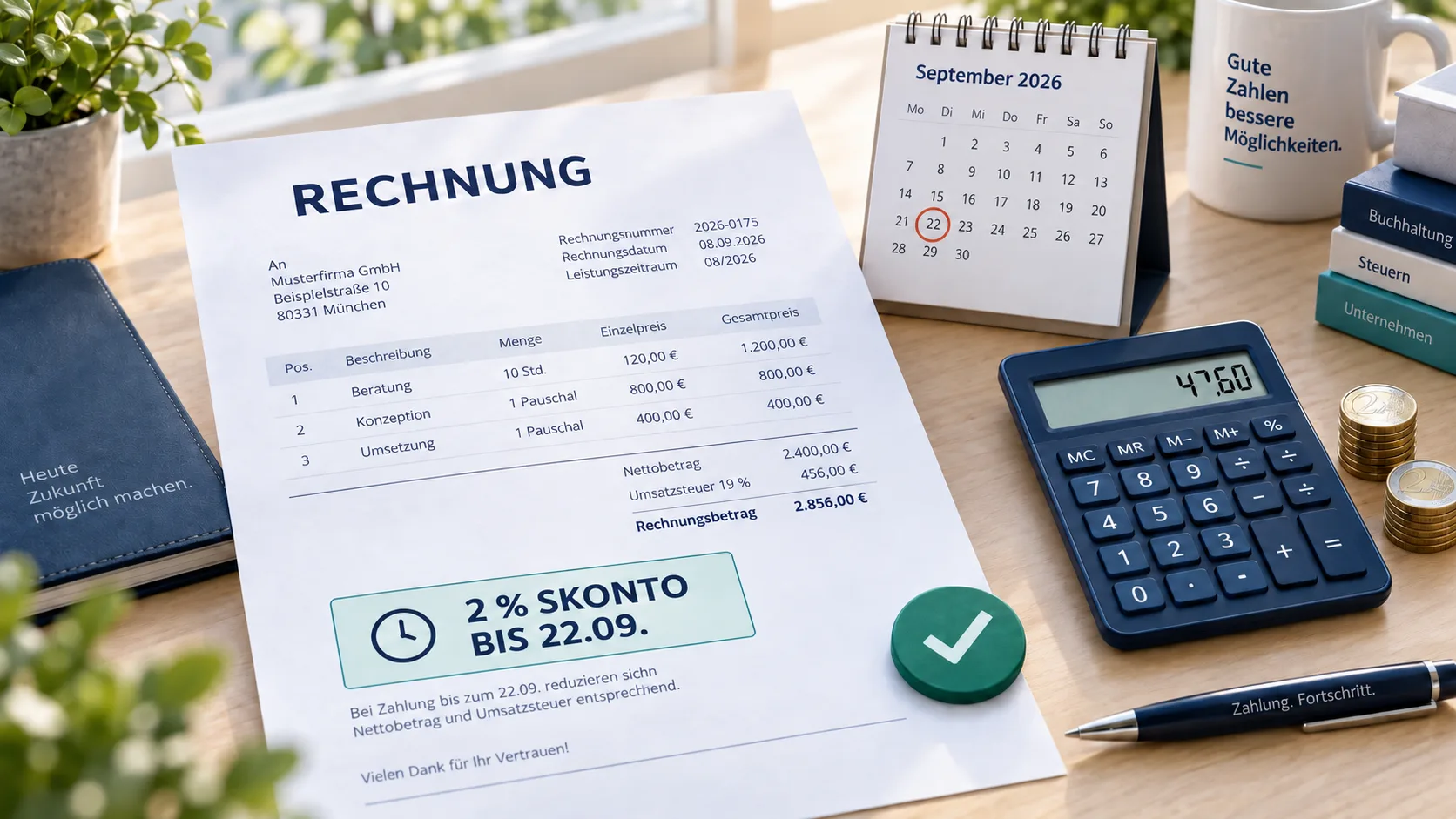
Cash Discount on an Invoice: Wording, Deadline and VAT
A client deducts a cash discount even though they paid far too late – and looking at your invoice, you realise your wording never settled the point.
 Invoicing & Accounting
Payment terms on an invoice: wording, deadlines, default
How long may your customer take, what do you put on the invoice, and when may you send a reminder? The answers, with wording you can copy.