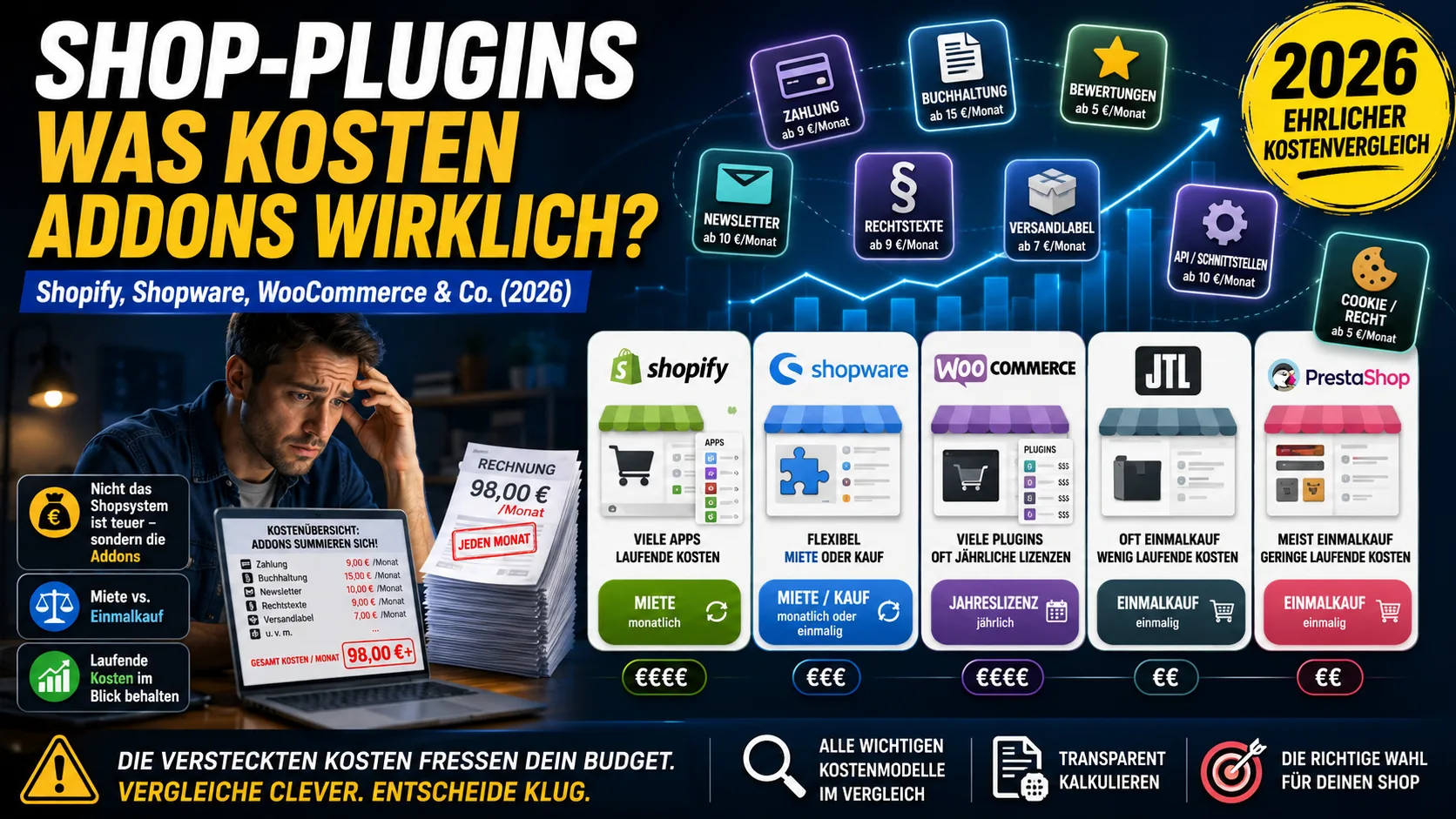
When you plan an online shop, you usually compare the base prices of the systems: What does Shopify cost per month, what does Shopware cost, what does WooCommerce cost? But those figures are only half the truth. The actual costs arise elsewhere — with the extensions. Almost every shop needs additional functions that are not included out of the box: a connection to your accounting, a specific payment provider, reviews, newsletters, legal texts, shipping labels. Depending on the system, these extensions are called apps, plugins or extensions — they all mean the same thing.
The decisive difference between the systems is not only what a single add-on costs, but which model it is billed under. That is exactly what people overlook in a quick comparison — and then wonder later about the running costs.
Table of Contents
- Why Add-ons Often Cost More Than the Shop System
- Two Pricing Models You Need to Know
- Shopify: Largest Selection, but Ongoing Costs
- Shopware: Buy or Rent – and Freely Extensible
- WooCommerce: Lots Free, Extensions Usually as an Annual License
- JTL-Shop: Free Core, Plugins Often One-Time
- PrestaShop: Open Source with a One-Time-Purchase Marketplace
- Legal Compliance Example: Same Need, Very Different Billing
- Pricing Models and Typical Costs at a Glance
- The Catch with Cloud Systems – and When Your Own Plugin Pays Off
- Two Cost Items That Are Not Add-ons but Still Belong in the Calculation
- What This Means for Your Decision
- Custom Shop Plugins Built to Your Specifications
Why Add-ons Often Cost More Than the Shop System
A sample calculation makes it clear. A Shopify basic package costs a manageable amount per month. But an average shop quickly uses five to ten additional apps — for reviews, shipping, accounting, marketing, legal compliance. Together, these apps can cost 100 to 200 euros per month, in many cases more than the shop system itself.
Over the course of a year, that quickly adds up to 1,200 to 2,400 euros that do not appear at all in the initial price comparison. That is why it is worth honestly considering before you choose a system: Which functions do I really need — and how are they billed with each system?
Payment plugins are often free, the fees behind them are not: which provider costs what per transaction, and why PayPal should be connected directly, is in Payment providers for online shops.
Two Pricing Models You Need to Know
Behind all the numbers there are essentially just two models:
- Monthly rental (subscription): You pay for each add-on month after month, as long as you use it. The entry point is cheap, but the costs continue permanently and add up with every additional function. Typical for Shopify.
- One-time purchase (possibly plus an update fee): You buy an add-on once and may use it permanently. Sometimes an annual fee for updates and support is added. Higher initial costs, but predictable and often cheaper in the long run. Typical for JTL, PrestaShop and self-hosted systems.
A third, related model is the annual license: you pay once a year per extension and shop — common with WooCommerce. Which model is cheaper depends on how long you operate the shop and how many extensions you need. As a rule of thumb: the longer the operation and the more add-ons, the more a one-time purchase pays off compared to renting.
Shopify: Largest Selection, but Ongoing Costs
With over 8,000 apps, Shopify has by far the largest selection. For practically every wish there is a ready-made solution that can be installed with a few clicks — that is the big strength. The price for it: the vast majority of apps are billed monthly, many in the range of 5 to 50 euros per month per app. With five to ten apps you quickly end up at 100 to 200 euros per month on top of the base price.
- Strengths: huge selection, easy installation, no technical knowledge required, updates run automatically.
- Weaknesses: permanently ongoing costs that rise with every app; you are dependent on the app offering (more on that below).
Shopware: Buy or Rent – and Freely Extensible
Shopware offers around 2,900 extensions — considerably fewer than Shopify, but with a strong focus on the German-speaking market and its requirements. On price, Shopware is flexible: many plugins are available either as a one-time purchase or for monthly rental. On top of that, Shopware runs in a self-hosted variant — so you can add your own functions that do not exist as ready-made products.
- Strengths: flexible pricing models, highly customizable, geared toward German legal and market requirements.
- Weaknesses: more effort for setup and maintenance; depending on the variant, there are also hosting costs and possibly agency hours. The pure cloud variant of Shopware, in turn, is more restricted (see below).
WooCommerce: Lots Free, Extensions Usually as an Annual License
WooCommerce is a free extension for WordPress and lives off the huge WordPress ecosystem with over 60,000 plugins. Many simple plugins are free. For serious functions — certain payment methods, shipping solutions, accounting connections — you usually pay an annual license per shop, often in the range of around 50 to 200 euros per plugin per year. The base system is cheap, but you should keep an eye on the sum of many annual licenses.
- Strengths: many free plugins, a very large selection, low entry costs, completely self-hosted and therefore freely extensible.
- Weaknesses: you are responsible for updates, security and the interaction of the plugins yourself; with many paid plugins, the annual licenses add up.
JTL-Shop: Free Core, Plugins Often One-Time
JTL is especially widespread in German retail because of the combination of inventory management and shop. The JTL-Shop itself is free in the Community Edition. Extensions come from the JTL Extension Store and are frequently offered as a one-time purchase — a single plugin costs, for example, around 159 euros once (as of 2026, excluding VAT). Some service partners additionally offer affordable maintenance for updates.
- Strengths: free core, predictable one-time costs, close integration with inventory management, self-hosted and extensible.
- Weaknesses: a smaller selection than Shopify; a basic technical understanding or a partner for setup and upkeep is advisable.
PrestaShop: Open Source with a One-Time-Purchase Marketplace
PrestaShop is a free open-source system with its own add-on marketplace. The extensions there are sold predominantly as a one-time purchase; prices range from a few euros to several hundred euros depending on scope. Here too the rule applies: the system is free, and the sum of the add-ons determines the actual costs.
- Strengths: free system, one-time-purchase model, internationally widespread, self-hosted and extensible.
- Weaknesses: the quality and support of the add-ons vary from provider to provider; maintenance is up to you.
Legal Compliance Example: Same Need, Very Different Billing
One need that practically every shop in Germany has shows the pricing-model difference particularly clearly: legally compliant mandatory information — terms and conditions, cancellation policy, privacy policy, cookie consent and the correct display of prices and shipping costs. Almost every system needs an extension for this.
With Shopify, this typically runs through a paid app (a well-known one is „German Market"), which is billed monthly — depending on the provider, roughly 10 to 30 euros per month, i.e. 120 to 360 euros per year, and permanently so. With WordPress/WooCommerce there are partly free basic solutions for the same purpose as well as paid variants as an annual license or one-time purchase. JTL and Shopware are geared toward the German market by default and already include many of these functions or handle them via one-time-purchased plugins; with PrestaShop you usually buy the matching legal add-on once.
The point is not that one system is „the right one" — but that the same need appears with one as a permanent monthly fee and with another as a one-time purchase. (The legal texts themselves, for example from a service for warning-notice-proof legal texts, cost extra depending on the provider — regardless of the shop system.)
Pricing Models and Typical Costs at a Glance
The following values are a rough guide (as of 2026) and depend heavily on your specific requirements:
| System | Base system | Add-on pricing model | Typical add-on costs | Own plugins possible? |
|---|---|---|---|---|
| Shopify | monthly subscription | predominantly monthly rental | ~5–50 €/month per app, often 100–200 €/month in total | only limited (cloud) |
| Shopware | free to paid, depending on edition | one-time purchase or rental | highly variable, one-time or monthly | yes, in the self-hosted variant |
| WooCommerce | free (WordPress) | mostly annual license per shop | many free; paid ~50–200 €/year per plugin | yes |
| JTL-Shop | free (Community) | frequently one-time purchase | e.g. ~159 € one-time per plugin | yes |
| PrestaShop | free (open source) | predominantly one-time purchase | a few to several hundred euros one-time | yes |
The table shows the pattern: cloud systems like Shopify are convenient, but the costs keep running monthly. Self-hosted systems demand more personal responsibility, but in return they are more predictable when it comes to extensions — and freer in one decisive respect.
The Catch with Cloud Systems – and When Your Own Plugin Pays Off
Sometimes there simply is no ready-made add-on for a requirement — for example an interface to a special inventory management system, a wholesaler or an individual process in your business. Then you need a tailor-made extension. And this is where cloud and self-hosted part ways:
With pure cloud systems (such as Shopify or the Shopware Cloud), your shop runs on the provider's servers. You cannot build arbitrary custom extensions there; you are limited to the official app offering and its interfaces. If a function is missing, you have to wait until someone offers it as an app — or it is not possible at all.
With self-hosted systems (WooCommerce, Shopware in the self-hosted variant, JTL, PrestaShop) the shop runs on your own web space. There, a suitable custom extension can be developed and built in.
That way you get exactly the function or interface your business needs, instead of making do with a ready-made add-on that only fits 80 percent. Whether it is worth it is a simple calculation: recurring monthly app costs or a process that no standard add-on covers speak in favor of your own solution. PepperTools builds exactly these tailor-made extensions — how an inquiry works is described at the end of this article.
Two Cost Items That Are Not Add-ons but Still Belong in the Calculation
To keep the calculation honest, two items belong here that are, strictly speaking, not extensions:
- Maintenance, updates and security. With self-hosted systems (WooCommerce, Shopware, JTL, PrestaShop) you have to keep the shop up to date and secure — install updates, create backups, close security gaps. You either do this yourself or you pay a service partner or an agency, realistically in the order of 100 to 200 euros per month. With cloud systems like Shopify, this is included in the subscription. This item puts the one-time-purchase advantage into perspective: the add-ons are cheaper, but ongoing operation costs upkeep.
- Transaction and payment fees. Independent of add-ons, a fee from the payment provider applies with every payment. Shopify additionally charges its own fee (roughly 0.6 to 2 percent of turnover) if you do not use its in-house payment service, Shopify Payments. That is a topic in itself, but it should not be missing from the overall calculation.
Both items change nothing about the core point of this article — the pricing model of the extensions — but they belong in an honest overall assessment.
What This Means for Your Decision
There is no single cheapest system — it depends on your situation:
- Do you want to start conveniently, without technology, and accept ongoing costs? Then a cloud system like Shopify is an obvious choice. Factor in the monthly app costs from the very start.
- Do you operate the shop long-term, need many extensions or a custom connection? Then in the long run you are often cheaper and more flexible with a self-hosted system (WooCommerce, Shopware, JTL, PrestaShop) — also because your own plugins are possible. What you have to budget for in return is maintenance and security, which are your responsibility here.
Before you commit, it helps to take a look at the fundamental system question in our comparison Online Store Systems 2026. If you want to run Shopware yourself, the Shopware installation guide offers step-by-step help. And anyone who wants to hand over the build entirely will find a cost orientation in the article Having a website built.
Custom Shop Plugins Built to Your Specifications
If no ready-made add-on fits your needs, PepperTools builds your shop plugin individually to your specifications — for any shop system that allows extensions (that is, the self-hosted variants of Shopware, WooCommerce, JTL or PrestaShop; in the pure cloud this is technically not possible). Whether it is an interface to your inventory management, a special ordering or pricing process, or a function that simply does not exist on the market: exactly what you need is what gets implemented.
Here is how an inquiry works:
- You submit a non-binding inquiry via our contact form and briefly describe what you need: peppertools.de/de/kontakt.
- We talk on the phone and clarify the details.
- You receive a concrete quote from us.
- You decide at your leisure whether we should implement it.
That way you see in advance exactly what the custom solution costs — and can weigh it against the ongoing add-on costs that this article is all about.
Handle invoices more easily
Easy Invoice combines quotes, invoices and customer management in the cloud.
Try Easy InvoiceRead next
 E-Commerce & Marketplaces
New eBay Terms of Service from 15 September 2026: What Sellers Should Check Now
New eBay terms apply from 15 September. Four things change, and one of them can cost you your account.
 E-Commerce & Marketplaces
Creating invoices for Shopify
Shopify sends order confirmations – not invoices. How to get from a Shopify order to a finished invoice in five steps, with your own number, correct tax details and automatic sending.
 E-Commerce & Marketplaces
eBay vehicle parts: free returns become mandatory on 28 September – what it will cost you
New parts over 10 euros at a fixed price: from 28 September you have to take them back free of charge for 30 days. What actually changes, which returns are not covered, why eBay will make the switch for you if you don't – and why 12 August matters more to you than the deadline itself.