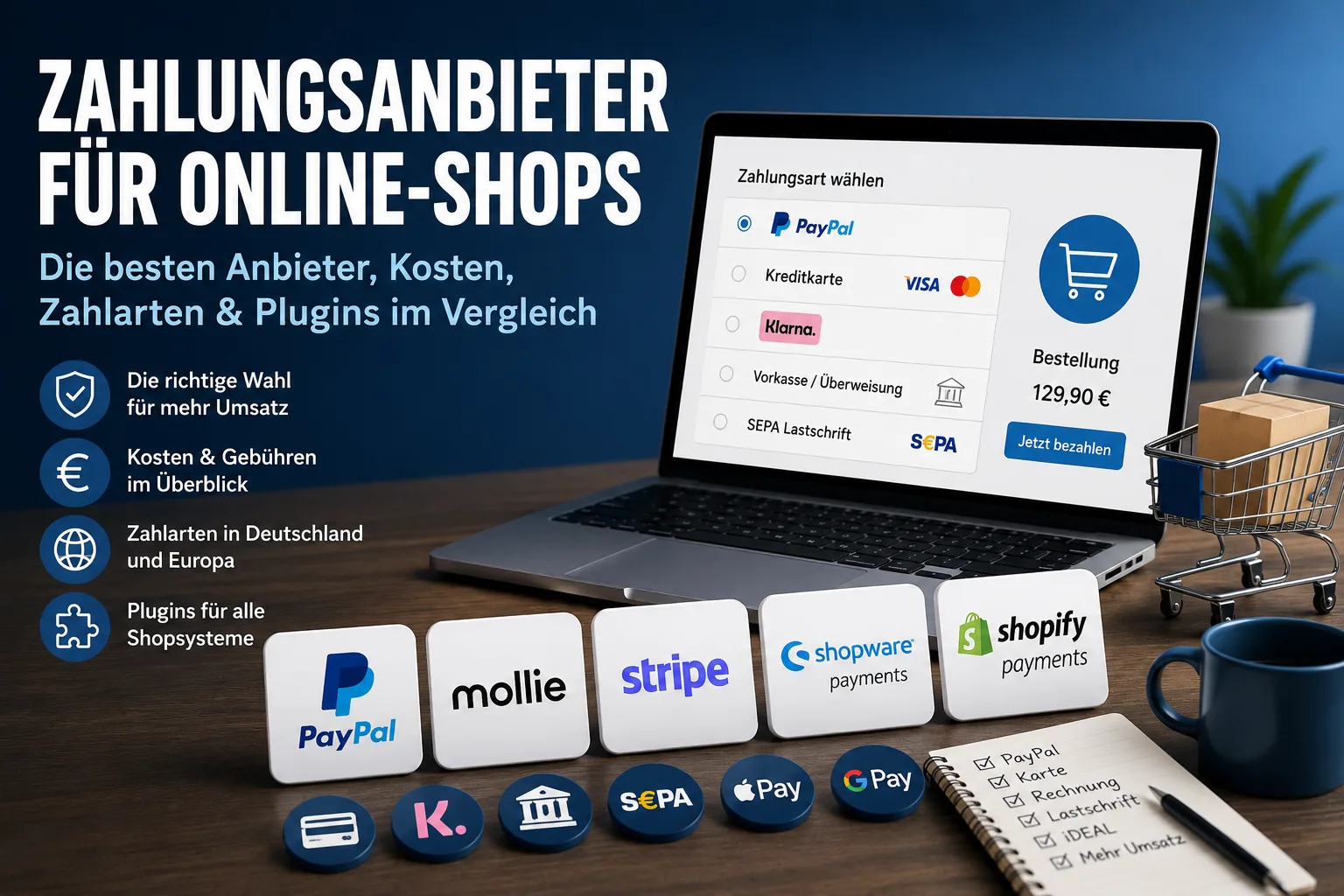
The recommendation up front: A typical small German online shop is best served with PayPal, card payments (including Apple Pay and Google Pay) and advance payment – handled through two accounts: PayPal directly and Mollie for everything else. PayPal is non-negotiable, because 28.7 percent of German online revenue runs through it; take it out of your checkout and you will see it in your order numbers immediately. But connect it directly rather than through your payment service provider – routed through Mollie, every PayPal payment costs an extra 10 cents. Mollie covers the rest with no base fee and no contract term: cards at 1.80 percent + €0.25, SEPA direct debit at €0.35 and Klarna at 2.99 percent + €0.35, without you having to negotiate with Klarna yourself. Three exceptions: if card payments dominate your business and you are technically confident, take Stripe instead of Mollie (1.5 percent + €0.25 on EEA cards). If you run Shopware, take Shopware Payments (1.65 percent + €0.27, PayPal with no surcharge). And if you are on Shopify, take Shopify Payments, because Shopify adds up to 2 percent on top of any third-party provider.
Why that is and where the expensive mistakes are waiting is set out below. All prices are list prices as of July 2026 – check them with the provider again before signing anything, they change regularly. This article provides general information and is no substitute for legal or tax advice.
Table of contents
- Do you even need a payment provider?
- Payment method, provider, service provider – the difference in five sentences
- What your customers in Germany actually pay with
- What the providers cost
- Worked example: what is left on €15, €60 and €400
- Why you should connect PayPal directly
- Before you sell: approval, documents, excluded industries
- Three traps that cost real money
- What you may not do: surcharging for a payment method
- Bookkeeping: batch payouts and fees
- Selling across the EU – and why iDEAL is about to disappear
- If you want to switch later
Do you even need a payment provider?
If you sell exclusively through Etsy, eBay or Amazon: no. The marketplace handles payment, deducts its fees and transfers the rest to you. You need no contract of your own and can safely skip the rest of this article – it only becomes relevant once you set up your own shop alongside.
As soon as you do run your own shop, there is no way around it. And the decision comes earlier than most people expect: the payment provider has to be approved before the shop goes live, and that can take a while.
Payment method, provider, service provider – the difference in five sentences
The payment method is what your customer clicks in the checkout: PayPal, credit card, direct debit, invoice.
The payment service provider – usually shortened to PSP – is the company behind it that processes the money technically and pays it out to you. Stripe, Mollie, Unzer and PAYONE are pure service providers; they never appear in the checkout.
PayPal is confusing because it is both at once: a payment method customers recognise and click, and a provider where you hold a merchant account. Hence the most common beginner's question: do I need both? Yes – and that is normal. Almost every shop combines several providers; it is neither unusual nor a lot of work.
What your customers in Germany actually pay with
The EHI Retail Institute surveys every year how German online revenue is distributed across payment methods. The 2026 edition (based on 2025 data, around €87.7 billion in revenue) looks like this:
| Payment method | Share of revenue |
|---|---|
| PayPal | 28.7 % |
| Purchase on invoice | 26.1 % |
| Direct debit | 14.4 % |
| Credit and debit cards | 13.7 % |
| Instalments | 4.7 % |
| Apple Pay | 1.3 % |
| Sofortüberweisung | 0.9 % |
| Amazon Pay | 0.6 % |
Two things matter here. First: in small and medium shops the PayPal share is even higher than average – cards are used mainly in large shops. Second: credit and debit cards are the fastest-growing group at plus 1.4 percentage points, driven by Visa and Mastercard debit cards. Anyone starting today needs both.
The EHI figures on actual costs are just as interesting: on average, the merchants surveyed pay 1.94 percent for PayPal, 1.42 percent for purchase on invoice and 0.65 percent for direct debit. Those numbers are well below the official price lists – large merchants negotiate. As a small shop you will initially pay the list price, and that is what you should calculate with.
What the providers cost
PayPal charges 2.99 percent + €0.39 in shop checkout. Important for service businesses without a shop: if you only send a payment link instead ("money for goods and services"), you pay 2.49 percent + €0.35. Payments from the EEA carry no surcharge, the United Kingdom adds 1.29 percent, the rest of the world 1.99 percent. Currency conversion adds 3 percent on top of the base exchange rate. A chargeback costs €16.
Stripe has the cheapest list price on cards: 1.5 percent + €0.25 for standard EEA cards, 1.9 percent for premium cards, 2.5 percent for UK cards and 3.25 percent for cards from outside the EEA. SEPA direct debit costs €0.35, currency conversion 2 percent, a chargeback €20 – refunded if you win the case. No base or setup fee. Stripe is more technically demanding than its competitors and is clearly aimed at developers.
Mollie prices per payment method: Visa and Mastercard from EU consumers 1.80 percent + €0.25, commercial cards and American Express 2.90 percent + €0.25, Klarna 2.99 percent + €0.35, SEPA direct debit €0.35, bank transfer €0.25, iDEAL and Wero €0.42. Currency conversion 1 percent. The first five payouts each month are free, after that they cost €0.25. No base fee, no contract term. The appeal is that European payment methods are billed as a flat amount – on high-value baskets that is unbeatable.
Shopware Payments is Shopware's in-house solution and runs on PayPal – not on Mollie, as is claimed in a few places online. For Shopware users the terms are hard to beat: Visa and Mastercard 1.65 percent + €0.27 on Community and Rise, 1.45 percent + €0.25 from Evolve upwards. Apple Pay and Google Pay at the same rates, PayPal at your own PayPal terms with no surcharge, Klarna 2.79 percent + €0.35, iDEAL and Wero as well as SEPA in the range of 0.19 to 0.25 percent. Payout within 24 hours, available all the way down to the free Community Edition, currently for Germany and Austria.
Klarna does not publish prices for Germany; terms are negotiated individually. Guides circulate figures of 2.99 percent + €1.69 for purchase on invoice – unconfirmed. If they are accurate, that fixed fee of €1.69 is a serious problem on small orders. The practical way out for small shops: book Klarna through Mollie or Shopware Payments, where the rates are published and no separate Klarna contract is needed.
Shopify Payments costs from 2.1 percent + €0.30 depending on plan (Basic, €25 per month), from 1.8 percent (Grow) or from 1.6 percent (Advanced). The flip side is what counts: for any other payment provider, Shopify charges up to 2 percent in additional transaction fees. If you are on Shopify, you should generally use Shopify Payments.
Amazon Pay sits at 1.9 percent + €0.35, cheaper above €50,000 monthly turnover. At a 0.6 percent revenue share, the integration effort rarely pays off for small shops.
German service providers such as Unzer (Heidelberg), PAYONE (Kiel), Novalnet, Computop or secupay publish no prices – they quote individually by payment method, volume and contract. Market rates run from 0.2 to 4 percent plus 11 to 39 cents per transaction. Their selling point is German-language support with a named contact. That can be worth a lot when something goes wrong – but it usually comes with a contract term.
And the cheapest payment method of all: advance payment. No fee, no default risk, no approval process. You ship only after the money arrives, which adds days to your delivery time and costs you orders. As your only payment method it is hopeless – as an addition on day one it is unbeatable.
Payment provider pricing 2026: the fee comparison in one table
The list prices from above side by side, so you can compare payment gateway fees at a glance (Germany, July 2026, per successful transaction):
| Provider | Cards (EEA consumer) | PayPal | SEPA direct debit | Klarna | Base fee / contract term |
|---|---|---|---|---|---|
| PayPal (direct) | – | 2.99 % + €0.39 in checkout, 2.49 % + €0.35 by payment link | – | – | none / none |
| Stripe | 1.5 % + €0.25 | connect PayPal directly | €0.35 | own Klarna terms | none / none |
| Mollie | 1.80 % + €0.25 | +€0.10 per payment on top of your PayPal rates | €0.35 | 2.99 % + €0.35 | none / none |
| Shopware Payments | 1.65 % + €0.27 (Community, Rise), 1.45 % + €0.25 from Evolve | your PayPal rates, no surcharge | 0.19 % to 0.25 % | 2.79 % + €0.35 | none / Shopware plan |
| Shopify Payments | from 2.1 % + €0.30 (Basic) | separate PayPal account | – | – | Shopify plan from €25 per month |
| Amazon Pay | 1.9 % + €0.35 | – | – | – | none |
| Klarna (direct contract) | – | – | – | not published, negotiated individually | individual |
| Unzer, PAYONE, Novalnet, Computop, secupay | 0.2 % to 4 % + €0.11 to €0.39 (individual quote) | individual | individual | individual | usually with a contract term |
Read the table together with the worked example below: on small baskets the fixed cents decide, on large baskets the percentage.
Worked example: what is left on €15, €60 and €400
Percentages alone say little. Only the fixed fee shows what you really pay:
| Provider and method | €15 | €60 | €400 |
|---|---|---|---|
| PayPal Checkout | €0.84 = 5.59 % | €2.18 = 3.64 % | €12.35 = 3.09 % |
| Stripe, EEA card | €0.48 = 3.17 % | €1.15 = 1.92 % | €6.25 = 1.56 % |
| Mollie, card | €0.52 = 3.47 % | €1.33 = 2.22 % | €7.45 = 1.86 % |
| Shopware Payments, card | €0.52 = 3.45 % | €1.26 = 2.10 % | €6.87 = 1.72 % |
| Mollie, SEPA direct debit | €0.35 = 2.33 % | €0.35 = 0.58 % | €0.35 = 0.09 % |
| Klarna purchase on invoice* | €2.14 = 14.26 % | €3.48 = 5.81 % | €13.65 = 3.41 % |
\* based on the circulating, unconfirmed terms
From this follows the most important thing you need to know about payment fees: on small baskets the fixed fee decides, not the percentage. A €15 sale through PayPal effectively costs you 5.59 percent, even though the price sheet says 2.99 percent. If your range sits in the low double digits, that is the lever to pull – not the third decimal place of a card rate.
Why you should connect PayPal directly
Almost every service provider offers to handle PayPal as well. Convenient – but it costs. Mollie charges the PayPal fee plus €0.10 per transaction for it. At 300 PayPal payments a month that is €30 you are spending for nothing.
Setting up the second account is not much work: open a PayPal business account, activate the PayPal module in your shop system, done. With Shopware Payments the point is moot anyway, as PayPal runs there on your own terms without a surcharge.
Before you sell: approval, documents, excluded industries
A merchant account is not granted at the push of a button. Expect to need: an identity document, your trade registration or an extract from the commercial register, the IBAN of a business account, a tax number or VAT identification number – and a reachable website with a legal notice, terms and conditions, cancellation policy and privacy policy. If the legal texts are missing, approval is regularly delayed.
Above all: there is no entitlement to being approved. Every provider keeps a list of excluded industries, and they resemble one another closely because they trace back to the card networks' rules. At Stripe, for instance, the following are excluded: gambling and betting, adult services, crypto mining and the resale of NFTs, cannabis and CBD products above local THC limits, as well as illegal weapons and hazardous materials. Only after additional review are legal firearms, e-cigarettes and tobacco, telemedicine and prescription products possible.
If you operate in any of those corners, sort out your payment provider before you build the shop. Nothing is more frustrating than a finished shop that cannot take money.
Three traps that cost real money
The direct debit trap. At an average of 0.65 percent, direct debit is the cheapest payment method – and the riskiest. You need a creditor identification number, which you apply for free of charge and exclusively online at the Deutsche Bundesbank. And then this applies: your customer can return a SEPA core direct debit within eight weeks without giving any reason. If no valid mandate exists or it has been revoked, the period is 13 months. By then the goods are long gone. For a new shop, direct debit is therefore the wrong main payment method, however tempting the fee looks.
The Shopify trap. Shopify charges up to 2 percent extra for every third-party payment provider. Anyone using a supposedly cheaper provider on Shopify ends up paying more.
The small-basket trap. See the worked example above. If your average basket is below €20, think about minimum order values or bundles – that does more for your margin than any change of provider.
A fourth point, not a trap but a frequent surprise: card payments in the EEA generally require strong customer authentication via 3-D Secure. Below €30 it may be waived, but only for a maximum of five consecutive payments or up to a cumulative amount of €150. Whether an exemption applies is decided neither by your shop nor by your provider, but by the customer's bank.
What you may not do: surcharging for a payment method
The obvious idea of simply passing the fees on to customers does not work for the most important payment methods. Under § 270a of the German Civil Code, an agreement obliging the customer to pay a fee for using a SEPA transfer, a SEPA direct debit or a payment card is invalid. The variant "free payment method only above a certain order value" is also considered inadmissible under the prevailing reading.
Such clauses in your terms and conditions can be challenged by competitors or consumer protection associations. In practice this means: payment fees belong in your pricing, not in your checkout. Have your terms reviewed by a lawyer if in doubt – this article is not legal advice.
Bookkeeping: batch payouts and fees
The point where almost every shop stumbles in its first year: payment service providers pay out in batches and deduct their fee beforehand. What lands in your bank account is therefore not the invoice amount of a single order, but a lump transfer covering several orders less fees. Anyone trying to match that one-to-one will despair.
The clean approach is to treat the PSP account like a cash account of its own: incoming payment per order, fee as an expense, payout as a transfer to the bank account. The fee is usually booked as incidental costs of monetary transactions – SKR03 to account 4970, SKR04 to account 6855. Which of the two charts of accounts you keep is explained in SKR03 or SKR04.
For VAT, the prevailing view is that payment transaction services are exempt under § 4 no. 8 of the German VAT Act; the fees then contain no German VAT and there is no input tax to deduct. There are, however, differing opinions that point towards treatment under the reverse charge procedure. Clarify this with your tax advisor before you book it wrongly for a year.
Selling across the EU – and why iDEAL is about to disappear
As soon as you sell across the border, your choice of payment methods becomes a revenue factor. In almost every European country one national scheme dominates that German merchants tend not to have on their radar:
| Country | What people pay with there |
|---|---|
| Netherlands | iDEAL, around 70 % of all online payments |
| Poland | BLIK, 2.9 billion transactions in 2025 alone |
| Spain | Bizum, around 31 million users |
| Belgium | Bancontact |
| France | Cartes Bancaires, plus PayPal |
| Sweden | Swish, along with Klarna and other instalment models |
| Norway | Vipps |
| Denmark | MobilePay |
| Italy | Bancomat |
| Portugal | MB Way |
Without iDEAL you will sell virtually nothing in the Netherlands – that is not a comfort question but the difference between an order and an abandoned cart.
Except: iDEAL is being phased out. It is merging into Wero, the European banks' payment scheme. The systems are being tested for online retail in 2026, the first Dutch web shops switch over at the end of the year, and iDEAL is set to disappear entirely in 2027. In parallel, the European Payments Initiative agreed in February 2026 to cooperate with Bancomat (Italy), Bizum (Spain), SIBS (Portugal) and Vipps MobilePay (Scandinavia) – initially for payments between private individuals, and from 2027 in retail as well. The national schemes are growing together.
For you this mainly means one thing: if you sell across the EU, pick a provider that covers the local schemes and Wero, so you do not have to organise the switch yourself. Mollie and Shopware Payments already carry both. We have described how Wero works and what it means for German shops in a separate article: Wero in online retail.
By the way: if you still come across giropay in guides – the scheme was discontinued on 31 December 2024. paydirekt is gone as well. Many instructions and even plugin descriptions still list it.
If you want to switch later
Switching is straightforward as long as you only process one-off orders: activate the new module, deactivate the old one, done.
It gets expensive with subscription models and recurring payments. Stored cards and granted SEPA mandates do not automatically move to the new provider – in the worst case you have to ask all existing customers to enter their payment details again, and you will lose some of them along the way. If you are planning subscriptions, choose your provider carefully from the start and ask in advance how a migration would work.
One more piece of practical advice: test every payment method end to end after installing it – purchase, refund, cancellation. Most providers offer a test environment for this. A checkout that jams on refunds otherwise only shows up when a customer wants their money back.
If you want to know what else running a shop costs, here is an overview of add-on and plugin prices at Shopify, Shopware and WooCommerce and a comparison of shipping providers.
Handle invoices more easily
Easy Invoice combines quotes, invoices and customer management in the cloud.
Try Easy InvoiceRead next
 E-Commerce & Marketplaces
New eBay Terms of Service from 15 September 2026: What Sellers Should Check Now
New eBay terms apply from 15 September. Four things change, and one of them can cost you your account.
 E-Commerce & Marketplaces
Creating invoices for Shopify
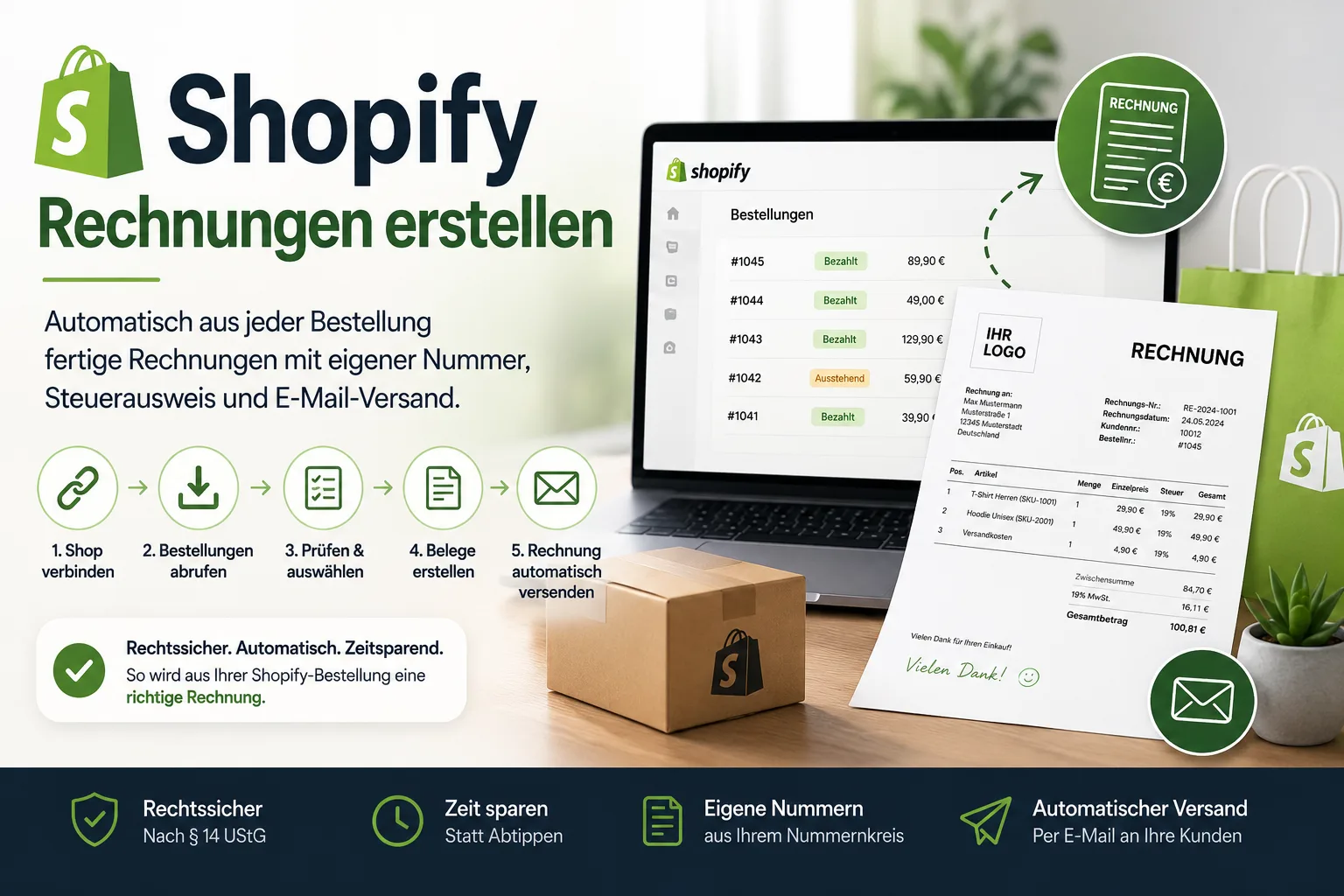
Shopify sends order confirmations – not invoices. How to get from a Shopify order to a finished invoice in five steps, with your own number, correct tax details and automatic sending.
 E-Commerce & Marketplaces
eBay vehicle parts: free returns become mandatory on 28 September – what it will cost you
New parts over 10 euros at a fixed price: from 28 September you have to take them back free of charge for 30 days. What actually changes, which returns are not covered, why eBay will make the switch for you if you don't – and why 12 August matters more to you than the deadline itself.