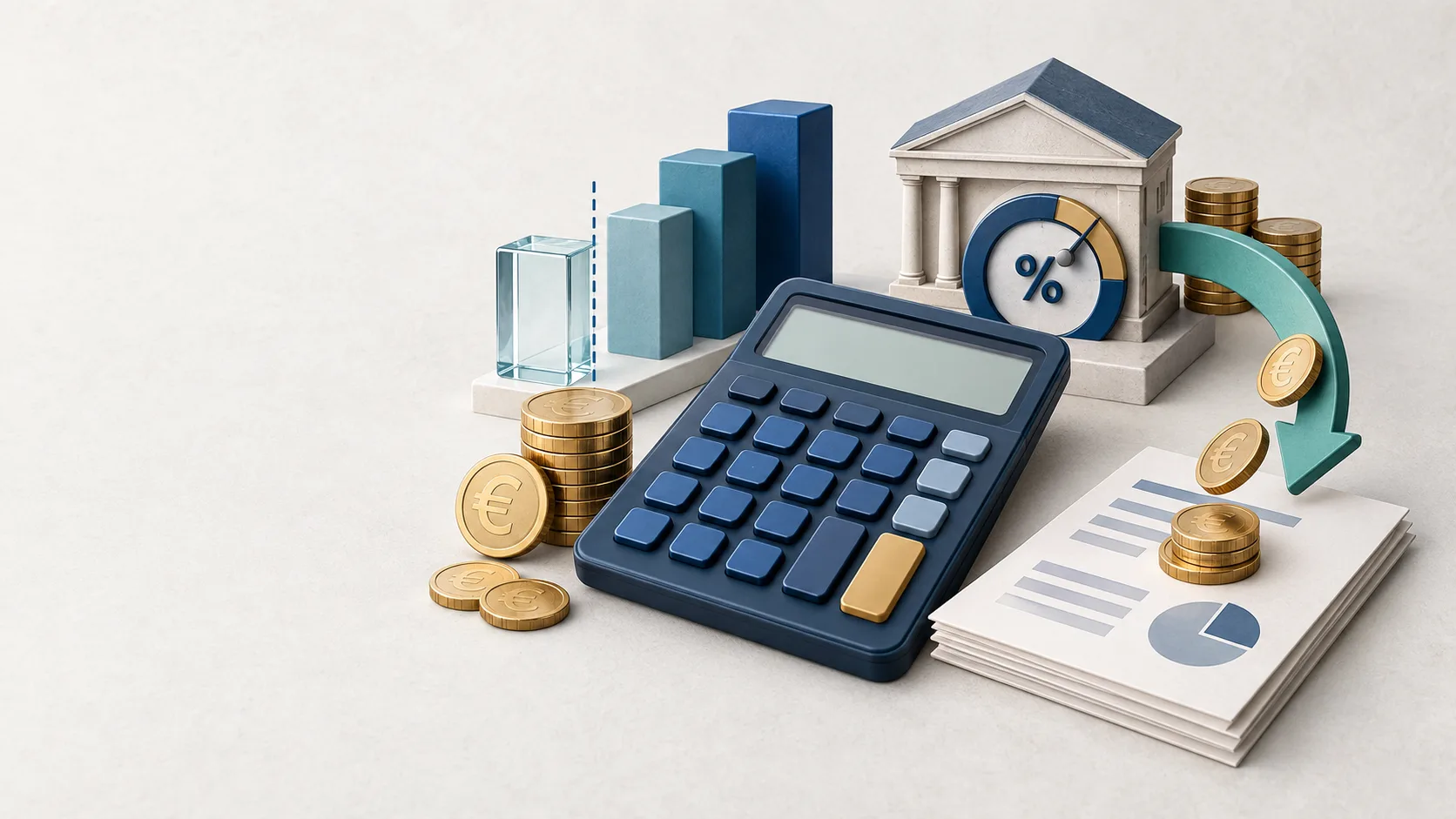
In Germany, as a sole trader (Einzelunternehmer), you only pay trade tax (Gewerbesteuer) once your profit exceeds 24,500 euros a year. You take 3.5 percent of the amount above that and multiply the result by your municipality's multiplier (Hebesatz). With a profit of 50,000 euros and a Hebesatz of 400 percent, that is 3,570 euros. You get almost all of it back through a lower income tax; a real extra burden only arises where the Hebesatz is above 400 percent.
Contents
- Do I have to pay trade tax at all?
- The formula in three steps
- Examples: 40,000, 50,000 and 100,000 euros profit
- The Hebesatz: where to find yours
- Credit: how much you get back through income tax
- When you pay: notice and advance payments
- Trade tax return: when you have to file one
- Special cases: year of founding, loss, high rents, GmbH
- Frequently asked questions
Do I have to pay trade tax at all?
If your profit is below 24,500 euros, you pay no trade tax as a sole trader. This is the tax-free allowance (Freibetrag) under § 11 of the German Trade Tax Act (Gewerbesteuergesetz, GewStG). It applies to sole traders and partnerships (Personengesellschaften) such as the GbR, not to the GmbH.
Three misunderstandings are common:
- The allowance applies to profit, not to turnover. If you turn over 80,000 euros and have 20,000 euros profit after all expenses, you pay nothing.
- Kleinunternehmer is a VAT term. Not charging VAT does not exempt you from trade tax. The two rules have nothing to do with each other. The difference is explained in the article Kleingewerbe and Kleinunternehmer.
- Members of the liberal professions (Freiberufler) pay no trade tax at all. This covers, for example, doctors, architects, translators or journalists. Whether your activity belongs to them is explained in the article Freiberufler or trade business.
The obligation depends on the activity, not on registration with the trade office (Gewerbeamt). If you sell commercially without having registered a trade, you still owe the tax. If you only occasionally sell your own used belongings, on the other hand, you do not run a trade business.
The formula in three steps
You need two figures: your profit and your municipality's Hebesatz. The rest is set by law.
- Determine the trade income (Gewerbeertrag). This is your profit from the cash-basis income statement (Einnahmenüberschussrechnung, EÜR), rounded down to full 100 euros. You do not deduct the trade tax itself, as it is not a business expense (§ 4 Abs. 5b EStG). For most small businesses, profit and trade income are the same. The exception is in the section Special cases.
- Deduct the allowance and calculate the base tax amount (Steuermessbetrag). Trade income minus 24,500 euros, of that 3.5 percent. The result is called the Steuermessbetrag. The tax office (Finanzamt) sets it in a separate notice, the Gewerbesteuermessbescheid.
- Multiply by the Hebesatz. Steuermessbetrag times the municipality's Hebesatz. That is your trade tax.
As a formula:
(profit − €24,500) × 3.5% × Hebesatz = trade tax
How to determine the profit for step 1 is shown in the article Doing the EÜR yourself. If the bookkeeping is kept properly throughout the year, the figure is ready at the end of the year without searching. Accounting software that keeps invoices and incoming receipts in one place helps with this.
Examples: 40,000, 50,000 and 100,000 euros profit
The table uses two Hebesätze. 400 percent is close to the average of all German municipalities, which was 409 percent in 2024. 450 percent shows what changes in a municipality above the average.
| Profit | minus allowance | Steuermessbetrag (3.5%) | Trade tax at 400% | Trade tax at 450% |
|---|---|---|---|---|
| €24,000 | €0 | €0 | €0 | €0 |
| €40,000 | €15,500 | €542.50 | €2,170.00 | €2,441.25 |
| €50,000 | €25,500 | €892.50 | €3,570.00 | €4,016.25 |
| €100,000 | €75,500 | €2,642.50 | €10,570.00 | €11,891.25 |
Calculation for 50,000 euros at 450 percent: 50,000 minus 24,500 gives 25,500 euros. 3.5 percent of that is 892.50 euros. Times 4.5 gives 4,016.25 euros.
If the profit is an uneven figure, round it down first: 40,080 euros becomes 40,000 euros.
These amounts are not yet your actual burden. You deduct most of it from your income tax, see Credit.
The Hebesatz: where to find yours
What counts is the Hebesatz of the municipality where your business is located, not that of your place of residence. If you work from home, it is the same municipality.
You find the current value here:
- on the website of your town or municipality, usually under "Steuern" (taxes) or "Haushaltssatzung" (budget statute),
- in the annual overview "Hebesätze der Realsteuern" (multipliers of the real taxes) from the statistical offices, with all municipalities in Germany,
- on your last trade tax notice (Gewerbesteuerbescheid), if you have already received one.
Up to and including 2026, the Hebesatz is at least 200 percent. From the assessment year 2027, the minimum rises to 280 percent (§ 16 Abs. 4 GewStG in conjunction with § 36 Abs. 5b). This only affects the few municipalities that are below that today.
Credit: how much you get back through income tax
As a sole trader or partner in a partnership, your income tax goes down by four times the Steuermessbetrag. Up to a Hebesatz of 400 percent, this fully offsets the trade tax. If the Hebesatz is higher, the difference remains as a real burden.
Using the example with 50,000 euros profit:
| Hebesatz 400% | Hebesatz 450% | |
|---|---|---|
| Trade tax | €3,570.00 | €4,016.25 |
| Deduction from income tax (4 × €892.50) | €3,570.00 | €3,570.00 |
| What you actually pay extra | €0 | €446.25 |
The rule is set out in § 35 of the German Income Tax Act (Einkommensteuergesetz, EStG). There are two limits:
- At most the trade tax you actually pay is deducted. With a Hebesatz below 400 percent, there is therefore no surplus.
- At most the income tax attributable to your profit is deducted. If you pay little income tax, for example because high losses from other sources or joint assessment with income splitting (Splittingtarif) push it down, the rest is lost. It is neither refunded nor carried forward.
The tax office applies the credit itself with the income tax assessment. You do not apply for anything.
For your reserve, this means: set aside the amount from the table, not just the extra amount. You pay the trade tax to the municipality; the relief only comes later through the tax office.
When you pay: notice and advance payments
After the first profit year above the allowance, you make advance payments four times a year: on 15 February, 15 May, 15 August and 15 November. Each instalment is a quarter of the tax from the last notice (§ 19 GewStG). If an instalment is below 50 euros, the municipality does not set one.
The process:
- After the end of the year, you file the trade tax return (Gewerbesteuererklärung) with the tax office.
- The tax office sends you the Gewerbesteuermessbescheid and reports the Steuermessbetrag to the municipality.
- The municipality sends the trade tax notice (Gewerbesteuerbescheid) with the amount and the advance payments for the coming quarters. In most cases, you pay the municipality, not the tax office.
If your profit rises sharply, the first notice often brings both at once: the additional payment for the past year and higher advance payments for the current one. If the profit falls, you can apply to the municipality for a reduction of the advance payments. The municipality may adjust them to the expected profit.
Trade tax return: when you have to file one
A trade tax return is mandatory as soon as your trade income for the year was above 24,500 euros (§ 25 of the Trade Tax Implementing Ordinance, Gewerbesteuer-Durchführungsverordnung). Below that, you do not have to file one as a sole trader, unless the tax office expressly asks you to. A GmbH always files one.
The return goes electronically via ELSTER, the German tax authorities' online portal, to the tax office, not to the municipality (§ 14a GewStG). The deadline is the same as for the income tax return.
Special cases: year of founding, loss, high rents, GmbH
Year of founding. You get the full allowance of 24,500 euros even if you only started during the year. It is not split across the months (Trade Tax Guidelines, Gewerbesteuer-Richtlinien, R 11.1). The municipality sets the first advance payments based on your estimate in the tax registration questionnaire (Fragebogen zur steuerlichen Erfassung). If you state too high a profit there, you pay too much in advance for a year. How to fill in the questionnaire is explained in the article Registering a trade and the Fragebogen zur steuerlichen Erfassung.
Loss. If you make a loss, no trade tax is due. You deduct the loss from the trade income in the following years (§ 10a GewStG), up to 1 million euros a year without restriction. A carry-back to earlier years, as with income tax, does not exist for trade tax.
High rents, interest and leasing instalments. Part of these costs is added back to the profit: for example half of the rent for premises, one fifth of the leasing instalments for machines and vehicles, and all interest. A quarter of this is added back, but only to the extent that the total exceeds 200,000 euros (§ 8 Nr. 1 GewStG). A business with a monthly rent of 2,000 euros comes to 12,000 euros and is far below that. For most small businesses, the add-back therefore plays no role.
GmbH and UG. The corporation gets no allowance; every euro of trade income counts. There is no credit against income tax either, because the GmbH pays corporation tax (Körperschaftsteuer). For it, the trade tax is therefore always a full burden.
Frequently asked questions
How much trade tax do you pay on 50,000 euros profit?
At a Hebesatz of 400 percent, 3,570 euros; at 450 percent, 4,016.25 euros. As a sole trader, you get 3,570 euros of that back through income tax.
Does the allowance apply to turnover or to profit?
To profit. Turnover plays no role for trade tax.
From when do I have to pay trade tax?
As a sole trader, from a profit above 24,500 euros a year; with a GmbH, from the first euro of trade income.
Can I deduct the trade tax as a business expense?
No. Since 2008, it is no longer a business expense (§ 4 Abs. 5b EStG). The compensation works through the credit against income tax.
What happens if I cannot pay the trade tax?
Contact the municipality before the instalment is due. It can grant a deferral (Stundung) or payment in instalments. If the profit has fallen, also apply for a reduction of the advance payments.
Sources
- § 11 GewStG, tax rate and base tax amount (Steuermesszahl und Steuermessbetrag)
- § 16 GewStG, multiplier (Hebesatz)
- § 36 GewStG, temporal scope of application (Zeitlicher Anwendungsbereich)
- § 7 GewStG, trade income (Gewerbeertrag)
- § 8 GewStG, add-backs (Hinzurechnungen)
- § 10a GewStG, trade loss (Gewerbeverlust)
- § 14a GewStG, obligation to file a tax return (Steuererklärungspflicht)
- § 19 GewStG, advance payments (Vorauszahlungen)
- § 25 GewStDV, trade tax return (Gewerbesteuererklärung)
- § 35 EStG, tax reduction for income from a trade business (Steuerermäßigung bei Einkünften aus Gewerbebetrieb)
- § 4 EStG, definition of profit (Abs. 5b)
- Federal Ministry of Finance: official Trade Tax Handbook 2024 (Amtliches Gewerbesteuer-Handbuch), § 11 and R 11.1
- Federal Statistical Office (Destatis): trade tax revenue 2024, average Hebesatz
- Statistical Offices of the Federation and the Länder: multipliers of the real taxes (Hebesätze der Realsteuern)
Try Easy Invoice free for 10 days — no payment details, the trial ends by itself.
Handle invoices more easily
Easy Invoice combines quotes, invoices and customer management in the cloud.
Try Easy InvoiceRead next
 Taxes & Law
Zusammenfassende Meldung (ZM): deadline, ELSTER and who must file
Anyone who supplies goods or invoices services without German VAT to business customers in other EU countries reports these sales to the German Federal Central Tax Office. Here you can find out who has to report, by when, what goes into the report and what happens if it is missing.
 Taxes & Law
USt-IdNr.: how to apply, how to check and when you need one
The USt-IdNr. (EU VAT ID) is a second number alongside the Steuernummer, meant for business with companies in other EU countries. You apply for it free of charge at the German Federal Central Tax Office and check your customer's number there too; here is how both work and how to find out whether you need one at all.
 Taxes & Law
Low-value assets in Germany (GWG) 2026: €800 limit, net or gross
The GWG limit in Germany is €800 net in 2026, also under the small business scheme. Which purchases you deduct at once, when the pooled item pays off and how to book it.