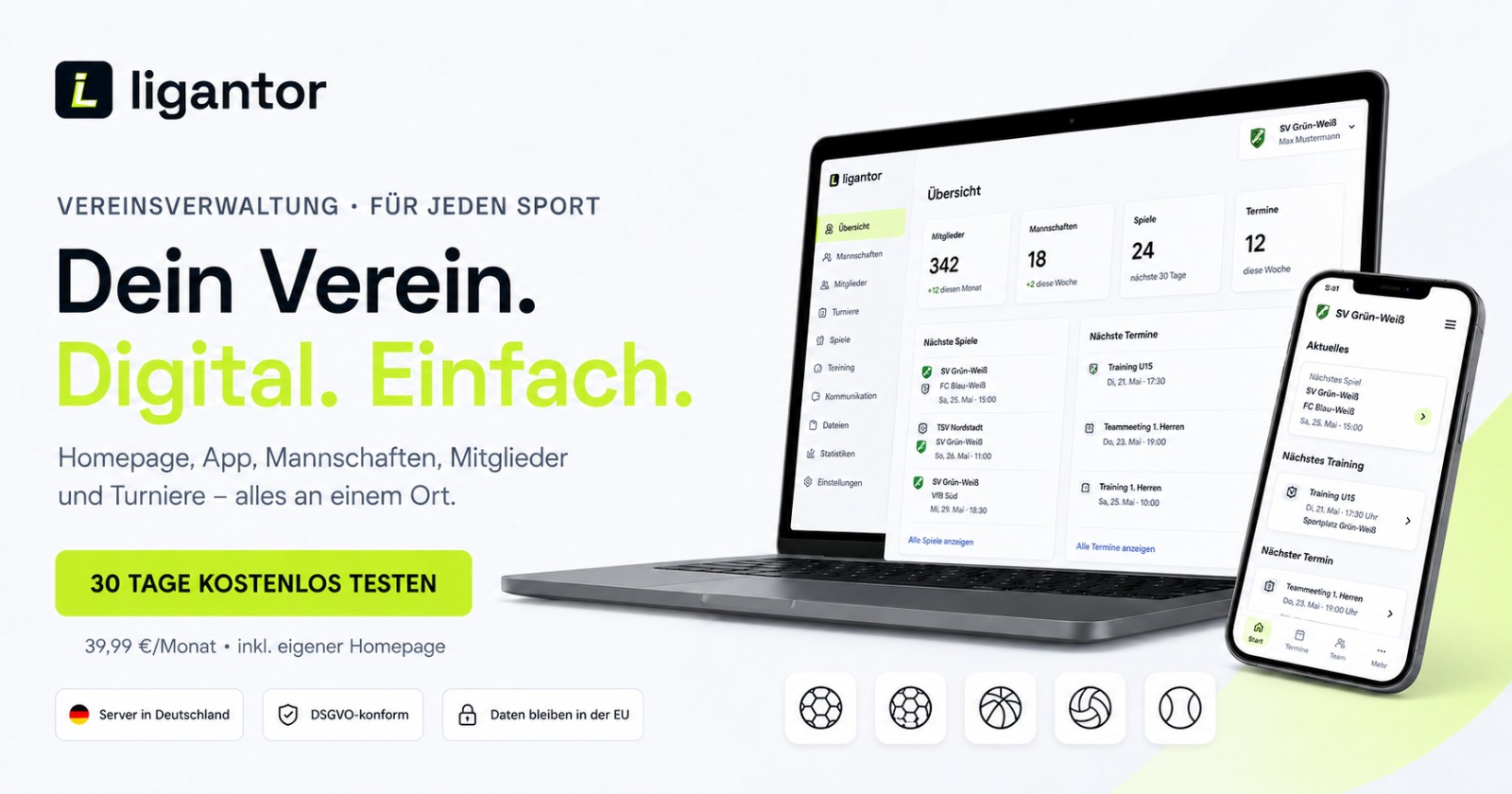
A football club pays ligantor €39.99 a month – for the whole club, whether that is one men's side or twelve youth teams. In return it gets a club website, an app for players and parents, and the full administration behind it. The real point, though, is not the list of features but what disappears afterwards: nobody copies fixture dates any more, nobody types in results and league tables, nobody digs cancellations out of five WhatsApp groups, and the schedule for your own tournament is built at the push of a button instead of over three evenings in Excel. You can try all of it free for 30 days, without a credit card and without it turning into a contract.
How to get started
- Register your club, three to five minutes. Club name, an account for the administrator, your preferred web address. After that the club is online.
- Upload your crest and set your club colour. From that moment the website, the emails and the printouts look like your club.
- Create teams and invite coaches. From then on the fixture list keeps itself up to date.
- Bring your players across – upload your existing list in one go, or let parents enter themselves.
Depending on the size of your club you are done in 30 minutes to two hours. 30 days free, no credit card.
Here is what happens in day-to-day life after that:
Contents
- What the system takes off you week after week
- The Sunday evening you get back
- Who is coming to training? Cancellations without the search
- The club website nobody has to maintain
- The app for players, parents and fans
- New signings: registration forms at the push of a button
- Your own tournament without Excel and a clipboard
- On match day: live ticker, stats and the Instagram graphic
- The line-up: a tactics board instead of a scrap of paper
- Who is allowed to see what?
- Pitches, changing rooms, kit, minibus and team kitty
- What it costs
- Where the data is stored
What the system takes off you week after week
The quickest way to see the difference is to put the jobs somebody in the club does today next to what is left of them:
| What somebody does today | With ligantor |
|---|---|
| Copying fixture dates onto the website | gone – dates arrive automatically every night |
| Adding results and league tables | gone – updates itself |
| Correcting a postponed match in website, calendar and WhatsApp | gone – changes everywhere at once |
| Collecting cancellations from several chats | one list, with reasons, in real time |
| Copying a training cancellation into every group | one notification, everybody has it |
| Finding the association form and typing it out | one click from the squad, pre-filled |
| Building a tournament schedule in Excel | one click, more than 90 templates |
| Keeping the helper list on a clipboard | share a link, people sign up themselves |
| Chalking tournament tables onto a board | live on the parents' phones |
| Assembling a match-day graphic in Word | ready from crest, opponent and kick-off time |
| Sketching the line-up on paper | tactics board with the names from your squad |
| Who is driving to the away game? | create a car pool, parents add themselves |
The thread running through all of it is simple: the data sits in one place and the areas feed into each other. The squad becomes the attendance list for training, the attendance list becomes the line-up, the line-up becomes the live ticker, the live ticker becomes the season statistics. That is why nobody has to enter the same information twice – and why nothing goes stale when a coach moves on.
The Sunday evening you get back
This is the feature that pays for the €39.99 on its own at most clubs.
ligantor collects the fixtures every night by itself – from where they already are, namely fussball.de. League and friendly matches for every team land in the fixture list without anyone lifting a finger – in the app, on the club website and in each individual player's calendar. If a match is moved, the date changes everywhere at the same time. If one is called off, it disappears. Nobody has to type, nobody has to correct, nobody has to remember.
Results and tables come along with them. That is the difference to any home-made club site: there the fixture list is out of date by October, because whoever kept it up ran out of time. Here there is nobody who would have to keep it up. If you used to sit down at nine on a Sunday evening to type results into a form, you now do not do it at all.
What you still enter yourself are the dates no association holds: friendlies, in-house tournaments, the training camp, the Christmas party. They then sit in the same fixture list as everything else.
And in summer the club stays put. The moment many clubs give up on their software is the change of season, because everything has to be set up again. Here the admin gets a list of all teams and assigns each one to its new division. Merged, dissolved and newly founded teams are catered for. The squads stay exactly as they are.
Who is coming to training? Cancellations without the search
Every youth coach knows the Wednesday-evening arithmetic: twelve messages in the group, three of them a thumbs-up on somebody else's message, two cancellations in a private chat – and then only eight children turn up.
In ligantor every player taps once to accept or decline, and the coach sees the number in real time. Four details make the difference day to day:
- The reason is right there. Whoever cancels picks work, school, illness, holiday or other. When the squad for the weekend is settled on Friday, the coach knows whether somebody was ill or simply could not be bothered three times running.
- Holidays and illness in one go. A player enters a period, and every appointment inside it is cancelled and marked with the reason. Nobody has to cancel day by day from a ski holiday.
- Parents cancel for their child. Parents get their own account and switch between several children inside it. Anyone who still plays for the veterans uses the same account for that.
- After the deadline it is closed. The coach sets cancellations to be possible up to, say, 24 hours beforehand. After that the button is locked for players – the coach can still make changes.
If a session falls through, the coach taps cancel once. Everybody gets the notification on their phone. No copying into five groups, no follow-up questions from the three parents who are not in the group.
Coaches and assistant coaches have the same access to the same team – with youth sides that are always run by two people, that is the normal case.
The club website nobody has to maintain
This is what separates ligantor from a pure team app: the club website is not an add-on, it is part of the monthly price.
You get a public site straight away with a home page, news, fixtures, team pages, tournaments, sponsors, contact details and a legal notice. Upload the crest, pick the club colour – done. The colour then runs through everything: the website, the emails the club sends out, and the printouts.
Your address stays your address. If you already have sv-musterdorf.de, you can keep it; ligantor handles the switch with you. If you do not have one, you get sv-musterdorf.ligantor.de the moment you sign up – free and immediately.
Team pages appear by themselves. Every team you create automatically has its own page with squad, fixtures and training times. If a player moves up to the next team, the page changes with them. Nobody copies anything.
News and sponsors. An admin writes news with a picture and text, and it appears in order on the home page. You add sponsor logos with an image, a link and a running order; they run as a banner strip across the site and can be hidden at the end of the season without being deleted. That is also an argument in the sponsor meeting: the logos then sit on a page somebody looks at every week, because that is where the fixtures are.
And visitors do not have to click anything away. According to the provider the club site works without the cookie box people tap away everywhere else – there are no advertising or tracking cookies.
For a sense of what a club site otherwise costs: commissioning a website means a four-figure sum once plus ongoing hosting – we have broken down the usual items in our guide on what having a website built costs. With a website builder you save the fee and enter fixtures and results by hand every week instead.
If you would rather not build it yourself, you can hand that over: ligantor will set the website up completely on request, agreed individually.
The app for players, parents and fans
There is an app, and it costs nothing extra.
For iPhone and iPad you download it from the App Store. On Android phones and every other device you open your club page and add it to the home screen with two taps – after that it behaves like any other app, just without a download. For parents that is often the easier route: no account, no installation, no App Store password.
Inside is what you need when you are out and about: fixtures, accepting and declining, team chat, live ticker, line-up, team kitty, car pools, news. And the notifications on the phone – training cancelled, match moved, goal scored – are, in practice, the reason parents keep an app like this at all.
New signings: registration forms at the push of a button
The routine for a new signing is the same at almost every club: find the form from the regional association, download it, copy date of birth and address out of the Excel list, print, get it signed, add the club stamp. A good quarter of an hour per child, and in summer twelve arrive at once.
The player registration generator builds the form from the data already sitting in the squad. Name, date of birth, address and nationality are filled in, the club crest sits at the top of the form, and the fields for stamp and signature are there.
The forms of 18 regional associations are built in – Lower Saxony, Westphalia, Lower Rhine, Bavaria, South Baden, Württemberg, Hesse, Berlin, Saxony, Saxony-Anhalt, North East, Bremen, Mecklenburg-Vorpommern, Thuringia, Schleswig-Holstein, Saarland, Hamburg and Rhineland. The system works out which one applies from your club address. So you do not need to know what your form is called or where it is hidden on the association's site.
The membership application comes with it – in your club's design, with the fields for the direct debit. If the parents have already stored their bank details in the player profile, they are in there. You print both in one go: the family signs once and the job is finished.
If you are going digital for the first time, you do not have to type the players in one by one – you upload your existing list in one go, and a template comes with it. After that new players can enter themselves through the club's own sign-up form: parents fill it in, confirm by email, and the coach just approves. The sheet of paper at the clubhouse is gone.
An honest note: the templates are based on the associations' official forms and contain the usual data-protection and consent wording. As with any template, it is worth going through it once with your committee before you start sending it out regularly.
Your own tournament without Excel and a clipboard
The summer tournament or the indoor competition in January is the single biggest piece of work in the year for many clubs. The tournament planner is included at no extra cost, with no limit on the number of tournaments or teams.
The schedule is built with one click. More than 90 templates are ready to go: single tournaments, group stage plus finals, group phases from two to sixteen groups, knockout rounds up to 32 teams, round robin, placement matches. The schedule is built so that every team plays the same number of games, the breaks are spread fairly and several pitches run in parallel. Anyone who has built one in Excel knows that this alone costs two evenings. Once generated the schedule stays stable – moving a match or correcting a result by hand is still possible at any time.
Visiting clubs enter themselves. Every tournament gets a public entry page with an invitation and a form. The visiting club enters its team, contact person and details, and you confirm with one click. The back and forth by email disappears, and you have all the contact details in one place instead of in fourteen emails.
Helpers sign themselves up. You generate a link and send it into the WhatsApp group. Whoever helps enters their name and shift – no account, no password. You can see at any time who is baking cake, who is on the barbecue and which shift is still open. This is the point where somebody usually ends up rostered twice.
Parents see the table on their phone. The public tournament page shows the schedule, group tables, knockout round and final placings. After every result entered, everything is refreshed within seconds. On top of that each tournament gets a QR code for posters and notices: visitors point their phone camera at it and land straight on the live page. The question "when are we playing again?" largely stops on the day.
For the officials' table there is a print view with schedule and tables in your club colours, plus an invitation designer for the flyer with crest, date, timetable, prize money and entry code – ready for the notice board, WhatsApp and Instagram.
You can assign pitches to the tournament. In the booking plan the other coaches then see immediately that nothing is available that weekend.
Normally only admins can create tournaments. If you want a particular coach to run their own youth tournament, that permission is enabled individually.
On match day: live ticker, stats and the Instagram graphic
During the match the coach or a team manager opens the live ticker and enters goals, cards, substitutions and short comments. Anyone who stayed at home sees it in real time on the club website and gets a notification on their phone for every goal.
A few details that show somebody has stood on the touchline themselves:
- The ticker can be handed over. If the coach is needed on the pitch, they pass the controls to a team manager or a parent.
- The clock counts correctly. Playing times are stored per age group – under-11s two times 25 minutes, under-13s two times 30, under-15s two times 35 and so on. Extra time, the interval and penalty shoot-outs are catered for.
- Fans without club membership. Anyone who wants can sign up as a fan on a team page and gets kick-off, every goal and the final whistle on their phone. For grandparents who no longer make it to the pitch every Sunday, this is the feature people talk about most.
The statistics build themselves out of the ticker. Scorers, assists, cards and minutes played feed the season records – top scorers, yellow-card counts, per team and for the whole club. On top comes each player's attendance across training and matches. Anyone discussing playing time with parents in youth football now has numbers instead of impressions.
And the Instagram graphic builds itself. From crest, opponent, kick-off time and venue, the match-day image appears in your club colours, ready to post. Connect your Instagram account once and the match-day post can even be published automatically at the time you want. The Sunday morning somebody spends assembling a graphic is gone.
The line-up: a tactics board instead of a scrap of paper
The tactics board works with a pitch in real dimensions, 68 by 105 metres, as a full pitch and as a half. That means the distances are right – a situation from the weekend can be reproduced exactly, instead of being hinted at on a distorted rectangle.
Formations such as 4-4-2, 4-3-3, 3-5-2 or 4-2-3-1 are ready as templates and set the team up with one click, with the bench underneath. The player figures carry names and shirt numbers, and the names come from your squad – nobody types out a line-up. You draw runs as arrows, shade zones, and place balls and cones freely.
You can name and save line-ups: starting eleven, plan B for the second half, a variant for the league leaders. Before the match you show it on a phone, a tablet or the television in the dressing room, and exported as a PDF it goes to the assistant coach on WhatsApp or onto the dressing-room wall.
For cup games and stand-ins you can pull players from other teams into the line-up without transferring them permanently.
Who is allowed to see what?
As soon as children's dates of birth and bank details are involved, this question comes from the committee – usually first.
There are fixed roles: admin, coach, player, parent, groundsman, football director, plus youth, men's, women's and girls' section heads. The admin sees everything. A coach sees only the teams they look after – not the data of the other teams. The section roles bundle several teams in one age band. One person can hold several roles at once; the youth officer who coaches the under-15s and plays for the veterans himself is the normal case.
Two roles stand out because hardly anyone else offers them:
- The groundsman has his own area for closures, for example for pitch maintenance or frost, and sees home games that have not yet been assigned a pitch. That way no match is forgotten.
- The youth section head gets an overview with numbers: how many players per age group, how full the squads are, which year groups are thinning out. Anyone who can see today that the under-13s will be missing in three years can do something about it now. The men's, women's and girls' sections get the same view.
Pitches, changing rooms, kit, minibus and team kitty
A lot in a club is too small for software of its own and too important to forget. That is exactly what is covered here:
Pitches and changing rooms. Grass pitch, artificial turf and sports hall are set up, and every training session and match is given a pitch or half a pitch. If two coaches want the same pitch at the same time, there is a warning – that saves the argument by the fence. Half pitches count separately: under-19s on half one, under-13s on half two. The booking plan shows day by day who is where and can be printed for the notice board; a club's entire training schedule fits on one A4 page. If the groundsman closes a pitch, the affected coaches are notified automatically and the closure appears on the club website.
Kit. Which set of shirts is with which team and who wears which number is on record. Numbers are unique within a team; assigning one twice is not possible, and free ones are suggested.
Car pools. Before an away game a coach or a parent sets up a journey with meeting point, departure time and free seats. Others tap "coming along" and add their child. Everybody sees immediately who is going. The meeting point is normally the ground 60 minutes beforehand, but can be set differently for individual matches.
Team kitty. Contributions, fines and the balance per team, with a statement – the beer-money list, only traceable and without an argument at the end of the season.
Club minibus and mileage log. If you have a bus: a weekly calendar with every booking, a digital mileage log with odometer readings and driver.
Timesheets. For paid staff – groundsman, full-time coach, office worker – there are monthly timesheets as PDFs. Exactly what the bookkeeping needs for a part-time payroll.
Meetings. Plan a coaches' meeting with venue, time and agenda, send the invitation to phones, collect acceptances and refusals, with reminders 24 hours and one hour beforehand and minutes to go with it.
Team chat. Every team has an internal chat for coaches and players. Parents use it through their account for the child in question.
Lost property. For forgotten water bottles, shin pads and sports bags: add a photo, note where it was found, the owner gets in touch. Completed entries clear themselves after 30 days.
What is not part of it, in fairness: the team kitty is the kitty of the individual team. The bookkeeping of the club as a whole and the invoices to sponsors stay where the treasurer does them today – what has to appear on an invoice like that is in our guide to writing an invoice.
What it costs
€39.99 a month. For the whole club. Whether you have 60 or 600 members. However many teams, coaches and accounts. Everything included, no module surcharges, no set-up fee.
The average German club has 346 members and six teams. For that club it looks like this:
| Club | Per month | Per member and month |
|---|---|---|
| 100 members | €39.99 | €0.40 |
| 200 members | €39.99 | €0.20 |
| 346 members (national average) | €39.99 | €0.12 |
Twelve cents per member per month – for website, app, fixtures, training, tournaments, live ticker, registration forms and tactics board together.
And the middle column stays as it is. If the club grows to 500 members, a tiered model means the next price band. Not here.
30 days free. Full feature set, no credit card, no subscription you would have to cancel – if you do not continue, the access simply runs out. After that a minimum term of twelve months, paid by direct debit or credit card.
Where the data is stored
For a club that stores children's dates of birth, addresses and bank details, this is not a side issue – and the question comes up at the AGM at the latest.
The servers are in Germany, hosted according to the provider in certified German data centres, with no transfer to countries outside the EU. The contract a club needs with every service provider that stores member data on its behalf comes with it – so the committee has the document that gets asked for if it ever matters.
You can download your data at any time. If the contract ends, according to the provider it is kept available for export for 30 days; on request you get a file with player records and content beforehand.
What nobody takes off you: the club itself decides which data it collects and who inside the club may see it. That is exactly what the roles in the previous section are for. This article describes features and is not legal advice.
One piece of advice on the order of things: start with a single team – ideally your own. Once the parents there notice that cancellations, car pools and dates run by themselves, the other teams follow of their own accord. For the start there is a step-by-step checklist, a manual and an assistant on the website; the most common questions are answered in the FAQ.
ligantor is not limited to football – handball, basketball, volleyball, tennis, table tennis, hockey, gymnastics, athletics, swimming, badminton and riding run on it too. The registration generator and the automatic fixture list, however, are clearly built for German football, and that is where the difference shows most. As soon as this turns into regular income, it needs proper invoicing — guides for that at office1.cloud.
Handle invoices more easily
Easy Invoice combines quotes, invoices and customer management in the cloud.
Try Easy InvoiceRead next
 World News
Claude Fable 5.1 is here: what the benchmarks really say – and why your quota still shrinks on September 14
Anthropic releases Claude Fable 5.1: far ahead of Opus 5 and GPT-5.6 Sol in science and automation tests, and about 25% cheaper to run. At the same time, the Claude Code weekly quota effectively shrinks from September 14 – even though Anthropic calls it an increase.
 World News
Making Money on Twitch in 2026: Monetization Is Now Open to Everyone – and What That Means for Your Taxes
Twitch is making monetization open to everyone in 2026 and lowering the Affiliate hurdles. What that means for you – and when a hobby turns into taxable side income.
 World News
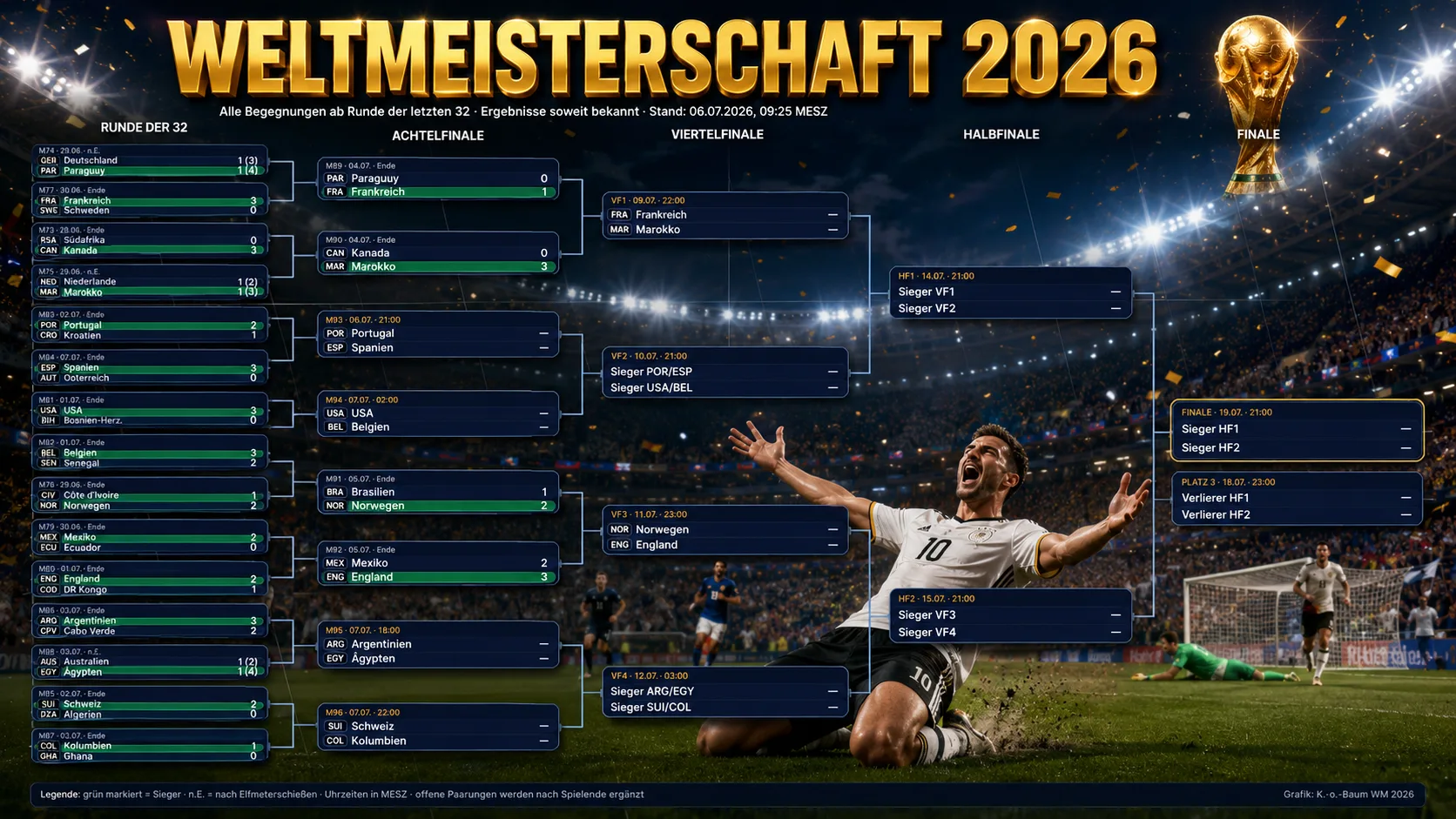
World Cup 2026: The Knockout Stage Is On – Round of 16 With Heavyweights
The 2026 World Cup has left the group stage behind and entered the knockout phase. Plenty is new: 48 teams, an extra round of 32, unfamiliar kick-off times from North America. An overview of the format, the state of play and the heavyweight round-of-16 ties.