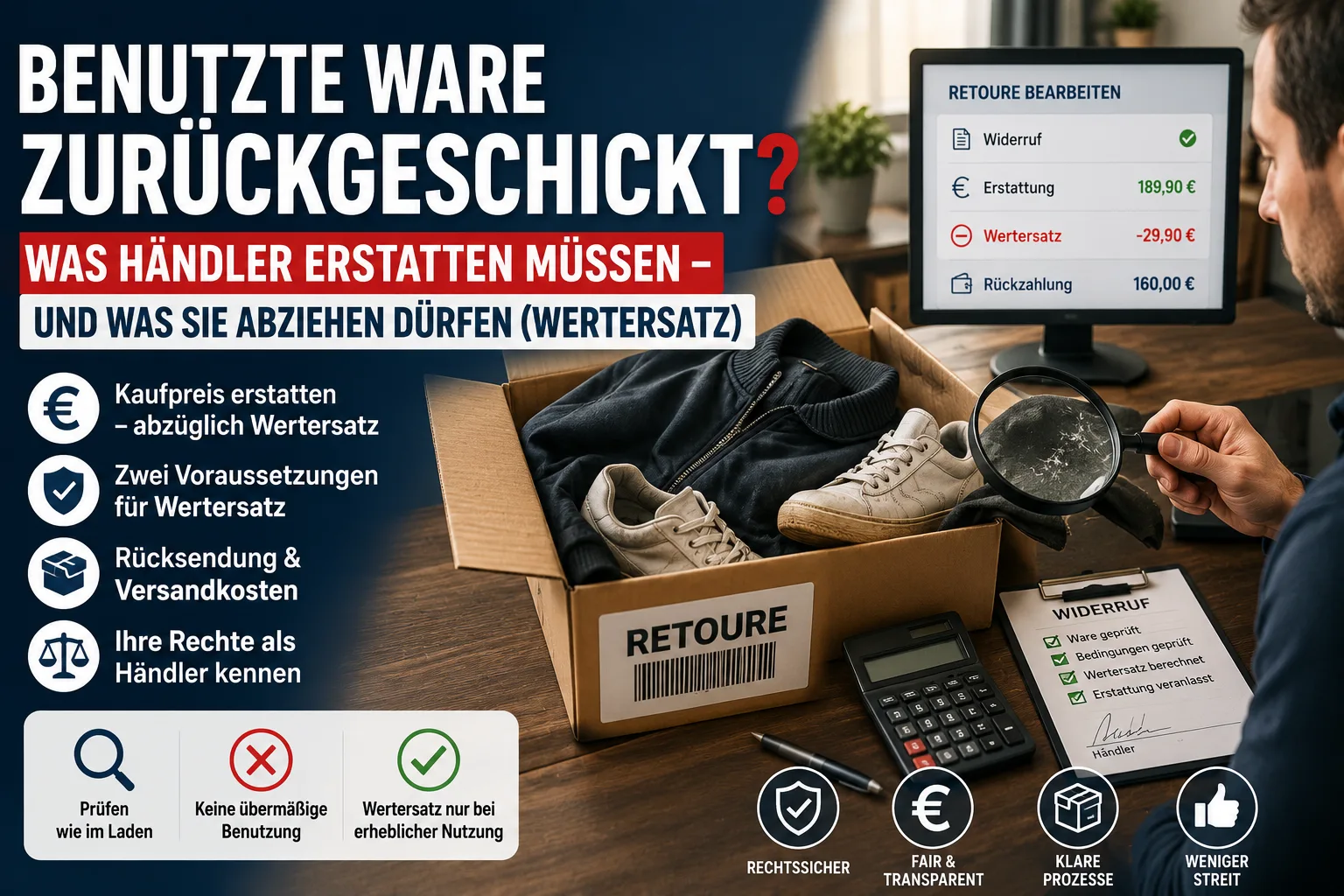
If a customer sends back used goods, you still have to accept the withdrawal and refund the purchase price plus standard shipping – use of the goods does not invalidate the withdrawal under German law. However, you may make a deduction, the so-called compensation for loss of value (Wertersatz), if two conditions are met: the customer went further with the goods than was necessary to examine them (the yardstick: more than they would have been allowed to do in a physical shop), and you correctly informed them about their right of withdrawal beforehand. You may almost never refuse the refund entirely – only for the few product groups that are completely exempt from the right of withdrawal, such as custom-made items or unsealed hygiene products.
Contents
- May the customer actually use the goods and still withdraw?
- What you must refund after a withdrawal
- When may you deduct compensation for loss of value?
- How much may you deduct?
- Who pays for the return shipment?
- Which goods carry no right of withdrawal at all
- Special cases from practice: returns without notice, transport damage & co.
- How to proceed in practice when used goods arrive
- Less trouble from the start: setting up your withdrawal policy, terms and returns process properly
- These three mistakes regularly cost sellers money
May the customer actually use the goods and still withdraw?
Yes – within a clearly defined limit. The idea behind the right of withdrawal: anyone who orders online cannot pick the goods up beforehand. The customer may therefore do at home what they would also be allowed to do in a physical shop: unpack, look at, touch, try on, try out.
The decisive question is always: would the customer have been allowed to do this in a shop?
Two rulings by Germany's Federal Court of Justice (BGH) show where the line runs:
- The waterbed case (BGH, judgment of 3 November 2010, VIII ZR 337/09): A customer assembled a waterbed bought online and filled the mattress with water – after that it was practically unsellable. The BGH ruled: no compensation. There is simply no other way to examine a waterbed. If testing inevitably deteriorates the goods, that is the seller's burden.
- The catalytic converter case (BGH, judgment of 12 October 2016, VIII ZR 55/15): A customer had a catalytic converter bought online installed in his car and took a test drive. That went too far for the BGH: installation and driving are no longer examination but use. The customer may still withdraw – but the seller may deduct the loss of value.
Translated into everyday situations, that means roughly:
| Permitted examination (no deduction) | Use beyond that (deduction possible) |
|---|---|
| Trying shoes on indoors | Wearing shoes outside for a week |
| Putting a jacket on in front of the mirror | Wearing the jacket on holiday, care label removed |
| Unpacking and inspecting a coffee machine | Using the coffee machine for weeks, limescale marks |
| Assembling a piece of furniture | Using the furniture for months, scratches |
Important: even if the customer has clearly used the goods, the withdrawal itself remains valid. You cannot refuse to take the goods back – you can only reduce the refund.
What you must refund after a withdrawal
The obligations are set out in Section 357 of the German Civil Code (BGB):
- The full purchase price – initially regardless of the condition of the goods; any justified compensation for loss of value is then offset.
- Outbound shipping costs – what the customer paid to have the goods delivered. But only up to the cheapest standard delivery: if the customer chose express, you only need to refund standard shipping (Section 357 (2) BGB).
- Deadline: 14 days from the withdrawal. However, you may withhold the refund until the goods are back with you or the customer proves they have sent them, e.g. with a posting receipt (Section 357 (4) BGB).
- Same means of payment: if the customer paid via PayPal, you refund via PayPal – a voucher instead of money is not permissible unless the customer expressly agrees (Section 357 (3) BGB).
The customer, for their part, must return the goods no later than 14 days after their withdrawal (Section 357 (1) BGB).
For your bookkeeping: a refund requires a cancellation invoice or corrective invoice so that VAT is handled correctly. Our article Correcting an invoice: cancellation and correction done right shows how.
When may you deduct compensation for loss of value?
Compensation for loss of value means: the customer must compensate you for the loss in value the goods suffered through their excessive use. You refund the purchase price but may offset the loss of value.
The law (Section 357a (1) BGB) requires both conditions:
- The loss of value results from handling that was not necessary for examination. In other words, more than the shop-level examination from the first section: worn instead of tried on, used instead of inspected, installed instead of examined.
- You properly informed the customer about their right of withdrawal. If the withdrawal information is missing or faulty, you lose the compensation claim entirely – even for heavily used goods. On top of that, missing information extends the withdrawal period from 14 days to up to 12 months and 14 days. Keeping your legal texts up to date pays off twice. Since June 2026, online shops in Germany also need a withdrawal button – details in our article The withdrawal button: how it must work.
Normal traces of permitted examination – opened outer packaging, removed film, plugged in once – do not justify a deduction. The fact that the goods can no longer be sold as new is your business risk in distance selling.
How much may you deduct?
There is no statutory formula. The yardstick: by how much has the excessive use reduced the value of the goods – measured against the purchase price?
In practice, most sellers calculate like this: purchase price minus the amount the goods can still realistically fetch when resold as used.
An example: you sell a pair of sneakers for 120 euros. The customer wears them for two weeks, the soles are visibly worn, then withdraws. As „worn, with signs of use" the shoes can still be sold for about 60 euros. Your compensation: around 60 euros. So you refund the customer 120 euros purchase price + 4.95 euros standard shipping − 60 euros compensation = 64.95 euros.
Three things you should know:
- The burden of proof lies with you. In a dispute you must show that the goods were used and how great the loss of value is. Without documentation (more on that below) you are in a weak position.
- Flat rates are risky. Clauses like „we retain 20 % for returns without original packaging" regularly fail in court. The deduction must be based on the actual loss of value in the individual case.
- Up to 100 % is possible. If the goods have become practically unsellable through use (e.g. heavily soiled, damaged, with a strong odour), the compensation can reach the entire purchase price. That is the exception, though, and should be well documented.
Who pays for the return shipment?
The direct costs of returning the goods are borne by the customer – but only if you informed them of this beforehand, usually in the withdrawal information (Section 357 (5) BGB). If this notice is missing, or if you promised to cover the costs, you pay.
Many sellers voluntarily include a returns label because it builds customer loyalty. That is a business decision, not an obligation. What matters is: whatever your withdrawal information says, applies. In the vehicle parts categories that choice ends on 28 September 2026: there eBay makes free returns mandatory.
Which goods carry no right of withdrawal at all
For some product groups, Section 312g (2) BGB excludes the right of withdrawal from the outset – here the compensation question does not even arise, because you can refuse the return entirely:
- Custom-made products and goods clearly tailored to personal needs (the engraved piece of jewellery, the curtain made to measure),
- quickly perishable goods (fresh food, flowers),
- sealed hygiene products where the seal has been removed (cosmetics, toothbrushes, adult products – the seal must be a genuine hygiene seal, not just the usual clear film),
- unsealed audio and video recordings and software (CDs, DVDs, games with a broken seal),
- newspapers and magazines (except subscriptions) plus a few special cases such as goods inseparably mixed with others.
Beware of wishful thinking: „for reduced goods" or „once the packaging is opened" are not exceptions. Anyone who writes such clauses into their terms risks a formal warning (Abmahnung).
Special cases from practice: returns without notice, transport damage & co.
The following situations come up again and again in seller forums – and are often handled incorrectly.
The parcel came back without notice, without the customer withdrawing. Do I have to refund? No, not yet. A withdrawal must be declared expressly – the declaration must make the customer's decision to withdraw unambiguous (Section 355 (1) BGB). Merely sending the goods back is not such a declaration. Ask the customer what they intend with the return: withdrawal? A complaint about a defect (then warranty rules apply, not the right of withdrawal)? Only once a valid withdrawal exists does your 14-day refund period begin. If the withdrawal period expires without the customer declaring anything, the right of withdrawal lapses. That does not mean you may simply keep or dispose of the goods – store them and actively clarify the case.
The return arrived damaged – transport damage on the way back. Who is liable? In principle, you: in the case of withdrawal, the seller bears the risk of the return shipment (Section 355 (3) BGB). If the parcel is damaged or lost on the way back, you still have to refund. There is one important exception: if the customer packed the goods evidently inadequately – the TV loose in a thin box without padding – the damage results from their improper handling, and you can claim compensation under Section 357a BGB. Here too: photograph the condition of the parcel and packaging immediately upon opening.
The customer withdrew but is not sending the goods back. How long do I wait? The customer must return the goods no later than 14 days after their withdrawal (Section 357 (1) BGB). Until the goods arrive or the customer proves dispatch, you may withhold the refund – but you must actively invoke this right if the customer demands money (Section 357 (4) BGB). If nothing happens, demand the return in writing with a deadline. You do not have to pay in advance and you do not have to wait forever.
The parcel arrived with postage unpaid. Accept or refuse? Accept it. Refusing acceptance is risky: the customer may have validly withdrawn in parallel by e-mail, and without the goods you can neither assess their condition nor quantify any compensation. The surcharge belongs to the direct costs of the return – if your withdrawal information makes the customer bear the return costs, you can offset it against the refund.
Original packaging or accessories are missing. May I reduce the refund? Missing original packaging does not invalidate the withdrawal – but if it genuinely reduces the resale value (often considerable with electronics), that is a case for compensation. Missing accessories (charging cable, remote control, spare key) may be deducted from the refund at their value, because the customer must return the received goods in full.
The parcel contained something else – or nothing at all. The classic fraud suspicion: instead of the smartphone, an old device or a brick comes back. Document the opening of such returns (for higher-value goods ideally on video, including the parcel weight on a scale), match serial numbers against your outgoing goods records and refuse the refund for goods you demonstrably did not get back. In cases of clear fraud, a criminal complaint is an option – legal support is worthwhile here.
How to proceed in practice when used goods arrive
- Document while unpacking. Photos or a short video of the condition directly upon opening the return: signs of use, missing accessories, soiling – with a date. This is your most important evidence later.
- Quantify the loss of value concretely. Note why the goods can no longer be sold as new and what they can realistically still fetch as B-stock. Comparison prices (e.g. your own B-stock sales or marketplace prices for used goods) support your reasoning.
- Explain the deduction to the customer. Do not simply refund the reduced amount without comment. A short, factual e-mail with photos and the calculation („purchase price 120 € − compensation 60 € due to clear signs of wear = refund 60 € plus shipping costs") prevents many disputes.
- Keep an eye on the deadline. Even if the amount is disputed: the 14-day refund period is running. When in doubt, pay the undisputed part on time.
- Update your bookkeeping cleanly. Create a cancellation or corrective invoice so that refund and VAT match. In an invoicing program like office1.cloud you generate the cancellation invoice directly from the original invoice and the process remains traceably documented.
Less trouble from the start: setting up your withdrawal policy, terms and returns process properly
First, the honest limitation: the right of withdrawal is mandatory consumer law. Clauses that deviate from the law to the customer's disadvantage are void (Section 361 (2) BGB) – and expose you to formal warnings on top. „In your favour" therefore does not mean overriding the law via your terms, but making full use of the levers the law allows. Most sellers leave several of them unused:
- Use the statutory model withdrawal information – complete and up to date. It is your most important instrument, because almost everything depends on it: only with proper information does the withdrawal period stay at 14 days (instead of up to 12 months and 14 days), only then are you entitled to compensation, and only then does the customer bear the return costs. The official model contains the necessary notices – including the one on loss of value. Using it unchanged is the least error-prone route.
- Expressly impose the return costs on the customer. That is your legitimate choice – but the sentence must appear in the withdrawal information, otherwise you pay. You can still voluntarily include a free returns label; your information text just should not promise more than you intend.
- Make the right of retention your standard process. Refunds are issued after the return has arrived and been inspected – not already upon the withdrawal e-mail. That is your right and prevents you from refunding money and then unpacking damaged goods.
- Make the exceptions to the right of withdrawal actually usable. The hygiene exception only applies if the goods really were sealed – a proper seal label costs cents and decides the case. Custom-made items should be clearly labelled as such in the shop („made to your measurements"), so the exception is tangible and transparent for the customer.
- Document your outgoing goods. Record serial numbers, take photos of high-value goods before dispatch, use inconspicuous markings where appropriate. Without outbound documentation you cannot prove anything in a swap-fraud case.
- Channel returns through a form or portal. If customers register the return online, you automatically get the express withdrawal declaration with a date, no parcels without notice, and a clean run of deadlines. The chaos from the special-cases section simply never arises. Since June 2026, online shops need a withdrawal button anyway – the requirements are in our article The withdrawal button: how it must work.
- Separate goodwill from obligation. A voluntary extended return period („60-day returns") is a strong selling point – and here you may set the conditions freely, because the promise goes beyond the law: for example only unworn, only with tags, refund as store credit. What matters is a clean separation in your terms: first the statutory right of withdrawal (untouched), then the additional returns guarantee with its own rules.
- Throw out void clauses. „Only unopened returns", „20 % deduction if original packaging is missing", „refunds only as vouchers" – such sentences do not improve your position; they earn you formal warnings and weaken you in a dispute. An annual check of your legal texts (or an update service) is far cheaper than a single lost case.
These three mistakes regularly cost sellers money
Mistake 1: refusing acceptance or the refund entirely. „We do not take back used goods" is void and warnable. The withdrawal remains valid – your only lever is the compensation for loss of value.
Mistake 2: refunding too quickly. Refunding without an express withdrawal declaration, before the goods arrive or without inspecting their condition – whoever pays first negotiates from the weaker position afterwards. Use the order the law grants you: withdrawal declaration, goods, inspection, then refund.
Mistake 3: deducting without evidence. Anyone who withholds a flat 30 % without photos and reasoning almost always loses the dispute – and with payment services like PayPal or card payments often already in the buyer-protection process, before a court ever gets involved.
Finally, the honest classification: compensation for loss of value is a balancing tool, not a punishment. For the bulk of returns – briefly inspected, properly sent back – there is simply nothing to deduct. But in the cases that hurt, because the goods come back visibly used, you do not have to simply swallow the loss. This article is general information on German law and does not replace legal advice in individual cases; for larger amounts in dispute or recurring patterns, consulting a law firm specialising in IT and commercial law is worthwhile. More guides on obligations, deadlines and invoicing for small businesses are available at office1.cloud.
Handle invoices more easily
Easy Invoice combines quotes, invoices and customer management in the cloud.
Try Easy InvoiceRead next
 Taxes & Law
Low-value assets in Germany (GWG) 2026: €800 limit, net or gross
The GWG limit in Germany is €800 net in 2026, also under the small business scheme. Which purchases you deduct at once, when the pooled item pays off and how to book it.
 Taxes & Law
Germany's 1% rule for company cars: how the self-employed pay tax
If you also drive your company car privately, you pay tax on 1 percent of the list price every month. What comes on top, what the calculation looks like with figures and when a mileage logbook saves money.
 Taxes & Law
Keeping a mileage logbook in Germany: template, required details
A German mileage logbook only counts if every trip is recorded promptly and without gaps. Which details are required, what a filled-in logbook looks like and why Excel is not enough.