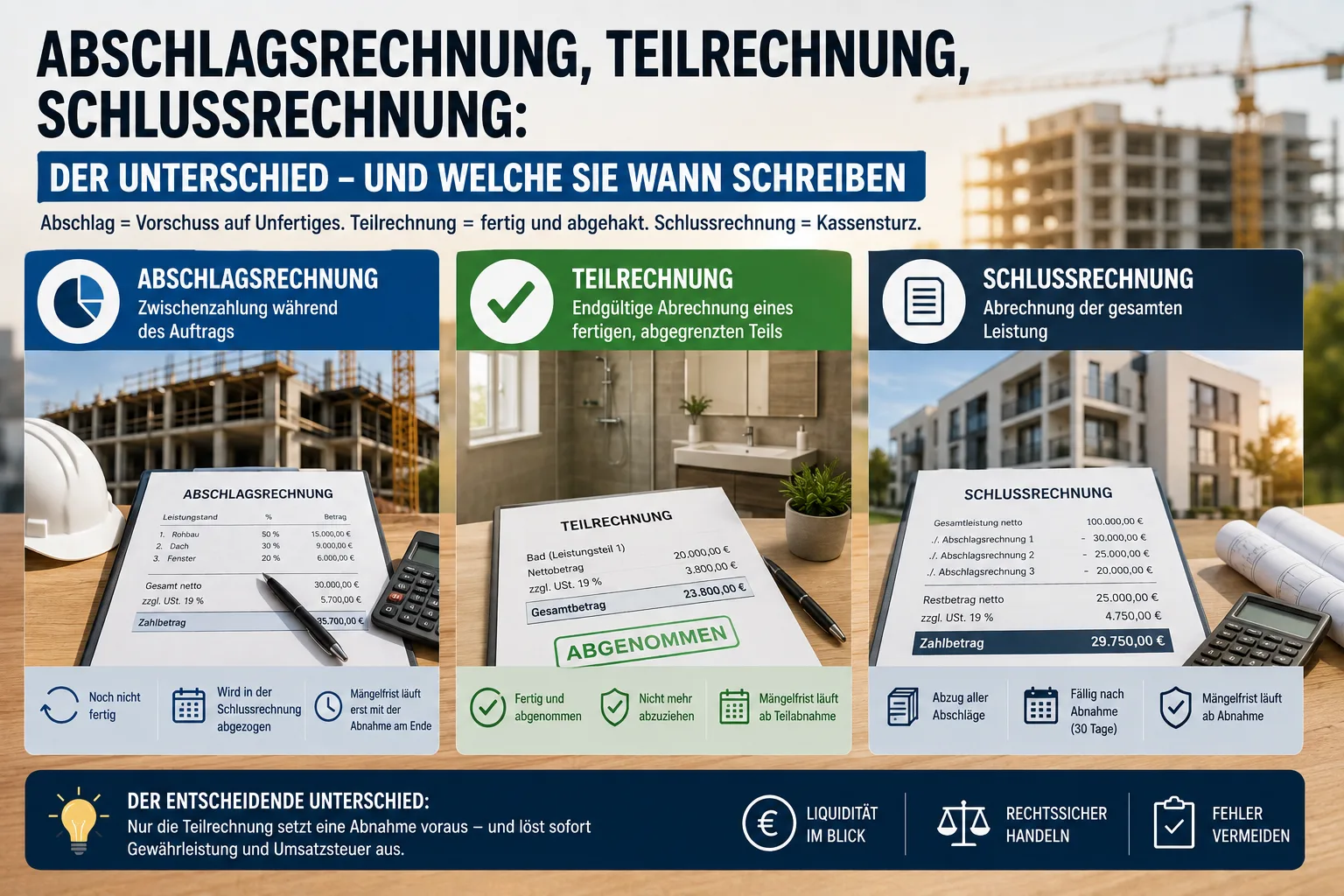
Progress invoice: an interim payment while the job is still running. It is deducted again in the final invoice. Partial invoice: the final bill for one part of the job that is finished and has been accepted. It is not deducted later. Final invoice: the settlement at the end, in which all progress payments are deducted. The important difference is not in the name but in the consequence: with a partial invoice that part of the work is closed – the period for defect claims runs from acceptance, and you cannot add anything afterwards. With progress invoices everything stays open and correctable until the final invoice.
Contents
- The three side by side
- Progress invoice: the standard tool for running jobs
- Partial invoice: the condition that is almost always missing
- Final invoice: what comes together here
- The VAT difference hardly anyone explains
- The three most common mistakes
- Three questions from practice
- What is left of all this for small businesses
The three side by side
| Progress invoice | Partial invoice | Final invoice | |
|---|---|---|---|
| What for | interim payment on the way to the finished work | one finished, clearly defined part of the job | the complete settlement at the end |
| Is that part finished? | no, work continues | yes, this part is done | yes, everything is done |
| Separate acceptance needed? | no | yes, partial acceptance | yes, acceptance |
| Final? | no, it gets offset | yes | yes |
| Deducted later? | yes, in the final invoice | no | – |
| Defect period starts | at acceptance at the end | at the partial acceptance | at acceptance |
Rule of thumb: progress = advance on unfinished work. Partial invoice = done and closed. Final invoice = the reckoning.
If you want to write invoices with all mandatory details in a few minutes, you can try the invoicing software Easy Invoice free for 10 days.
Progress invoice: the standard tool for running jobs
For the vast majority of cases the progress invoice is the right tool. You may request progress payments up to the value of what you have already delivered – this is set out in Section 632a of the German Civil Code (BGB) and applies without any special agreement.
Three things to know:
- You have to prove what you delivered. The law requires a statement that allows a „quick and reliable assessment". In practice: items as in the quote, with quantities and status – not „progress payment 1: 5,000 €".
- The customer may withhold for defects. If the work delivered does not match the contract, they may withhold an appropriate part. Until acceptance, you must prove that your work was sound – not the customer the opposite.
- If the German VOB/B construction terms are agreed, the progress payment falls due 21 days after your statement is received. Without VOB/B, the contract decides.
The big advantage: none of it is final. If a progress payment is set too high or too low, it is straightened out in the final invoice.
How such an invoice is built in detail is explained in Writing a progress invoice.
Partial invoice: the condition that is almost always missing
A partial invoice is not a „bigger progress invoice". It requires that a part of the job was agreed in the contract as a separate part – with its own price – and that this part has been accepted. Under the VOB/B, self-contained parts of the work can be finally assessed and paid after a partial acceptance, regardless of how the rest proceeds.
That is exactly where it fails in practice: the contract states one total sum, there was no partial acceptance – then it is a progress invoice, even if „partial invoice" is printed on it.
Instalments are particularly often misclassified: instalments are not partial performances. If you carry out a single job and the customer pays it in three instalments, it remains a one-off service – no matter how the instalments are worded in the contract. The German Federal Fiscal Court made this clear in its ruling of 1 February 2022: a partial performance requires a service of a continuous or recurring character. A construction job running in accepted sections meets that – a one-off delivery paid in instalments does not.
Where it really fits: a job covers a bathroom and a kitchen, both separately commissioned and separately priced. The bathroom is finished and accepted, work on the kitchen continues. The bathroom can be invoiced definitively.
You should know this in advance, because a partial acceptance has consequences:
- The limitation period for defects starts immediately – for buildings that is five years, counted from the acceptance of that part. Not from the end of the whole job.
- Risk passes. If the accepted bathroom is later damaged on site, that is no longer automatically your problem.
- The amount is out of the offsetting. It no longer appears in the deduction block of the final invoice.
That can be good for you: the warranty period expires earlier and the money is definitively earned. For the customer it is rather unattractive – which is why genuine partial acceptances rarely happen by themselves. If you want one, it has to be in the contract.
Final invoice: what comes together here
The final invoice shows the entire service and deducts the progress invoices already issued – each with the net amount and the VAT attributable to it. If the tax amounts are left out, you owe the VAT from the final invoice a second time in full. What the deduction looks like correctly, with a worked example and a template, is explained in Final invoice with deduction of progress payments.
If the VOB/B is agreed, additional deadlines apply: the final payment falls due at the latest 30 days after the auditable final invoice is received; only where objectively justified and expressly agreed may it be up to 60 days. If the customer pays less than invoiced, a reservation must be declared within 28 days of the notice of final payment – and substantiated within a further 28 days, otherwise it lapses. Missing these deadlines costs you claims, not just time.
The VAT difference hardly anyone explains
This is where progress invoice and partial invoice really part ways – and it affects your bank account.
With a progress invoice the VAT only arises once the money is in. You declare it in the period in which the payment arrived. If you issue a progress invoice in June and the customer pays in August, the tax belongs in August.
With a genuine partial performance the VAT arises on execution – that is, when the part is finished and accepted. Whether the customer has already paid is irrelevant.
The practical difference: in June you have a defined construction section worth 20,000 euros accepted and issue a partial invoice. The customer pays only in September. You still have to declare the 3,800 euros of VAT for June and advance it out of your own pocket. With a progress invoice that would not have happened.
Anyone short on cash therefore travels more calmly with progress invoices.
One exception concerns the construction trade: if you work for another building firm, it is not you who owes the VAT but your client – progress invoices included. When that applies is explained in Section 13b UStG for construction services.
The three most common mistakes
Writing „partial invoice" but meaning a progress invoice. The most frequent case. As long as no separate part of the work was agreed and accepted, it is a progress invoice. Then call it that – otherwise you will later argue about when the warranty period started.
Deducting the partial invoice again in the final invoice. Only progress payments are deducted, that is, payments for work not yet performed. An invoiced partial performance is done and taxed. At the end you only bill what is left.
Progress invoices without a statement. A single line „progress payment 2" without a status of works is not auditable. The customer may withhold payment, and under the VOB/B the 21-day period does not even start to run.
Three questions from practice
How many progress invoices may I issue? There is no fixed number. The benchmark is the value of what you have already delivered – under the VOB/B, progress payments are even to be granted „at short intervals" if you request them. In practice you tie them to construction sections or months. Important: every progress invoice needs its own consecutive invoice number, otherwise the deduction in the final invoice becomes unmanageable.
Does the customer have to accept progress invoices at all? Yes. The right to progress payments is in the law and applies even if the contract says nothing about it. The customer may, however, withhold an appropriate part if the work delivered is defective – and until acceptance you must prove that your work was sound.
Is an advance payment the same as a progress payment? In everyday terms, no: an advance payment is made before any work has been done at all – for example as security for materials. A progress payment presumes that part of the work is already complete. For VAT purposes both are treated the same: the tax arises when the money arrives, and both are deducted in the final invoice. How to agree an advance payment and invoice it correctly is shown in Advance payment invoice and prepayment.
What is left of all this for small businesses
As a small business under Section 19 UStG you do not show VAT. The entire tax section drops away for you – and with it the most expensive trap. What remains still matters:
- You may request progress payments just the same. Section 632a BGB applies regardless of VAT.
- You still need the statement of the work delivered.
- And a partial acceptance has the same consequence for you: the period for defect claims starts running immediately.
If you are unsure which of the three fits: ask yourself whether the customer has already accepted this part. No? Then it is a progress invoice.
This article explains which invoice fits when – not how it is posted in the books. If you also need the bookkeeping side, meaning how advance payments are recorded and released again with the final invoice, DATEV covers it in Anzahlungen richtig buchen (February 2026, paid). It is written for bookkeepers and tax advisers and goes considerably deeper. An invoicing software writes invoices with every mandatory detail in minutes.
Sources: Section 632a BGB · Section 634a BGB · Section 13(1) no. 1 UStG · Section 14(5) UStG · Section 16 VOB/B · German VAT Application Decree 13.4 (partial performances) · DATEV magazin: tax point for partial performances
_This article provides general information and does not replace legal or tax advice._
Handle invoices more easily
Easy Invoice combines quotes, invoices and customer management in the cloud.
Try Easy InvoiceRead next
 Invoicing & Accounting
Booking private withdrawals in Germany: accounts, tax, contributions
A private withdrawal is not a salary and does not lower your profit. Which accounts apply, when VAT is due on goods and the car, and what goes into the Anlage EÜR.
 Invoicing & Accounting
Cost estimate in Germany (Kostenvoranschlag): template and what goes in
A German cost estimate (Kostenvoranschlag) is an estimate, not a fixed price. With a sample to copy: what goes in, which sentences protect you from disputes and when it may cost money.
 Invoicing & Accounting
Receipt lost? How to write an Eigenbeleg in Germany
No booking without a receipt – but there is a substitute. What belongs on a German Eigenbeleg, when the tax office accepts it, and why the VAT is gone anyway.