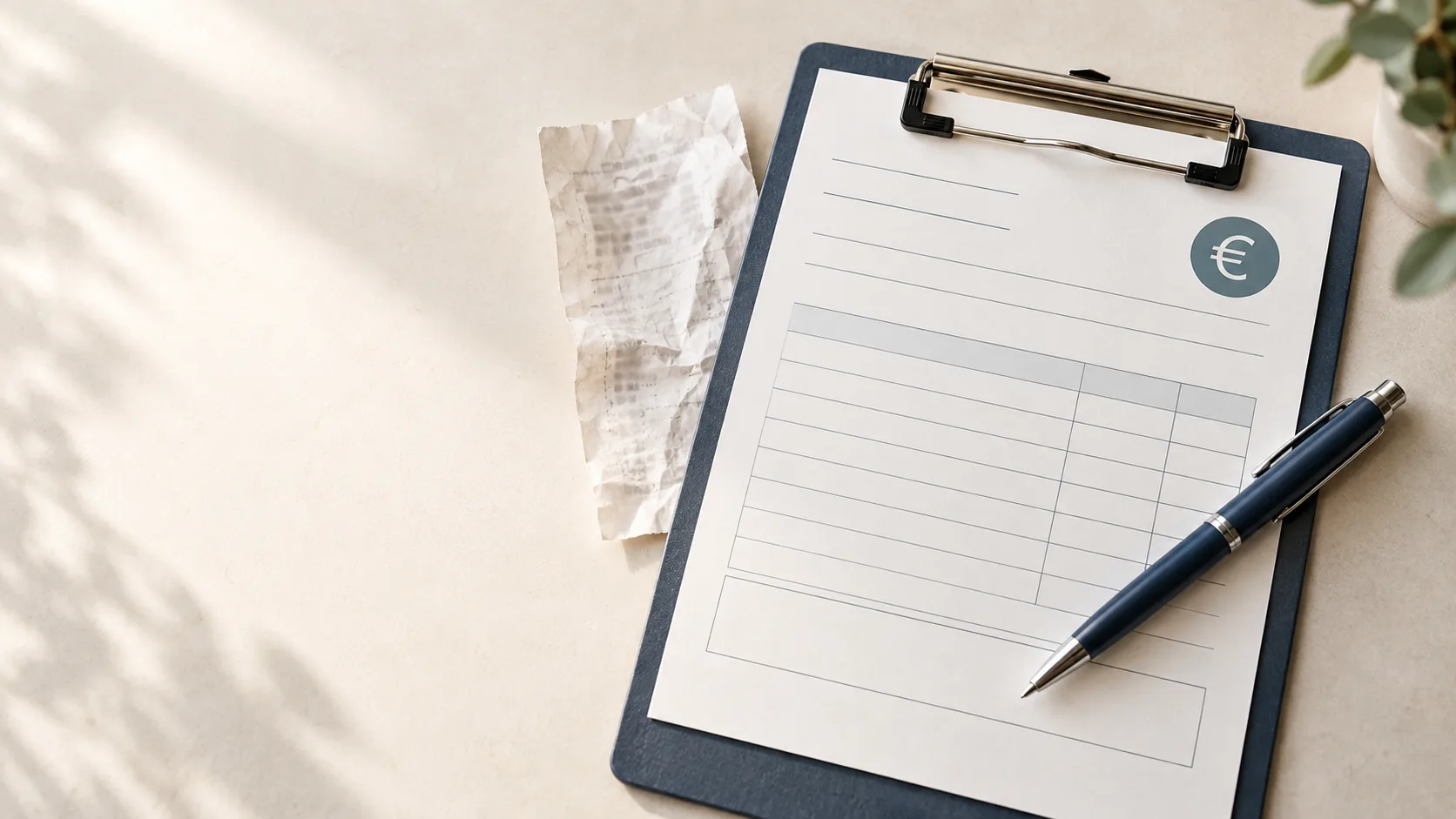
If the receipt is missing, you write it yourself. Such a self-issued receipt, called Eigenbeleg in Germany, counts as a business expense and lowers your profit, provided it states what you paid for, when, and why the proper receipt is missing. One thing it will not recover: the VAT. To deduct input tax, German law requires a real invoice from the seller, and you cannot issue that to yourself.
Contents
- When may I write an Eigenbeleg?
- What has to be on it?
- Template to copy
- Why the VAT is lost
- Invoice lost, but you once had it
- How many Eigenbelege are too many?
- Frequently asked questions
When may I write an Eigenbeleg?
Whenever there is no seller's receipt and none can exist. Two cases occur in daily business:
| Case | Examples |
|---|---|
| There never was a receipt | Parking machine without a slip, tips, market stall, coin-operated machine, car wash, stamps from a vending machine |
| The receipt is gone | Till slip through the washing machine, lost receipt, faded thermal paper, receipt lost while moving |
Behind this stands a simple principle of German bookkeeping: no booking without a receipt. The tax administration puts it like this in the principles of proper accounting (GoBD): "Every business transaction must be documented by the original document or a copy of the original. If no third-party receipt is available, a self-issued receipt must be created" (margin number 61). So the Eigenbeleg is not a liberty you take, it is the route the rules provide.
It is not meant for expenses where you could get a receipt but do not bother. Anyone who waves off the slip at the DIY store and writes it himself later turns the idea on its head.
If you file your receipts digitally anyway, accounting software with document management helps you store the Eigenbeleg with the transaction instead of in a shoebox.
What has to be on it?
Six details, and most people forget one of them. In margin number 77, the GoBD list what every accounting document must contain:
| Detail | What you write down |
|---|---|
| Unique document number | A number from your running document file so the receipt stays findable |
| Recipient of the money | Name and place of the seller, as precisely as you still remember |
| Amount | The amount paid. If you know the VAT rate, state it – it is not mandatory |
| Explanation of the transaction | What you bought and what for. "Material" is not enough, "silicone for the Meier bathroom job" is |
| Document date | The day you paid. Not the day you write the receipt |
| Responsible issuer | Your name |
The one people miss: the reason. Why is there no seller's receipt? "Till slip lost" or "parking machine issues no receipt" belongs on the sheet. Without that sentence an auditor sees nothing but a self-written piece of paper.
Add your signature. The GoBD do not list it as mandatory, but it is the point where you personally confirm the content. It costs nothing and turns a note into a declaration.
Template to copy
You do not need a form. A sheet of paper with these lines meets the requirements just as well as a template from the internet:
EIGENBELEG (self-issued receipt)            No.: 2026-0147

Date of expense:        14 September 2026
Recipient:              Parkhaus am Markt, Rosenheim
Amount:                 EUR 4.50
Purpose:                Parking fee, client meeting Yilmaz,
                        quote for bathroom renovation
Reason for the Eigenbeleg: machine issues no receipt

Issued on:              20 September 2026
Name, signature:        ____________________________
Two points that go wrong in practice:
- Two dates, not one. The day of the expense and the day you write the receipt are different things. Both belong on it. Anyone noting only today's date books the expense in the wrong month.
- The purpose is a sentence, not a label. "Travel costs" explains nothing. Where, to whom, why – that is what separates a business expense from a private one.
Why the VAT is lost
You deduct the net amount, not the VAT. The reason is in section 15 paragraph 1 sentence 1 number 1 of the German VAT Act: input tax may only be deducted by someone who "holds an invoice issued in accordance with sections 14, 14a". An invoice is issued by the seller, not the buyer. Your own sheet of paper is not one.
For small businesses under section 19 of the VAT Act this changes nothing. Anyone who does not charge VAT does not deduct input tax either – for them the Eigenbeleg covers the expense in full.
With small amounts it is therefore worth a look in the waste bin before you reach for an Eigenbeleg: up to 250 euros, a simple till slip showing the seller's name, the date, the goods and the VAT rate is enough for the input tax deduction – section 33 of the VAT Implementing Ordinance asks for no more. What belongs on it is explained in Small-amount invoices up to 250 euros. A recovered slip is real money, an Eigenbeleg is not.
Invoice lost, but you once had it
Here the VAT is not automatically gone. If you did hold a proper invoice and it was lost later, you may prove that you held it by other means. The Federal Fiscal Court confirmed this in its judgment of 23 October 2014 (case V R 23/13): the proof may be provided by any admissible evidence.
What helps, in this order:
- Ask the supplier for a duplicate. The best route, and usually one email away. The duplicate should be marked as "Duplikat" or "Zweitschrift".
- Present a copy or scan if you had already filed the invoice once.
- Proof of payment plus Eigenbeleg. Bank or credit card statements show that and to whom you paid. That does not replace the invoice, but it supports your account.
The Eigenbeleg comes last in this sequence, not first. Ask first, write your own only afterwards.
How many Eigenbelege are too many?
There is no fixed number, and no amount limit either. Neither the Fiscal Code nor the GoBD name a maximum amount above which an Eigenbeleg would be inadmissible. The frequently quoted 150 euros appear in no statute.
What matters is the proportion: a few parking fees and one lost slip a year catch nobody's eye. But if a larger share of your expenses rests on self-written receipts alone, the propriety of your bookkeeping as a whole is in question – with the consequence that the tax office may estimate.
A second point concerns larger amounts: under section 160 of the Fiscal Code the tax authority may require you to name the recipient of a payment "precisely". If you fail to do so, the expenses are "as a rule not to be taken into account for tax purposes". At 4.50 euros for parking nobody cares. At 800 euros to a tradesman without an invoice this becomes a real problem – and no Eigenbeleg helps against it, only the name and address of the recipient.
Try Easy Invoice free for 10 days – no payment details, the trial ends by itself.
Frequently asked questions
How long must I keep an Eigenbeleg?
Eight years. The Eigenbeleg is an accounting document, and since 1 January 2025 the shortened period in section 147 paragraph 3 of the Fiscal Code applies to those. Before that it was ten years. Commercial books and inventories still have to be kept for ten years.
Can I write an Eigenbeleg months later?
Yes, but the later it is, the less convincing it gets. If you notice the gap while sorting your receipts, write the Eigenbeleg straight away and state the issue date honestly. A backdated receipt is no longer an irregularity, it is a false statement.
Do I need an Eigenbeleg for a tip?
Only if nobody signs for it. For a tip during business entertainment the burden of proof lies with you; in its circular of 19 November 2025 the Federal Ministry of Finance gives the example that the recipient signs for the tip on the invoice. So have those two euros initialled on the bill. What else belongs on an entertainment receipt is explained in Filling in a Bewirtungsbeleg correctly.
May I write an Eigenbeleg for an invoice I have not paid yet?
No. The Eigenbeleg replaces a missing document about something that has happened. An open incoming invoice you never received is something you request from the supplier. How to keep incoming invoices in order is shown in Managing incoming invoices.
Which account do I book an Eigenbeleg to?
The same account as the expense itself. An Eigenbeleg is not a separate type of transaction, only the evidence for a normal one. The parking fee goes to travel or vehicle costs, the lost DIY material to goods or materials – exactly as with an original slip. The only difference is that you book no input tax.
May I write the Eigenbeleg on the computer and keep it digitally only?
Yes. The form is free, paper is not prescribed. What matters is that the document cannot be changed unnoticed after filing and that it stays findable – in your accounting software, in a document archive or as a scan with a fixed number. A Word file in your downloads folder that you can overwrite at any time does not meet that.
Does the Eigenbeleg count the same way in the German cash-basis accounts?
Yes. It works there like any other expense document and reduces the profit in the year of payment. The procedure is described in Doing your EÜR yourself.
Sources
- GoBD, Federal Ministry of Finance circular of 28 November 2019, margin numbers 61 and 77
- Section 147 Fiscal Code – retention periods
- Section 160 Fiscal Code – naming of creditors and payees
- Section 15 VAT Act – input tax deduction
- Section 33 VAT Implementing Ordinance – small-amount invoices
- Federal Ministry of Finance circular of 19 November 2025 on entertainment expenses
Handle invoices more easily
Easy Invoice combines quotes, invoices and customer management in the cloud.
Try Easy InvoiceRead next
 Invoicing & Accounting
Pro forma invoice: meaning, template and when you need one
A pro forma invoice demands no money and gives no input VAT deduction. It serves customs and advance information. What belongs on it and where the traps are.
 Invoicing & Accounting
Late payment interest in Germany: rate, formula and example
A customer has not paid for weeks. You may charge interest without asking. Here is how much exactly, from which day it counts and how to work out the amount.
 Invoicing & Accounting
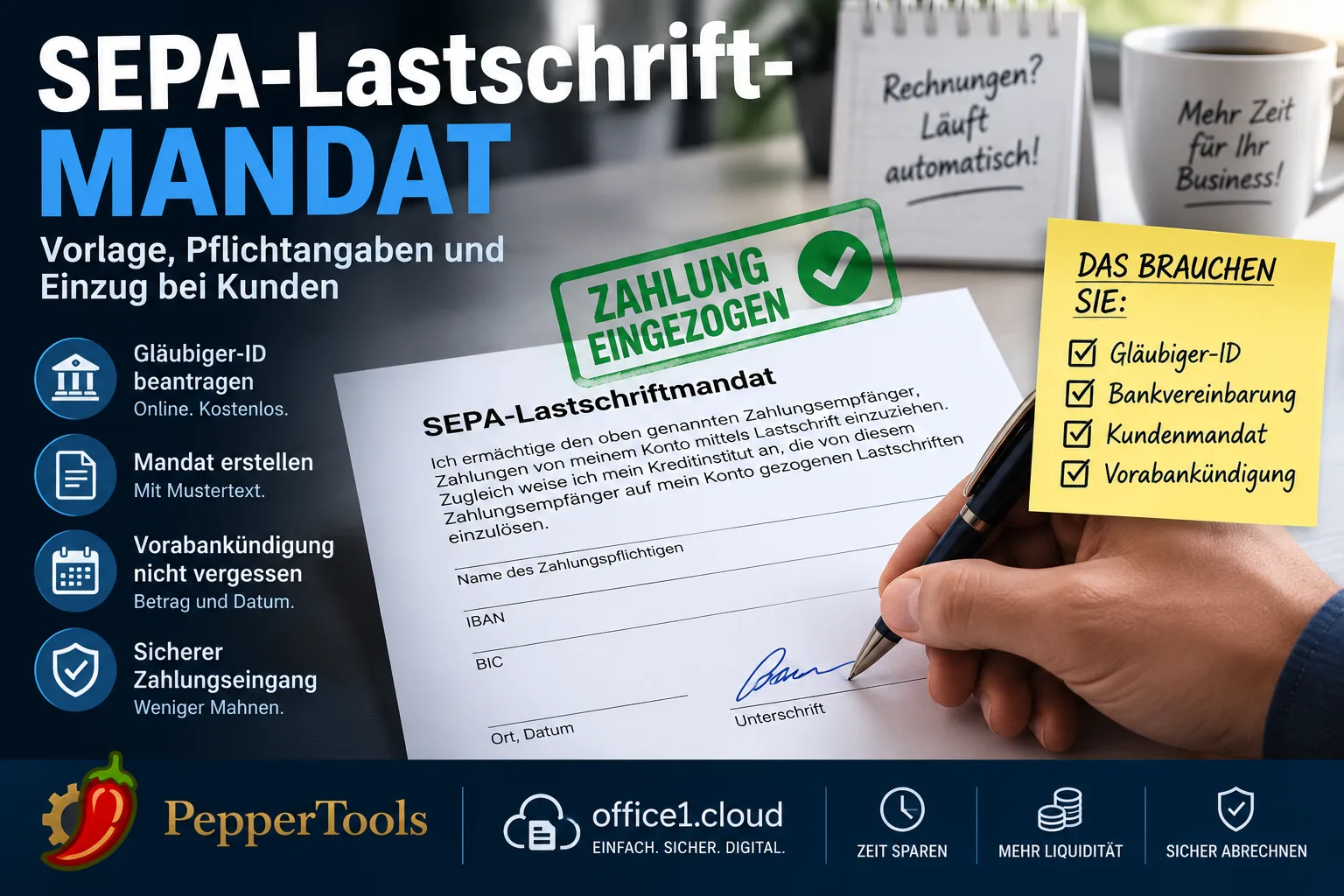
SEPA Direct Debit Mandate: Template, Required Details, Collection
Chasing 40 invoices every month? With direct debit, the money comes in by itself. What you need, what goes in the mandate and what the customer can claw back.