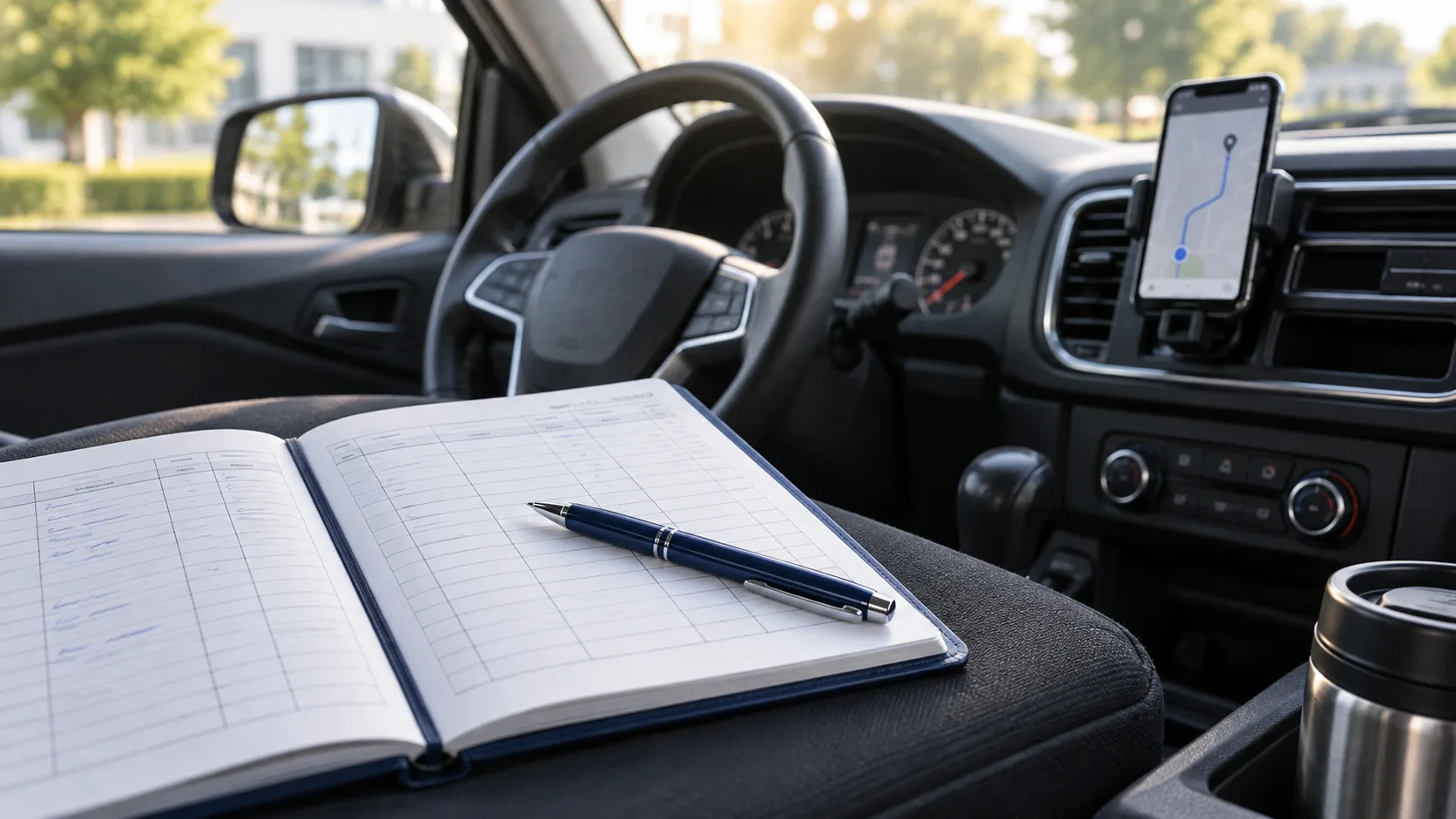
The German tax office (Finanzamt) only accepts a mileage logbook (Fahrtenbuch) if you record every trip promptly, without gaps and in a way that nothing can be changed later without it showing. For every business trip, you enter the date, the odometer reading at the start and end, the destination with its address, the purpose and the client you visited. For private trips, the kilometres are enough. An Excel spreadsheet is not accepted, a bound notebook or an app that locks or logs changes is. Just a few serious mistakes can lead the tax office to reject the whole year and tax your private use under the 1% rule.
Contents
- Template: what a filled-in mileage logbook looks like
- Which details are required
- Notebook, Excel or app: what is accepted
- Electronic logbook via app or OBD plug
- When you have to make the entries
- The most common mistakes
- Do you need a mileage logbook at all?
- Simplifications for certain professions
- Frequently asked questions
Template: what a filled-in mileage logbook looks like
Copy these columns into a bound logbook or check whether your app records all of them. The example shows one day of Elif Arslan, a master electrician with a business in Kassel, including a private trip in the evening.
| Date | km start | km end | km | Type | Destination | Purpose and client |
|---|---|---|---|---|---|---|
| 05.10.2026 | 48,210 | 48,222 | 12 | Home – business | Business, Industriestraße 4, Kassel | – |
| 05.10.2026 | 48,222 | 48,259 | 37 | business | Hauptstraße 18, Baunatal | Replace meter cabinet, client Tomasz Nowak |
| 05.10.2026 | 48,259 | 48,301 | 42 | business | Electrical wholesaler, Am Hafen 7, Kassel, then business | Pick up material, then back |
| 05.10.2026 | 48,301 | 48,313 | 12 | Home – business | Home | – |
| 05.10.2026 | 48,313 | 48,327 | 14 | private | – | – |
| 06.10.2026 | 48,327 | 48,339 | 12 | Home – business | Business, Industriestraße 4, Kassel | – |
Three things make this example robust. The odometer reading at the end of one line is the start of the next, there is no gap. Every business trip gives a full address and a name. And the private trip in the evening starts on a new line instead of being absorbed into the last business trip.
Keep a separate logbook for each car, and for the whole calendar year. For the same car, you may not switch between the logbook and the 1% rule in the middle of the year. Fuel receipts and garage invoices do not go into the logbook but into your bookkeeping, for example in accounting software. Together, both later show the share of the costs that falls on your private trips.
Which details are required
Business trips take most of the work, private trips cost you one number per entry. The Federal Fiscal Court (Bundesfinanzhof, BFH) requires the records to be complete and correct and to be verifiable with reasonable effort (judgment of 1 March 2012, VI R 33/10).
| Type of trip | What must be entered |
|---|---|
| Business trip | Date, odometer reading at start and end, destination with address, purpose, client or business partner visited. For a detour, also the route driven |
| Private trip | Date and kilometres |
| Trip between home and business | Date, kilometres and a short note such as "Home – business" |
For the destination, the street name alone is not enough. This is exactly why the logbook failed in the 2012 judgment: for most trips, it only said "…straße", with no house number and no client. A company name is not enough either if the company has several branches in the town.
You may combine several client visits in a row into one line. In that case, you list all clients in the order you visited them and the odometer reading at the end of the whole tour. If you make a private stop on the way, for example to go shopping, a new line starts for it with the odometer reading from that moment.
Notebook, Excel or app: what is accepted
What matters is not the medium, but whether an entry can later be changed without it showing.
| Form | Accepted? | Why |
|---|---|---|
| Bound notebook, filled in continuously | yes | Later entries stand out |
| Loose sheets, typed up later | no | No closed form |
| Excel or Word table | no | Every cell can be overwritten without a trace |
| App or OBD plug that locks or logs changes | yes | Fulfils the same purpose as the notebook |
An Excel file does not become acceptable because you print it out every month. At most, Excel is useful as a model to plan the columns for your notebook.
Electronic logbook via app or OBD plug: is that allowed?
Yes, an electronic logbook is expressly allowed, whether as an app on your phone or as a plug in the car. The Federal Ministry of Finance accepts it if it provides the same information as a notebook and later changes are technically impossible or at least documented (letter of 3 March 2022, margin number 28). In addition, the GoBD apply, the tax office's rules for digital records. There is no official approval and no tax office seal for individual devices. A claim such as "tax office compliant" in advertising is the provider's statement, not a commitment from your tax office.
There are two types. An app detects trips via the phone's GPS. An OBD plug goes into the diagnostic port that almost every car has under the dashboard and records trips as soon as the engine runs. Depending on the device and the car, it also reads the odometer. Both record date, route and destination by themselves. What they cannot know is the purpose of the trip and whom you visited. You add that afterwards. For devices that record every trip automatically, the entry counts as prompt if you add the purpose and client within seven calendar days. Trips without an addition are then treated as private (margin number 29 of the same letter, which covers company cars for employees).
Check these four points before you buy:
- Can a saved trip only be edited afterwards with a visible change log?
- Does the logbook show the car's total odometer reading, not just the distance driven? An app measures distance by GPS, the odometer counts differently. The Federal Fiscal Court requires the odometer reading at the end of each trip.
- Does the device record every trip, even when the phone stays at home? An app only records when the phone travels with you. Missing trips show up in the odometer reading.
- Can you hand the whole year to the tax office as a file or printout?
When you have to make the entries
Enter each trip on the same day, but at the latest before you lose track. The law sets no fixed deadline, the Federal Fiscal Court requires the entries to be "prompt" (zeitnah). A logbook you write up from your calendar at the end of the year is not prompt, even if every number is correct.
For apps and plugs that record every trip themselves, there is a deadline of seven calendar days for purpose and client, see electronic logbook.
The most common mistakes
Not every small mistake sinks the logbook. The Federal Fiscal Court accepts it despite minor flaws as long as it remains reliable overall. But if you have the same gaps throughout, you lose it entirely.
- Only the town or the street as the destination, with no house number and no client.
- Odometer readings that do not follow on from each other.
- Private trips that "ride along" in a business trip without a line of their own.
- Details that are only added later in a separate list. The required details must be in the logbook itself, a list submitted afterwards does not save it (BFH, VI R 33/10).
- Odometer readings that do not match the garage invoices, which show the mileage.
- A logbook for only a few months.
If the tax office rejects the logbook, it taxes the private use under the 1% rule. For the self-employed, this only applies if the car is used more than half for business. Otherwise, the tax office estimates the private share.
Do you need a mileage logbook at all?
No, the law does not require a mileage logbook. It is the way to prove your actual private use instead of paying the flat rate. Without a logbook, the 1% rule applies to a company car you mainly drive for business: every month, you pay tax on 1 percent of the gross list price as private use, less for electric cars.
Whether the logbook pays off depends mainly on how much you drive privately and how expensive the car was new. If you drive little privately or drive an expensive car that is already older, the logbook often saves tax. The price is the daily paperwork and the risk that a faulty logbook does not count in the end.
If, on the other hand, you use your private car for occasional business trips, you do not need a logbook. You note the individual trips and claim a flat rate per kilometre, as described in the article Travel expense report.
None of this has anything to do with the police logbook. This logbook order (Fahrtenbuchauflage) is imposed by the traffic authority after a traffic offence if the driver could not be identified. It follows different rules.
Simplifications for certain professions
If you visit many clients every day, you do not have to justify each route separately. The Federal Ministry of Finance names sales representatives, couriers, vending machine suppliers, customer service technicians and nursing services. For them, it is enough to record which clients they visited at which location. The route is only needed if it is significantly longer than the direct way. For taxi journeys in the mandatory service area, the odometer reading at the start and end of the day with the note "Taxifahrten im Pflichtfahrgebiet" is enough, for driving instructors the note "Lehrfahrten" (letter of 3 March 2022, margin number 30).
Date and odometer readings remain mandatory in these professions too.
Frequently asked questions
How long do I have to keep a mileage logbook? For the whole calendar year and for each car separately. You may only switch between the logbook and the 1% rule for a whole year, not in the middle of the year.
Do I have to submit the logbook to the tax office? No. You keep it and present it when the tax office asks for it, usually during a tax audit.
Can I use abbreviations? Yes, as long as it is clear what they mean. In the 2012 judgment, the Federal Fiscal Court accepted "F" for the company's own premises as the starting point. For clients you visit often, you can put a list of abbreviations with full addresses at the front of the notebook.
Does a mileage logbook also apply to a van? If you also drive the van privately, the same rules apply. Whether a pure workshop vehicle that you never drive privately falls under this at all is something to clarify with your tax adviser.
What happens if I forgot a trip? Add it and mark the addition as such, in the notebook for example with the date of the addition. Whether the tax office accepts a single addition as a minor flaw depends on the individual case. If you add many trips afterwards, you put the whole logbook at risk.
Sources
- Federal Fiscal Court, judgment of 1 March 2012, VI R 33/10: minimum requirements for a proper mileage logbook
- Federal Ministry of Finance: provision of a company vehicle to employees, letter of 3 March 2022 (copy from the IHK)
- § 6 EStG, valuation (paragraph 1 no. 4)
- § 8 EStG, income (paragraph 2)
- Hamburg Chamber of Commerce: business cars and company cars
Try Easy Invoice free for 10 days — no payment details, the trial ends by itself.
Handle invoices more easily
Easy Invoice combines quotes, invoices and customer management in the cloud.
Try Easy InvoiceRead next
 Taxes & Law
Low-value assets in Germany (GWG) 2026: €800 limit, net or gross
The GWG limit in Germany is €800 net in 2026, also under the small business scheme. Which purchases you deduct at once, when the pooled item pays off and how to book it.
 Taxes & Law
Germany's 1% rule for company cars: how the self-employed pay tax
If you also drive your company car privately, you pay tax on 1 percent of the list price every month. What comes on top, what the calculation looks like with figures and when a mileage logbook saves money.
 Taxes & Law
Travel expense report in Germany 2026: template, rates, receipts
A German travel expense report has four parts: travel, hotel, meals and incidentals. What you claim for each part, which receipts you need and how to re-invoice travel costs to clients.