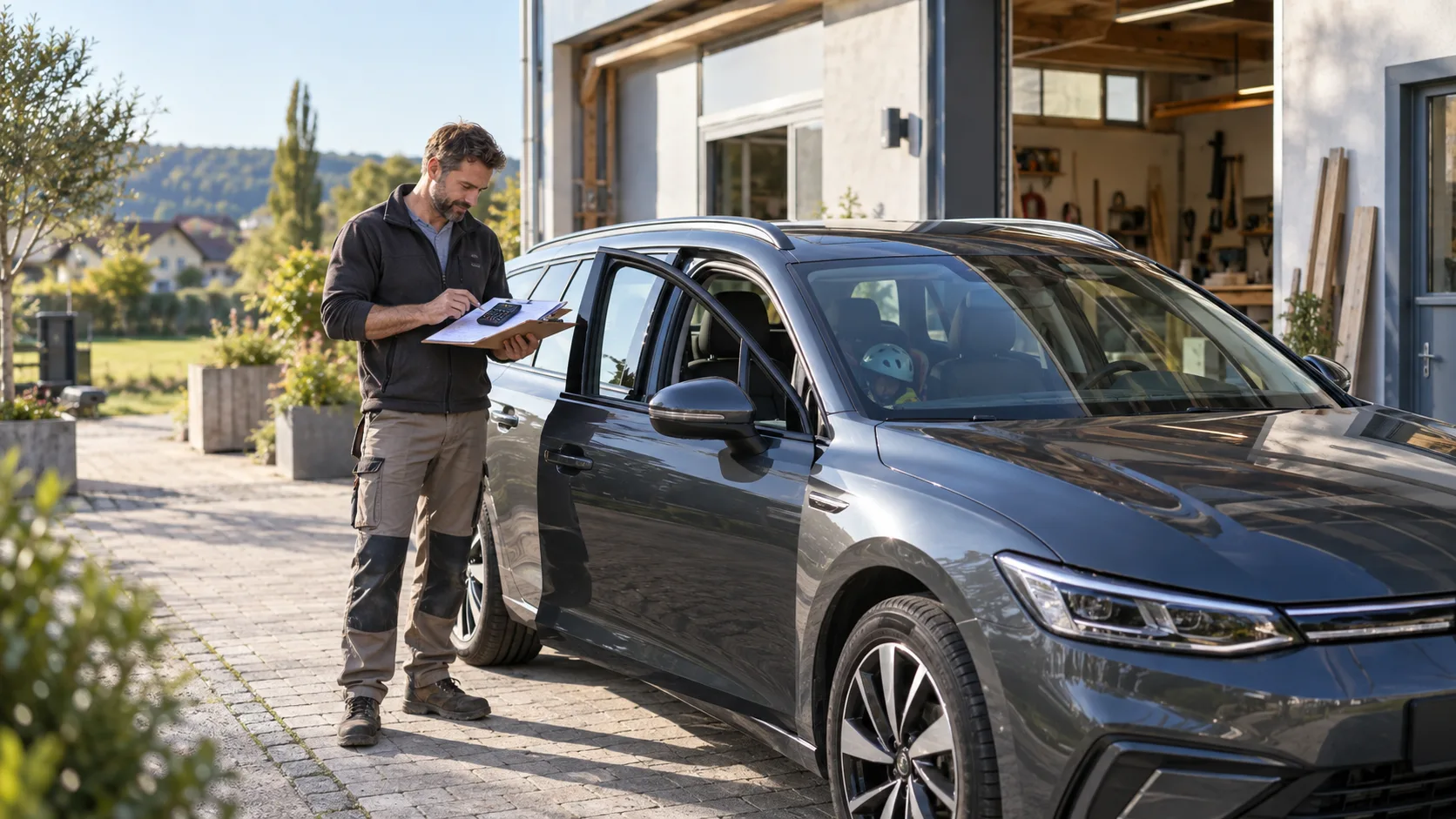
If you also drive your company car privately, your profit increases every month by 1 percent of the gross list price (Bruttolistenpreis) the car had at its first registration. If you also use the car to get to your business, 0.03 percent per kilometre of distance per month is added, minus the commuting allowance (Entfernungspauschale). For a car with a list price of 42,300 euros and 15 kilometres to the business, that is around 6,100 euros of additional profit per year, plus around 770 euros of VAT (Umsatzsteuer). For purely electric cars, only a quarter of the list price applies. You may only use the rule if you drive the car more than half for business.
Contents
- Example calculation: what the 1% rule costs per year
- Which list price counts
- Trips between home and business
- VAT on private use
- Electric car as a company car: 0.25 percent, VAT, charging at home
- When you may not use the 1% rule
- Mileage logbook or 1% rule: which is cheaper
- Cost cap: never more than the car costs
- If an employee drives the company car privately
- Frequently asked questions
Example calculation: what the 1% rule costs per year
With three figures, you can calculate your own amount: list price, distance to the business and number of working days. The example shows Dragan Petrović, a master painter in Bielefeld. He bought a used estate car for 24,000 euros. New, the car cost 42,380 euros according to the list, rounded down 42,300 euros. On 220 days a year, he drives 15 kilometres to his workshop.
| Item | Calculation | per year |
|---|---|---|
| Private use | 1% of €42,300 × 12 months | €5,076.00 |
| Trips home – business | 0.03% of €42,300 × 15 km × 12 months | €2,284.20 |
| minus commuting allowance | 220 days × 15 km × €0.38 | − €1,254.00 |
| Additional profit | €6,106.20 | |
| VAT on private use | €5,076 − 20% deduction = €4,060.80 × 19% | €771.55 |
You do not pay the 6,106.20 euros as tax, they increase your profit. How much income tax results from this depends on your personal tax rate. If it is 30 percent, that is around 1,830 euros per year. The VAT, on the other hand, you pay in full to the tax office (Finanzamt).
You continue to deduct the costs of the car as business expenses (Betriebsausgaben). The flat rate covers the private share. How depreciation works for the car itself is explained in the article Depreciation and AfA table. You need fuel and garage receipts for the cost cap or the mileage logbook (Fahrtenbuch). They belong in your bookkeeping, for example in accounting software.
Which list price counts
What matters is the price the car cost new according to the manufacturer's list, not the price you paid. This also applies to used cars, leased cars and rental cars. With a used car bought cheaply, the 1% rule can therefore become expensive.
- Gross, not net: The list price counts including VAT, even if you get the input tax (Vorsteuer) back.
- With optional extras: Factory extras, such as a built-in navigation system, are included.
- Reference date first registration: What counts is the day on which exactly this car was registered for the first time. The date is shown in the registration documents.
- Rounding down: The list price is rounded down to the full 100 euros.
If the list price can no longer be determined, it is estimated.
Trips between home and business
If you drive the company car from home to your business, this costs an additional 0.03 percent of the list price per kilometre of one-way distance per month. In return, you may deduct the commuting allowance of 0.38 euros per kilometre and working day. Only the difference increases your profit.
The 0.03 percent applies in full every month, whether you drive there on 5 or on 22 days. Under certain conditions, employees can instead claim the actual trips individually at 0.002 percent, for a maximum of 180 days per year. This does not apply to the self-employed: they calculate with the full 0.03 percent even with fewer than 15 trips per month, according to the Federal Fiscal Court (Bundesfinanzhof) in its judgment of 12 June 2018.
If you work from home and have no business premises to drive to, this item does not apply.
VAT on private use
If the car entitled you to deduct input tax, you pay VAT on the private use. If you use the 1% rule for income tax, you may start from this value for simplicity: take the annual amount for private use, deduct 20 percent, and apply 19 percent VAT to the result.
The 20 percent deduction stands as a flat rate for the costs on which no input tax was charged. The starting value is only the 1% flat rate for private use. For VAT purposes, trips between home and business count as business use, so the 0.03 percent surcharge is not added.
If you are a small business owner (Kleinunternehmer) and do not deduct input tax, no VAT is due on private use. If you could not deduct input tax when buying the car, for example when buying from a private seller, only the running costs on which input tax was charged count for VAT. Clarify with your tax adviser (Steuerkanzlei) how high the amount is in that case.
Electric car as a company car: 0.25 percent, VAT, charging at home
For a purely electric car, you only pay tax on a quarter of the list price, which in effect means 0.25 percent per month. This applies to cars acquired between 2019 and the end of 2030. For acquisitions from 1 July 2025, the gross list price may be no more than 100,000 euros for this, lower limits applied to earlier acquisitions. For VAT, there is no such discount, neither for electric cars nor for hybrids.
| Drive type (acquired from 1 July 2025) | Share of the list price | in effect per month |
|---|---|---|
| Electric car up to €100,000 list price | a quarter | 0.25% |
| Electric car over €100,000 list price | half | 0.5% |
| Plug-in hybrid with no more than 50 g CO₂ per km or at least 80 km electric range | half | 0.5% |
| Other hybrids, petrol, diesel | full | 1% |
The values for CO₂ and electric range are stated in the manufacturer's certificate of conformity (Übereinstimmungsbescheinigung). The reduction also applies to the 0.03 percent for the trip to the business.
Example calculation: electric car versus combustion engine
Dragan Petrović from the example above instead buys a new electric car with a list price of 48,000 euros in 2026. For comparison, a combustion engine car with the same list price is shown next to it.
| Item | Combustion engine | Electric car |
|---|---|---|
| List price for the calculation | €48,000 | a quarter: €12,000 |
| Private use, 1% × 12 months | €5,760.00 | €1,440.00 |
| Home – business, 0.03% × 15 km × 12 months | €2,592.00 | €648.00 |
| minus commuting allowance | − €1,254.00 | − €1,254.00, at most down to €0 |
| Additional profit | €7,098.00 | €1,440.00 |
| VAT: 1% of €48,000 × 12 − 20% × 19% | €875.52 | €875.52 |
Two things stand out. With the electric car, the commuting allowance completely eats up the surcharge for the commute. However, the remainder does not become negative and does not reduce the profit. And the VAT is the same for both cars, because the full list price counts there. With the electric car, it is therefore often the larger item: at a personal tax rate of 30 percent, the 1,440 euros of profit cost around 430 euros of income tax, while the VAT is around 876 euros. If you are a small business owner without input tax deduction, there is no VAT.
Mileage logbook for an electric car
The discount also applies with a mileage logbook. The acquisition costs or comparable costs count only at a quarter in the total costs of the car, for the eligible hybrids at half. Electricity, insurance and garage costs count in full. Only the calculation with your figures shows whether the logbook is cheaper.
Charging at home: what you can deduct
For self-employed people who charge the company car at their own socket or wallbox, we have found no official rule (as of 28 September 2026). Clarify with your tax adviser how to account for this electricity in your bookkeeping.
There is an official rule for employees who charge a company car at home. Since 1 January 2026, the Federal Ministry of Finance has required the amount of electricity charged there to be proven via a separate meter, for example in the wallbox, via a mobile measuring device or via the meter in the car. The electricity is billed at the employee's own electricity price, including a proportionate share of the standing charge. Details are in the section If an employee drives the company car privately.
Vehicle tax and depreciation
A purely electric car first registered by the end of 2030 is exempt from vehicle tax (Kfz-Steuer) for ten years, until the end of 2035 at the latest. If you buy it for your business between 1 July 2025 and the end of 2027, you may depreciate 75 percent of the acquisition costs in the first year. Details are in the article on the investment booster.
When you may not use the 1% rule
The 1% rule is only allowed if you drive the car more than 50 percent for business. Trips between home and business count as business use. If you use the car 50 percent or less for business, the rule does not apply. Clarify with your tax adviser how the private share is then calculated. If you use your private car for occasional business trips, the procedure is described in the article Travel expense report.
You only have to prove the more than 50 percent if it does not already follow from your work. The Federal Ministry of Finance names as examples taxi operators, sales representatives, tradespeople in construction and construction-related trades, and rural vets. If you have several cars in your business, this only applies to the car with the most kilometres per year. Otherwise, appointment calendars, mileage statements with clients or informal records over three months are enough: the reason and route of each business trip, plus the odometer reading at the start and at the end. Once you have proven the share, it continues to apply for the following years as long as nothing significant changes in your work.
Simply claiming that you do not drive the car privately is not enough. If it is the only car in your business, purely business use is considered untypical, and you have to prove it.
Mileage logbook or 1% rule: which is cheaper
Which method is cheaper depends on your figures: how much you drive privately and what the car costs per year. For this, you have to keep a mileage logbook continuously, all year.
The same example with a mileage logbook: Dragan Petrović drives 30,000 kilometres a year. Of these, 3,000 are private (10 percent) and 6,600 between home and workshop (22 percent). All in all, the car costs him 9,000 euros a year.
| Item | 1% rule | Mileage logbook |
|---|---|---|
| Private use | €5,076.00 | 10% of €9,000 = €900.00 |
| Home – business after deducting the allowance | €1,030.20 | 22% of €9,000 = €1,980 − €1,254 = €726.00 |
| Additional profit | €6,106.20 | €1,626.00 |
The mileage logbook can also be more expensive. If he drives 40 percent privately and the car costs 15,000 euros a year, for example a new car with high depreciation, the logbook results in 6,000 euros plus 2,046 euros for the commute, 8,046 euros in total. That is more than the flat rate. Therefore, calculate your case with real figures before you commit. What a mileage logbook that the tax office accepts looks like is explained in the article Keeping a mileage logbook properly.
You make the choice with your tax return, per car and for a whole financial year. You may only switch in the middle of the year if you change the car. As long as the tax assessment is not final, you can still change your choice. However, a mileage logbook cannot be written retrospectively.
Cost cap: never more than the car costs
If the flat rate is higher than everything the car actually costs per year, you pay tax on no more than these costs.
Example: The car had a list price of 30,000 euros, is fully depreciated and, with fuel, insurance and garage, still costs 5,000 euros a year. The business is 25 kilometres away. The flat rate would be 3,600 euros for private use plus 2,700 euros for the commute, 6,300 euros in total. Only 5,000 euros are applied. You may still deduct the commuting allowance.
The cap only applies if you prove the total costs with receipts. Therefore, keep all receipts for the car completely.
If an employee drives the company car privately
If you let an employee use a company car privately as well, the employee pays tax on the benefit via their payroll. The same rates apply: 1 percent of the list price per month, plus 0.03 percent per kilometre to the place of work. The costs of the car are business expenses for you.
For you as the employer, this means: the payroll office states the amount in the payslip every month. If the employee is not allowed to use the car privately, there is no benefit, provided you prove the ban with documents, for example in the employment contract. You keep these documents with the payroll account. The details of the payroll are governed by a separate letter from the Federal Ministry of Finance of 3 March 2022.
If the employee drives an electric car and charges it at home, you may reimburse the electricity tax-free. Since 2026, this is only possible against proof of the kilowatt hours charged via a meter. As the price, you take their electricity tariff including a proportionate share of the standing charge, or for 2026 a flat rate of 34 cents per kilowatt hour. If they charge at a charging station at your business, this benefit is tax-free for them if you grant it in addition to the wages owed anyway.
Frequently asked questions
Is fuel already included in the 1% rule? Yes. Like all costs of the car, you deduct the costs of fuel or electricity as business expenses. The flat rate covers all private use, so you do not account for individual private trips.
Does the 1% rule also apply to leasing? Yes. For a leased car, too, what counts is the gross list price at first registration, not the leasing instalment.
I hardly ever drive privately. Do I still have to pay 1 percent? Yes, the full monthly value applies even with occasional private use. It only lapses for whole calendar months in which private use is ruled out. Whether a mileage logbook is cheaper in that case is shown in the section Mileage logbook or 1% rule.
May my spouse drive the company car? Yes. Trips by your family also count as private use and are covered by the flat rate for this car. If your family drives further cars from the business privately, a separate flat rate generally applies to each one.
How long do I have to stay with the 1% rule? One financial year. In the next year, you can switch to the mileage logbook if you keep it without gaps from the first day of that year.
Sources
- § 6 EStG, valuation (paragraph 1 no. 4)
- § 4 EStG, definition of profit (paragraph 5 sentence 1 no. 6)
- § 9 EStG, income-related expenses (commuting allowance)
- § 8 EStG, income (paragraph 2)
- § 52 EStG, application provisions (paragraph 12)
- § 7 EStG, depreciation (paragraph 2a, electric vehicles)
- § 3d KraftStG, tax exemption for electric vehicles
- Federal Ministry of Finance: tax exemption under § 3 no. 46 EStG and electricity costs borne by the employee, letter of 11 November 2025
- § 3 UStG, supply, other services (paragraph 9a)
- Federal Ministry of Finance: private use of a business vehicle, letter of 18 November 2009 (copy from the Hamburg Chamber of Commerce)
- Federal Ministry of Finance: VAT Application Decree, section 15.23 (input tax deduction and VAT on vehicles), as of 2 June 2026
- Federal Fiscal Court, judgment of 12 June 2018, VIII R 14/15: trips between home and place of business under the 1% rule
- Federal Ministry of Finance: provision of a company vehicle to employees, letter of 3 March 2022 (copy from the IHK)
Try Easy Invoice free for 10 days — no payment details, the trial ends by itself.
Handle invoices more easily
Easy Invoice combines quotes, invoices and customer management in the cloud.
Try Easy InvoiceRead next
 Taxes & Law
Low-value assets in Germany (GWG) 2026: €800 limit, net or gross
The GWG limit in Germany is €800 net in 2026, also under the small business scheme. Which purchases you deduct at once, when the pooled item pays off and how to book it.
 Taxes & Law
Keeping a mileage logbook in Germany: template, required details
A German mileage logbook only counts if every trip is recorded promptly and without gaps. Which details are required, what a filled-in logbook looks like and why Excel is not enough.
 Taxes & Law
Travel expense report in Germany 2026: template, rates, receipts
A German travel expense report has four parts: travel, hotel, meals and incidentals. What you claim for each part, which receipts you need and how to re-invoice travel costs to clients.