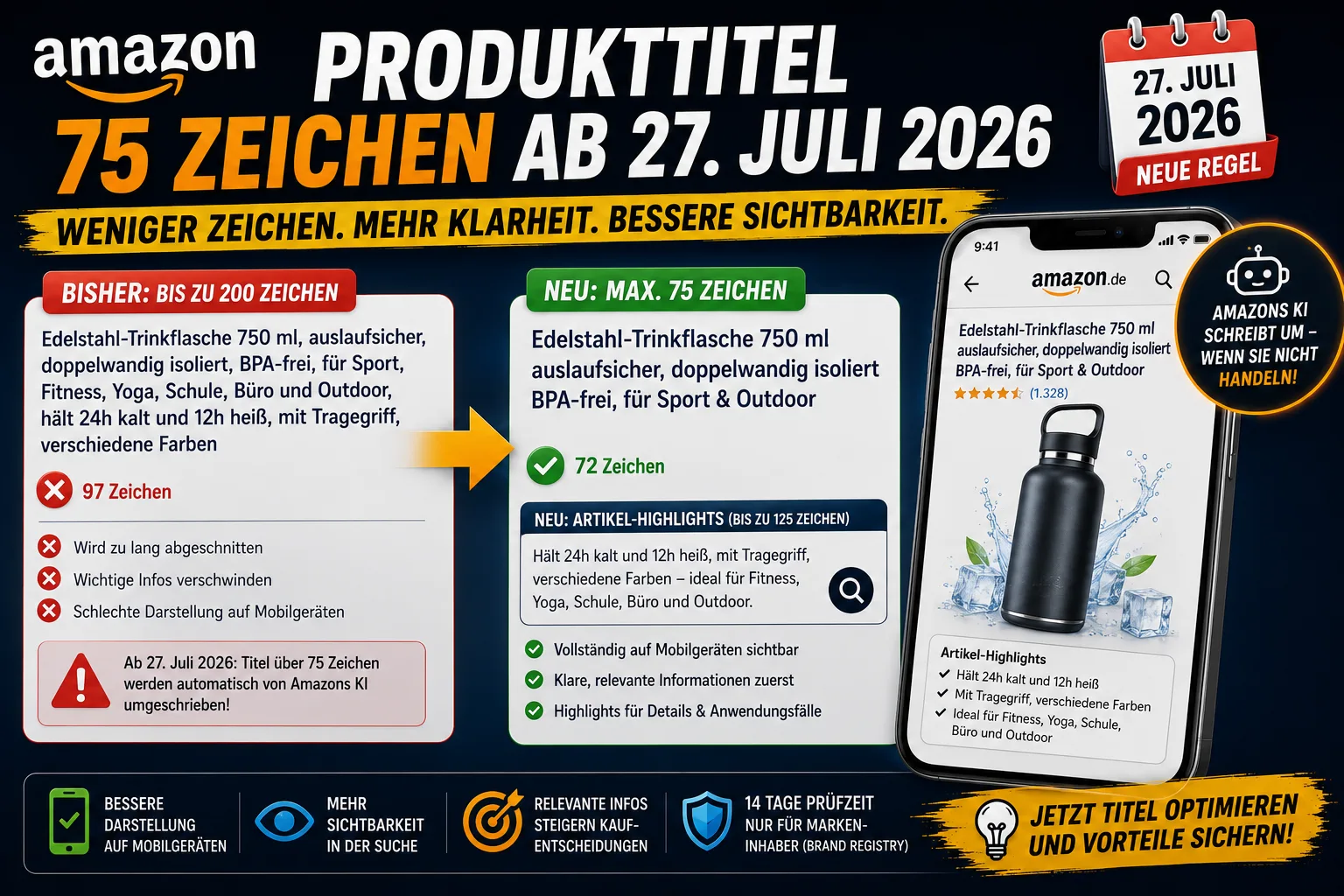
From 27 July 2026, product titles on Amazon may only be 75 characters long – including spaces. Until now, most categories allowed 200. Amazon announced the change on 10 June 2026 in the seller forums, word for word on sellercentral.amazon.de and sellercentral.amazon.com. If your catalogue today contains a typical Amazon title with brand, model, colour, size, quantity and three keywords, you are well above the new limit.
The most important news first, because a lot of nonsense is circulating right now: your listing will not be suppressed because of this.
What exactly applies from 27 July
Amazon's wording is terse: titles in all categories except Media must be no more than 75 characters long from 27 July 2026, spaces included. A title such as "Stainless Steel Water Bottle 750 ml, Leakproof, Double-Walled Insulated, BPA-Free, for Sports and Office" has 104 characters – so it would be too long. And that is still a restrained example: it is missing the brand, which in practice comes first.
Amazon gives two reasons: the title should be displayed in full on mobile devices, and it should be in line with the title length used by other online shops.
The move doesn't come out of nowhere. Since 21 January 2025 there has already been a cap of 200 characters including spaces "for most product categories", supplemented by stricter category-specific limits in Amazon's style guides. The 75 characters are therefore the second tightening within 18 months – and by far the harder one.
What happens if your title is longer
This is worth a close look, because several advice sites are currently writing about suppressions, blocked offers or items that can no longer be found. Amazon says the opposite, and does so literally: titles over 75 characters will be gradually replaced by the AI recommendation after 27 July – "Your listings stay active throughout this process", and both titles and Item Highlights can be changed at any time.
So the real consequence is not suppression but loss of control: if you do nothing, Amazon's AI decides which 75 characters of your title survive – and which details disappear. For a title that carries quantity, size or compatibility ("for iPhone 15/16"), that can be the difference between being found and not being found.
Amazon has not published a schedule for which ASIN is switched over when. "Gradually" is all that is known.
The 14 days to object don't apply to everyone
Amazon grants a 14-day window to review, adjust and approve the AI suggestions. But that window explicitly applies only to brand owners with Brand Registry – and it covers all ASINs carrying their brand, even if other sellers offer those items.
If you don't react within the 14 days, Amazon adopts the proposed changes automatically on your product pages. After that you can still correct things via support, but the suggestion is live for the time being.
For everyone else, that is the actual news in this change: if you don't have Brand Registry, you don't get a window to object. You can shorten your titles yourself at any time – but you don't get 14 days to reject an AI suggestion. And if you're a reseller carrying other companies' branded goods, you have only limited influence over those ASINs' titles anyway. Amazon did not answer the obvious question from the seller forum: who decides on an item with several resellers?
Anyone who runs their own brands and still has no Brand Registry can see here, quite directly, what it's worth in day-to-day business.
Item Highlights: 125 characters alongside
In parallel, Amazon is introducing a new field: Item Highlights. Amazon describes it as an additional 125 characters for materials or recommended use cases that help customers compare. Important here: this content is searchable and is displayed together with the title in the search results and on the product detail page.
Two things that often get mixed up:
- Item Highlights do not replace the bullet points. The familiar bullets under "About this item" remain a separate, technically distinct field.
- The sum 75 + 125 = 200 is arithmetic, not an Amazon statement. In total you do have roughly as much searchable space as before, just divided differently. Whether Amazon weights both equally is something Amazon doesn't say – and anyone telling you Item Highlights carry a particular ranking weight is speculating.
Amazon's only concrete prioritisation advice is to keep the core product information in the title and move additional details into the Item Highlights.
One catch worth knowing: when the announcement went out, the field was practically impossible to fill – sellers reported the upload error "100476: This attribute 'Item Highlight' is currently unsupported". The German trade association Händlerbund also criticised that the new functions were not available at the time of the announcement. So if you want to prepare the field, plan for the possibility that it doesn't work for you yet.
Where to see what Amazon plans to do with your titles
The AI suggestions are already sitting in Seller Central, ahead of the deadline:
- View and adjust suggestions: Manage All Inventory → in the "Edit" drop-down → on the left "View enhancements".
- Approve or reject suggestions (Brand Registry only): Manage All Inventory → "Review Listing Updates". There you confirm or reject with thumbs up/down.
Amazon does not mention a report that lists all overlong titles in your catalogue at a glance. If you carry a lot of ASINs, you probably won't get around exporting your inventory and counting characters in a spreadsheet.
Which title rules still apply alongside
The 75 characters come on top of the rules from January 2025; they don't replace them:
- The special characters
!,$,?,_,{,},^,¬and¦are not allowed in the title – unless they are part of the brand name. - The same word may appear at most twice; prepositions, articles and conjunctions don't count.
- Promotional claims such as "bestseller", "sale" or "free shipping" don't belong in the title, and neither do prices or condition statements.
In 75 characters, keyword stuffing is no longer an option anyway. The order recommended in the trade press – brand, product type, key feature – is however an industry rule of thumb, not an Amazon requirement.
By the way: if you also sell on Etsy, you know this movement. There, new title rules including AI suggestions have applied since May 2026 – the marketplaces are currently taking title writing out of sellers' hands in parallel.
What Amazon leaves open
Honestly, four weeks before the deadline several points are unresolved – and they're points that affect many sellers directly:
- What "Media" covers exactly is not defined in Amazon's announcement. That books, music and video are meant is plausible and is reported that way in the trade press, but it isn't stated in the Amazon notice.
- Whether there are further category exceptions besides Media. In the official Q&A thread, sellers asked exactly that for Art, Toys & Games and bundles – Amazon didn't answer, even though Amazon's help page on title-length exceptions still exists.
- How it works with variations – do the 75 characters apply to the parent, the children or both? Also asked, also unanswered.
- Whether the old title can be restored after the AI replacement. Amazon says nothing about this anywhere.
- Which marketplaces this applies to. The identical announcement is documented for amazon.de and amazon.com. There is no Amazon statement saying "worldwide" – reports that speak of "the European marketplaces" are less precise at this point than the source.
What Amazon's search actually decides on
Before you start cutting, you should know what you're optimising for. And that's where it gets uncomfortable: Amazon does not publish its ranking algorithm. There is no page on which Amazon discloses ranking factors or their weighting. What is sold in guides as "the A10 algorithm" is a term from the seller community – Amazon has never used it. "A9" really existed; it was an Amazon subsidiary that built the early search technology. Amazon never announced an "A10".
What does exist are Amazon's own recommendations and Amazon's own research papers. Together, the two give a usable picture.
The search term doesn't have to appear literally in the title. This is the point where most title guides are ten years behind. In its research paper "Semantic Product Search" (2019), Amazon itself writes that pure word-for-word matching falls short: it doesn't understand synonyms, it fails on variants like "woman" and "women", and on typos. That's why Amazon has for years additionally used models that have learned from purchasing behaviour what fits a search query – even without a literal match. That doesn't mean classic word matching has been abolished: on its research page, Amazon names behavioural data, lexical matches and semantic matches side by side as three signals that work together. So if you're afraid that with 75 characters every dropped word is lost without replacement, you're overestimating how literal this search is.
There is no evidence for "keywords up front". The claim that the first five words count double, or that the first 80 characters carry more weight, appears in no Amazon source. It probably arose from a mix-up: around 75 to 80 characters has for years been what the Amazon app displays of a title before it truncates it. That's a display limit, not a ranking factor – and it incidentally explains where the new 75 characters come from: Amazon is turning the mobile truncation limit into a rule.
Repeating gets you nothing. Amazon writes in its own SEO post: "If you use a key phrase once, you probably don't need it a second time" – and, more bluntly: "Keyword stuffing can worsen the customer experience and hurt your ranking." That fits the rule that the same word may appear at most twice in the title.
Behaviour has an effect – just not the way it's sold. That clicks and purchases play a role is not speculation: by Amazon's own account, its search models are trained on exactly that – purchased items count as a positive example, items seen but not purchased as a negative one. What gets clicked and bought gets shown more often. What is pure invention, however, are the percentages: "conversion rate accounts for 50 % of the ranking" appears in no Amazon source, and the guides that quote such figures contradict each other (sometimes 15 %, sometimes 30–40 %, sometimes "the single most important factor of all"). Where everyone has a different number, nobody has measured it.
How to write the best title for your product
From this follows the actual principle: your title has two audiences, and the human is the more important of the two. The machine makes sure you show up in the results list at all – and it's more tolerant about that than keyword folklore suggests. Whether you get clicked and bought there is decided by the customer in half a second while skimming. And because exactly that behaviour flows back into Amazon's models, the readable title isn't the alternative to search engine optimisation – it's the route to it. A title that looks like a list of keywords doesn't lose out on the index; it loses out on the customer, and via that on the index after all.
What's remarkable, therefore, is the reasoning Amazon gives for the 75 characters: full display on mobile and alignment with other online shops. Not a word about ranking or SEO. And back in September 2025, long before this announcement, Amazon recommended in its own seller blog: title limit 200 characters, "we recommend no more than 60". So the 75 characters aren't a U-turn – they're the end of a recommendation that hardly anyone followed.
How to get a title down to 75 characters
The example from above shows nicely where the characters go. Starting point, 104 characters:
Stainless Steel Water Bottle 750 ml, Leakproof, Double-Walled Insulated, BPA-Free, for Sports and Office
With the brand up front, without "BPA-Free" and without the use case, it's 80 characters – still five too many:
Brand Name Water Bottle Stainless Steel 750 ml, Double-Wall Insulated, Leakproof
Only when "Double-Wall" goes (the insulation is the message, the construction is the detail) does it fit, at 68 characters and with a bit of room to spare:
Brand Name Water Bottle Stainless Steel 750 ml, Insulated, Leakproof
The rest isn't lost – it moves into the Item Highlights, taking 69 of the permitted 125 characters, searchable according to Amazon and visible next to the title in the search results:
BPA-free, dishwasher safe, carry loop, for sports, office and cycling
What this shows can be applied to almost any title:
- Count, don't estimate. 75 characters including spaces is less than you think. If you have a lot of ASINs, export your inventory and let the spreadsheet calculate the length – almost every title in your catalogue was written for 200 characters.
- First to go is what's forbidden anyway: promotional phrases like "bestseller" or "free shipping", prices, condition statements, a word repeated for the third time.
- Then the filler words. "High-quality", "practical", "ideal for", "premium" – nobody searches for those, and they describe nothing. Synonym chains ("water bottle drinks bottle sports bottle") only cost space too.
- What stays is what carries the purchase decision: compatibility ("for iPhone 15/16"), quantity, size, colour. With variations in particular that's no detail – without that information the customer picks the wrong variant. This matches Amazon's only concrete recommendation on the subject: keep the core product information in the title, move additional details into the Item Highlights.
- One synonym fewer is not a ranking loss. Because Amazon resolves synonyms, plurals and typos itself anyway, "water bottle drinks bottle sports bottle" isn't a triple hit – it's space wasted twice.
- Order: brand, product type, key feature. That's industry practice, not an Amazon requirement – and it isn't aimed at the index but at the eye: the customer reads the first words and decides in half a second to read on or move on.
Should you use Amazon's AI suggestion?
Look at it: absolutely. The suggestion is already in Seller Central, and it shows you exactly what will happen on 27 July if you do nothing. That's the most useful information you can get right now – even if in the end you write your own title.
Adopt it unchecked: rather not. Amazon's AI doesn't know your range the way you do. It doesn't know that in your case the compatibility statement carries half the conversion, or that "750 ml" is the reason customers buy. And Amazon doesn't disclose how the suggestion is weighted. For brand owners with Brand Registry, that is precisely the point of the 14 days: not to wave things through, but to adjust them. If you don't have Brand Registry, you're better off writing your titles yourself before 27 July – because there's no window to object.
And what if you use ChatGPT or another tool to shorten them? As a text workhorse it's quite usable, especially with a few hundred titles. Two things to note: don't let the AI count the characters – let the spreadsheet do it, because language models reliably miscount characters. And give the model the rules, otherwise it will hand you back promotional phrases that Amazon doesn't allow in the title. How to set this up cleanly in practice is covered in our post ChatGPT for product descriptions.
Incidentally, 27 July isn't the only Amazon construction site this month: from 20 July, Amazon is also awarding the Buy Box under new rules in the EU.
Handle invoices more easily
Easy Invoice combines quotes, invoices and customer management in the cloud.
Try Easy InvoiceRead next
 E-Commerce & Marketplaces
New eBay Terms of Service from 15 September 2026: What Sellers Should Check Now
New eBay terms apply from 15 September. Four things change, and one of them can cost you your account.
 E-Commerce & Marketplaces
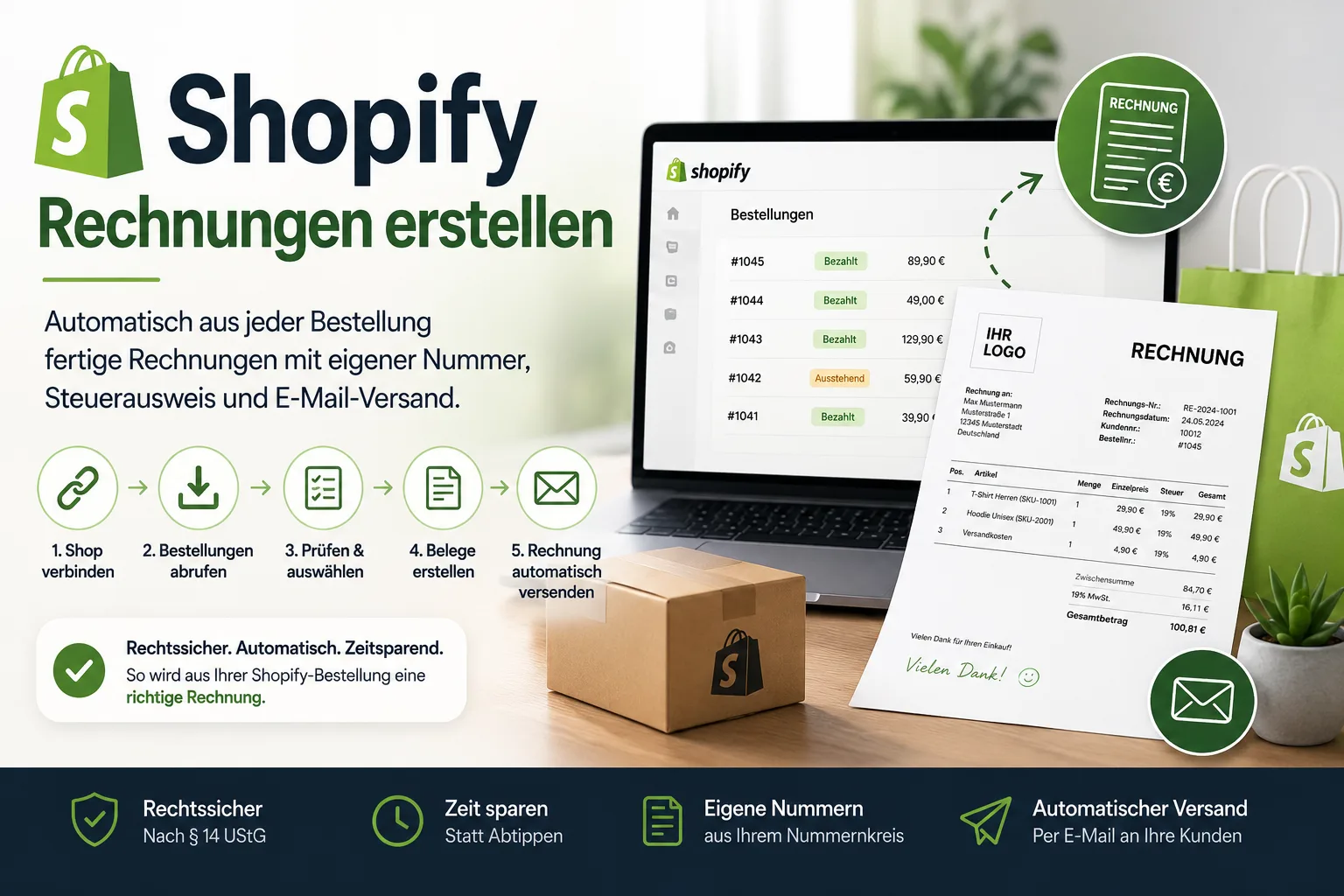
Creating invoices for Shopify
Shopify sends order confirmations – not invoices. How to get from a Shopify order to a finished invoice in five steps, with your own number, correct tax details and automatic sending.
 E-Commerce & Marketplaces
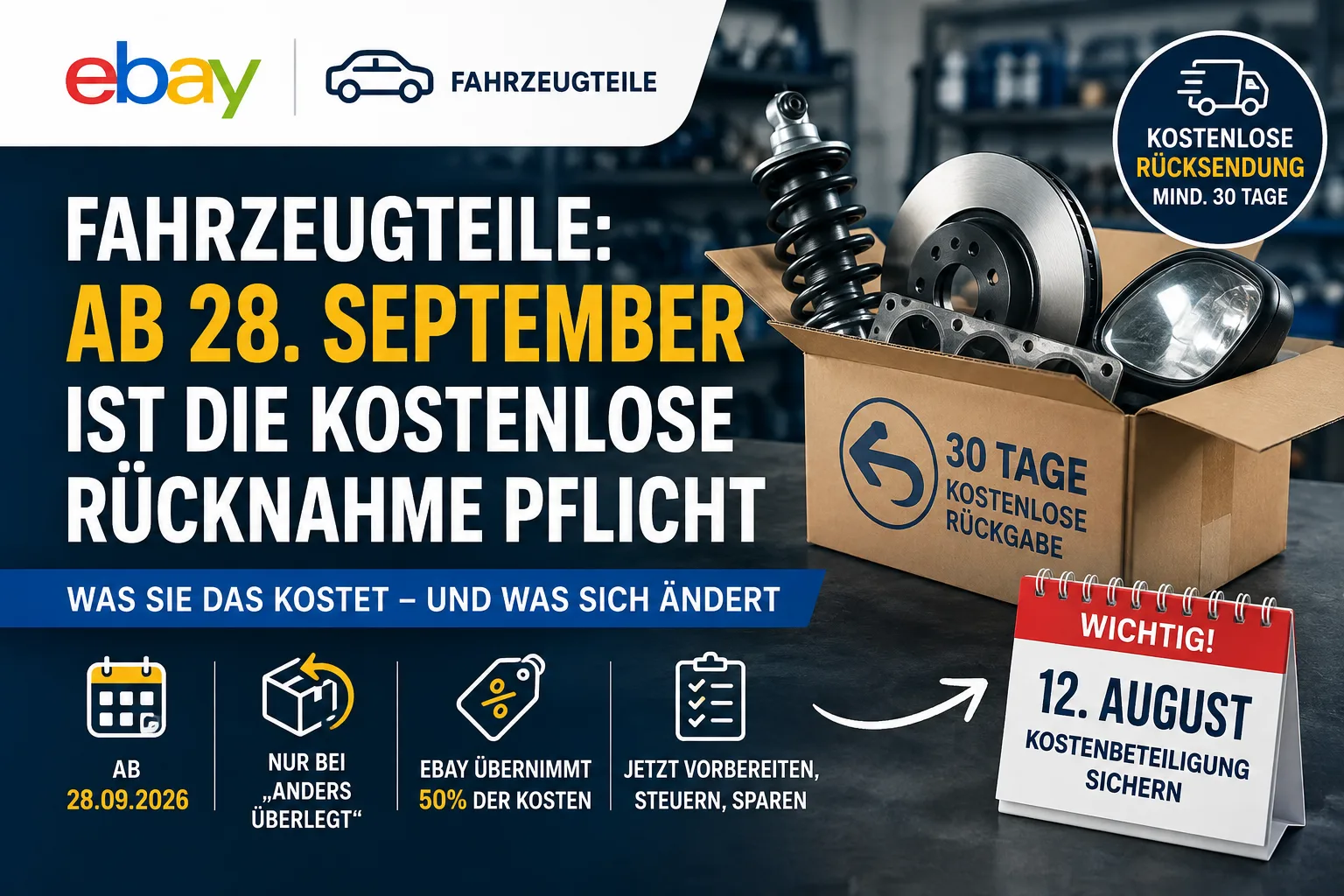
eBay vehicle parts: free returns become mandatory on 28 September – what it will cost you
New parts over 10 euros at a fixed price: from 28 September you have to take them back free of charge for 30 days. What actually changes, which returns are not covered, why eBay will make the switch for you if you don't – and why 12 August matters more to you than the deadline itself.