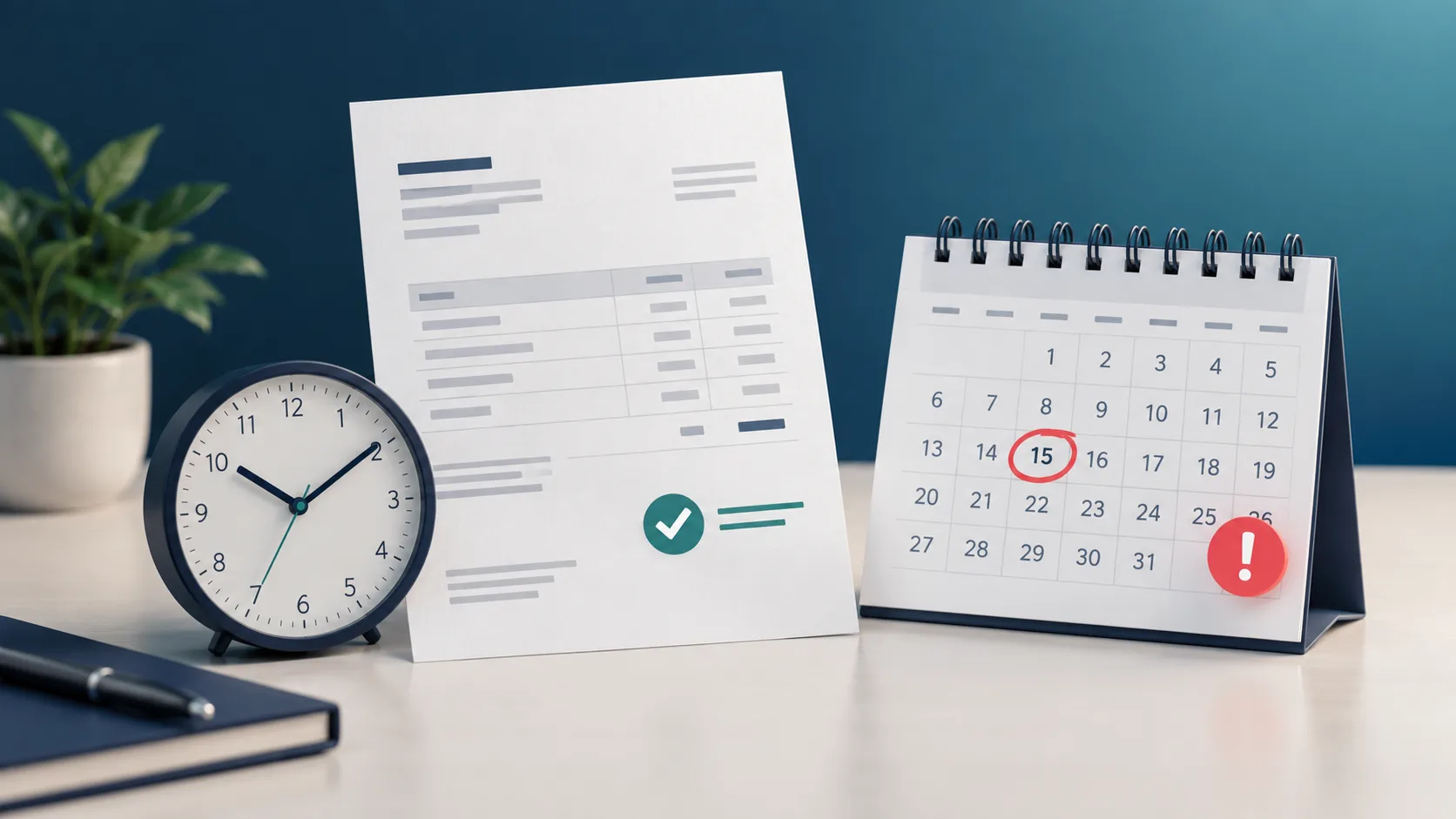
You are free to choose the payment term. Fourteen days is the norm. If you write nothing on the invoice, the amount is due immediately – but your customer is not yet in default. What matters is where the deadline is stated. A payment term that appears for the first time on the invoice does not replace a formal reminder. If you agreed the deadline beforehand – in the order, the quotation or your terms and conditions – your customer falls into default once it expires, without any reminder. With no agreement at all you are left with a reminder or the 30-day rule in section 286(3) of the German Civil Code (BGB), and with private customers only if you point this out on the invoice.
This guide covers German law. It applies to you if you invoice customers in Germany, wherever your business is based.
Contents
- What wording belongs on the invoice?
- Does an invoice need a payment term at all?
- 7, 14 or 30 days: what is allowed, what is customary?
- When may you send a reminder?
- How to reach default without a reminder
- Does the ban apply to business customers too?
- The sentence that makes the difference with private customers
- Which day does the deadline start?
- What default costs your customer
- Special cases: trades, small businesses, customers abroad
- Frequently asked questions
- Sources
What wording belongs on the invoice?
A specific date works better than a number of days. Your customer does not have to do the arithmetic, and there is no later argument about when the invoice arrived.
| Situation | Sentence for the invoice |
|---|---|
| Standard case | Payable by 24 September 2026 without deduction. |
| Period instead of date | Payable within 14 days of receiving this invoice, without deduction. |
| Private customer | Payable by 24 September 2026 without deduction. If you do not pay within 30 days of receiving this invoice, you will be in default even without a reminder (section 286(3) BGB). |
| Immediate payment | Payable immediately on receipt of this invoice, without deduction. |
| With early-payment discount | Payable net by 10 October 2026. Pay by 20 September 2026 and we grant a 2 % discount. |
| Direct debit | The invoice amount will be debited from your account on 24 September 2026. Please ensure sufficient funds. |
„Without deduction" means no discount and no reduction. Leave the phrase out if you offer an early-payment discount. How to word the discount period unambiguously and what to do about VAT is covered in Cash discount on an invoice.
Anyone who writes invoices in Word forgets this sentence on roughly every third one. In an invoicing and dunning program you store your payment terms once in the company settings: name, net days, up to two discount levels and the text that is to appear on the document. Ten common templates are already set up and you can add your own. The document then shows a specific due date, calculated from the net days.
Does an invoice need a payment term at all?
No. The payment term is not one of the mandatory details of an invoice. Which details are mandatory is covered in Writing an invoice.
Without any statement, section 271(1) BGB applies: the amount is due immediately. In theory you could demand the money on the day of the invoice. In practice that helps little, because being due alone does not trigger default and therefore earns you neither interest nor reminder costs.
There are still good reasons to name a deadline:
- Your customer knows where they stand and does not put the invoice on the „later" pile.
- You have a date you can refer to in your reminder.
- With private customers you can include the notice under section 286(3) BGB at the same time.
7, 14 or 30 days: what is allowed, what is customary?
With private customers your choice is free. Between businesses, section 271a BGB sets limits – but in the opposite direction to what many expect: the provision protects you as the party issuing the invoice against excessively long payment terms.
| Situation | What applies |
|---|---|
| Your customer is a private individual | You set the deadline, there is no statutory upper limit |
| Your customer is a business | Agreed payment periods over 60 days are only effective if expressly agreed and not grossly unfair to you (section 271a(1) BGB) |
| Your customer is a public authority | Over 30 days only with objective justification, over 60 days generally ineffective (section 271a(2) BGB) |
| Your customer has purchasing terms with a long period | If those give the customer more than 30 days, the clause is ineffective in case of doubt (section 308 no. 1a BGB) |
Fourteen days is the everyday norm. Shorter than 7 days quickly reads as impolite with private customers, without getting you your money any faster. Longer than 30 days costs you liquidity without your customer valuing it.
One point many overlook: under standard taxation you pay the VAT in the month in which you performed the service – not when the money arrives. With a 60-day payment term you are therefore advancing the VAT out of your own pocket. Under cash accounting per section 20 of the German VAT Act, the tax only arises when the money comes in.
When may you send a reminder?
You may send a reminder as soon as the claim is due. Without an agreement that is immediately after the invoice; with a payment term, once it has expired.
The second question matters more: from when is your customer in default? Only then can you claim interest and costs. Default arises in three cases:
- You have sent a reminder. A reminder after the due date puts the customer in default (section 286(1) BGB). That is the safe route.
- The payment date was agreed in the contract. If the quotation, the order or your terms and conditions state when payment is due, no reminder is needed (section 286(2) nos. 1 and 2 BGB). How to do this is described in How to reach default without a reminder.
- The 30-day rule applies. At the latest 30 days after the due date and receipt of the invoice, your customer is in default (section 286(3) BGB).
And here is where the workload is decided: a payment term you write unilaterally on the invoice does not fall under case 2. The German Federal Court of Justice has held that a payment term determined unilaterally by the creditor is not sufficient for default under section 286(2) no. 1 BGB (judgment of 25 October 2007, III ZR 91/07). The payment date must be set by legal transaction, statute or court judgment – a sentence on your invoice is none of these.
In practice: if you write „payable within 14 days" on the invoice and the customer has not paid after 20 days, they are not yet in default. You have to send a reminder or wait out the 30 days.
That does not make the payment term useless. It tells your customer when you expect the money, and most people stick to it. It simply does not replace the reminder.
How a reminder is structured is covered in Writing a payment reminder. If that does not help either, see Customer does not pay – what now?.
The effort stays manageable if your program keeps count. In office1.cloud you call up which documents are due for a reminder on a given date and send the reminders in one go by email – with a separate reminder letter and the original invoice attached. How many reminder levels you go through is up to you; three are preset.
How to reach default without a reminder
You do not have to accept the reminder step. The route runs through the contract, not the invoice: if the payment period is agreed before or at the time the contract is concluded, default occurs by itself once it expires. There are two places for this.
In the quotation or the order. The simplest route for businesses without their own terms and conditions. One sentence in the quotation that the customer signs is enough:
Payment within 14 days of receipt of the invoice, without deduction.
In the terms and conditions. If you have terms and conditions, that is where the deadline belongs. It then applies to every order without you having to think about it.
For this to hold, three things must be right:
| Requirement | What that means |
|---|---|
| The terms are effectively incorporated | You point to them before the contract is concluded and your customer can reasonably take note of them (section 305(2) BGB). Terms that only arrive with the invoice are not incorporated |
| The period is in the clause itself and is reasonable | Ten to 14 days after receipt of the invoice or after delivery is customary. Too short a period makes the clause ineffective, a zero-day period never works |
| You set the payment date, not the default | A clause releasing you from the reminder is ineffective towards consumers (section 309 no. 4 BGB). Towards business customers it counts as an indication of ineffectiveness, see below |
The third point is the trap that many templates from the internet fall into. The difference lies in the wording:
| Wording | Assessment |
|---|---|
| „The purchase price is payable within 14 days of receipt of the invoice, without deduction." | Sets the payment date. Default follows by operation of law. Effective towards private and business customers |
| „The customer is automatically in default 14 days after the invoice date, without a reminder." | Orders default itself and releases you from the reminder. Ineffective towards private customers, risky towards business customers |
The difference looks like hair-splitting but decides your interest claim in a dispute. „After the invoice date" is also worse than „after receipt of the invoice", because you set the invoice date yourself.
Does the ban apply to business customers too?
Not directly. Under section 310(1) BGB, the prohibited clauses in section 309 BGB do not apply to terms used towards businesses. There, review takes place only under section 307 BGB, with due regard to commercial customs and practices.
That does not make you free. The Federal Court of Justice gives the lists of prohibited clauses an indicative effect: the prohibitions „carry indicative effect for the ineffectiveness of the clause in commercial dealings between businesses as well" (BGHZ 174, 1). If your clause falls under section 309 no. 4, it is therefore presumed unreasonable to begin with. It remains effective only if that presumption can be rebutted in the individual case by the particularities of commercial dealings. Whether that succeeds is decided by a court – not by you when drafting the clause.
In practice the default clause gains you nothing towards business customers that you cannot have more safely:
- The clause setting the payment date achieves the same result and is not under suspicion.
- With no clause at all, your business customer is in default at the latest 30 days after the due date and receipt of the invoice, with no notice required (section 286(3) BGB).
So you are risking a dispute over the clause for an advantage you can obtain safely in two other ways.
Terms and conditions are not a text block you copy once. Have your terms checked by a lawyer before you use them – an ineffective clause leaves you worse off than none at all.
The sentence that makes the difference with private customers
The 30-day rule in section 286(3) BGB applies to private customers only if you have specifically pointed out this consequence on the invoice. Without that notice, only the reminder is left to you – even after 30, 60 or 90 days.
With business customers you do not need the notice. The 30 days run automatically there.
For you that means: if you invoice private customers a lot, put the notice into your invoice template. It costs one line and saves you a reminder in a dispute.
Which day does the deadline start?
For the 30-day rule, receipt of the invoice counts, not the invoice date. If you date an invoice 1 September and send it on 8 September, the 30 days start on 8 September.
The claim must also be due. Both together decide the matter:
| Your service | When it becomes due |
|---|---|
| Sale of goods, service without an agreement | immediately on performance (section 271(1) BGB) |
| Work performance, such as painting or a repair | on acceptance by the customer (section 641(1) BGB) |
| Partial services with their own remuneration | on acceptance of each part (section 641(1) BGB) |
The second line matters for tradespeople: without acceptance your remuneration does not become due, and without a due date no deadline runs. A customer who delays acceptance also delays default.
You need evidence of when the invoice arrived. With email that is the time of sending; by post it is usually deemed received after a few days. Anyone who has to argue to the exact day should clarify this with a lawyer – proof of receipt is regularly the crux of a dispute.
What default costs your customer
From default onwards you may claim interest. The rate depends on the base rate under section 247 BGB, which the Deutsche Bundesbank sets on 1 January and 1 July. Since 1 July 2026 it has been 1.52 percent.
| Who owes | Surcharge | Rate since 1 July 2026 |
|---|---|---|
| Private customer | 5 percentage points above the base rate (section 288(1) BGB) | 6.52 % |
| Business customer, payment claim | 9 percentage points above the base rate (section 288(2) BGB) | 10.52 % |
With business customers a flat fee of 40 euros per claim is added (section 288(5) BGB). There is no such fee towards private customers. The 40 euros are set off against damages based on the costs of pursuing the claim.
Worked example: 3,000 euros outstanding, business customer, 30 days in default. 3,000 × 10.52 % × 30/365 gives roughly 25.94 euros in interest, plus the 40 euro flat fee.
Special cases: trades, small businesses, customers abroad
Construction work under VOB/B. The VOB/B does not apply automatically, only if you have agreed it. Where it is agreed, separate deadlines apply to interim and final invoices which differ from the BGB rules. In that case check your contract rather than relying on the details here.
Small businesses under section 19 of the German VAT Act. Nothing changes for the payment term, default or default interest. You simply do not show VAT. The upside: you do not have to advance any VAT when a customer takes a long time.
Customers elsewhere in the EU. The German rules on late payment implement EU Directive 2011/7/EU, so similar rules apply in every member state. Which law applies to your contract depends on the individual case. For larger cross-border orders, a choice of law belongs in the contract.
Announced but not in force. In 2023 the European Commission proposed a regulation to replace the directive and limit payment periods in business dealings more strictly. The procedure is ongoing, and the Commission and Parliament hold different versions. Until they agree, the current legal position remains unchanged.
Frequently asked questions
May I write „payable immediately" on the invoice?
Yes. That matches the statutory default rule in section 271(1) BGB. But it does not speed up default: even with „immediately" you need a reminder or have to wait out the 30 days.
Does the invoice date count, or the day the customer receives the invoice?
For the 30-day rule, receipt counts. If you put a fixed date on the invoice, allow for the postal route and do not date it too tightly.
Can I shorten the payment term afterwards?
Not unilaterally. If you named 30 days, your customer is not bound by it as an agreement – but they may rely on you not sending a reminder before then. If you want shorter deadlines, change the template for future invoices.
Does a payment term also apply to interim invoices?
Yes, provided the interim payment is agreed and due. For contracts for work, the due date follows the contract or section 632a BGB. Whether your specific interim payment is due should be clarified with a lawyer if in doubt.
What is the difference between a payment term and a payment deadline?
In everyday use they are the same. Both refer to the period your customer has before paying.
Do I have to add VAT to default interest and reminder fees?
No. The tax authorities treat default interest and reminder fees as genuine damages. There is no service in return, so no VAT arises (VAT Application Decree, section 1.3). You invoice the amount without VAT.
My customer pays only part. What applies to the rest?
The outstanding balance remains due and default continues for that balance. From the day of the part payment you calculate interest only on the remainder.
Sources
- Section 271 BGB – Time of performance
- Section 271a BGB – Agreements on payment, inspection or acceptance periods
- Section 286 BGB – Default of the obligor
- Section 288 BGB – Default interest and other damage caused by default
- Section 305 BGB – Incorporation of standard business terms into the contract
- Section 308 BGB – Prohibited clauses with the possibility of evaluation
- Section 309 BGB – Prohibited clauses without the possibility of evaluation
- Section 310 BGB – Scope of application
- Section 641 BGB – Due date of remuneration
- Deutsche Bundesbank: base rate under section 247 BGB
- VAT Application Decree, section 1.3 Damages
If a customer asks for more time than your payment term allows, record it in an instalment agreement – which also explains why the VAT still falls due in full straight away.
Still running your invoices from a Word template? Try Easy Invoice for free – the due date then appears on every document, you find open items again on any given date, and the reminder levels run to your settings. An automatic dunning process keeps track of open items and deadlines.
Handle invoices more easily
Easy Invoice combines quotes, invoices and customer management in the cloud.
Try Easy InvoiceRead next
 Invoicing & Accounting
Instalment agreement with customers: template and rules
Your customer asks whether they can pay the invoice in three instalments. Before you agree, two things matter: the tax office will not wait, and your favour legally becomes a loan.
 Invoicing & Accounting
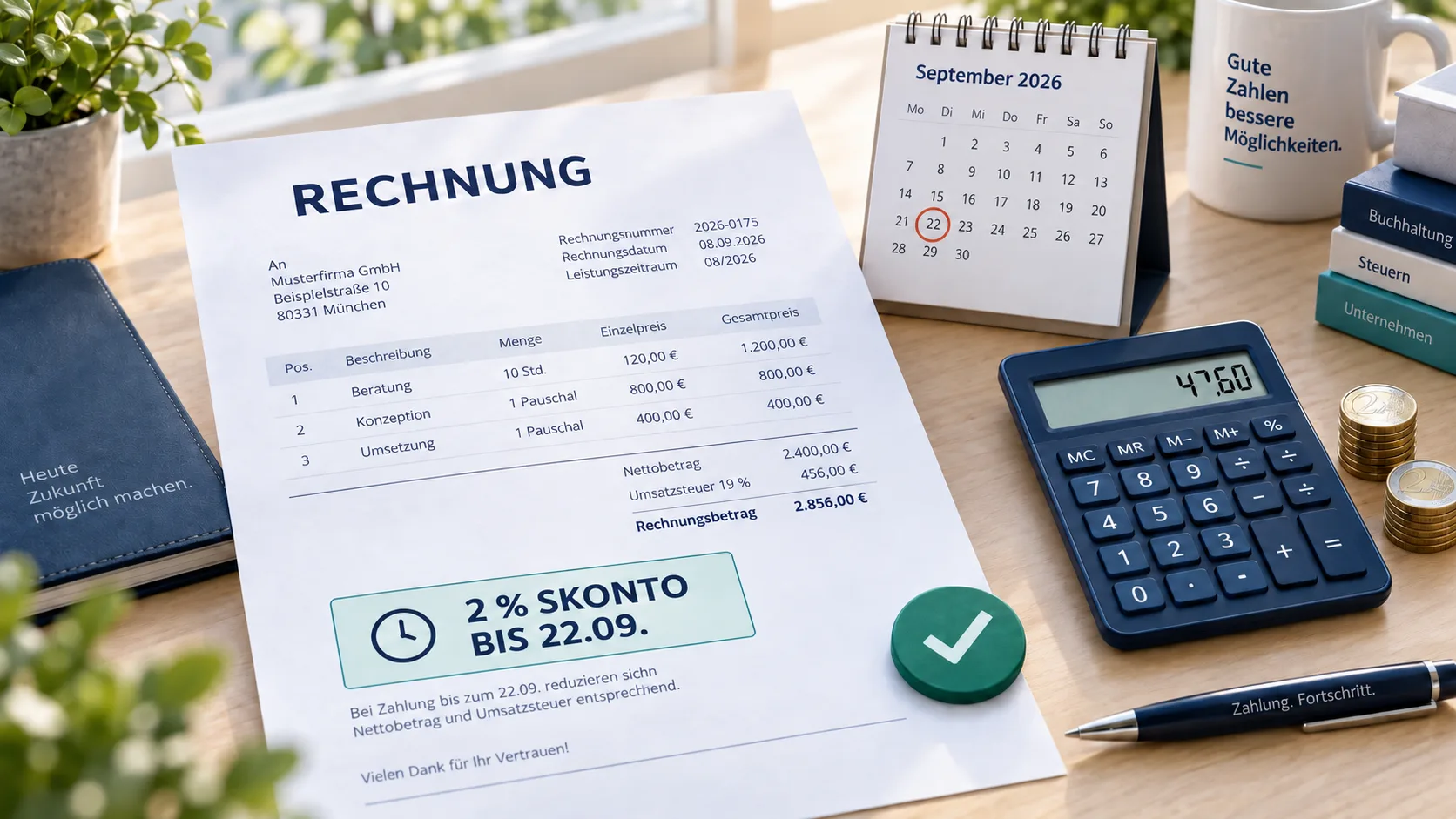
Cash Discount on an Invoice: Wording, Deadline and VAT
A client deducts a cash discount even though they paid far too late – and looking at your invoice, you realise your wording never settled the point.
 Invoicing & Accounting
Invoicing Without a Trade License in Germany: Allowed, With a Limit
A client wants an invoice, but you haven't registered a trade. You may still write one – the real question is when a favor turns into an obligation.