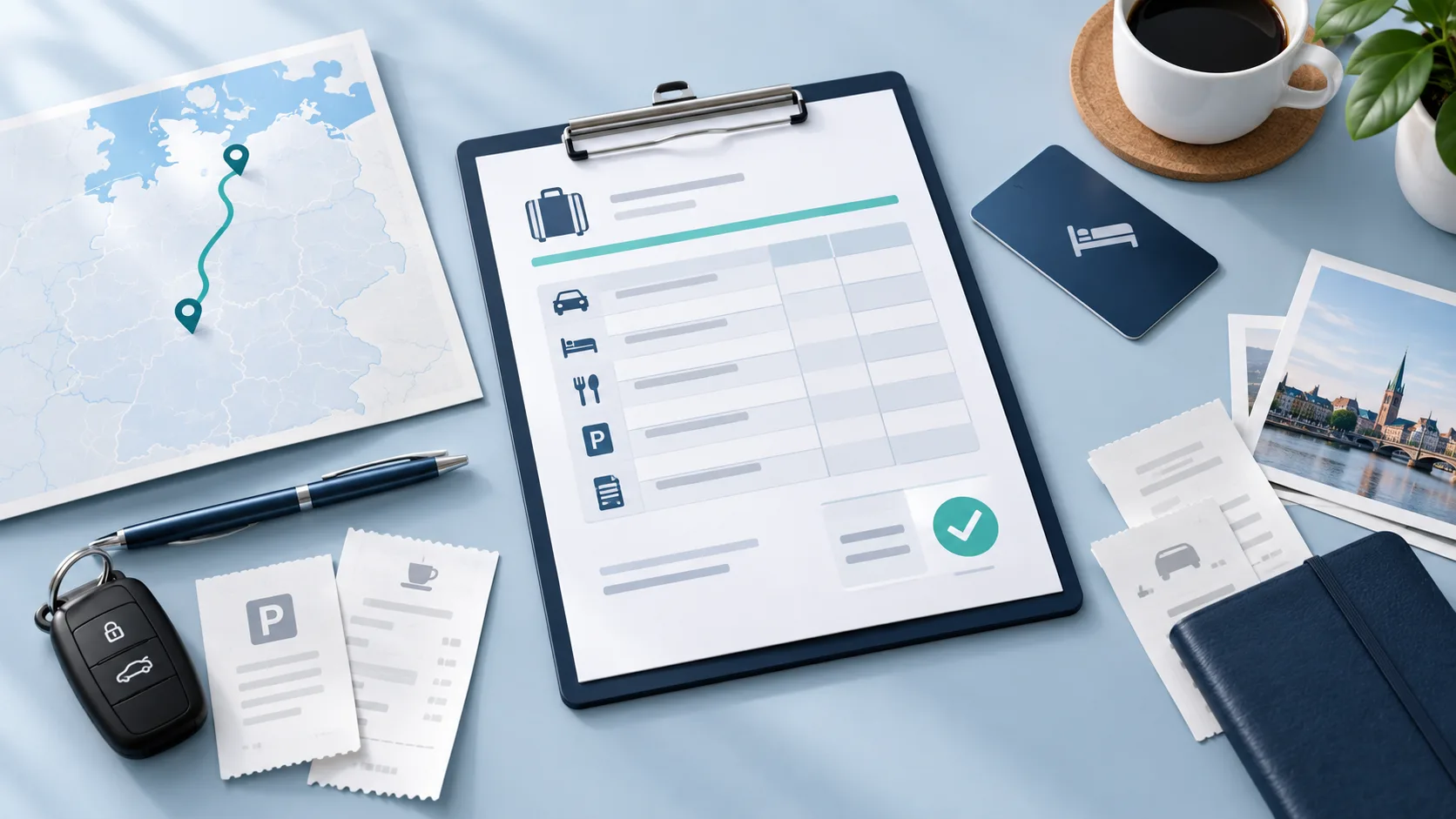
A travel expense report in Germany (Reisekostenabrechnung) covers four types of cost: travel, accommodation, meals and incidental costs such as parking. With your own car, you claim 0.30 euros per kilometre driven, the hotel at the amount on the invoice, and meals only as a flat rate of 14 or 28 euros per day. You also record when you left and came back, where you went and why. For the self-employed, the report is a receipt of its own for the books. For employees, it is the basis for reimbursing their costs tax-free.
Contents
- Template: what goes into the report
- When a journey counts as a business trip
- The 2026 flat rates and what else you claim
- Example: two days at a client in Hamburg
- Receipts and input VAT
- Invoicing travel costs to your client
- Travel expenses for employees
- Where the amounts go in the EÜR
- Frequently asked questions
Template: what goes into the report
The report is not mandatory, but without it you have no proof for the kilometres and the flat rates. There is no official form. You may use any spreadsheet, sheet of paper or program, as long as it contains these details for each trip:
| Field | Example |
|---|---|
| Name, for employees also the business | Jonas Weber, Weber Anlagentechnik |
| Destination | Hamburg, client Hansen Logistik GmbH |
| Purpose | commissioning of the conveyor system |
| Departure with date and time | 12.10.2026, 6:30 am |
| Return with date and time | 13.10.2026, 7:15 pm |
| Means of transport and kilometres driven | own car, 610 km |
| Travel costs | 610 km × €0.30 = €183.00 |
| Accommodation as invoiced | €112.00 |
| Deduction for breakfast, if included in the hotel bill | − €5.60 |
| Meal allowances per day | €14.00 + €14.00 |
| Incidental costs as per receipt | car park €10.00 |
| Total | €327.40 |
| Attachments | hotel invoice, parking receipt |
| Date and signature | 14.10.2026, J. Weber |
The times are not a formality. They decide whether a meal allowance applies at all. File the report together with the receipts, on paper or digitally, for example in accounting software. As a booking receipt, you keep both for eight years (§ 147(3) of the German Fiscal Code, AO).
When a journey counts as a business trip
Every trip to a client, a construction site, a trade fair or a supplier is a business trip. The daily commute from home to your own workshop, shop or office is not.
For this daily commute, the commuter allowance (Entfernungspauschale) applies: 0.38 euros per kilometre of the one-way distance, no matter how often you drive back and forth. It does not belong in the travel expense report but goes separately into the EÜR, the German profit statement for small businesses. For a business trip, on the other hand, all kilometres driven count, there and back.
Three cases where the line lies differently than many people think:
- A home office is not a business premises. If you work from home and drive to clients, you are on a business trip from your front door.
- A client can become your business premises. If you work regularly at a fixed location of one client, for example on two full days a week, and the contract is open-ended or set for more than 48 months, that location counts like your workshop. The trip there then only earns the commuter allowance.
- From the workshop to the client is a business trip. The absence counts from the moment you leave the workshop.
For the self-employed, the rules are set out in a letter from the Federal Ministry of Finance dated 23 December 2014. For everything else, it refers to the rules for employees.
The 2026 flat rates and what else you claim
For travel and meals you claim fixed amounts, for hotel and incidentals the receipt counts.
| Type of cost | What you claim |
|---|---|
| Travel with a private car | €0.30 per kilometre driven, or the share of the actual car costs |
| Travel with a company car | no kilometre rate, the costs are already in the business's car costs |
| Train, flight, taxi, rental car | the price on the ticket or invoice |
| Accommodation | the amount on the hotel invoice, without breakfast |
| Meals in Germany | €14 for more than 8 hours away and for arrival and departure days, €28 for each full day |
| Incidental costs | as per receipt, for example car park or luggage storage |
Company car. If the car is a business asset, you book fuel, insurance and repairs as business expenses anyway. You do not get the 0.30 euros on top, otherwise the same trip would be deducted twice. The German income tax guidelines only allow the flat rate for private vehicles (R 4.12(2) EStR). You still record the trip in the report, because of the meal allowance. How to prove the private use of a company car with a logbook is explained in the article Keeping a mileage logbook in Germany.
Accommodation. As a self-employed person, you always claim the invoice amount for the hotel. There is no flat rate for you. If breakfast is shown separately, leave that item out. If the invoice only shows a total price, deduct 5.60 euros per breakfast in Germany.
Meals. Restaurant bills are worthless for tax purposes, only the flat rate counts. Which day brings which amount, when hotel breakfast reduces the allowance and what applies abroad is explained in the article Per diem rates in Germany 2026.
Example: two days at a client in Hamburg
Jonas Weber is a self-employed plant technician in Kassel and works from his home office. He drives his private car to a client in Hamburg, stays one night and is back the next evening. He can deduct input VAT, so he calculates with net amounts.
| Item | Calculation | Amount |
|---|---|---|
| Travel | 610 km × €0.30 | €183.00 |
| Hotel | €112.00 net, breakfast included | €112.00 |
| Breakfast deduction | total price, so flat rate | − €5.60 |
| Meals, arrival day | trip with overnight stay | €14.00 |
| Meals, departure day | trip with overnight stay | €14.00 |
| Car park | €10.00 net | €10.00 |
| Total business expenses | €327.40 |
He also reclaims the VAT on the hotel and parking invoices as input VAT. There is no input VAT on the 183 euros travel costs and the 28 euros meal allowance, because there is no invoice for them.
Had he taken the train, the ticket price would appear in the report instead of the 183 euros. Had he returned the same day, there would be no hotel and only one meal allowance of 14 euros, because he was away for more than 8 hours.
Receipts and input VAT
For every amount claimed from an invoice you need the receipt: hotel invoice, ticket, parking receipt, taxi receipt. For the flat rates, the report itself is enough, meaning destination, purpose and times. For the kilometres, note the start, destination and distance driven. With the odometer reading at departure and return, the figure is easiest to check.
Input VAT. You deduct the VAT on hotel, train, taxi and car park as input VAT, unless you are a small business under the German small business rule (Kleinunternehmer). Use the amounts shown on the invoice. Hotel invoices often contain two VAT rates: 7 percent on the room, 19 percent for example on parking or drinks.
Name on the invoice. Up to 250 euros, a small-amount invoice without your name is enough, which covers most tickets and parking receipts. Above 250 euros, the invoice must show your name and address as the recipient (§ 14(4) of the German VAT Act, UStG). So give your business address when you check in, not just your name.
Invoicing travel costs to your client
Travel costs you pass on to your client go on the invoice as a separate line item, net and with the same VAT rate as your actual work. In most cases that is 19 percent, even if the hotel itself only charged 7 percent.
The reason: you booked the hotel and the journey in your own name. The costs are therefore part of the price of your service (§ 10(1) UStG). Only amounts you pay expressly in the name and on behalf of the client are a pass-through item (durchlaufender Posten) without VAT. That is rare with travel costs. The journey is an ancillary service and, according to the German VAT application decree, takes the VAT rate of the main service (section 3.10(5) UStAE).
Example for Jonas Weber, who agreed 0.50 euros per kilometre with the client:
| Item | Net |
|---|---|
| Commissioning of conveyor system, 14 hours × €85 | €1,190.00 |
| Travel Kassel–Hamburg and back, 610 km × €0.50 | €305.00 |
| Accommodation as per receipt | €112.00 |
| Total net | €1,607.00 |
| VAT 19 % | €305.33 |
| Total | €1,912.33 |
How much you charge per kilometre is freely agreed with the client. For your own tax, it stays at 0.30 euros. What the client pays is ordinary business income, the costs of the trip remain business expenses. As a Kleinunternehmer, you invoice the travel costs without VAT, like everything else.
Travel expenses for employees
You reimburse your employees' travel costs tax-free and free of social security contributions, as long as you do not pay more than they could deduct as work-related expenses themselves (§ 3 no. 16 of the German Income Tax Act, EStG). For this, the employee submits a report based on the template, and you keep it with the receipts in the payroll account.
| Type of cost | Tax-free reimbursement |
|---|---|
| Travel with the employee's own car | €0.30 per kilometre |
| Travel with your company car | nothing, not even partly |
| Train, flight, taxi | amount as per receipt |
| Accommodation in Germany | amount on the hotel invoice, or €20 per night without a receipt |
| Meals | up to the flat rate |
| Incidental costs | amount as per receipt |
You may only pay the 20 euros per night without a receipt to an employee, not to yourself. It also does not apply if you paid the hotel directly or the employee sleeps in the vehicle (R 9.7(3) of the German wage tax guidelines, LStR). If you pay more meal money than the flat rate, there is a tier with 25 percent flat-rate wage tax. The details are in the article Per diem rates in Germany 2026.
The law sets no deadline for employees in the private sector by which they must submit their travel report. Set one in your business, for example by the end of the following month. The six-month cut-off period you often read about applies to federal civil servants under the Federal Travel Expenses Act (BRKG).
Where the amounts go in the EÜR
Travel costs go into several lines of the Anlage EÜR, not into one total. In the 2026 form, the lines have moved down by one compared to 2025:
| What | Anlage EÜR 2025 | Anlage EÜR 2026 |
|---|---|---|
| Travel with a private car, €0.30 per kilometre | line 71 | line 72 |
| Train, flight, taxi | line 70 | line 71 |
| Hotel and incidentals, for example car park | line 44 | line 45 |
| Your own meal allowances | line 64 | line 65 |
| Travel costs of your employees | line 30 | line 31 |
| Daily commute to your own workshop or office | lines 72 and 73 | lines 73 and 74 |
Jonas Weber's trip in October 2026 belongs in the 2026 form: 183.00 euros in line 72, 116.40 euros in line 45 and 28.00 euros in line 65. How the whole statement is structured is shown in the article Doing your EÜR yourself.
Frequently asked questions
Is there a template for a travel expense report?
There is no official form. The table in the section Template contains all the fields the tax office wants to see. You can rebuild it in Excel or on paper.
What is the 2026 mileage rate for business trips in Germany?
0.30 euros per kilometre driven by car, counted there and back. The 0.38 euros that are new in 2026 only apply to the daily commute and only per kilometre of the one-way distance.
Can I deduct travel costs if the client pays them?
Yes. As a self-employed person, you deduct your costs, and what the client pays is income. Both go into the EÜR. It is different for employees: what you reimburse tax-free, they cannot deduct again in their tax return.
What applies to travel costs abroad?
You claim travel, hotel and incidentals just as in Germany: 0.30 euros per kilometre with your own car, otherwise the amount as per receipt. Only meals have their own rates per country, listed in the article Per diem rates in Germany 2026. You do not deduct foreign VAT on the hotel invoice in your German VAT return. From other EU countries, you reclaim it via the online portal of the Federal Central Tax Office (BZSt). The application must arrive there by 30 September of the following year.
What about a business meal during the trip?
If you invite a client to a meal, that is business entertainment, not a meal allowance. You deduct 70 percent of the bill (§ 4(5) sentence 1 no. 2 EStG) and need a completed entertainment receipt, see Filling in an entertainment receipt. Your meal allowance for the day is not reduced.
I have lost a receipt. What now?
Write a self-issued receipt (Eigenbeleg) with date, amount, purpose and the reason why the original is missing. How to do this is explained in the article Writing a self-issued receipt. You cannot deduct input VAT from a self-issued receipt.
Sources
- § 9 EStG, work-related expenses (paragraph 1 no. 4 and 4a, paragraphs 4 and 4a)
- § 3 EStG, tax-free income (no. 16)
- § 5 Federal Travel Expenses Act, mileage allowance
- § 3 Federal Travel Expenses Act, entitlement and cut-off period
- § 10 UStG, taxable amount and pass-through items
- § 12 UStG, VAT rates (paragraph 2 no. 10 and 11)
- § 14 UStG, mandatory invoice details (paragraph 4)
- § 4 EStG, profit (paragraph 5 sentence 1 no. 2, entertainment)
- Federal Central Tax Office: VAT refund for domestic businesses
- § 147 AO, retention periods
- Federal Ministry of Finance: travel costs in profit calculation, letter of 23 December 2014 (copy from IHK Munich)
- Federal Ministry of Finance: Anlage EÜR 2025 with instructions
- Federal Ministry of Finance: Anlage EÜR 2026 with instructions
Try Easy Invoice free for 10 days — no payment details, the trial ends by itself.
Handle invoices more easily
Easy Invoice combines quotes, invoices and customer management in the cloud.
Try Easy InvoiceRead next
 Taxes & Law
Low-value assets in Germany (GWG) 2026: €800 limit, net or gross
The GWG limit in Germany is €800 net in 2026, also under the small business scheme. Which purchases you deduct at once, when the pooled item pays off and how to book it.
 Taxes & Law
Germany's 1% rule for company cars: how the self-employed pay tax
If you also drive your company car privately, you pay tax on 1 percent of the list price every month. What comes on top, what the calculation looks like with figures and when a mileage logbook saves money.
 Taxes & Law
Keeping a mileage logbook in Germany: template, required details
A German mileage logbook only counts if every trip is recorded promptly and without gaps. Which details are required, what a filled-in logbook looks like and why Excel is not enough.