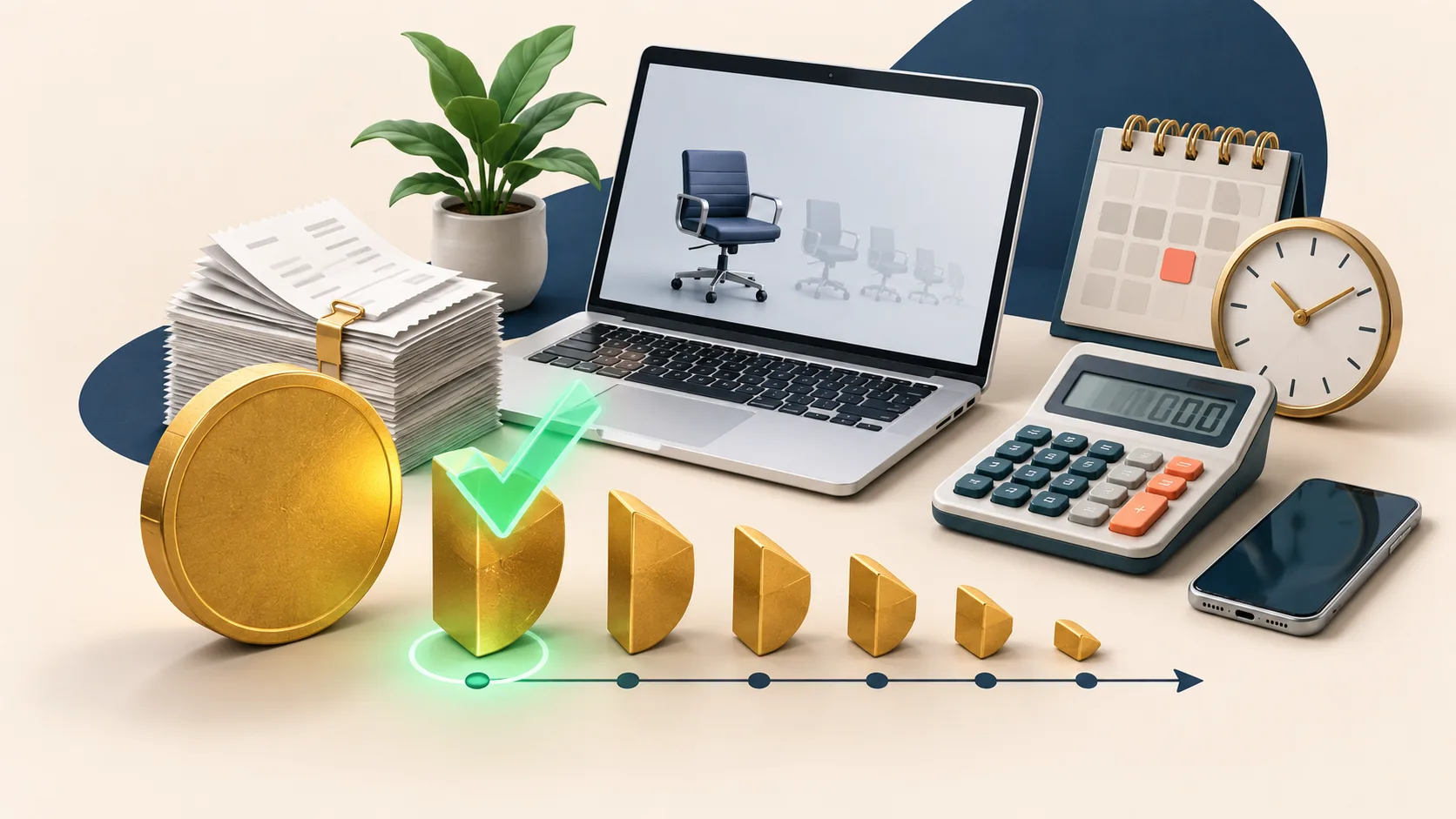
Under German tax law, if an asset for your business costs no more than 800 euros net, you deduct it in full in the year of purchase. If the price is higher, you spread the cost over the useful life from the official AfA table — six years for a car, 13 for office furniture. Computers, laptops, printers and software are the exception: you may deduct them in full in the year of purchase, whatever the price. AfA stands for "Absetzung für Abnutzung" and is the German tax term for depreciation.
Contents
- Deduct at once or depreciate: the three thresholds
- Computers, laptops and software: one year
- AfA table: how long you depreciate
- Calculating depreciation: example with monthly calculation
- Sammelposten: the option between 250 and 1,000 euros
- Kleinunternehmer: check net, deduct gross
- Used, partly private, sold
- Where depreciation goes in the tax return
- Frequently asked questions
Deduct at once or depreciate: the three thresholds
Up to 800 euros net, you do not have to spread anything. What counts is always the price without VAT. The thresholds are set out in § 6 Abs. 2 and 2a of the German Income Tax Act (EStG).
| Net price | What you do | Record |
|---|---|---|
| up to 250 euros | deduct in full as an expense in the year of purchase | none in particular |
| over 250 up to 800 euros | deduct in full as an expense in the year of purchase (low-value asset, geringwertiges Wirtschaftsgut, GWG) | in the register, unless it is clear from the accounts |
| over 800 euros | depreciate over the useful life | in the fixed asset register |
| special route 250 to 1,000 euros | optional pool (Sammelposten), one fifth each over five years | see the section on the Sammelposten |
The threshold applies to each item that can be used on its own. An office chair for 450 euros is an immediate expense. A part that can only be used together with a specific machine and is technically matched to it does not count on its own (§ 6 Abs. 2 Satz 2 EStG).
The purchase invoice is the proof for every depreciation, often over many years. If you file it in one place with your other incoming invoices, you have it at hand for the next tax return and for a tax audit.
What exactly counts as a low-value asset (GWG), why the limit is a net amount even for small businesses and which account to post it to is explained in a separate article.
Computers, laptops and software: one year
No price limit applies to computers and software. A laptop for 1,400 euros net goes into costs in full in the year of purchase, even if you buy it in December. The German Federal Ministry of Finance (BMF) has allowed this since 2021 with a useful life of one year.
According to the BMF letter of 22 February 2022, this covers:
- desktop computers, notebooks, tablets, workstations and small servers
- docking stations and external power supplies
- peripherals such as monitors, printers, scanners, keyboards, mice, headsets, external hard drives and projectors
- operating and application software, including inventory management and accounting programs
The smartphone is not on the list. The ministry expressly calls the list of computers exhaustive. For a smartphone over 800 euros net, the AfA table therefore applies, with five years for mobile phones, or the Sammelposten.
Two things remain despite the one year: the laptop belongs in the fixed asset register, and you may also choose a longer useful life if you prefer.
AfA table: how long you depreciate
You look up the number of years in the AfA table for generally usable fixed assets. The tax office uses these values as its benchmark. It only accepts a shorter period if the device is demonstrably worn out sooner. The table applies to everything acquired after 31 December 2000.
| Item | Useful life | Reference in the table |
|---|---|---|
| Computer, laptop, printer, software | 1 year (BMF letter 2022) | replaces the old 3 years |
| Smartphone, mobile phone | 5 years | 6.13.2.2 |
| Cash register | 6 years | 6.14.7 |
| Car and estate car | 6 years | 4.2.1 |
| Bicycle, cargo bike, motorcycle, scooter | 7 years | 4.2.2 |
| Camera | 7 years | 6.14.4 |
| Photocopier | 7 years | 6.14.10 |
| Shop fittings, shop installations | 8 years | 6.2 and 3.7 |
| Lorry, tipper | 9 years | 4.2.3 |
| Sales counter | 10 years | 6.16 |
| Refrigerator | 10 years | 7.7 |
| Trailer | 11 years | 4.2.6 |
| Office furniture | 13 years | 6.15 |
| Safe | 23 years | 6.19.2 |
Many industries also have their own tables, for example construction or hospitality. If your device is listed there, the industry table takes precedence.
Buildings follow their own percentages under § 7 Abs. 4 EStG and are not covered in this article.
Calculating depreciation: example with monthly calculation
You divide the net price by the years of useful life. In the year of purchase, only the months from the month of purchase onwards count. This is called straight-line depreciation and is set out in § 7 Abs. 1 EStG.
Example: on 10 August 2026 you buy a cargo bike for 3,000 euros net. The table gives seven years.
- Annual amount: 3,000 euros ÷ 7 = 428.57 euros
- 2026: August to December is five months, so 428.57 × 5/12 = 178.57 euros
- 2027 to 2032: 428.57 euros each
- 2033: January to July, the remaining 250.00 euros
Together that is exactly 3,000 euros. August counts in full, even though you only bought on the 10th: only the full months before the month of purchase are deducted.
For acquisitions from 1 July 2025 to 31 December 2027, you may use declining-balance depreciation instead, which means more in the first years. For the cargo bike, that would be 375 euros instead of 178.57 euros in 2026. How it works and who benefits is explained in the article on the investment booster with 30 percent declining-balance AfA. It also covers the special rule for electric cars with 75 percent in the first year.
Sammelposten: the option between 250 and 1,000 euros
The pool (Sammelposten) is almost only worthwhile for items between 800 and 1,000 euros net with a long useful life. All acquisitions of one year between 250 and 1,000 euros go into one pool, which you release over five years at one fifth each.
Example: a smartphone for 900 euros net.
| Route | Expense in the year of purchase |
|---|---|
| AfA table, 5 years, purchase in January | 180 euros |
| AfA table, 5 years, purchase in October | 45 euros |
| Sammelposten | 180 euros, whatever the month |
The catch: the choice applies to the whole year. If you take the Sammelposten, the office chair for 450 euros and the shelf for 300 euros must go into it as well. You may then no longer deduct them at once. If you buy many items under 800 euros in the same year, you lose more with the Sammelposten than you gain.
Kleinunternehmer: check net, deduct gross
As a small business owner without input tax deduction (Kleinunternehmer), you check the thresholds with the net price but deduct the gross price. That sounds contradictory, but it works in your favour.
Example: a desk costs 900 euros gross. Net, that is 756.30 euros, so below 800 euros. You deduct the full 900 euros in the year of purchase. Looking at the gross price for the 800-euro threshold would be a mistake that costs you money.
Whether you get the VAT refunded plays no role for the thresholds. This is set out in the German Income Tax Guidelines (EStR), R 9b Abs. 2. If you work with input tax deduction, you only depreciate the net amount (§ 9b Abs. 1 EStG) and recover the VAT through the advance VAT return.
Used, partly private, sold
Bought used. You depreciate over the remaining useful life, which you estimate yourself. What matters is age, condition and how you intend to use the device. The six years of the AfA table minus the age are not a fixed benchmark for this: for a used car, the Federal Fiscal Court (Bundesfinanzhof) also accepts a longer total period, depending on age and mileage. If you buy from a private person without an invoice, record the purchase contract and the payment. If there is no receipt at all, a self-made receipt helps.
Already owned privately. If you bring an item from your private property into the business, its current value usually counts, not the old purchase price. If you bought it in the last three years, stricter rules apply under § 6 Abs. 1 Nr. 5 EStG. Here it is worth asking a tax adviser.
Also used privately. If you use a device more than 50 percent for business, it belongs entirely to the business. Between 10 and 50 percent, you may assign it to the business; below 10 percent it remains private (R 4.2 Abs. 1 EStR). For a car, you account for the private share with the one-percent rule (Ein-Prozent-Regel) or with a logbook (Fahrtenbuch) (§ 6 Abs. 1 Nr. 4 EStG).
Sold early or broken. The sale proceeds are business income. What has not yet been depreciated, the residual book value, becomes an expense in the same year. This does not apply to the Sammelposten: it continues as if nothing had happened. This is stated in the instructions for the Anlage EÜR 2025, lines 19 and 38.
Where depreciation goes in the tax return
If you determine your profit with the cash-basis income statement (Einnahmenüberschussrechnung, EÜR), you enter the year's depreciation in the Anlage EÜR. The individual items with purchase date, price and depreciation belong in the Anlage AVEÜR, the fixed asset register for the EÜR. According to the instructions of the Federal Ministry of Finance, it is a required part of the EÜR. How the EÜR works as a whole is shown in the article Doing the EÜR yourself.
You enter low-value assets up to 800 euros as a total in a separate line of the Anlage EÜR; they do not appear in the Anlage AVEÜR. Computers with a useful life of one year, on the other hand, still belong in the Anlage AVEÜR.
Frequently asked questions
What threshold applies in 2026 for deducting at once?
800 euros net per item. The amount has been unchanged since 2018 and is the same in 2026.
Can I write off a laptop at once?
Yes, whatever the price. This also applies to Kleinunternehmer and to laptops you buy in December. Only the smartphone is not covered.
How long do I depreciate a mobile phone?
Up to 800 euros net not at all, it is an immediate expense. Above that, five years under the AfA table or, up to 1,000 euros, five years through the Sammelposten.
How long do I depreciate a car?
Six years for a new car. For a used car, the estimated remaining useful life. For purely electric cars acquired from July 2025, a special rule applies with 75 percent in the first year.
Do I have to depreciate, or may I skip it?
Depreciation is mandatory, also with the EÜR (§ 4 Abs. 3 Satz 3 EStG). If you forgot it by mistake, spread the remainder over the remaining useful life. If you leave it out deliberately to shift it into a year with higher profit, you may not catch it up later (Federal Fiscal Court, 3 July 1980).
Sources
- § 6 EStG, valuation (low-value assets and Sammelposten)
- § 7 EStG, depreciation (Absetzung für Abnutzung)
- Federal Ministry of Finance: AfA table for generally usable fixed assets
- Federal Ministry of Finance: AfA tables for individual industries
- BMF letter of 22 February 2022, useful life of computer hardware and software, GZ IV C 3 - S 2190/21/10002 :025
- German Income Tax Guidelines (EStR), R 9b Abs. 2 and R 4.2 Abs. 1
- § 4 EStG, definition of profit and cash-basis income statement
- § 9b EStG, input tax deduction under VAT law
- Federal Ministry of Finance: Anlage EÜR 2025 with instructions
Try Easy Invoice free for 10 days — no payment details, the trial ends by itself.
Handle invoices more easily
Easy Invoice combines quotes, invoices and customer management in the cloud.
Try Easy InvoiceRead next
 Taxes & Law
Low-value assets in Germany (GWG) 2026: €800 limit, net or gross
The GWG limit in Germany is €800 net in 2026, also under the small business scheme. Which purchases you deduct at once, when the pooled item pays off and how to book it.
 Taxes & Law
Germany's 1% rule for company cars: how the self-employed pay tax
If you also drive your company car privately, you pay tax on 1 percent of the list price every month. What comes on top, what the calculation looks like with figures and when a mileage logbook saves money.
 Taxes & Law
Keeping a mileage logbook in Germany: template, required details
A German mileage logbook only counts if every trip is recorded promptly and without gaps. Which details are required, what a filled-in logbook looks like and why Excel is not enough.