
A minijob employee at the limit of 603 euros costs you around 791 euros a month. The employer contributions of at most 31.17 percent are added on top of the wage, not deducted from it. On top of that comes the accident insurance fund with roughly 20 to 30 euros a month, depending on your trade. Converted to the hours your employee actually works, you end up at just under 22 euros – and around 29 euros for every hour you can bill to a customer. For those 603 euros, the employee may work around 43 hours a month in 2026, roughly ten per week. Anyone who demands more hours and still pays only 603 euros is paying less than the minimum wage.
Contents
- What a minijob employee really costs you per month
- What the accident insurance fund costs – with figures
- What the employee costs you per hour
- 603 euros – how many hours is that?
- How do I register my minijob employee?
- When the money leaves: contributions fall due before the wage
- What if the employee already works somewhere else?
- When it gets busy: the limit may be exceeded twice a year
- Winter break: deregister and register again – is it worth it?
- Holiday, sickness, public holidays: a minijob employee is a normal employee
- The timesheet duty that customs inspects
- What the employee does to your hourly rate
- The mistake that costs the most
What a minijob employee really costs you per month
Most people budget for the wage and are then surprised by their bank statement. For a commercial minijob you as the employer pay fixed percentages to the Minijob-Zentrale, the central office for marginal employment. They are added on top of the wage. At the full limit it looks like this:
| Item | Rate | On 603 euros of wages |
|---|---|---|
| Wage to the minijob employee | – | 603.00 € |
| Health insurance | 13 % | 78.39 € |
| Pension insurance | 15 % | 90.45 € |
| Flat-rate tax | 2 % | 12.06 € |
| Levy U1 (sickness) | 0.8 % | 4.82 € |
| Levy U2 (maternity) | 0.22 % | 1.33 € |
| Insolvency levy | 0.15 % | 0.90 € |
| Your contributions together | at most 31.17 % | around 188 € |
| Total cost per month | around 791 € |
On top of this comes the contribution to your accident insurance fund. It is billed once a year and is covered in the next section.
The three small items in the middle are levies – a kind of compulsory insurance among employers. The U1 pays you back a large part of the wage if your minijob employee falls ill and you have to keep paying them. The U2 applies to maternity protection. The insolvency levy secures wages if a business goes under. The flat-rate tax of 2 percent settles the wage tax completely – your employee then does not have to declare this income in their own tax return.
One point concerns them rather than you: 3.6 percent of the wage goes to the pension insurance, because a minijob is subject to pension contributions. Your employee can apply to be exempted. They have to give you that in writing, and you file it with the payroll records. Without that piece of paper, you deduct the 3.6 percent.
What the accident insurance fund costs – with figures
„It depends on your trade" helps nobody decide whether they can afford the employee. So here is the order of magnitude: for a minijob employee at the limit you pay roughly 100 to 350 euros a year, depending on the trade – about 8 to 30 euros a month.
Every accident insurance fund calculates the same way:
annual wage paid × risk class × contribution rate
The risk class is the risk figure for your activity — carpentry work has a high one, office work a low one. Which one applies to you is stated in your assessment notice; if you do not have one yet, your fund will tell you the figure over the phone. The contribution rate is the price per risk point, set anew each year by each fund itself.
For a minijob employee with 7,236 euros of annual wages it looks like this:
| Accident insurance fund | Risk class | Contribution rate | Per year | Per month |
|---|---|---|---|---|
| BG BAU, structural construction | 11.84 | 0.3850 (per 100) | around 330 € | around 27 € |
| BG Holz und Metall, medium risk (assumed risk class 5) | 5.00 | 7.15 (per 1,000) | around 259 € | around 22 € |
| BG Holz und Metall, light activity (assumed risk class 2) | 2.00 | 7.15 (per 1,000) | around 103 € | around 9 € |
The risk class for structural construction and both contribution rates come from BG BAU and BG Holz und Metall, as of 2025. The risk classes 5 and 2 are assumptions to show the range — your own figure may be higher or lower.
Two more things to know. First, there is a minimum contribution: at BG BAU it is 100 euros a year, even if the calculation would give less. Second, you pay in arrears — the bill for one year arrives in the spring of the following year. Set the 30 euros aside monthly, otherwise the invoice turns up unexpectedly in April.
What the employee costs you per hour
The monthly figure is only half the answer. What matters for your pricing is what one working hour of this employee costs — and it is more expensive than the minimum wage, because you also pay for hours in which nobody works.
The calculation for a minijob employee at the limit, over one year:
| Step | Calculation | Result |
|---|---|---|
| Wage per year | 603 € × 12 months | 7,236 € |
| Your contributions | 31.17 % of that | 2,255 € |
| Accident insurance fund | example: structural construction | 330 € |
| Your cost per year | 9,821 € | |
| Paid hours | 43.4 hours/month × 12 months | 521 hours |
| of which paid but not worked | 8 holiday days, 3 public holidays, 3 sick days | around 70 hours |
| Hours actually worked | 451 hours | |
| Cost per hour worked | 9,821 € ÷ 451 | 21.78 € |
So 13.90 euros of minimum wage turn into just under 22 euros for every hour your employee actually works for you. That is 57 percent more than the hourly wage you agreed with them.
And it goes further: not every hour worked can be charged to a customer. Travel, fetching materials, tidying up and workshop time are not paid separately. If you assume that about three quarters of the hours reach the customer, that leaves 338 billable hours a year:
9,821 euros ÷ 338 hours = around 29 euros per billable hour
Those 29 euros are the figure that has to go into your prices — not the 13.90 euros. Two things soften it: you largely recover the sick days through the U1 levy, and the more time your employee spends directly at the customer, the lower the figure.
603 euros – how many hours is that?
The limit for a minijob is 603 euros a month in 2026. It is not an arbitrary number but tied to the minimum wage: the minimum wage is multiplied by 130, divided by three and rounded up to full euros (Section 8 SGB IV). At a minimum wage of 13.90 euros since 1 January 2026, that gives 603 euros. If the minimum wage rises, the limit rises automatically.
That gives you your real ceiling:
603 euros divided by 13.90 euros = around 43 hours a month, roughly ten hours a week.
This is exactly where many first minijobs go wrong. The boss thinks in money („603 euros, that is the maximum"), but the business needs 15 hours a week. Anyone who has 15 hours worked and pays 603 euros is paying about 9.30 euros an hour – below the minimum wage. In an inspection this is the first calculation customs performs: wage divided by hours actually worked. The Minimum Wage Act provides for fines of up to 500,000 euros (Section 21 MiLoG) – a maximum for serious cases, but it shows how seriously this is taken.
If you need more hours, there is no way around a regular part-time position. It costs more, but it is the honest route. If you pay an hourly wage above the minimum wage, the permitted number of hours falls accordingly: at 16 euros it is around 37 hours a month.
How do I register my minijob employee?
In three steps, and the order matters, because step two does not work without step one.
1. Company number from the employment agency. This is your identification number as an employer, an eight-digit figure. Without it you cannot file a single report. You apply for it at the company number service of the Federal Employment Agency. Take care of it as soon as the hiring is decided – not the day before.
2. Registration with the Minijob-Zentrale. Registration is electronic, either through a payroll program or through the free SV-Meldeportal, the social insurance reporting portal. To register there you need an ELSTER organisation certificate – the same certificate file you use to identify yourself to the tax office. If you do not have one yet, get it early: the activation code arrives by post and takes a few days.
For the report you need your employee's name, address, date of birth and their social insurance number. It is shown on their social insurance card; someone who has never worked does not have one – then you file the report without it and the pension insurance issues the number. Two code numbers are also needed, and the portal guides you through them: the person group and the activity code. The activity code describes what the employee does and what qualification they hold.
Registration belongs to the start of employment, not to the end of the month. Deal with it in the week the employee starts.
3. Accident insurance fund. Every business with employees belongs to a statutory accident insurance fund. A new business must notify the responsible fund within one week of starting (Section 192 SGB VII). If you have been self-employed for longer and know your fund, tell them that you now employ somebody – the number of insured persons is the basis for your contribution. This is the step most often forgotten, and the fund also claims contributions retroactively.
A special case for construction, hospitality, transport and building cleaning: in these sectors an immediate report is added. It goes to the data centre of the pension insurance, at the latest when the employment starts – so before the employee lifts a finger. Reporting only in the evening means the deadline has already been missed.
When the money leaves: contributions fall due before the wage
The timing surprises almost everyone the first time. Contributions to the Minijob-Zentrale are due monthly, regardless of when you pay the wage:
- The contribution statement – the report of how much you are paying – must be filed by the start of the fifth-to-last banking day of the month.
- The money must reach the Minijob-Zentrale by the third-to-last banking day of the month.
In plain terms: the contributions for August are due at the end of August, even though the August wage may only reach your employee's account on 1 September. If you set up a SEPA direct debit mandate, the Minijob-Zentrale collects on time and you do not have to remember the date. In the first year that is the calmer option.
What if the employee already works somewhere else?
This question comes up constantly in practice, because many minijob employees work in several places. The rules are in Section 8 subsection 2 SGB IV:
- Several minijobs are added together. If somebody earns 400 euros with you and 300 euros at another business, that is 700 euros in total. The limit is exceeded and both jobs become subject to full social insurance – including yours.
- Alongside a main job subject to social insurance, one minijob stays free. Anyone in regular employment may hold one minijob without it being added together. A second minijob is then added to the main job.
You cannot check this yourself, which is why the law places the duty to clarify on you: ask before the first working day, in writing, about other employment and have the answer signed. If you fail to do so and it later emerges that the jobs had to be added together, the back payment can land with you. With the signed sheet in the personnel file you are on the safe side – and you have also made your employee aware that they must report changes.
When it gets busy: the limit may be exceeded twice a year
An order comes in at short notice, your skilled worker is off sick, and your minijob employee steps in. That blows the limit – the minijob would strictly speaking be over.
The law leaves room here: the limit may be exceeded in no more than two calendar months a year, provided the excess was unforeseeable (Section 8 subsection 1b SGB IV). In such a month, at most double the limit may be reached. The decisive word is „unforeseeable": covering for illness yes, a planned Christmas season no. Anyone who goes over the limit every December cannot rely on the exception.
Otherwise the annual measure applies: 603 euros a month is 7,236 euros a year. Fluctuations are unproblematic as long as this frame holds and you agreed it from the start – one month with 700 euros and one with 500 euros is not a problem.
Winter break: deregister and register again – is it worth it?
In winter the site is quiet, in summer it runs. Your minijob employee does not work for three months – and the question is whether you should deregister them for that time to save money. The answer: you do not save a single euro that way. The comparison for a three-month break:
| Registered, but no wage | Deregistered | |
|---|---|---|
| Wage | 0 € | 0 € |
| Contributions to the Minijob-Zentrale | 0 € | 0 € |
| Accident insurance contribution | 0 € for those months | 0 € for those months |
| Effort for you | none | two reports |
The reason: all contributions are calculated from the wage you actually pay out. If you pay nothing in January, you pay no contributions in January – whether the employee is registered at the time makes no difference to the cost. The accident insurance contribution is also based on the wages paid during the year and falls by itself.
So you have already saved by not having work done in those months – around 2,450 euros over three months for an employee at the limit. Deregistering contributes nothing to that. It is a pure reporting formality.
You still have to deregister if the break lasts longer. If the employment relationship continues without wage payments, the employment counts as continuing for one more month (Section 7 subsection 3 SGB IV). For a break of two or three months you therefore deregister and register again on resumption – not to save money, but because it is required. Both reports take a few minutes in the portal and cost nothing.
Do not terminate the contract over this. Deregistering only ends the report to the Minijob-Zentrale, not the employment relationship. If you terminate instead and hire again in spring, you lose more than the formalities are worth: the six-month qualifying period for the full holiday entitlement starts again, you need a new employment contract — and above all, your employee may have started somewhere else by then. A trained helper who knows where the materials are is harder to replace in the trades than two reports.
The better solution for seasonal businesses: agree fluctuating hours from the outset. The measure for a minijob is the annual income of 7,236 euros. Someone who works nine months and earns 800 euros in each of them stays within the frame at 7,200 euros a year, even though individual months are above 603 euros. This has to be agreed and documented in advance — if you are planning it, ask the Minijob-Zentrale beforehand, the advice is free.
Holiday, sickness, public holidays: a minijob employee is a normal employee
The most common misconception: that a minijob is a casual arrangement without entitlements. Legally your minijob employee is an employee like any other, just with fewer hours:
- Holiday. The Federal Holiday Act provides for at least 24 working days a year, calculated on a six-day week (Section 3 BUrlG). Your employee receives the share matching their working days: someone working two days a week is entitled to eight holiday days. The full entitlement arises for the first time after six months (Section 4 BUrlG).
- Wages during illness. If they are ill, you keep paying. You recover a large part through the U1 levy you pay every month anyway – that is what it is for.
- Public holidays. If a working day falls on a public holiday, it is paid even though nobody worked.
- Employment contract. A minijob too needs the essential working conditions in writing. Use a template from your chamber or guild rather than drafting freely.
These entitlements belong in your costing. Paid holiday and sick days are hours you pay for while nobody works for you.
The timesheet duty that customs inspects
Minijob employees are subject to a recording duty that does not apply in this form to regular full-time staff. Under Section 17 MiLoG you record the start, end and duration of daily working time, at the latest seven days after the working day in question. You keep the records for two years. If they are missing, the law provides for fines of up to 50,000 euros.
Responsible for the inspection is the financial control of undeclared work at customs. Without records you have nothing in hand at an inspection to prove the hourly wage you paid.
A sheet with three columns is enough. What matters is that it is filled in promptly and not reconstructed from memory at the end of the year. If you have been thinking about digital time tracking anyway, your first minijob employee is the moment the question answers itself.
What the employee does to your hourly rate
As soon as somebody works for you, your previous calculation no longer holds. The roughly 29 euros per billable hour from the third section are pure cost — without your own earnings, without tools, without a vehicle, without profit. If you have been charging 45 euros an hour and now have that hour worked by the helper, you earn considerably less on it than the difference suggests.
So recalculate what hourly rate you need from the customer. The method is set out in the article on the hourly rate for tradespeople: you divide your total costs by the hours you can actually bill – not by the hours somebody is present.
Whether the employee pays for themselves shows up afterwards in the figures. In a monthly business analysis the staff costs appear on a line of their own, and after three months you can see whether revenue has grown with them. In office1.cloud you record your invoices and expenses and receive that analysis; payroll accounting itself is not part of it – that is done by your tax adviser or a payroll program.
The mistake that costs the most
The most expensive mistake is not the forgotten registration but the quiet transition: the helper „on call" gradually becomes somebody with fixed hours who uses your tools and appears at the customer in your name – but keeps writing invoices instead of receiving wages. That is no longer self-employment, and the German pension insurance takes the same view in an audit. Anyone still undecided between a minijob and freelance work should know beforehand what happens if it is classified as bogus self-employment – there the back payment falls on the client.
The minijob, by contrast, is the calculable route: you know in advance what it costs, and the reports are done in one morning. Two dates are worth noting at the start – the week in which the company number has to be there, and the third-to-last banking day of the month.
This article provides general information and does not replace legal or tax advice. If you are unsure whether an arrangement qualifies as a minijob, ask your tax adviser or the Minijob-Zentrale – their advice is free. Wage costs, receipts and revenue then belong in the same place so the year-end figures add up: an accounting software keeps them together.
Handle invoices more easily
Easy Invoice combines quotes, invoices and customer management in the cloud.
Try Easy InvoiceRead next
 Trades & Services
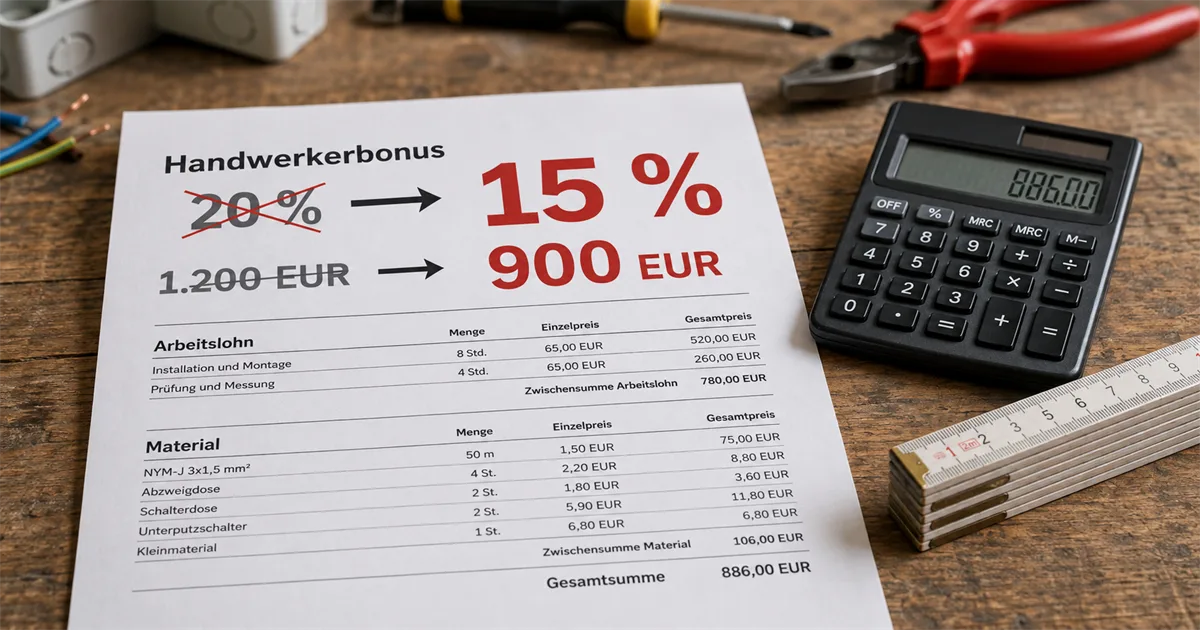
German trade tax credit set to drop to 15 percent: your customer loses up to 300 euros from 2027
In 2026, 20 percent and 1,200 euros still apply unchanged. The cut is planned for 2027 but not yet law – what your customers need to know now.
 Trades & Services
Digital time tracking in Germany: Do you need it — and if so, what must it look like?
Everyone talks about the duty to track time digitally. For businesses with up to ten employees, it is precisely the electronic form that is set to be waived permanently – the recording itself still applies, and for mini-jobbers it is stricter. Find your case first.
 Trades & Services
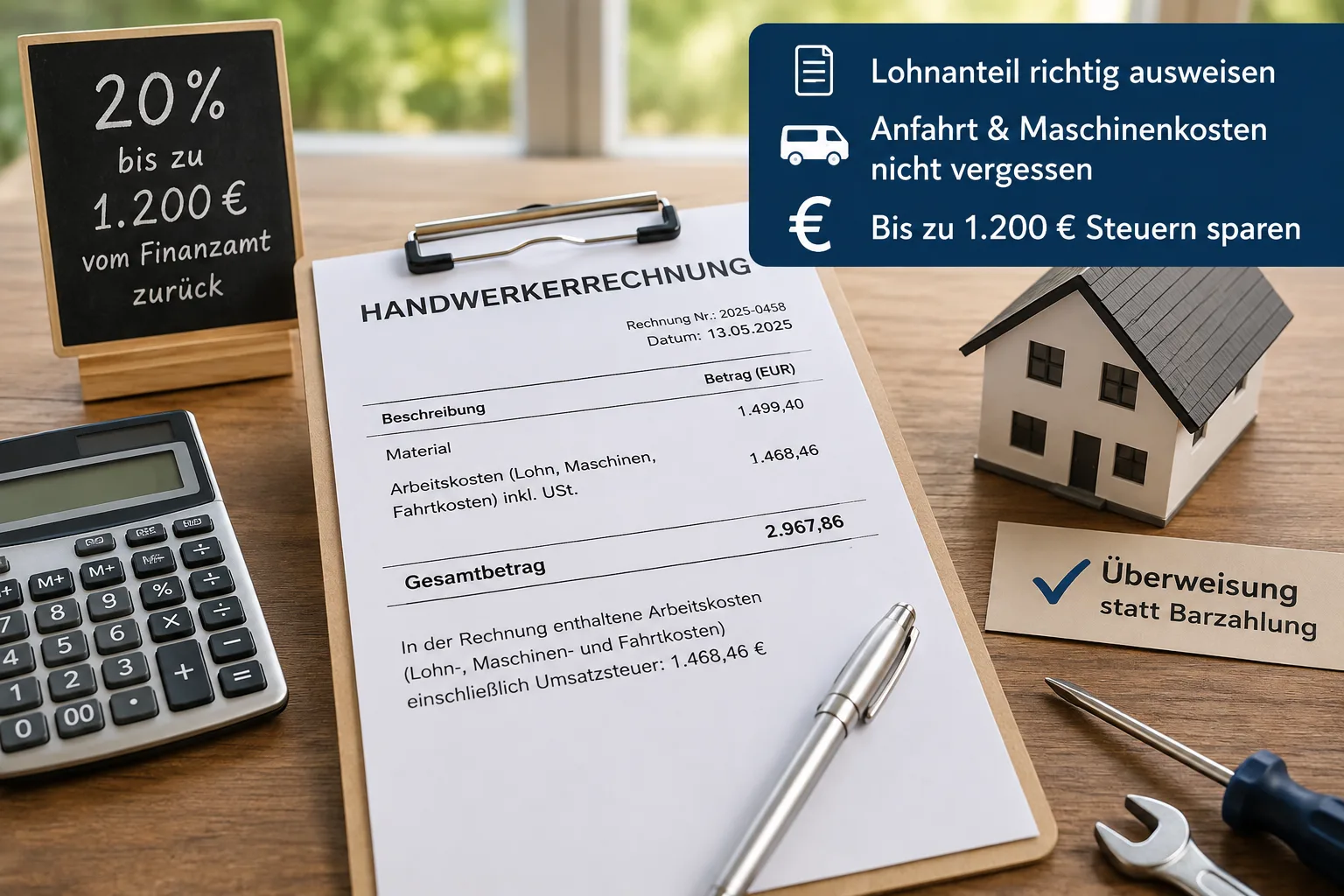
Tradesman's invoice: how to show the labour cost – and save your customer up to 1,200 euros in tax
Private customers can deduct 20 percent of the labour cost from their tax – but only if your invoice shows it separately. Here is how to write it.