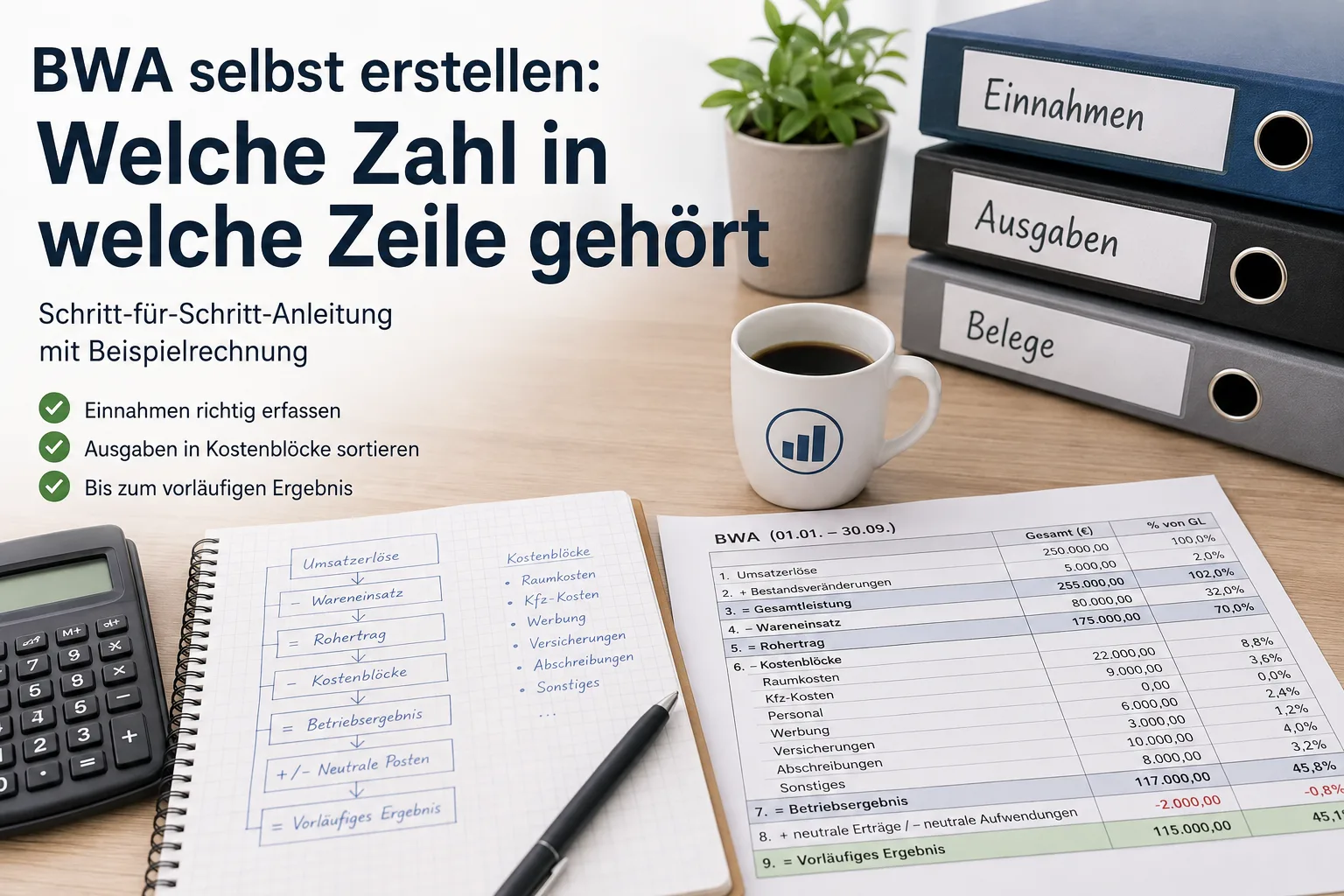
Creating a BWA – the German „betriebswirtschaftliche Auswertung", a short-term business analysis – is not accounting wizardry. It is sorting work followed by addition. You need two piles: the invoices you have issued and the expenses you have paid. And you need a fixed order: add up income, separate materials from everything else, sort the remaining costs into six to eight blocks, calculate depreciation pro rata, move one-off items to the bottom. What comes out is called the „preliminary result". The difficult part is not the arithmetic but the allocation: the VAT payment to the tax office, for instance, does not belong in the BWA at all, nor does the repayment of your loan – the interest on it does, but right at the bottom.
This article provides general information and does not replace tax or legal advice.
Contents
- The framework: a BWA as a calculation chain
- What a finished BWA looks like: all positions at a glance
- Step 1: Set the period and the method
- Step 2: Add up income – and what does not belong there
- Step 3: Sort expenses into clusters – the allocation table
- Step 4: Calculate depreciation
- Step 5: Move one-off items to the bottom
- Step 6: Add it all up – the complete example
- Step 7: Percentage columns and prior-year comparison
- Four checks before you hand the BWA over
- Why your result will never match the tax assessment
- Who asks for a BWA – and what the recipients read into it
- The success overview in Easy Invoice – and what it does not contain
- Frequently asked questions
The framework: a BWA as a calculation chain
BWA stands for „betriebswirtschaftliche Auswertung", a business analysis. The term does not come from any statute but from the practice of German tax advisors – the most widespread format is DATEV's standard BWA no. 01, which is called „kurzfristige Erfolgsrechnung", short-term income statement. There is no obligation to produce one, no prescribed format and no recipient at the tax office. You are allowed to build it yourself.
And it is always the same chain. Once you understand these nine lines, you have the principle:
   Revenue                          (everything from your actual work, net)
 + Changes in inventory             (finished work not yet invoiced)
 = Total output
 − Cost of materials                (materials and subcontracted services)
 = Gross profit
 − Cost blocks                      (premises, vehicles, staff, advertising,
                                     insurance, depreciation, other)
 = Operating result
 + neutral income − neutral expenses  (one-off items, interest)
 = Preliminary result
Two dividing lines carry the entire meaning, and they are exactly where people get sloppy when doing it themselves:
- The first dividing line is the cost of materials. Materials and subcontracted services are separated from all other costs because they grow with revenue: twice the order means twice the material, but not twice the rent. That is why gross profit shows what is left of every euro of revenue after materials – and whether that is deteriorating.
- The second dividing line is at the bottom, before the neutral items. Everything one-off and unrelated to the business is kept out of the operating result. Otherwise a month in which you sold your old van looks like a good trading month.
As a continuous example I will use an electrical business without employees, period 1 January to 30 September.
Receipts, bank transactions and the export for your accountant are bundled in the Easy Invoice accounting software in one place.
What a finished BWA looks like: all positions at a glance
Before you start calculating, here is the destination – the list of positions that end up on the sheet. The same overview also works the other way round: if somebody hands you a BWA, you can read it from top to bottom with it.
| Position | What it means in plain language | Where the figure comes from |
|---|---|---|
| Revenue | Everything you have earned from your actual work, excluding VAT | Your outgoing invoices, less credit notes |
| Changes in inventory | Finished or partly finished work that has not been invoiced yet | Stocktaking – usually €0 in small businesses |
| Total output | Subtotal: revenue plus work not yet invoiced | Calculation step |
| Cost of materials | Materials and subcontracted services that went into your jobs | Supplier invoices, subcontractors |
| Gross profit | Subtotal: what is left after materials | Calculation step |
| Staff costs | Wages, salaries, social security contributions, temporary help | Payroll – empty for sole traders |
| Premises costs | Rent, electricity, heating, cleaning for workshop, shop or office | Lease, energy bills |
| Vehicle costs | Fuel, insurance, garage, lease payments for business vehicles | Fuel receipts, garage invoices |
| Insurance and contributions | Business liability, chamber of trade, employers' liability insurance | Contribution notices |
| Advertising and travel | Adverts, website, trade fairs, hotels, rail, client entertainment | Receipts |
| Depreciation | The loss in value of larger purchases, spread over several years | Invoice divided by useful life |
| Other costs | Phone, internet, software, postage, office supplies, tax advisor, tools up to €800 | Remaining receipts |
| Operating result | Subtotal: what your business earned from ongoing trade | Calculation step |
| Neutral income | One-off and non-operating income: vehicle sale, insurance payout, interest received | Individual receipts |
| Neutral expenses | The same in the other direction, above all loan interest | Bank statement, bank charges |
| Preliminary result | The figure at the very bottom – what most people call „profit" | Calculation step |
So where is the profit? In the last line. But the word „preliminary" in front of it is meant seriously: this figure is not yet the profit you will be taxed on. Why that is, and how big the difference typically is, is explained further down in the section on the tax assessment.
You do not need every line. If you have no employees, staff costs stay empty; if you sell a pure service, you have no cost of materials. An empty line is not a mistake – a missing one is: if a trading business submits a BWA with no cost of materials at all, every reader notices immediately.
Some BWAs carry an additional line for taxes below the operating result. That is where trade tax appears – which is paid, but is expressly not a deductible business expense (section 4 (5b) of the German Income Tax Act). As a sole trader the first €24,500 of trade income are exempt anyway (section 11 (1) of the German Trade Tax Act).
Step 1: Set the period and the method
Have four things ready before you start: all outgoing invoices for the period, all incoming invoices and till receipts, the bank statements for the business account, and a list of your larger purchases from recent years with price and date. Almost everyone forgets the last list – without it, the depreciation goes missing later on.
The period: from 1 January to the last month that is fully complete. Not the single month, but cumulative – with banks, „current BWA" almost always means this cumulative view. Write the period in large letters at the top of the sheet; a BWA without a date is the most common reason for a query.
The method: you have to choose one of two views and stick to it.
| By invoice date | By payment date | |
|---|---|---|
| What counts | every invoice issued | every payment in and out |
| Shows | how much you have worked | how much money actually moved |
| Suits | businesses that prepare a balance sheet | the cash-basis accounting most small businesses use |
| Typical mistake | unpaid invoices look like money | a good month looks bad because clients pay late |
Both are defensible. What does not work is mixing them – income by invoice date and expenses by bank debit. Note your choice on the sheet. If you determine your profit on a cash basis, the payment view is usually the more natural one; how that method of determining profit works is explained in our article on doing your tax return as a self-employed person.
Step 2: Add up income – and what does not belong there
Add up all outgoing invoices for the period, net – that is, excluding VAT. Deduct credit notes and cancellations.
In the example:
| Amount | |
|---|---|
| Outgoing invoices January–September (net) | €118,400 |
| – credit note to a client after a complaint | – €2,400 |
| = Revenue | €116,000 |
Four things regularly end up in this line by mistake:
- VAT. It is a pass-through item, not income. Anyone adding up gross amounts inflates their revenue by 19 per cent. (As a small business under the German VAT exemption you do not have this problem – gross and net are identical, see writing an invoice without VAT.)
- Loans paid out. In the bank account it looks like money, but it is debt, not revenue.
- Private contributions. If you put your own money in, that is not income.
- Sales of business assets. The old van belongs at the bottom under neutral income, not in revenue.
The line changes in inventory above only concerns those who have finished or partly finished work in stock – for service providers and small trade businesses it usually stays empty. Without a stocktake you cannot fill it properly anyway. In the example: €0, so total output is also €116,000.
Step 3: Sort expenses into clusters – the allocation table
This is the part that determines the quality of your BWA. Take your expense receipts and give each of them an allocation. Not „business expense" – but one of these blocks:
| What the receipt says | Goes into the line | What to watch out for |
|---|---|---|
| Cable, pipes, lights, spare parts, goods for resale | Cost of materials | only material that goes into jobs – not your tool kit |
| Invoice from a subcontractor | Cost of materials (subcontracted services) | belongs here because it grows with the job |
| Rent, electricity, heating, cleaning for workshop or office | Premises costs | a room in your private flat only under strict conditions |
| Fuel, vehicle insurance, garage, lease payment for a company car | Vehicle costs | deduct the private share of usage |
| Wages, salaries, social security, temporary help | Staff costs | your own drawings do not belong here |
| Business liability, chamber contribution, employers' liability insurance | Insurance and contributions | private health and pension insurance do not |
| Adverts, website, business cards, trade fair stand | Advertising costs | |
| Hotel, rail, per-diem allowances for external appointments | Travel costs | |
| Entertaining clients | Advertising/travel costs | only 70 per cent is deductible (section 4 (5) no. 2 Income Tax Act) |
| Phone, internet, software subscriptions, postage, office supplies | Other costs | deduct the private share of phone and internet |
| Tax advisor, lawyer, bank charges | Other costs | |
| Work clothing, technical literature, training | Other costs | |
| Tools up to €800 net per item | Other costs, immediately in full | immediate deduction under section 6 (2) Income Tax Act |
| Machine or vehicle over €800 net | Depreciation, spread out | see step 4 |
| Interest on a business loan | neutral expenses (bottom) |
And this does not belong in the BWA at all:
| Transaction | Why not |
|---|---|
| VAT prepayment to the tax office | pass-through item – you are forwarding somebody else's money, that is not an expense |
| Income tax prepayment, solidarity surcharge | private taxes, not business expenses (section 12 no. 3 Income Tax Act) |
| Repayment of a loan | reduction of debt, not an expense – only the interest counts |
| Private drawings, your „salary" as a sole trader | appropriation of profit, not a cost |
| Gifts to clients above €50 per year and person | not deductible (section 4 (5) no. 1 Income Tax Act) |
| Trade tax | expressly not a business expense (section 4 (5b) Income Tax Act) – if you show it, put it in a separate line below the operating result |
The practical trick: write this allocation down as a list once, and note it in the top right corner of every receipt on your first pass. Next month you will only be sorting instead of deciding all over again. If you file your incoming invoices digitally anyway, assign the category as you record them – our article on managing incoming invoices explains how to do that systematically.
In the example this produces:
| Block | Amount |
|---|---|
| Cost of materials (materials €39,800 + subcontractors €7,500) | €47,300 |
| Premises costs | €7,200 |
| Vehicle costs | €6,850 |
| Insurance and contributions | €2,130 |
| Advertising and travel costs | €1,480 |
| Other costs | €5,940 |
Step 4: Calculate depreciation
Anything that cost more than €800 net and lasts longer than a year may not be deducted in one go but has to be spread over its useful life. The calculation is simple:
net purchase price ÷ useful life in years        = depreciation per year
depreciation per year ÷ 12 × months in period    = your share for the BWA
You are not free to choose the useful life – the German Federal Ministry of Finance publishes a depreciation table for that. A few values from it:
| Purchase | Useful life per the table |
|---|---|
| Passenger cars and estate cars | 6 years |
| Lorries, tractor units, tippers | 9 years |
| Trailers, semi-trailers | 11 years |
| Office furniture | 13 years |
| PCs, notebooks, printers, monitors | 3 years |
In the example there are two purchases:
| Item | Net price | Useful life | per year | for 9 months |
|---|---|---|---|---|
| Company car | €30,000 | 6 years | €5,000 | €3,750 |
| Office furnishings | €5,200 | 13 years | €400 | €300 |
| Total depreciation | €4,050 |
Two special cases that come up often:
- Between €250 and €1,000 net you may alternatively put the items into a pooled asset and release that evenly over five years (section 6 (2a) Income Tax Act). You have to decide uniformly for a whole year – not device by device.
- If you do not know exactly during the year, estimate and write „estimated" next to it. A labelled estimate is far better than an empty line: without depreciation your result systematically looks too good, and that is precisely what readers who see many BWAs look for.
Step 5: Move one-off items to the bottom
Now go through everything once more and pull out whatever has nothing to do with your actual trade or does not repeat. It moves below the operating result:
- sale of the old van: €3,000 neutral income
- interest on the vehicle loan: €1,100 neutral expense
- also belonging here: insurance payouts, refunds relating to previous years, interest received
Why bother? Because otherwise the operating result is no longer comparable. The question every reader of your BWA asks is: „Does the business carry itself out of ongoing trade?" A vehicle sale does not answer that question.
Step 6: Add it all up – the complete example
Now simply work through the chain from the top:
| Line | Amount |
|---|---|
| Revenue | €116,000 |
| + changes in inventory | €0 |
| = Total output | €116,000 |
| – cost of materials | – €47,300 |
| = Gross profit | €68,700 |
| – premises costs | – €7,200 |
| – vehicle costs | – €6,850 |
| – insurance and contributions | – €2,130 |
| – advertising and travel costs | – €1,480 |
| – depreciation | – €4,050 |
| – other costs | – €5,940 |
| = Operating result | €41,050 |
| + neutral income (vehicle sale) | + €3,000 |
| – neutral expenses (interest) | – €1,100 |
| = Preliminary result | €42,950 |
That is the BWA. Nine months, one sheet, and every figure can be traced back to the pile of receipts.
Step 7: Percentage columns and prior-year comparison
The absolute figures are only half the analysis. Two additions turn it into a management tool – and they are also what experienced readers look at first.
The percentage column relates every line to total output:
position ÷ total output × 100 = share in per centThe prior-year comparison puts the same period of the previous year alongside:
| Jan–Sep prior year | Share | Jan–Sep current | Share | |
|---|---|---|---|---|
| Total output | €101,500 | 100 % | €116,000 | 100 % |
| Cost of materials | €38,100 | 37.5 % | €47,300 | 40.8 % |
| Gross profit | €63,400 | 62.5 % | €68,700 | 59.2 % |
And suddenly the actual news is on the sheet: revenue is up by 14 per cent, but proportionally less gross profit is left than last year. Materials and subcontracted services have grown faster than prices. In absolute figures the year looked good; in percentages you can see that three percentage points of margin have been lost – on total output of €116,000 that is around €3,800.
There is no universally valid target for these ratios – a trading business looks completely different from a service provider. Your benchmark is your own previous year.
That is what a BWA is for. Not the bank.
Four checks before you hand the BWA over
- Cross-check the bank account: does your revenue roughly match the money received plus the invoices still outstanding? Big deviations usually mean one invoice recorded twice or one forgotten.
- Go through the empty lines: is there a €0 anywhere that should hold a figure? A trade business without cost of materials, a business with a vehicle but no vehicle costs – that stands out immediately.
- Extrapolate: result ÷ months × 12. In the example: 42,950 ÷ 9 × 12 = around €57,300 for the year. Does that order of magnitude fit your tax prepayments? If not, either the BWA is wrong – or your prepayment should be adjusted.
- Have it recalculated: every subtotal has to follow from the lines above it. A result that cannot be recalculated is the most common reason why a self-prepared analysis comes back.
Why your result will never match the tax assessment
The €42,950 from the example are not the profit you will eventually be taxed on. That is not an error but built in – the word „preliminary" is there for a reason. Four causes:
- Private shares are still missing. If you use the company car 20 per cent privately, around €1,370 of the €6,850 vehicle costs do not belong in the business. The same applies to phone and internet.
- Stock is not recorded. Material still lying in the store has been paid for but not consumed.
- Accruals are missing. The insurance premium for twelve months, paid in January, sits entirely inside this period under the payment view.
- Timing shifts. A December invoice paid in January belongs to the following year under cash-basis accounting.
With the private-share correction the example would be closer to €41,300 than €42,950. If your tax advisor arrives at a different figure later, that is the normal case – not a point of dispute.
Who asks for a BWA – and what the recipients read into it
Hardly anybody builds a BWA voluntarily. Usually somebody has called:
The bank before a loan or lease. There is in fact no statutory duty of disclosure here: section 18 of the German Banking Act only applies once the loan exceeds €1.5 million in total – and it names annual financial statements, not BWAs. The bank asks for a practical reason: your last annual accounts are twelve to eighteen months old, while it has to decide about payments starting next month. The BWA closes that gap. Which is why cumulative figures and the prior-year comparison are expected – a single month without any comparison does not answer the question.
The health insurance fund. If you are voluntarily insured in the statutory system and self-employed as your main occupation, your fund initially sets your contributions provisionally under section 240 (4a) of the German Social Code Book V and settles up later on the basis of your income tax assessment. During that phase the BWA is the usual means of substantiating reduced income. Important: anyone who fails to submit a tax assessment for three years is finally assessed at the contribution ceiling – that is, at the maximum.
Leasing companies, landlords and funding bodies ask for the same reason. In all these cases, clarify in advance which period is meant and whether a self-prepared analysis is accepted.
How often is it worth it? For the one-off occasion, one will do. For yourself, only repetition shows anything – monthly is ideal, quarterly the minimum. A single BWA says little; three in a row show whether your materials ratio is running away from you.
One call is worth making first: ask your tax advisor whether the BWA is already included in your ongoing bookkeeping. Anyone who hands over their bookkeeping anyway has very often paid for it long ago – it simply is not sent out automatically. What they need from you is described in our article on preparatory bookkeeping.
The success overview in Easy Invoice – and what it does not contain
If you record invoices and expenses in a program anyway, the sorting work from step 3 is already done – the analysis is then built from the categories you assigned when recording.
In Easy Invoice you will find it under Reports → Success overview. It is not called „BWA" there, because that is a term from the tax advisor world, but it follows exactly the chain above: revenue, total output, cost of materials, gross profit, cost blocks, operating result, neutral items, preliminary result. On top of that there is the monthly trend and the comparison with the same period before, which you would otherwise have to add by hand. You can export the result as an Excel file or as a PDF.
What is not in there is worth knowing before you rely on it: staff costs and depreciation are not recorded, and neither are goods in stock or self-built assets. The lines exist but stay empty. For self-employed people without employees that is workable – you add the depreciation from step 4 by hand. Anyone paying wages or running larger machinery still needs the BWA from their tax advisor's bookkeeping.
Frequently asked questions
Can I really create a BWA myself for free? Yes. You do not need a program for it – a spreadsheet with the lines from the framework is enough, and setting it up takes one to two hours. After that the ongoing effort depends only on how neatly your receipts are sorted.
Does the BWA have to come from a tax advisor? No. Neither a signature nor a particular sender is prescribed. Some banks ask of their own accord for an analysis „from the bookkeeping" – in that case ask first, before you put work into it.
Doesn't a self-built analysis look unprofessional? Not if the period, the method, the prior-year comparison and a comprehensible structure are there. What does stand out is something else: round figures without decimals, missing cost blocks, and subtotals that cannot be recalculated.
Do I have to send the BWA to the tax office? Not on your own initiative. The tax office receives the cash-basis profit statement or the annual accounts at year-end. During a tax audit, however, the auditor may request access to your accounting data – our article on the GoBD rules explains what is expected then.
BWA and cash-basis profit statement – are they the same thing? No. The cash-basis statement is the annual calculation for the tax office with a fixed form structure. The BWA is the voluntary interim status that you may structure however it serves you.
What do I do if the BWA shows a loss? Do not dress anything up. An explained loss is better at the bank than a polished profit that collapses at the year-end. Add two sentences of explanation – a one-off purchase, a postponed major order, illness. That is exactly what the neutral lines are for.
What if clients do not pay – does that show in the BWA? Under the invoice-date view the revenue is in there even though the money is not. That is why banks additionally ask for a list of outstanding invoices. How to stay on top of that systematically is described in Client not paying – what to do?.
Try Easy Invoice free for 10 days — no payment details, the trial ends by itself.
Handle invoices more easily
Easy Invoice combines quotes, invoices and customer management in the cloud.
Try Easy InvoiceRead next
 Invoicing & Accounting
Showing a discount on an invoice in Germany: template, VAT, example
A discount is deducted from the net amount, and VAT is calculated afterwards. Here are two templates to copy, the rules for discount codes and vouchers, and what applies if you grant the reduction only after the invoice.
 Invoicing & Accounting
Freelancer invoices in Germany: template, required details, VAT
As a freelancer (Freiberufler) in Germany, you write invoices without registering a trade, but with the same mandatory details as any business. One question decides: do you add VAT or not? Here you find the answer for your case and a template for each of the three cases.
 Invoicing & Accounting
Retention periods 2026: invoices, receipts and what may go in 2027
Since 2025, eight instead of ten years have applied to invoices and other accounting vouchers (Buchungsbelege). The table shows all periods, when they start, when they run longer and which folders you may clear out at the start of 2027.