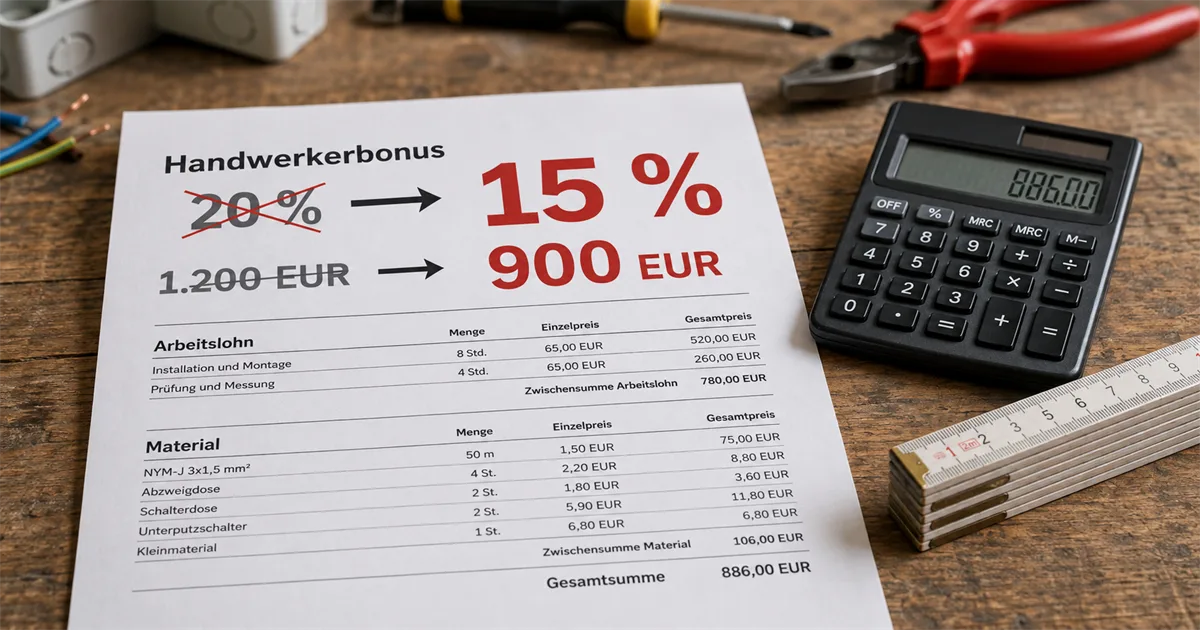
What applies today is unchanged: 20 percent of labour costs, up to 1,200 euros per year. Nothing changes for anything your customer pays in 2026. However, a cut to 15 percent and 900 euros is planned from 2027 – for a customer who uses the full amount, that would be 300 euros less per year.
This cut is not yet law. On 2 September 2026, the federal cabinet approved a draft bill – that is the government's proposal, not the finished law. The Bundestag and Bundesrat still have to agree, and the Bundesrat really can stop the law, because the federal states are entitled to a large share of income tax. A cut is likely in principle – originally, complete abolition was on the table, so 15 percent is already a compromise. Whether it ends up being exactly 15 percent is open.
More important for your day-to-day work than the percentage is one point that does not change at all: what counts is the year your customer pays, not the invoice date. Anyone who transfers the money in December 2026 still gets the 20 percent – even if you only write the invoice in January.
This article provides general information and does not replace tax advice.
Contents
- What your customer actually loses – two calculations
- Is this certain yet? Where the bill stands
- Payment date, not invoice date: where it gets expensive
- Is it worth settling jobs in 2026?
- What does NOT change: cleaning, garden care, winter service
- Does anything change on your invoices?
- What to tell your customer on the phone
- What else the reform means for your business
- Frequently asked questions
What your customer actually loses – two calculations
The tax credit for tradespeople's services is set out in section 35a paragraph 3 of the German Income Tax Act. It works differently from what people usually call "deducting": the amount is taken straight off the tax your customer owes. A 900-euro credit means 900 euros less tax – not 900 euros less taxable income.
The calculation is always based on labour costs including the VAT charged on them. Materials never count.
Example 1 – the small repair. You replace a fuse box, 1,400 euros of labour costs including VAT:
| 2026 (applies) | from 2027 (planned) | Difference | |
|---|---|---|---|
| Rate | 20 % | 15 % | |
| Customer's credit | 280.00 € | 210.00 € | −70.00 € |
Example 2 – the bathroom renovation. 7,500 euros of labour costs including VAT. Here the cap applies:
| 2026 (applies) | from 2027 (planned) | Difference | |
|---|---|---|---|
| Calculated | 1,500.00 € | 1,125.00 € | |
| Maximum | 1,200.00 € | 900.00 € | |
| Customer's credit | 1,200.00 € | 900.00 € | −300.00 € |
The cap kicks in at 6,000 euros of labour costs – that threshold stays the same, only the percentage applied to it falls. So anyone already above 6,000 euros loses exactly 300 euros. Below that, they lose a quarter of their previous credit.
Is this certain yet? Where the bill stands
No, it is not certain. That matters before you present it to a customer as settled.
Where the process stands. On 2 September 2026, the cabinet approved the draft Income Tax Reform Act 2027. A cabinet decision is the government's proposal – no more than that. Next, the Bundestag debates it, then the Bundesrat. Only once both have agreed and the law appears in the Federal Law Gazette does it apply.
Why the Bundesrat really has a say here. For taxes whose revenue goes to the federal states, the law needs the Bundesrat's consent – that is set out in Article 105 paragraph 3 of the Basic Law. With income tax, the states receive 42.5 percent. So the Bundesrat can not only delay the law but block it. The states warned about lost revenue in advance; the federal government has promised compensation, but the details are still open. These are exactly the points that get renegotiated during the process.
Why the cut is nevertheless likely. Originally, complete abolition of the tradesperson credit was on the table – the Federal Court of Auditors had recommended it. The German Confederation of Skilled Crafts spent months working against it; its president, Jörg Dittrich, counts keeping it in reduced form as a partial success. So the 15 percent is already the result of a compromise, not the start of a debate. On top of that, the cut helps fund the relief measures. Anyone who removes it has to find the money elsewhere.
What could still push back. The German Economic Institute calculates that the cut encourages undeclared work – in the worst case by around one billion euros a year. Parts of the governing parties consider the overall relief too small. Both can lead to amendments in the Bundestag. And the crafts confederation continues to criticise the draft: General Secretary Holger Schwannecke speaks of a "distortion of competition", because partnerships and sole traders are burdened more heavily than corporations.
Bottom line: a cut to the credit is likely. Exactly 15 percent and 900 euros is less certain – such details tend to get adjusted during the process. There is no date for the votes so far.
What this means for you: say "under the current draft bill" rather than "from 2027 this is how it is". If a customer brings a job forward because of it and the cut turns out differently later, they have still done nothing wrong – the 20 percent in 2026 is certain for them.
Payment date, not invoice date: where it gets expensive
This is the practical mistake you can prevent.
For the credit, only the year in which the money leaves your customer's account counts – so when they transfer it. Not when you wrote the invoice, and not when you did the work. (Tax people call this the cash-flow principle; you only need the term if your customer's tax adviser brings it up.)
Which leads to the case that causes trouble every January:
You finish the work on 18 December 2026 and write the invoice on 20 December. Your customer transfers the money on 8 January 2027. Result: the 15 percent applies, not the 20.
The customer thinks they are still in 2026 – after all, the work was done in 2026. The tax office only sees the payment date on the bank statement.
Note: the draft bill so far only states that the new rates apply from 1 January 2027. It contains no explicit transitional rule for cases that straddle the turn of the year. Until the final text of the law is available, the safe reading is: payment by 31 December 2026 = 20 percent.
Is it worth settling jobs in 2026?
For the customer: yes, if the work is due anyway. For you it is a selling point, but not a particularly strong one – be honest about the numbers.
On a job with 3,000 euros of labour costs, the difference is 150 euros. That rarely shifts a buying decision. On a renovation of 6,000 euros or more it is 300 euros – the customer notices that.
More interesting is a second point many people miss: the maximum applies per year and per household. On a large job, it pays for the customer to split it across the turn of the year – part paid in 2026, the rest in 2027. That way they use up two maximum amounts instead of one.
Worked example. 12,000 euros of labour costs, with a progress invoice of 6,000 euros paid in December 2026 and the final invoice of 6,000 euros in February 2027:
- All paid in 2027: 900 euros credit (the cap).
- Split: 1,200 euros (2026) + 900 euros (2027) = 2,100 euros.
That is a 1,200-euro difference for your customer – considerably more than the cut itself. The condition is that the progress invoice is factually justified and the customer actually pays it in the old year. How to bill this cleanly is covered in our article on writing a progress invoice.
Two things that can go wrong: the tax office does not accept a pure prepayment with no work performed. And if you agree a split with the customer, put the payment dates in writing – otherwise they will transfer everything at once anyway.
What does NOT change: cleaning, garden care, winter service
There is a lot of confusion about this right now, so here is the clear split.
Section 35a has several pots. Only the one for tradespeople's services is being cut:
| What | Paragraph | Rate | Maximum | Changing? |
|---|---|---|---|---|
| Trade services (renovation, maintenance, modernisation) | Para. 3 | 20 % → 15 % | 1,200 € → 900 € | yes, planned from 2027 |
| Household services (cleaning help, garden care, winter service) | Para. 2 | 20 % | 4,000 € | no |
| Household employment, minijob in a private household | Para. 1 | 20 % | 510 € | no |
This matters to you if you offer both. A landscaping business that paves a terrace (trade service) and mows the lawn (household service) under the same job will be billing at two different rates from 2027, if the draft goes through as it stands. Show those items separately – otherwise the customer has to explain to the tax office what belongs where, and in case of doubt it will assign everything to the less favourable pot.
Also unchanged: there is still no credit for new builds, and anyone claiming public funding for the same measure – from the state development bank KfW, for example – cannot claim the tax credit for it on top.
Does anything change on your invoices?
Not in terms of format. The requirements stay exactly the same, and they were already the decisive point:
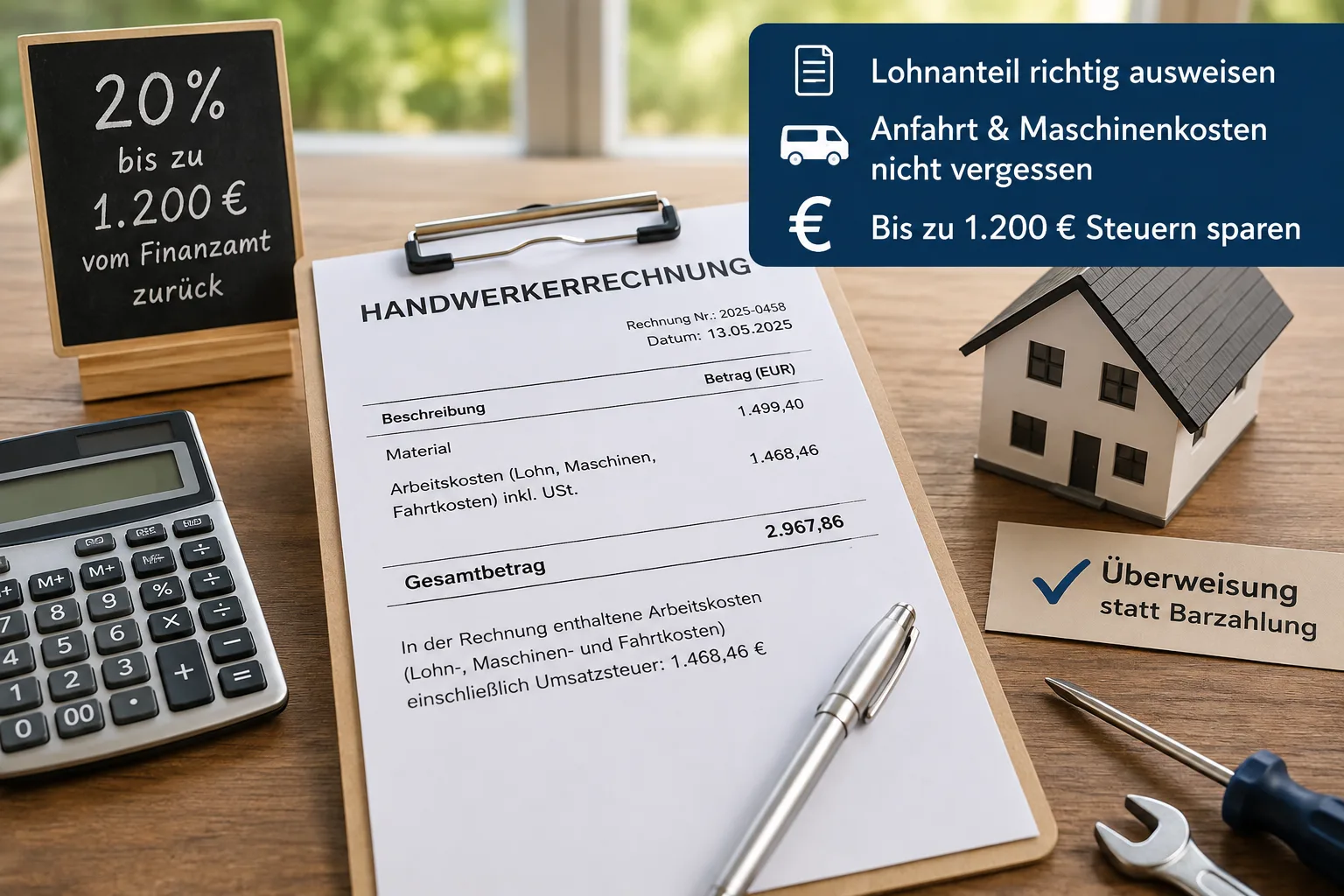
- The labour costs are shown separately from materials on the invoice. If there is only a total, your customer gets nothing – neither 20 nor 15 percent.
- The customer transferred the money rather than paying cash. Cash payment rules out the credit, even with a receipt.
- Labour costs also include travel and machine costs, not just the hours.
Our article writing a tradesperson's invoice: showing the labour share covers how to structure this in detail.
What does change is the significance of that split. Until now the cap sat at 6,000 euros of labour costs and a credit of 1,200 euros. In future the credit is smaller while the 6,000-euro threshold stays the same. Put differently: a customer who was already close to the maximum on a mid-sized job loses proportionally more if you state labour costs too low or incompletely. If you have quietly counted travel as materials until now, that will cost them noticeably more from 2027.
In office1.cloud, you separate labour and material items in the document editor and show the labour costs as their own total, so your customer can transfer the figure straight into their tax return.
What to tell your customer on the phone
If a customer asks because they heard it in the news, three sentences are enough:
"Under the current draft bill, the tax credit falls from 20 to 15 percent from 2027, with a maximum of 900 instead of 1,200 euros. It has not been passed yet – the Bundestag and Bundesrat still have to agree. What matters is when you pay: if you transfer the money this year, the 20 percent applies to you."
What to leave out: an estimate of what the customer personally saves. You do not know their other trade invoices for the year, and the maximum applies to the whole household. Give them the rates and the cap; their tax software works out the rest.
And if the customer hesitates because of it? Expect that if you have been mentioning the saving in your quotes. The honest answer is that little changes on the invoice: on a 3,000-euro job it is 150 euros. Anyone who leaves a faulty circuit for a year over 150 euros would have postponed the job anyway. On larger renovations, splitting across the turn of the year is the stronger argument – it brings the customer more than the cut takes away.
What else the reform means for your business
The cut hits your customer. Two further points in the draft hit you directly:
The flat-rate minijob tax is set to rise from 2 to 5 percent. If you employ an assistant on a 603-euro basis, your levy on that wage goes up. At 603 euros, that is around 18 euros more per month, a good 217 euros per year per minijobber. We have worked through what a minijob costs in total in taking on a minijob employee.
As a sole trader you get less out of it than a limited company. The reform mainly cuts income tax for low and middle incomes – the basic allowance rises to 12,564 euros (2027) and 12,900 euros (2028), the employee allowance from 1,230 to 1,430 euros, and child benefit goes up. You benefit from the rate cut like everyone else. The higher employee allowance, however, passes you by, because you are not an employee.
That is exactly where the crafts sector's criticism starts. Three quarters of skilled crafts businesses are sole traders or partnerships – businesses whose profit lands directly with the owner as income tax, unlike a limited company. For these businesses, the relief is weaker.
The federal government puts the total relief volume at around ten billion euros a year from 2028. If you state the labour share clearly, the proof for your customer is already done — a quote and invoice software comes with templates for it.
Frequently asked questions
Does the cut also apply to 2026 invoices that are only paid in 2027? If it goes through: yes. What counts is the year of payment, not the invoice date. The draft contains no explicit transitional rule for cases straddling the turn of the year.
Does VAT on the labour costs count towards it? Yes. The calculation uses the gross labour costs, including the VAT charged on them.
What if I invoice without VAT as a small business? Then the labour costs you state are the relevant amount. Your customer's credit is correspondingly lower because no VAT is added. That changes nothing about separating labour and materials.
My customer is a landlord and claims the work as income-related expenses. Does the cut affect them? No. Section 35a applies to the household you live in yourself. Anyone repairing a rented flat deducts the costs as income-related expenses – a different provision, untouched by this reform.
Does the 6,000-euro limit on labour costs change? No. Only the percentage applied to it falls, which is why the calculated maximum drops from 1,200 to 900 euros.
When will this be finally settled? Once the Bundestag and Bundesrat have agreed. No date has been set for that yet. Until then, 20 percent and 1,200 euros continue to apply for 2026.
Handle invoices more easily
Easy Invoice combines quotes, invoices and customer management in the cloud.
Try Easy InvoiceRead next
 Trades & Services
Hiring a minijob employee: what a 603-euro job really costs
A minijob employee costs more than their wages. What a 603-euro job costs per month and per hour in 2026, how many hours it covers, what the accident insurance fund charges and how you register the job.
 Trades & Services
Digital time tracking in Germany: Do you need it — and if so, what must it look like?
Everyone talks about the duty to track time digitally. For businesses with up to ten employees, it is precisely the electronic form that is set to be waived permanently – the recording itself still applies, and for mini-jobbers it is stricter. Find your case first.
 Trades & Services
Tradesman's invoice: how to show the labour cost – and save your customer up to 1,200 euros in tax
Private customers can deduct 20 percent of the labour cost from their tax – but only if your invoice shows it separately. Here is how to write it.