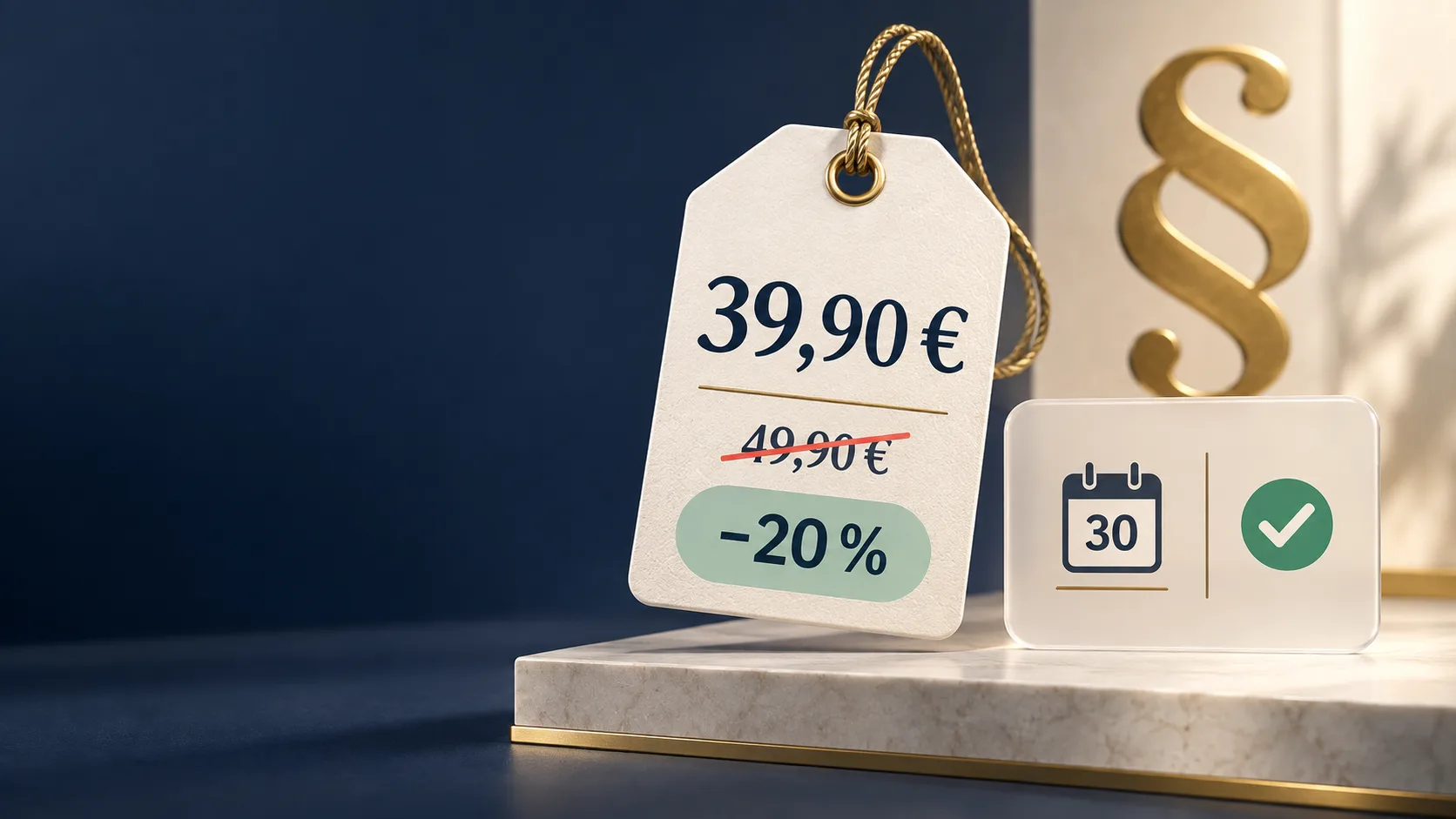
If you sell to consumers in Germany and cross out a price or advertise a discount in percent, the reference price may only be the lowest price you yourself charged in the 30 days before. The percentage must be calculated from exactly that price, and the reference must be clearly legible next to the sale price, not in a footnote. This applies to every discount campaign aimed at private customers, whether in an online shop, on a marketplace or in a store – on Black Friday just as on any other day. A breach costs a cease-and-desist letter, and in administrative proceedings up to 25,000 euros.
Contents
- Who does the Price Indication Ordinance apply to?
- What must always appear with the price?
- Which price may I cross out?
- Do I have to change every price for "20% off everything"?
- May I cross out the RRP?
- New goods, discount codes, loyalty discounts: the exceptions
- Strikethrough prices on eBay, Amazon and Shopify
- What happens if I break the rules?
- Frequently asked questions
Who does the Price Indication Ordinance apply to?
To anyone offering goods to private customers in Germany or advertising to them. Whether you run a physical store, your own online shop or sell via eBay makes no difference. As soon as a consumer can see your price, the ordinance applies.
Not covered are offers aimed exclusively at business customers. § 1 of the Preisangabenverordnung (PAngV, the German Price Indication Ordinance) governs "the indication of prices for goods or services by traders towards consumers". A pure wholesale shop with access checks falls outside. A shop serving both falls inside – for consumers, the duties then apply on every page they can see.
The 30-day rule for discounts has a second limit: it applies only to goods. If you offer a service at a lower price, such as a repair or a course, you do not have to state the old price under this rule. Misleading customers is still prohibited; competition law forbids that regardless of the ordinance.
The rule itself is not a German peculiarity. It implements Article 6a of the EU Price Indication Directive, so the same principle applies in every EU country. What differs is the detail of enforcement, and this article describes the German version.
Whether you count as a trader at all is not decided by the ordinance but by how you act on the market. Where the line runs is explained in When do I count as a business seller on eBay and other marketplaces?.
The ordinance no longer applies to the invoice after the sale; that is governed by the VAT Act. With an invoicing programme you then invoice the advertised sale price exactly as the customer saw it. Which details are mandatory on the invoice is explained in How to write an invoice.
What must always appear with the price?
Three details, regardless of any discount. Anyone who omits them is already in breach of the ordinance before the first campaign.
| Detail | What you have to do | Where it is regulated |
|---|---|---|
| Total price | State the price the customer pays in the end, including VAT and all other price components. If the price is broken down, the total price must be highlighted | § 3 PAngV |
| Note on VAT and shipping | In an online shop, say that VAT is included and whether shipping costs apply. State their amount if it can be calculated in advance | § 6 PAngV |
| Unit price | For goods sold by weight, volume, length or area, additionally state the price per kilogram, litre, metre or square metre, "unambiguously, clearly recognisable and easily legible" | § 4 PAngV |
The unit price is the point small shops most often overlook. If you sell 250 grams of coffee for 6.90 euros, you must add "27.60 euros/kg". If you sell a ten-metre roll of gift ribbon, you need the price per metre. Exceptions exist, among others, for packs under ten grams or ten millilitres, for vending machines and for farm shops, kiosks and similar small outlets with personal service.
Which price may I cross out?
Only the lowest price you yourself charged in the 30 days before the campaign. Not yesterday's price, not the "normal" price, not the catalogue price. § 11 paragraph 1 PAngV requires, at "every announcement of a price reduction for goods, the indication of the lowest total price which the trader applied towards consumers within the last 30 days before the application of the price reduction".
An example with figures, as happens constantly during Black Week:
| Period | Your price for the jumper | What follows |
|---|---|---|
| until 31 October | 59.90 euros | regular price |
| 1 to 20 November | 49.90 euros | autumn promotion |
| 21 to 26 November | 59.90 euros | regular again |
| from 27 November (Black Friday) | 39.90 euros | strikethrough price must be 49.90 euros, discount 20 percent |
Anyone who crosses out 59.90 euros here and writes "minus 33 percent" is in breach of the ordinance. The lowest price of the last 30 days was 49.90 euros, and 39.90 euros is only 20 percent less than that.
The Court of Justice of the European Union clarified the second part of this rule on 26 September 2024 (case C-330/23, Aldi Süd): the advertised percentage must relate to the 30-day price. It is not enough to add the 30-day price somewhere and calculate the discount from a higher price.
The German Federal Court of Justice settled the form on 9 October 2025 (case I ZR 183/24): the indication must be made "in a manner that is unambiguous, clearly recognisable and easily legible for the consumer addressed". In the case decided, the sale price of 4.44 euros was printed large, a comparison price of 6.99 euros small with "minus 36 percent", and the actual 30-day price only in a confusingly worded footnote. That is not sufficient.
This is what a price label looks like that complies with both rulings:
Merino jumper
39.90 €        −20 %
Lowest price of the last 30 days: 49.90 €
Three things are decisive: the reference price sits directly next to the sale price, it is legibly large, and the percentage matches it. Whether you cross out the old price or state it in a sentence is up to you. What does not work: an asterisk and the explanation at the bottom of the page.
Do I have to change every price for "20% off everything"?
No, you do not have to rewrite the price labels. But the 30-day rule still applies to every single product.
§ 9 paragraph 1 PAngV exempts "general price reductions limited to calendar days and announced through advertising or otherwise" from the duty to display a new total price for every item. The customer may deduct the 20 percent themselves. The exemption only reaches this far, though: the price from which they deduct must, for every item, be the lowest price of the last 30 days. In an online shop this means the price on every product page is that 30-day price, or it is shown there.
From this follows the most important rule for planning a campaign: do not raise any price in the 30 days before the start. Raising prices is not forbidden, it simply achieves nothing: the old, lower price still counts as the reference. Anyone who raises prices by 20 percent on 1 November and promises "20% off everything" on 27 November has not given a discount but restored the old price – and must state the old price as the reference. This is exactly the case the ordinance is meant to prevent, and exactly where those issuing warning letters start.
If you want to raise prices permanently, do it after the campaign and with notice. How customers take this best is explained in Raising prices: how to communicate adjustments properly.
One special case is permitted: if you increase the discount step by step within a running campaign, say 10 percent on Monday, 20 percent on Wednesday, 30 percent on Friday, § 11 paragraph 2 PAngV allows you to state the pre-campaign price as the reference throughout the whole campaign. Condition: the discount rises without interruption. If the price goes back up in between, the calculation starts afresh.
May I cross out the RRP?
Yes, if the customer clearly recognises that it is the manufacturer's recommendation and not your earlier price. As soon as the presentation looks like a discount on your own price, the 30-day rule applies here too – and the RRP was then the wrong reference price.
The courts currently draw the line differently:
| Court | What was advertised | Outcome |
|---|---|---|
| Higher Regional Court of Cologne, 15 May 2026 (6 U 92/25) | Discounter leaflet: yoghurt for 33 cents, "minus 58 percent", calculated from the crossed-out manufacturer's recommendation of 79 cents, clearly labelled as RRP | No breach. A price reduction under § 11 requires an earlier own price; the clearly labelled RRP is a comparison with a third party. Appeal to the Federal Court admitted, the consumer association has announced it |
| Higher Regional Court of Düsseldorf, 18 December 2025 (I-20 U 43/25) | Leaflet "Your brands even cheaper – save up to −48%", strikethrough prices on every tile, the word "RRP" small and in the background | Breach. The overall impression is a price cut by the retailer; then the 30-day price must be stated. Appeal to the Federal Court admitted, not final |
Both cases are therefore before the Federal Court of Justice. Until it decides, the safe design is this: the RRP is written out or marked "UVP" in the same font size as the price, without a percentage and without red colour, and not next to genuine discounts on the same page. Anyone who makes the RRP look like a discount will be measured against the rules for discounts.
Two conditions always apply: the RRP must actually have been issued by the manufacturer and still be valid. A recommendation the manufacturer lowered long ago is no longer a reference price but a fictitious price.
New goods, discount codes, loyalty discounts: the exceptions
Four cases in which you need no reference price or a different one:
| Case | What applies |
|---|---|
| Goods have been in the range for less than 30 days | The lowest price since the first day of the offer is decisive. An introductory price is allowed, but the goods must not have been "introduced" at a high price only on the day of the campaign |
| Individual discount | A code that only one particular customer receives, for a birthday or after a complaint, is not an "announcement of a price reduction" and falls outside under § 11 paragraph 4. A code displayed on your homepage or sent in a newsletter to everyone is, according to the prevailing view, a public campaign – the 30-day rule applies. There is no court ruling on this yet |
| Loyalty programme | Points or percentages that customers collect over a longer period are not an advertised price reduction on goods |
| Perishable goods | Anyone selling food cheaper shortly before its expiry date and making that clear needs no 30-day price |
Not on this list is the bundle offer ("two for the price of one"). It is not a price reduction within the meaning of § 11 as long as you do not advertise the bundle price with crossed-out individual prices. As soon as you add "you save 29.90 euros", you are calculating with a reference price again, and it must be correct.
Strikethrough prices on eBay, Amazon and Shopify
The platform does not take the responsibility off your hands. The person responsible for the price is always the one selling. What differs is the technology:
eBay knows two kinds of comparison price and regulates both in a dedicated policy: the manufacturer's RRP and the "was price", meaning your own earlier price. For the was price, eBay adopts the 30-day rule word for word: it must be "the seller's lowest previous selling price" that was "applied during a period of at least 30 days before the announcement of the price reduction". eBay may request evidence for this, such as sales reports, and expects it within two to three days. Anyone who fails to deliver risks suspension of the account or loss of Top Rated Seller status.
Amazon has itself been convicted: the Regional Court of Munich I on 14 July 2025 (4 HK O 13950/24, not final) objected to strikethrough prices during Prime Deal Days that related to the RRP or to an "average selling price" instead of the lowest price of the last 30 days. For you as a seller this means: whatever Amazon displays from your price fields is measured against the same rules. Enter into the RRP field only a recommendation the manufacturer actually issues and that you can prove. How else to prepare a promotion week on Amazon is explained in Amazon Prime Day: emergency plan for sellers.
Shopify has a "compare at price" field that produces the strikethrough price. It stores no history. Whether the value in it is the lowest price of the last 30 days is known only to those who have recorded their own price changes. So keep a list per product with date and price, or use an extension that calculates the 30-day price itself. WooCommerce and Shopware work just as much without a history unless you add a module.
What happens if I break the rules?
Usually a cease-and-desist letter, in the worse case a fine. Neither comes from the tax office but from competitors, consumer associations and competition associations.
The warning letter demands a cease-and-desist declaration and reimbursement of the lawyer's fees. Anyone who signs it and later makes the same mistake pays the agreed contractual penalty. Anyone who does not sign risks an injunction suit. Anyone who carries on afterwards pays an administrative fine set by the court.
In addition, the breach is a regulatory offence. § 20 PAngV expressly names the case in which someone, contrary to § 11 paragraph 1, indicates the lowest total price "not, not correctly or not completely". The fine can amount to up to 25,000 euros under § 3 paragraph 2 of the German Economic Offences Act.
Try Easy Invoice free for 10 days – no payment details, the trial ends by itself.
Frequently asked questions
Do I have to state the old price if I simply lower the price?
No. The duty only arises with the "announcement of a price reduction". Anyone who sets the price from 59.90 to 49.90 euros and says nothing about it needs no reference price. As soon as "discount", "offer", "sale" or a crossed-out price appears on the product, the reduction has been announced and the 30-day rule applies.
What applies to the next campaign after Black Friday?
The sale price becomes the reference price. Anyone who charged 39.90 euros on 27 November may not cross out 59.90 euros again in the December sale, but only 39.90 euros, until 30 days have passed since the end of the campaign. So if you plan three campaigns in a row, plan them as one stepwise reduction under § 11 paragraph 2 or leave 30 days between them.
May I advertise with "Black Friday" in Germany?
Yes. The word mark "Black Friday" has been completely deleted from the register of the German Patent and Trade Mark Office. The Regional Court of Berlin ordered the deletion in 2021, the Berlin Court of Appeal confirmed it on 14 October 2022 (5 U 46/21), and the Federal Court of Justice rejected the appeal against it in 2023. Warning letters over the term, as there used to be, no longer have any basis. In 2026 Black Friday falls on 27 November, Cyber Monday on 30 November.
Does the 30-day rule also apply in a physical store?
Yes. The ordinance does not distinguish between online shop and store. The Federal Court's coffee ruling concerned a leaflet for branches. The price label on the shelf must also legibly state the lowest price of the last 30 days if a discount appears next to it.
How long do I have to keep my price history?
There is no statutory period for this. But you need the history to prove, in a dispute, that your reference price was the lowest of the last 30 days – and eBay demands exactly this evidence within a few days. Keep the date and price of every change per product at least as long as a warning letter is possible, meaning beyond the current year.
What should the note on the old price say?
The ordinance prescribes no wording, only the substance: the lowest total price of the last 30 days, unambiguous and easily legible. "Lowest price of the last 30 days: €49.90" directly under the sale price has proven itself. A crossed-out price without explanation is permissible if it is that price; but it does not tell the customer what it refers to and protects you less if a competitor reads it differently.
Does all this also apply if I only give discounts to companies?
No. Anyone who addresses only business customers and enforces this, for instance with registration as a trader before the price is shown, does not fall under the ordinance. But as soon as the same price is also visible to a consumer, the duties apply in full to that view.
Sources
- § 1 Preisangabenverordnung – Anwendungsbereich
- § 3 Preisangabenverordnung – Pflicht zur Angabe des Gesamtpreises
- § 4 Preisangabenverordnung – Pflicht zur Angabe des Grundpreises
- § 6 Preisangabenverordnung – Fernabsatzverträge
- § 9 Preisangabenverordnung – Ausnahmen bei Preisermäßigungen
- § 11 Preisangabenverordnung – Zusätzliche Preisangabenpflicht bei Preisermäßigungen
- § 20 Preisangabenverordnung – Ordnungswidrigkeiten
- § 3 Wirtschaftsstrafgesetz 1954 – Preisverstöße
- Bundesgerichtshof, press release on the judgment of 9 October 2025, I ZR 183/24
- Court of Justice of the EU, judgment of 26 September 2024, C-330/23 (Aldi Süd)
- Oberlandesgericht Düsseldorf, judgment of 18 December 2025, I-20 U 43/25
- Oberlandesgericht Düsseldorf, press release of 18 December 2025
- Oberlandesgericht Köln, judgment of 15 May 2026, 6 U 92/25 (full text)
- Verbraucherzentrale Baden-Württemberg, press release on the judgment of the Regional Court of Munich I of 14 July 2025
- eBay, policy on advertising with comparison prices
- Noerr, the dispute over the "Black Friday" trade mark is over (deletion, KG 5 U 46/21)
Handle invoices more easily
Easy Invoice combines quotes, invoices and customer management in the cloud.
Try Easy InvoiceRead next
 Taxes & Law
Entertainment receipt in Germany: what to write on it
A German entertainment receipt needs five details: place, day, guests, reason and amount. Miss one and the deduction is gone — and since 2025 new rules apply to the restaurant bill.
 Taxes & Law
Advance VAT return in Germany: deadlines, thresholds, monthly or quarterly
If you run a business in Germany, you file an advance VAT return by the 10th day after each period. This article shows which cycle applies to you, when your next date falls and how to buy yourself an extra month.
 Taxes & Law
Which insurance do I need as a self-employed person in Germany? Mandatory, essential and skippable – costed out for three businesses
Health insurance is compulsory, pension insurance only for certain trades, and every business must register with its employers' liability association. Everything else is your call. What a roofer, a programmer and a café owner really need – and the order to buy in when money is tight.