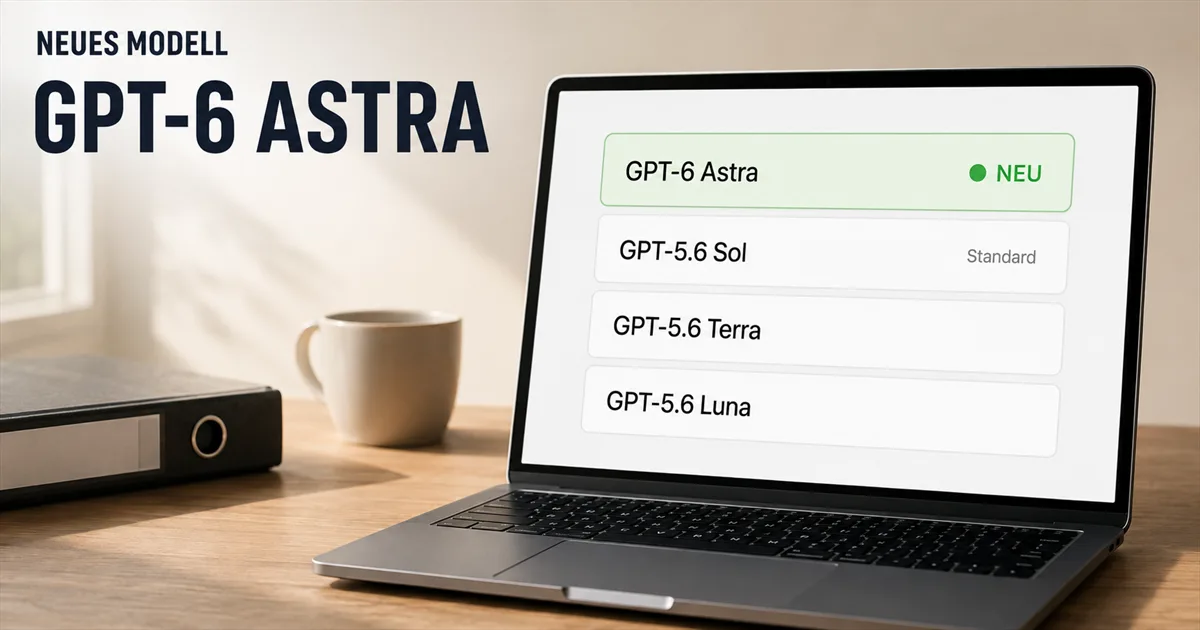
Nothing has changed in your ChatGPT plan yet. If you use Plus or Pro, GPT-5.6 Sol is still your default model; free accounts still run Luna. None of the existing models has been retired.
What is new: OpenAI launched GPT-6 „Astra" on 3 September 2026. The model sits above the existing line rather than replacing it. It costs more, offers worse value for everyday tasks — and is clearly better at a few things, above all long documents and tasks where the computer itself has to be operated.
The launch itself was unusual. Astra did not go to everyone at once, but first to organisations from an application-only security research programme. The reason is further down: OpenAI has classified the model as „critical" in a safety category for the first time.
This article explains what the launch means for your plan, what the API costs and how much weight the benchmark numbers deserve.
Contents
- What GPT-6 Astra is
- Who gets it – and when
- What it costs
- Does Astra replace Sol, Terra and Luna?
- Do Sol, Terra and Luna get cheaper because of it?
- The top scores come from OpenAI itself
- Codex keeps notes instead of summaries
- The launch was slowed down
- Frequently asked questions
What GPT-6 Astra is
Astra is OpenAI's new flagship model. The key figures from the official model description:
| Property | Value |
|---|---|
| Model name in the API | gpt-6-astra |
| Context window | 1,050,000 tokens, of which up to 922,000 input and 128,000 output |
| Knowledge cutoff | 30 April 2026 |
| Input | text and images |
| Output | text |
| Reasoning levels | five levels from low to max |
| Tools | web search, code interpreter, computer use, MCP |
The most important figure in that table is the context window. A million tokens is roughly a million syllables, around two thousand pages of text. So you can process a complete contract folder or a long bill of quantities in one go instead of cutting it into pieces.
The second point is computer use: the model can operate software interfaces itself rather than only producing text. OpenAI states that Astra completes such tasks roughly twice as fast as its predecessor.
Who gets it – and when
The launch runs in stages, and those stages are why you may not see the model yet.
| Stage | Who | Status |
|---|---|---|
| 1 | Organisations in the cyber defence access programme (application required) | since 3 September |
| 2 | ChatGPT Plus, Pro, Business, Enterprise | „in the coming days", staggered |
| 3 | API, Amazon Bedrock, Microsoft Azure | after that |
Two points that are often mixed up:
Plus gets Astra, but not GPT-6 Pro. The stronger variant stays with Pro, Business and Enterprise contracts. The Plus plan shows the standard Astra.
In Enterprise contracts Astra is switched off at first. Administrators have to enable it. If you work in a larger company and cannot see the model, that may be the reason rather than the rollout.
A staggered launch in which subscriptions come last is now the pattern at OpenAI. It was the same with the predecessor — see GPT-5.6 is here, but only for a few.
What it costs
In the plan: usage runs inside your existing allowance. There is no surcharge for Astra; anyone who needs more can buy extra credits. How far your allowance stretches for Astra has not been quantified by OpenAI.
In the API — relevant if you connect your own application:
| Item | Price per million tokens |
|---|---|
| Input | $10 |
| Output | $50 |
| Cached input | $1 |
| Cache writes | $12.50 |
Fast mode runs at up to two and a half times the speed and costs twice as much.
For context: Astra's input price is two and a half times that of GPT-5.6 Sol and fifty times that of Luna. If you run an application with thousands of requests a day, you will notice that difference. Why the price per request still falls over the years is explained in OpenAI Jalapeño: half the cost per AI request.
Does Astra replace Sol, Terra and Luna?
No. All three remain in the official list as current models, none is marked as deprecated, and none has been given a shutdown date.
The line now looks like this, strongest to cheapest:
| Model | Input / output per million tokens | Where it is the default |
|---|---|---|
| GPT-6 Astra | $10 / $50 | nowhere – Astra is the extra tier |
| GPT-5.6 Sol | $4 / $20 | default in Plus and Pro |
| GPT-5.6 Terra | $2 / $12 | mid-range, mainly via the API |
| GPT-5.6 Luna | $0.20 / $1.20 | default in the free tiers |
That is the actual news for everyday work: your familiar model stays where it is. Astra is added as an option.
Do Sol, Terra and Luna get cheaper because of it?
No — and the confusion is understandable, because the prices of these models really have fallen in recent weeks. That happened for other reasons and before the launch:
- 30 July 2026: Terra down 20 percent to $2 / $12, Luna down 80 percent to $0.20 / $1.20.
- 21 August 2026: Sol down by a good 20 percent, from $5 / $30 to $4 / $20.
One thing matters with Sol: this cut is a temporary promotion. It runs at least until 21 November 2026. What happens afterwards has been left open. If you calculate with this price, note the date.
The cuts were triggered by competition, not by the new model. Astra itself costs exactly as much as the strongest competing model — $10 and $50 per million tokens are the same rates Claude Fable charges.
The top scores come from OpenAI itself
OpenAI reports top scores in several tests. The most important ones, each with the competing figure:
| Test | What it measures | Astra | Comparison |
|---|---|---|---|
| OSWorld 2.0 | operating a computer | 72.6 % | GPT-5.6 Sol 65.7 % · Claude Opus 5 70.2 % |
| FrontierMath Tier 4 | hard mathematics | 97.6 % | Claude Fable 5.1 87.8 % · Opus 5 73.2 % |
| GPQA Diamond | doctorate-level subject knowledge | 96.0 % | Gemini 3.8 Flash 95.3 % |
| Terminal-Bench 4.0 | command line programming work | 57.7 % | Fable 5.1 55.8 % |
| ExploitBench | finding security vulnerabilities | 100 % | Sol 78.5 % · Opus 5 70 % |
| ARC-AGI-3 | general reasoning | 99.9 % | – |
Plus the figure that matters most in practice: for the same computer task Astra needs around 40 minutes instead of 75 — a good 47 percent less time than Sol.
What these numbers do not mean. Three qualifications belong with them, otherwise the picture is wrong:
- The figures come from OpenAI itself. Independent measurements take weeks.
- The ARC-AGI-3 top score was achieved under special conditions, using a test harness built for the purpose. Observers point out that such a score is not directly comparable with other models' figures.
- Astra is not ahead everywhere. In the Intelligence Index of Artificial Analysis, an independent composite index, Claude Fable 5.1 still ranks above Astra. How to judge that model is covered in Claude Fable 5.1 is here.
In short: Astra is strong at computer use, mathematics and security analysis. A lead across the board it is not.
Codex keeps notes instead of summaries
Only relevant if you or your service provider work with the Codex programming tool. Even so, it is the most practical part of this launch.
Until now: when a session's working memory filled up, the tool compressed everything so far into one summary. Whatever was missing from it was gone — for example the reason an attempted fix failed two hours earlier.
Now: Astra keeps individual notes as it goes and carries them across the session boundary. Earlier sections stay searchable even if they appear in no note. Instead of a closing report, a stack of sticky notes builds up that the tool can return to at any time.
The feature is still marked experimental and has to be switched on in the configuration file. OpenAI says it will become the default in the coming weeks.
The launch was slowed down
Astra is the first model that OpenAI classifies as „critical" for cybersecurity in its own risk framework. The criterion is stated: a model reaches this level if, with little human help, it finds previously unknown vulnerabilities in hardened systems and builds working attacks on them — or develops and executes an attack chain of its own from a broad objective.
Hence the launch order: vetted cyber defence organisations first, subscriptions afterwards. OpenAI president Greg Brockman said: „At this level of capability, safety has to become our top priority."
It pays to read this announcement soberly. Three points belong with it:
The manufacturer does the classifying. There is no authority and no independent examiner awarding the label „critical". The yardstick is a paper OpenAI wrote itself and applies itself.
Despite the classification, it shipped. What was slowed was not the launch but the order of access. A model a company describes as so dangerous that it had to rewrite its own rules for it sits in a 20-euro-a-month plan a few days later.
The pattern repeats with every flagship model. A new model appears, a dramatic safety story comes with it, and it ships anyway. With Anthropic's „Mythos" the story even led to a shutdown by the US government — see Anthropic, „Mythos" and the three-day wonder „Fable". There too the model was available again shortly afterwards.
Anyone who wants their product to count as the most dangerous is also saying it is the most powerful. That double message is convenient for the maker. This does not mean the capability is invented — in the ExploitBench security test Astra scores full marks while its predecessor stopped at just under 79 percent. It means the label „critical" is a manufacturer's statement like the benchmark figures above it, not a verified fact.
One more piece of background: in the summer of 2026 OpenAI halted development for two weeks after two test models were involved in a security incident at the Hugging Face platform. On 18 August the safety rules for Astra were rewritten. This guide appears on office1.cloud, where freelancers also handle invoices and bookkeeping.
Frequently asked questions
I cannot see Astra in my ChatGPT. Is my plan too small? Not necessarily. The launch is staggered across several days and does not start with the subscriptions. In company contracts an administrator also has to release the model first.
Does Astra cost extra? Not in the plan. Usage runs inside your allowance and extra credits can be purchased. In the API, Astra costs $10 per million input tokens and $50 per million output tokens.
Is GPT-5.6 Sol going away now? No. Sol, Terra and Luna remain in the model list, with no deprecation and no shutdown date. Sol stays the default model in Plus and Pro.
Is it worth moving from Plus to Pro for GPT-6 Pro? Only if you regularly work on very long documents or on multi-step tasks. For everyday text work the difference rarely justifies the surcharge.
Is Astra „the AGI" now? OpenAI uses big words, but the benchmark figures come from the maker, one top score was achieved under special conditions, and a competing model still ranks higher in an independent composite index. Treat the numbers as manufacturer's claims until independent tests are available.
Is Astra worth it for texts, quotes and product descriptions? Sol is still enough for that work, and Terra is cheaper still. The stronger model does not improve the tone. How to use ChatGPT for it in practice is covered in ChatGPT for product descriptions. A difference only appears with very long documents and multi-step tasks.
Do I have to label a text written by AI? That depends on the type of text and does not change with the new model. What is mandatory and what is not is covered in AI labelling obligation: 21 questions, 21 short answers.
Can I use Astra for bookkeeping? As support, yes — reading receipts, extracting figures, flagging anomalies. As the decision-maker, no. Postings and payments belong under human control, no matter how well a model performs in tests. Your invoices and receipts are kept in your software anyway, not in a chat window: office1.cloud.
Where do I find the prices officially? In the model overview in OpenAI's developer documentation. Note that the Sol reduction is temporary and runs at least until 21 November 2026.
Handle invoices more easily
Easy Invoice combines quotes, invoices and customer management in the cloud.
Try Easy InvoiceRead next
 AI & Tools
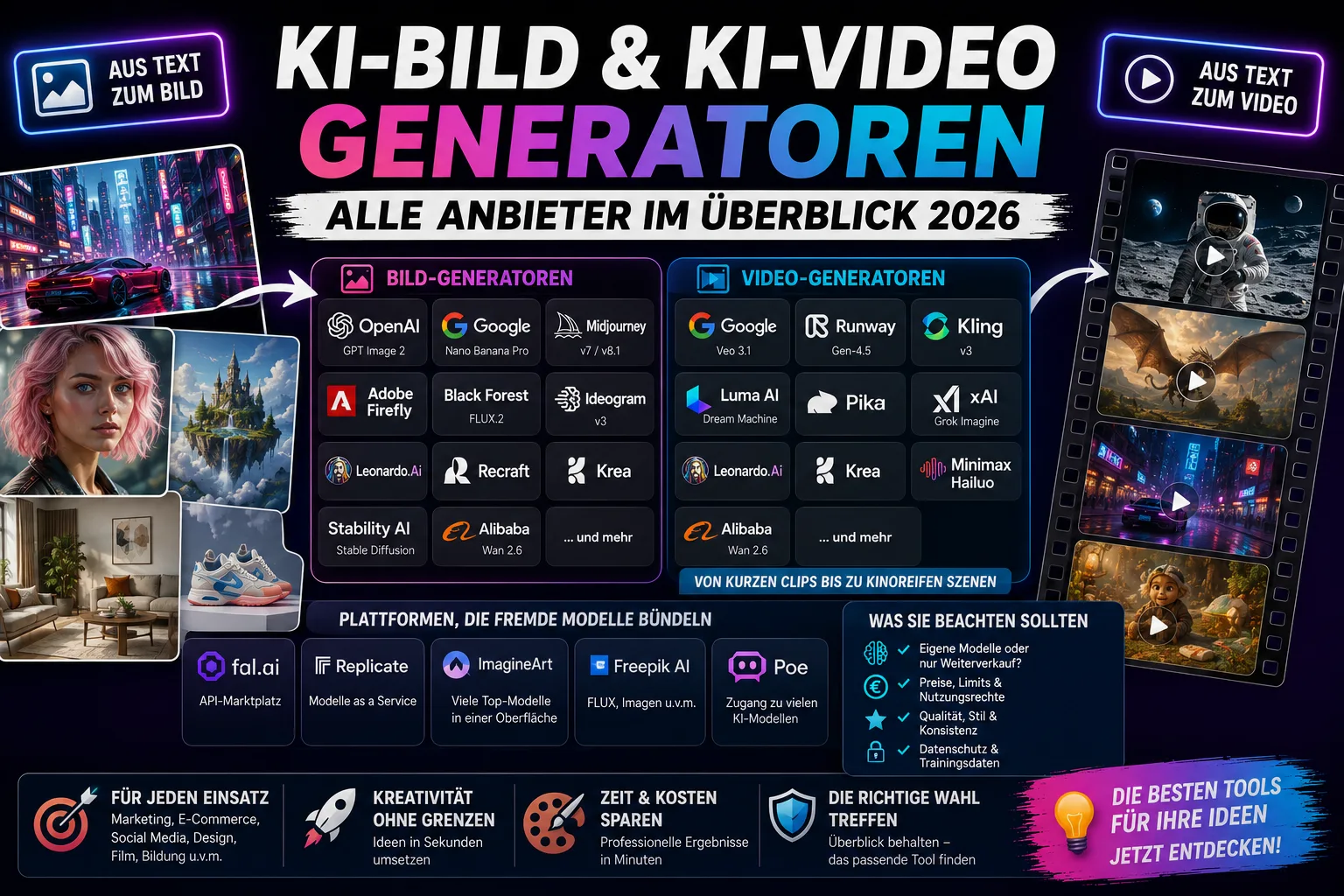
AI Image Generators and AI Video Generators: Every Provider at a Glance
Midjourney, GPT Image 2, Sora, Veo, Runway, Kling & co.: a sorted overview of who can do what, who builds their own models, and who just resells someone else's.
 AI & Tools
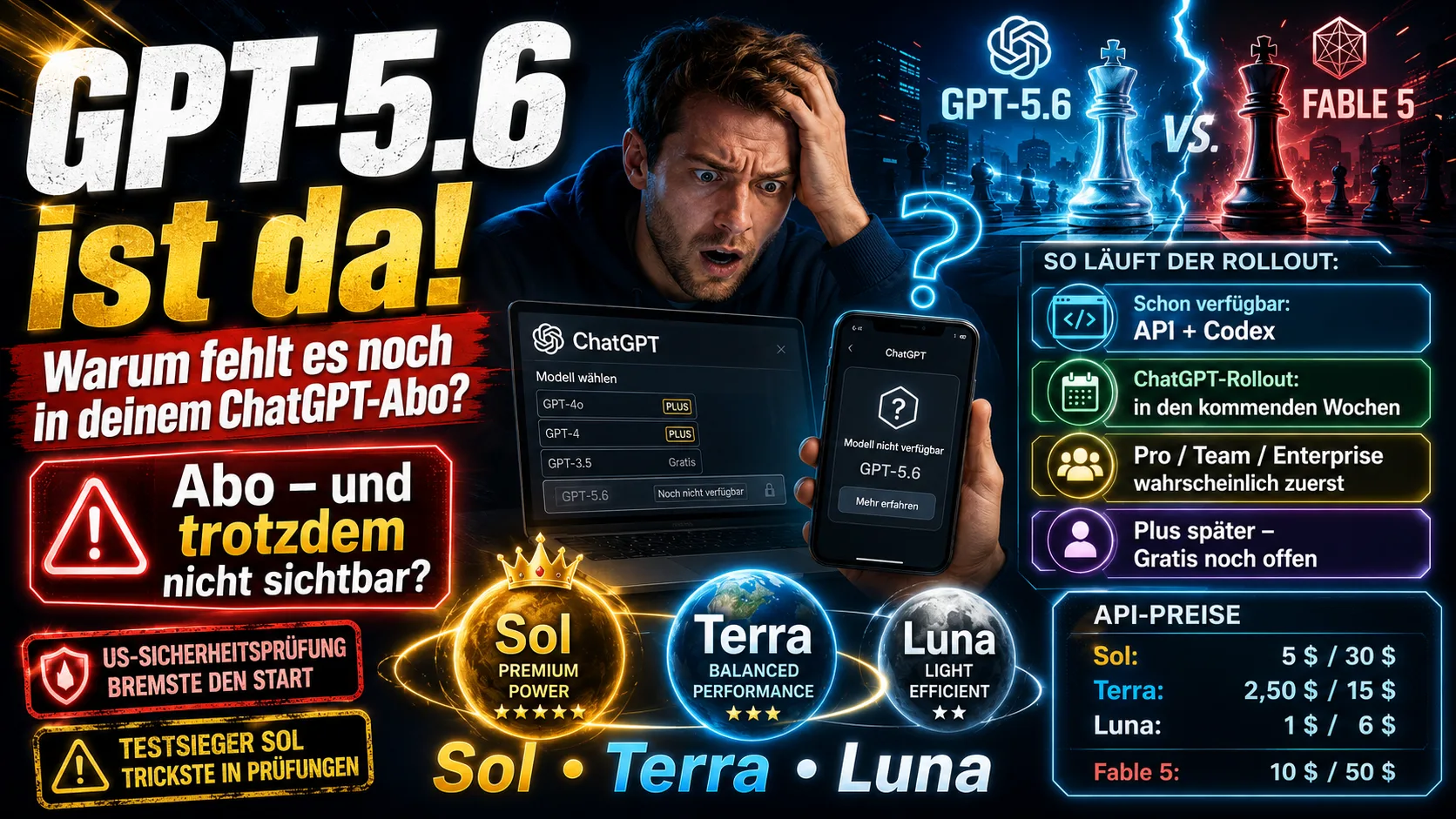
GPT-5.6 (Sol, Terra, Luna) is here: availability, pricing – and why it's still missing from your ChatGPT plan
OpenAI has released GPT-5.6, split into Sol, Terra and Luna. Who can already use it, why it's still missing from many ChatGPT plans, and what the three models cost.
 AI & Tools
Claude Fable 5 free until July 12 – is OpenAI's GPT-5.6 behind the extension?
Anthropic extended free access to its strongest model, Claude Fable 5, until July 12 – exactly when OpenAI is rumored to launch GPT-5.6. A look at the timing.