
For many self-employed people, their own tax return feels like a black box: Which forms are part of it? How do I work out my profit? And can I manage it without a tax adviser, without the tax office taking issue with something afterwards? The short answer up front: in most straightforward cases, you can do your tax return yourself. This guide walks you through the parts that really matter – from the schedules you need and the EÜR through to filing via ELSTER.
Do it yourself or hire a tax adviser? When each route pays off
The most common doubt first, because it decides everything else. Doing it yourself is realistic when your situation is manageable: a single self-employed activity, profit determined by a cash-basis income statement (the EÜR; more on that shortly), no employees, no complicated cross-border matters. You save the adviser's fee and get a better grasp of your own numbers along the way.
A tax adviser is worth it when things get intricate: an obligation to prepare a balance sheet, staff, shareholdings, restructurings, larger investments – or simply when you're short on time and a mistake would be costly. A good middle ground for many solo self-employed: prepare the return yourself with guided tax software (see below) and bring in an adviser only for specific points of doubt. The cost sits somewhere in between, too – tax software usually runs in the low double-digit euro range, whereas a tax adviser bills according to the official fee schedule and, depending on the scope, comes in considerably higher.
Worth knowing: as a self-employed person you are always required to file – even at a loss or with income below the basic tax-free allowance. More on this later in the section on special cases.
Receipts, bank transactions and the export for your accountant are bundled in the Easy Invoice accounting software in one place.
Which schedules you actually file as a self-employed person
For the self-employed, "the tax return" isn't a single form but a bundle. These are the parts you'll almost always need:
- Main form (cover sheet ESt 1 A) – your personal details.
- Anlage S or Anlage G – this is where your profit goes. Anlage S is used by liberal professionals (Freiberufler, e.g. copywriters, developers, designers, medical professions), Anlage G by commercial traders (Gewerbetreibende). Which one you are depends on the nature of your activity, not on your own assessment.
- Anlage EÜR – the actual profit calculation. It must be filed electronically via ELSTER; that is mandatory.
- Anlage Vorsorgeaufwand (pension and insurance costs) – for health, pension and other insurance contributions. Important: these private contributions belong here, not in the EÜR.
- Annual VAT return – only if you are liable for VAT. Small-business owners under the Kleinunternehmer scheme have been exempt from this since 2024 (more below).
- Trade tax return – for commercial traders, once the trade income exceeds the tax-free allowance of 24,500 euros.
Depending on your circumstances, further schedules may be added (children, rental income, capital gains). But the core for the self-employed activity remains: Anlage S/G + Anlage EÜR.
The EÜR: how to work out your profit
The Einnahmenüberschussrechnung (EÜR), a cash-basis income statement, is the heart of it all – and simpler than the name suggests. The principle: business income minus business expenses = profit. No double-entry bookkeeping, no balance sheet, just a straightforward comparison based on the cash principle of receipts and payments (§ 4 (3) EStG, the German Income Tax Act). What usually counts is when the money actually moved.
You may use this simple method of determining profit as long as you are not required to keep formal accounts. For commercial traders, the obligation to prepare a balance sheet only kicks in above 800,000 euros in turnover or 80,000 euros in profit per year (§ 141 AO, the German Fiscal Code) – and even then only after the tax office has expressly required you to do so. Liberal professionals may always use the EÜR, regardless of the amounts involved.
You draw the figures for the EÜR from your ongoing records: all invoices issued and paid on the income side, all business receipts on the expense side. If you record everything cleanly throughout the year, you'll fill in the EÜR in a good hour at year-end – if you're digging through a shoebox, you'll lose days. This is exactly where the final section comes in.
As a rule, you no longer submit the receipts themselves with the return – you keep them and only present them if the tax office asks for them. For invoices and accounting vouchers, a retention period of eight years has applied in most cases since 2025 (§ 147 AO); as long as an audit is possible, though, the documents should stay within reach.
What you can deduct – and where most people leave money on the table
Every euro of business expense lowers your profit and therefore your tax. Overlooking expenses is the most expensive beginner's mistake. The key items for the self-employed:
- Work equipment and depreciation: purchases up to 800 euros net can usually be claimed in full straight away in the year of purchase (low-value assets); more expensive items are depreciated over their useful life (AfA). For computers and software, the tax authorities generally allow a useful life of one year, so in practice they can be deducted immediately.
- Home-office flat rate or study: the flat rate is 6 euros per day, up to a maximum of 1,260 euros a year, even without a separate room. If you use a recognised dedicated home study as the centre of your activity, you can instead claim the proportionate actual costs (such as rent and utilities). Which is cheaper depends on the individual case.
- Travel and journey costs: business-related trips, plus a proportionate share of phone and internet.
- Professional development: specialist literature, courses, seminars and industry conferences related to your activity.
- Business entertainment expenses: with proper documentation, generally 70 percent deductible.
- Membership fees and business insurance: such as chamber or professional association fees and professional liability insurance.
- Office costs: office supplies, postage, specialist software, the cost of a business bank account.
Keep a clean separation: business-related costs go into the EÜR, whereas your private health and pension insurance go into the Anlage Vorsorgeaufwand – not into the EÜR. If you put private health insurance contributions into the EÜR, you're assigning them to the wrong place; that often prompts queries from the tax office. Whether a particular item is deductible, and to what extent, depends on the individual case – if in doubt, it's worth checking the official guidance or asking your tax adviser. Guided tax software usually assigns your entries to the right place automatically.
Step by step through ELSTER
Filing is done electronically via ELSTER, the tax authorities' free portal. Here's how to proceed:
- Create an account and obtain a certificate. Registering with "Mein ELSTER" takes a few days because the activation code is sent by post – start well before the deadline.
- Use the pre-filled tax return. On request, ELSTER retrieves data held by the tax office (Belegabruf, retrieval of records) and pre-fills parts automatically – saving typing and errors.
- Add the right schedules. This is where many people trip up: you have to actively select the main form, Anlage S or G, Anlage EÜR and Anlage Vorsorgeaufwand. The Anlage EÜR is a separate form that you open on its own.
- Check for plausibility and submit. ELSTER flags obvious errors. After submitting, you receive a transmission confirmation – keep it.
Plain ELSTER forms, however, offer no tax tips: you fill them in without anyone telling you where you might still deduct something. If you want guidance, reach for guided software (see the final section).
Special cases that unsettle many people
Employed and self-employed on the side. Then you combine the two: Anlage N records your employment income, while Anlage S/G plus EÜR record your self-employment income. Your employer already deducts wage tax – the return settles the balance. If your secondary income is below 410 euros a year, a hardship adjustment (Härteausgleich) applies.
Below the allowance or with (almost) no income. A widespread misconception: "I earned little or nothing, so I don't have to file." Wrong – as a self-employed person you are subject to mandatory assessment, regardless of the amount. You enter a loss, too; it can even pay off, because it is offset against other income. Below the basic tax-free allowance (2025: 12,096 euros, 2026: 12,348 euros) no income tax is due, but the return remains mandatory.
Small-business owners (Kleinunternehmer). Good news: since 2024, small-business owners no longer have to file an annual VAT return (exception: the tax office requires it, or you receive services under the reverse-charge mechanism). The income tax return with Anlage S/G and EÜR remains, however. Whether the small-business status is worth it for you at all is covered in our article Small business scheme – yes or no?; the rules for the invoice without VAT we've explained separately.
And if you're an employee? Tax returns for employees
Many self-employed people start out on the side and still have a main job – for them and for employees in general, two questions come up especially often.
When do employees have to file a tax return?
Unlike the self-employed, employees are not automatically obliged to file, because wage tax has already been paid via the employer. You are, however, required to file in cases including the following (§ 46 EStG):
- your secondary income exceeds 410 euros – for example from a self-employed activity or from rental income,
- you received wage-replacement benefits over 410 euros (parental, sickness, unemployment or short-time work benefits raise your tax rate through the progression proviso),
- spouses have chosen the tax class combination III/V or IV with a factor,
- you received wages from several employers at the same time, or a wage-tax allowance had been registered,
- or the tax office requires you to file.
How much do you get back – am I leaving money behind?
If you're not obliged to file, you may do so voluntarily (assessment on application) – and it usually pays off: around nine out of ten tax returns result in a refund, averaging 1,240 euros (Federal Statistical Office). If you file nothing, you often simply give this money away. And the best part: you can submit a voluntary return for up to four years retroactively – so in 2026 still for 2022. It almost always pays to catch up on the past years.
What comes after your first tax return: advance payments
One point surprises many in the first year: once the first tax return has been assessed, the tax office often sets quarterly income tax advance payments for the self-employed (§ 37 EStG) – due on 10 March, 10 June, 10 September and 10 December respectively. The basis is usually the tax from the latest assessment notice. This can mean that in one year the back payment for the previous year and the first advance payment for the current year coincide – it helps to plan for this in advance.
If your income drops significantly (for example after starting up, with seasonal fluctuations, or after losing a major contract), you can ask the tax office for a reduction of the advance payments. In any case, they are only set once certain minimum amounts are reached.
Because no ongoing wage tax is withheld for the self-employed, many set aside part of every incoming payment for tax. As a rough guide, a range of roughly 25 to 35 percent of profit – not turnover – is often cited. This is not a fixed rule, just a rough indication; the amount that actually fits depends on your income and tax rate.
Filing deadline: 31 July 2026
For tax year 2025, your tax return must reach the tax office by 31 July 2026 if you file it yourself; with a tax adviser the deadline is extended.
If you're late, you risk a late-filing penalty of at least 25 euros for each month started (§ 152 AO). Exact dates, extensions and adviser deadlines are in our article filing deadlines 2026.
How to make your tax return easier
Two tools take most of the work off your hands – and they mesh together:
Throughout the year: invoicing software. If your income and expenses are recorded cleanly on an ongoing basis, the EÜR at year-end is just a summary rather than a paperwork battle. Invoicing software like office1.cloud keeps invoices and receipts organised and delivers the figures pre-sorted – what matters here is shown in our article invoicing software 2026.
At year-end: guided tax software.
Advertisement
If you want to get the return done without officialese, guided tax software serves you well. WISO Steuer asks for your details in plain language and enters them in the right place – including Anlage EÜR, Anlage S/G and Vorsorgeaufwand. Handy features are the record retrieval from the tax office, ongoing tax-saving tips and direct transmission to ELSTER. For self-employed people with a manageable situation, it's often the affordable alternative to a tax adviser – while office1.cloud supplies the figures for it throughout the year.
If you would rather hand the bookkeeping over after all: what your tax advisor needs for that, and how you pass the figures on, is explained in preparatory bookkeeping.
_This article provides general information and does not replace tax advice. For complex situations or when in doubt, If you want to know where you stand during the year: the same receipts can be turned into an interim analysis – see creating a BWA yourself.
you should consult a tax adviser or an income tax assistance association (Lohnsteuerhilfeverein)._
Handle invoices more easily
Easy Invoice combines quotes, invoices and customer management in the cloud.
Try Easy InvoiceRead next
 Taxes & Law
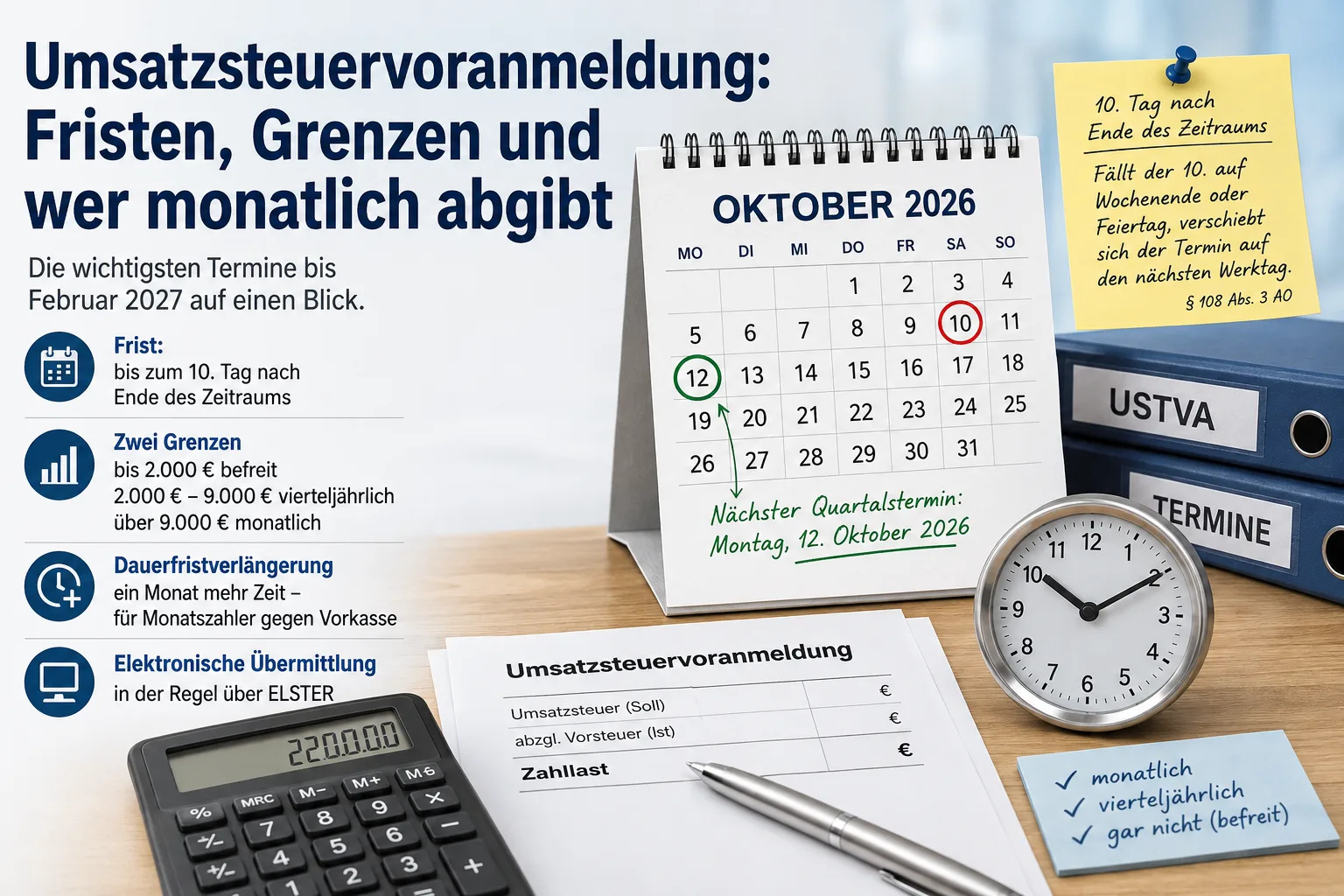
Advance VAT return in Germany: deadlines, thresholds, monthly or quarterly
If you run a business in Germany, you file an advance VAT return by the 10th day after each period. This article shows which cycle applies to you, when your next date falls and how to buy yourself an extra month.
 Taxes & Law
Which insurance do I need as a self-employed person in Germany? Mandatory, essential and skippable – costed out for three businesses
Health insurance is compulsory, pension insurance only for certain trades, and every business must register with its employers' liability association. Everything else is your call. What a roofer, a programmer and a café owner really need – and the order to buy in when money is tight.
 Taxes & Law
Bogus self-employment in Germany: when it applies – and why the back payment does not hit you
The fear of a huge back payment almost always targets the wrong person: your client owes the social security contributions, not you. What is really examined, what you actually risk – and how to get clarity without stirring things up.