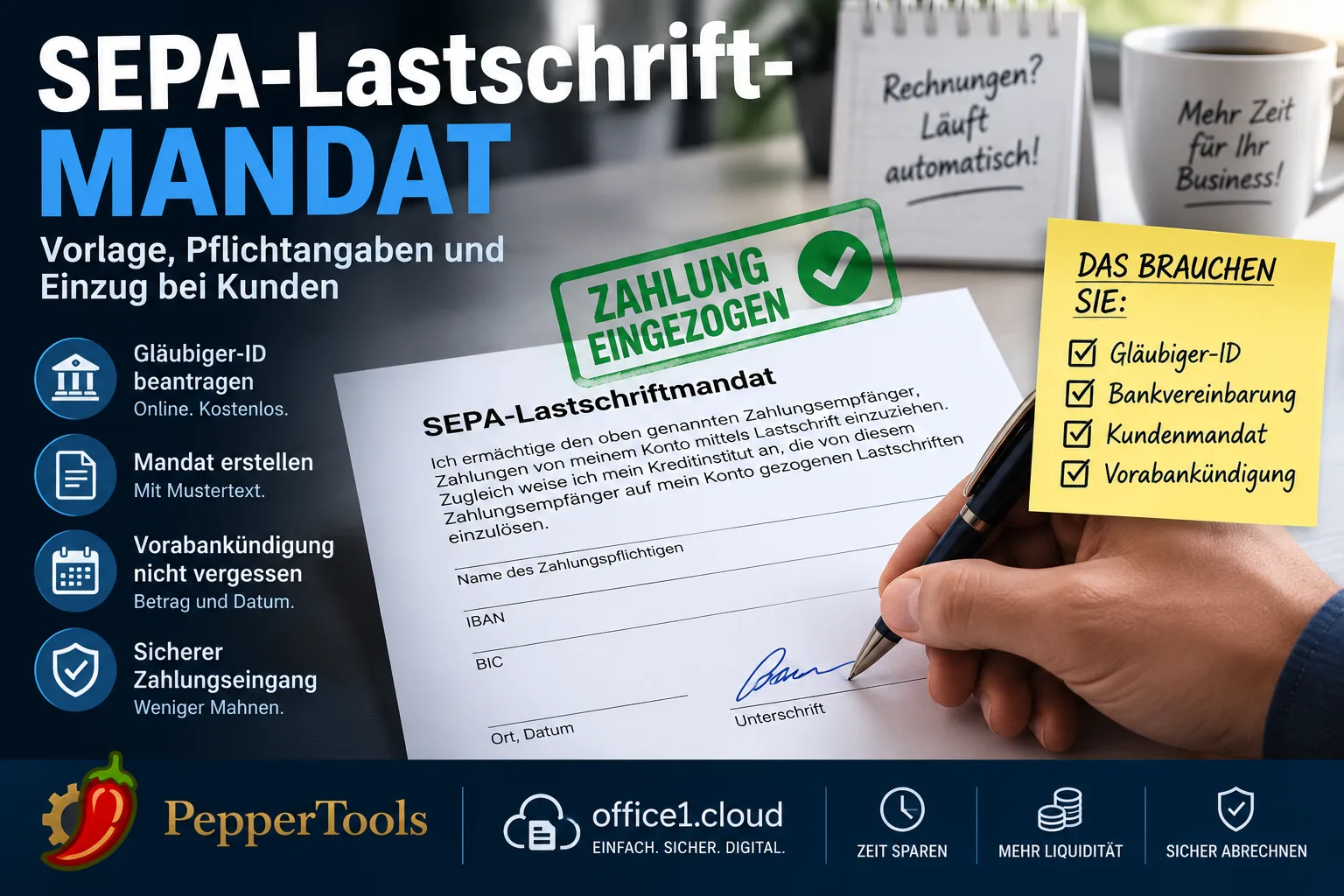
To collect invoice payments from your customers by direct debit, you need four things: a creditor identifier from the Deutsche Bundesbank (online, free of charge), an agreement with your own bank on direct debit collection, a signed SEPA direct debit mandate from every customer, and, before every collection, a notice stating the amount and date. You can draw up the mandate yourself using the model text further down. Be prepared for one thing: your customer can reclaim a Core Direct Debit for eight weeks without giving a reason. So the money is only truly yours after two months.
This article provides general information and is no substitute for legal or tax advice. What your bank specifically requires is set out in your direct debit collection agreement (Inkassovereinbarung) – that agreement takes precedence.
Table of contents
- Is direct debit worthwhile for my business?
- What you need before the first collection
- Applying for a creditor identifier: how it works
- Core Direct Debit or B2B Direct Debit?
- What the mandate must contain – with model text
- Signature on paper, by email or online?
- The mandate reference: one number per customer
- Pre-notification: the customer must know in advance
- Submitting to the bank: deadlines and due date
- Returned direct debits: what happens and what you may charge
- How long is a mandate valid, how long do you keep it?
- Frequently asked questions
Is direct debit worthwhile for my business?
If you invoice the same customers regularly, direct debit saves you the chasing. If you charge a customer a large amount once, it brings little and carries a risk.
The reason is the right of refund. With a Core Direct Debit, the customer may reclaim the money for eight weeks without giving reasons (§ 675x of the German Civil Code (BGB)). For a maintenance contract at 49 euros a month, that is bearable and practically never happens. For a one-off invoice of 6,000 euros, it is a real risk, because you have already delivered the service.
Direct debit therefore suits:
- subscriptions, maintenance and service contracts, membership fees, course fees, rent for equipment or premises
- amounts that stay the same every month or quarter, or that fluctuate within a manageable range
- customers you know and work with over a longer period
Direct debit does not suit one-off, high invoices to new customers. There, advance payment or a deposit is the better way.
Your invoice hardly changes. You write it as before; only the payment term reads differently: instead of “payable by”, it states that you will collect the amount on a specific date. The invoice then needs exactly this date as a specific due date, because it also serves as the notice of collection. If you store the payment term once in your invoicing software, this date is calculated automatically on every document.
What you need before the first collection
Before you collect the first euro, three things must be in place. If one is missing, your bank rejects the direct debit.
| What | From where | Cost | Time |
|---|---|---|---|
| Creditor identifier (Gläubiger-ID) | Deutsche Bundesbank, online only | free of charge | hours to one business day |
| Collection agreement (Inkassovereinbarung, admission to direct debit collection) | your own bank | depends on the bank, listed in its schedule of fees | appointment or online application with the bank |
| SEPA direct debit mandate | from each individual customer | none | one signature |
The order matters: first the creditor identifier, because the bank wants to see it when it admits you to the scheme. The Bundesbank says so explicitly: the creditor identifier involves “no admission to the collection of direct debits. This can only be granted by the applicant's account-servicing payment service provider” (translated from the German). Admission means: you sign an agreement with your bank on the collection of receivables by direct debit, usually called an Inkassovereinbarung for short. It sets out your obligations, the fees and, above all, the price per returned direct debit.
You also need a way to submit the direct debits. With most banks, this works directly in online banking for business customers or via a file that your software generates. Ask at your appointment with the bank which route it offers.
Applying for a creditor identifier: how it works
You apply for the creditor identifier yourself at the Bundesbank in a few minutes. It costs nothing, and you need nobody to help you.
The application runs exclusively online via the Deutsche Bundesbank portal at extranet.bundesbank.de/scp/. It is not possible by post or telephone. After applying, you receive an email with a confirmation link, according to the Bundesbank “only after a few hours or, depending on the time of application, not until the next business day” (translated). Click the link within ten calendar days, otherwise the Bundesbank deletes the application.
Two things you should know:
- You get your number only once. Every company, every person receives exactly one creditor identifier. If you want to separate several business areas, use the three freely selectable characters in the middle of the number, not a second identifier.
- Do not pay anything for it. Since January 2026, the Bundesbank has warned about websites of private providers that “take over” the application for a fee. The number is free of charge from the Bundesbank itself.
This is what a German creditor identifier looks like: DE98ZZZ09999999999 (example from the Bundesbank). 18 characters: DE as the country code, two check digits, then ZZZ as the business area code, which you may change yourself later, and eleven characters as your identifier.
Core Direct Debit or B2B Direct Debit?
For private customers, only the Core Direct Debit is available. For business customers, you can additionally use the B2B Direct Debit, under which the customer cannot reclaim the money. The price for this: your customer must also register the mandate with their bank, otherwise the direct debit is rejected.
| SEPA Core Direct Debit (CORE) | SEPA Business-to-Business Direct Debit (B2B) | |
|---|---|---|
| Permitted towards | all customers, including private individuals | only customers who are not consumers |
| Customer can reclaim the money | yes, eight weeks without giving a reason | no, not if a mandate has been given |
| Without a valid mandate | refund possible for 13 months | refund possible for 13 months |
| Customer must report the mandate to their bank | no | yes, before the first collection |
| Return by the customer's bank for insufficient funds | up to five business days after the due date | up to three business days after the due date |
| Sensible for small businesses | standard case | only with a few, larger business customers |
The B2B Direct Debit sounds tempting because the money is final. In practice, it often fails because the customer forgets the second step: they must confirm to their bank that they have given you a B2B direct debit mandate and provide it with the mandate data. If they do not, their bank rejects the first direct debit. For ten business customers with fixed contracts, it can be worthwhile. For a mixed customer base, the Core Direct Debit is the route with less friction.
Legally, the difference rests on § 675e (4) BGB: with customers who are not consumers, you may exclude the right of refund. With private individuals, you may not.
What the mandate must contain – with model text
A mandate is a sheet with two declarations by the customer and a few mandatory details. You can design it yourself as long as the content is correct. The heading must contain the word “SEPA”.
The mandate contains two declarations: the customer authorises you to collect money from their account, and they instruct their bank to honour these direct debits. Both are in the model text of the German Banking Industry Committee (Die Deutsche Kreditwirtschaft), which the banks prescribe in their collection agreements.
Mandatory details in the mandate:
- Heading “SEPA-Lastschriftmandat” (SEPA direct debit mandate)
- Your name and address as the payee
- Your creditor identifier
- The mandate reference (or a note that you will inform the customer of it later)
- Name of the customer as account holder, their IBAN
- Whether the mandate applies to recurring payments or a one-off payment
- Place, date and signature of the customer
Model text for recurring payments (Core Direct Debit):
The following is the official German wording of the German Banking Industry Committee. The mandate may be written in a language the customer understands; a translation of the declarations follows after the quotation.
SEPA-Lastschriftmandat
Zahlungsempfänger: [Ihr Firmenname, Straße, PLZ Ort]
Gläubiger-Identifikationsnummer: [DE00ZZZ00000000000]
Mandatsreferenz: [wird separat mitgeteilt / Ihre Nummer]Ich ermächtige (Wir ermächtigen) [Ihr Firmenname], Zahlungen von meinem (unserem) Konto mittels Lastschrift einzuziehen. Zugleich weise ich mein (weisen wir unser) Kreditinstitut an, die von [Ihr Firmenname] auf mein (unser) Konto gezogenen Lastschriften einzulösen.
Hinweis: Ich kann (Wir können) innerhalb von acht Wochen, beginnend mit dem Belastungsdatum, die Erstattung des belasteten Betrages verlangen. Es gelten dabei die mit meinem (unserem) Kreditinstitut vereinbarten Bedingungen.
Zahlungsart: wiederkehrende Zahlung
Kontoinhaber: [Vorname Nachname / Firma]
IBAN: [DE __ ____ ____ ____ ____ __][Ort, Datum] [Unterschrift des Kontoinhabers]
In English, the two declarations say: I (we) authorise [your company name] to collect payments from my (our) account by direct debit. At the same time, I (we) instruct my (our) bank to honour the direct debits drawn on my (our) account by [your company name]. The note says: I (we) can demand a refund of the debited amount within eight weeks, starting from the debit date; the conditions agreed with my (our) bank apply. The remaining fields are payee (Zahlungsempfänger), creditor identifier, mandate reference, type of payment (Zahlungsart: recurring payment), account holder (Kontoinhaber), IBAN, place, date and signature of the account holder.
For a one-off direct debit, replace “Zahlungen” (payments) in the first sentence with “einmalig eine Zahlung” (a single payment) and enter “einmalige Zahlung” (one-off payment) as the type of payment.
For a B2B Direct Debit, the note reads differently. Instead of the eight weeks, it states that the mandate serves only for collection from business accounts, that the customer cannot demand a refund after the debit has been honoured, and that they may instruct their bank not to honour the direct debit up to the due date. Your bank prescribes the exact wording.
Two rules on language: the mandate must be in a language the customer understands or that is your contract language. For customers abroad with whom you negotiate in English, use an English mandate.
Signature on paper, by email or online?
Legally, you may also obtain the mandate online. Whether your bank accepts that is its decision alone, and in the event of a dispute you must prove that the customer really did give the mandate. If you want to be on the safe side, have it signed on paper.
The Bundesbank puts it like this: in Germany, there are “no specific statutory requirements regarding the manner in which direct debit mandates are given”; mandates can “in principle also be given on the internet”. How a mandate is given depends “solely on the contractual agreements, in particular the collection agreement” with your bank. And: you bear “the burden of presentation and proof that a mandate authorised by the payer exists” (all quotations translated from the German).
What this means in day-to-day business:
- Paper with a signature is the standard that the German Banking Industry Committee's model collection agreement requires (“in writing and signed by the payer”). A scan is sufficient for retention; you do not need the original in your drawer.
- Online or by click works only if your bank permits it in the collection agreement. Ask about this explicitly at your appointment. Without this commitment, you risk the bank not recognising a mandate when a query arises.
- An email saying “yes, go ahead and debit” is not a mandate. The mandatory details and the signature are missing.
If a customer denies having given the mandate, your bank requests it from you. The model collection agreement gives you seven business days for this. If you cannot present it, the direct debit is deemed unauthorised, and the customer can reclaim it for 13 months.
The mandate reference: one number per customer
You give each mandate its own number, the mandate reference. It may be up to 35 characters long, letters and digits, and may be assigned only once. The simplest option is to use your customer number, with a sequential number after it if a customer has several mandates.
The mandate reference and your creditor identifier together identify the mandate uniquely. Both appear later on your customer's bank statement and with every direct debit you submit. You may write the reference into the mandate straight away or inform the customer of it later, for example with the first invoice.
Never assign a reference twice and do not change it afterwards. Your bank and the customer's bank use it to recognise whether a direct debit belongs to a known mandate.
Pre-notification: the customer must know in advance
Before you collect, the customer must know when you will debit which amount. The standard period is 14 calendar days before the due date. You may agree a shorter period with the customer, and you may simply put the notice on the invoice.
This notice is called Vorabankündigung or pre-notification. According to the Bundesbank, it needs two details: “the due date and the exact amount”. Any communication is suitable for this, “e.g. invoice, policy, contract” (translated). A separate letter is not necessary.
One sentence on the invoice is enough:
We will collect the amount of 149.00 euros from your account by SEPA direct debit on 15 October 2026 (creditor identifier DE00ZZZ00000000000, mandate reference K-1234).
The creditor identifier and mandate reference are not mandatory in the pre-notification, but they are customary and helpful, because the customer recognises the debit on their bank statement by them.
You may shorten the 14 days if you agree this with the customer, for example in the mandate or in the contract. The rulebooks name no minimum; they only say that a “different period” is possible. A typical sentence is “The period for the pre-notification is shortened to three days”. Without an agreement, the 14 days apply.
For fixed amounts that are always the same, it is even simpler: for recurring direct debits “with identical or fixed direct debit amounts”, a single notification before the first collection stating all due dates is sufficient. A maintenance contract at 49 euros on the 1st of every month therefore needs only one pre-notification, not twelve.
Submitting to the bank: deadlines and due date
The direct debit must reach the customer's bank no later than one business day before the due date. Your own bank needs lead time for this and names a cut-off time in the collection agreement. So submit two business days before the due date and you are on the safe side.
Since 21 November 2016, the same deadline has applied across Europe for all direct debits: one business day before the due date, whether first or recurring direct debit, whether Core or B2B. According to the Bundesbank, the earlier deadlines of five and two days “no longer apply”. You may not submit a direct debit earlier than 14 calendar days before the due date.
What you state when submitting:
| Detail | Source |
|---|---|
| Customer's IBAN and name | from the mandate |
| Amount | from the invoice |
| Due date | the date from your pre-notification |
| Creditor identifier | from the Bundesbank |
| Mandate reference | your number for this mandate |
| Date the mandate was signed | from the mandate |
| First, recurring, final or one-off direct debit | depending on the status of the mandate |
| Remittance information | invoice number, so the customer can match the payment |
The due date is the day on which the customer's account is debited. If it falls on a weekend or a public holiday, your bank moves it to the next business day. The money is usually in your account on the same day, but subject to reservation: if the direct debit is returned, the bank reverses the credit.
Returned direct debits: what happens and what you may charge
If a direct debit is returned, your bank takes the money back out of your account and charges you a fee. You may pass the bank fee on to the customer as damages if they caused the return. You may not demand an additional “processing fee” for your own work.
The most common reasons for a returned direct debit:
- The customer's account has insufficient funds.
- The customer objects at their bank or reclaims the money within the eight weeks.
- The account has been closed or the IBAN is wrong.
- The account does not allow direct debits.
- There is no valid mandate (return reason “no valid mandate”).
The customer's bank may return a Core Direct Debit up to five business days after the debit, a B2B Direct Debit up to three. On top of that, for the Core Direct Debit, comes the customer's eight-week right of refund. After that, the money is final, provided a valid mandate exists.
What you may charge the customer: In 2009, the Federal Court of Justice (Bundesgerichtshof, BGH) ruled that a flat fee of 50 euros per returned direct debit in general terms and conditions is invalid (BGH, judgment of 17 September 2009, Xa ZR 40/08). The reason: compensation is available only for the loss caused by the returned direct debit, that is, the fee your bank charges you. Your own working time for following up is not a loss but effort in performing the contract. If the customer does not keep sufficient funds, “the creditor can demand compensation for the loss arising to him from this” (translated), no more. So do not write a fixed flat fee into your terms and conditions; instead, charge the actual bank fee with a receipt.
If a direct debit is returned with the reason “no valid mandate”, you may not draw any further direct debit on this mandate. Clarify the case with the customer and obtain a new mandate.
After a returned direct debit, the invoice is open like any other. How to proceed then is explained in the article Customer does not pay: what to do.
How long is a mandate valid, how long do you keep it?
A mandate is valid indefinitely as long as you use it. If more than 36 months pass between two direct debits, it expires and you need a new one. You must retain the mandate for at least 14 months after the last direct debit, and beyond that in line with the general retention periods for business records.
The 36 months count from the last direct debit submitted, even if it was returned. The banks do not check this; it is your obligation. A customer who has paused for three years is presented with a new mandate before the next collection.
For retention, two periods apply side by side. The model collection agreement requires the mandate to be retained after expiry “for a further period of at least 14 months, calculated from the submission date of the last direct debit collected” (translated). This covers the 13 months in which the customer could reclaim a direct debit without a mandate. In addition, the retention periods under § 257 of the German Commercial Code (HGB) and § 147 of the German Fiscal Code (AO) apply to business records. No official body specifies how the mandate is to be classified there. If you keep it together with the customer's invoices, you are on the safe side. A scan is sufficient; according to the Bundesbank, the original does not have to be retained.
If the customer cancels the mandate, they may do so at any time with you or with their bank. From then on, you collect nothing more. Send them the invoices still open with a normal payment term.
Frequently asked questions
Can I collect direct debits as a private individual or an association?
Yes. The Bundesbank also issues the creditor identifier to natural persons and associations of persons based in Germany. Associations have been collecting membership fees this way for years. The route is the same as for companies: creditor identifier, collection agreement with the bank, mandate per member.
What happens if I forget to announce the collection?
The collection is not invalid because of that, but you breach your obligation under the collection agreement, and the customer has one more reason to reclaim the money. The notice costs nothing if it is on the invoice. Make it a habit.
Do I have to agree the switch from invoice to direct debit with every customer anew?
Yes, every customer must sign a mandate. A clause in your terms and conditions does not replace that. The simplest way is to enclose the mandate with the contract or the first invoice and to keep offering bank transfer until it comes back.
Can I also collect from customers abroad?
Yes, within the SEPA area. This includes all EU countries and some others, such as Switzerland and Norway. The mandate must then be in a language the customer understands; if in doubt, in English.
Does anything change for VAT or bookkeeping?
No. You write the invoice as before with all mandatory details; the direct debit is just a different way for the money to reach you. The incoming payment is booked like a bank transfer. If a direct debit is returned, you book the reversal and the bank fee as separate transactions.
Does the payee verification introduced in October 2025 also apply to direct debits?
No. The check of whether name and IBAN match has applied since 9 October 2025 to credit transfers and instant credit transfers. Direct debits are not affected.
Do the rules change in 2026?
Nothing you will notice in everyday business. The current rulebooks have applied since 5 October 2025. The next version is published in November 2026 and applies only from November 2027. Among other things, it discusses whether direct debits may in future be submitted on the due date itself. That has not been decided.
If you collect regularly, what you need above all is an overview of which invoice belongs to which collection and what came back. Try Easy Invoice for free – payment terms are available there as templates, and the due date appears as a date on the document.
Sources
- Deutsche Bundesbank: Creditor identifier – application and issuance
- Deutsche Bundesbank: Your creditor identifier in 10 steps
- Deutsche Bundesbank: Notice on applying for the creditor identifier (January 2026)
- Deutsche Bundesbank: Procedure for issuing the creditor identifier (PDF)
- Deutsche Bundesbank: Questions and answers on SEPA
- Deutsche Bundesbank: Procedural rules for SEPA direct debit, valid from 5 October 2025 (PDF)
- European Payments Council: SEPA Direct Debit Core Rulebook 2025, Version 1.1 (PDF)
- European Payments Council: SEPA Direct Debit B2B Rulebook 2025, Version 1.1 (PDF)
- German Banking Industry Committee: Sample forms for the SEPA B2B direct debit mandate (PDF)
- § 675x BGB – Right to a refund for an authorised direct debit
- § 676b BGB – Notification of unauthorised payment transactions
- § 675e BGB – Deviating agreements
- § 309 No. 5 BGB – Lump-sum claims for damages
- BGH, judgment of 17 September 2009, Xa ZR 40/08 (PDF)
- § 257 HGB – Retention of records
- § 147 AO – Regulations on the retention of records
- Deutsche Bundesbank: Questions and answers on instant credit transfers and payee verification
- European Payments Council: Public Consultation on 2026 Change Requests, SDD Core (PDF)
Handle invoices more easily
Easy Invoice combines quotes, invoices and customer management in the cloud.
Try Easy InvoiceRead next
 Invoicing & Accounting
Receipt lost? How to write an Eigenbeleg in Germany
No booking without a receipt – but there is a substitute. What belongs on a German Eigenbeleg, when the tax office accepts it, and why the VAT is gone anyway.
 Invoicing & Accounting
Pro forma invoice: meaning, template and when you need one
A pro forma invoice demands no money and gives no input VAT deduction. It serves customs and advance information. What belongs on it and where the traps are.
 Invoicing & Accounting
Late payment interest in Germany: rate, formula and example
A customer has not paid for weeks. You may charge interest without asking. Here is how much exactly, from which day it counts and how to work out the amount.