From a business customer you may charge 10.52 percent interest per year on the outstanding amount, from a private customer 6.52 percent. The formula: invoice amount × interest rate ÷ 100 × days in default ÷ 365. An invoice of 4,800 euros paid 30 days late by a business customer earns you 41.50 euros. You do not have to agree the interest in advance or announce it — the claim arises by itself as soon as the customer is in default. But you do have to ask for it; nobody pays it voluntarily.
Both rates apply until at least 31 December 2026. They depend on the base rate of the Deutsche Bundesbank, which can only change on 1 January and 1 July.
If you only want the number, you do not need this article: the late payment interest calculator does it with four entries, across several half-year periods and with part payments.
This article covers German law and is general information, not legal or tax advice.
Contents
- Do I have to do anything at all?
- How much may I charge?
- From which day does interest run?
- The formula, step by step
- Table: interest at a glance
- The extra 40 euros
- Is VAT added to the interest?
- Where do I put the interest amount?
- The customer pays only part: what is settled first?
- Is it worth the effort?
- Frequently asked questions
Do I have to do anything at all?
The claim arises without you doing anything, but the money does not arrive without you doing something. As soon as your customer is in default, they owe you interest — even if your invoice, your terms and the contract say nothing about it. Section 288(1) of the German Civil Code (BGB) puts it plainly: a monetary debt bears interest during the period of default.
You do, however, have to calculate the amount and ask for it. A customer who transfers interest unprompted is a rare customer.
The reverse is blocked: with business customers, nobody may exclude the interest claim in advance by contract — such a clause is void (Section 288(6) BGB). If you send reminders regularly, invoicing software with dunning tracks the deadlines for you.
How much may I charge?
The rate depends solely on who your customer is — not on how large the invoice is or how long it has been outstanding.
| Your customer | Interest per year | Calculation | Law |
|---|---|---|---|
| Company, association, authority, other self-employed | 10.52 % | 9 percentage points above the base rate | Sec. 288(2) BGB |
| Private individual | 6.52 % | 5 percentage points above the base rate | Sec. 288(1) BGB |
The base rate has been 1.52 percent since 1 July 2026. The Deutsche Bundesbank sets it twice a year, on 1 January and 1 July. For the six months before that it was 1.27 percent, so the rates were 10.27 and 6.27 percent.
Two traps hide in that table.
"Percentage points" is not "percent". Nine percentage points above 1.52 percent is 10.52 percent, not 1.66 percent. The base rate is added, not multiplied.
The higher rate applies only to payment claims between businesses. As soon as a consumer is on either side, the lower rate of 6.52 percent applies. What matters is whether your customer bought privately or for their business. The electrician ordering a boiler for their own home is a private customer. The same electrician ordering cable for a building site is a business customer.
If the default period runs across a cut-off date, calculate in two sections: the days up to 31 December at the old rate, the days from 1 January at the new one.
From which day does interest run?
Counting starts the day after default begins — and default begins later than most people think. A payment term alone is not enough.
Default occurs in one of these three cases:
- You have sent a reminder. The customer is in default from the moment the reminder arrives (Sec. 286(1) BGB). What such a reminder looks like is in writing a payment reminder.
- You agreed a fixed date. If the invoice says "payable by 30 September 2026", the customer is in default from 1 October without you doing anything (Sec. 286(2) no. 1 BGB). A mere "payable within 14 days" is not reliably enough — more on that in payment terms on the invoice.
- The 30-day rule applies. At the latest 30 days after the invoice falls due and has been received, the customer is in default (Sec. 286(3) BGB).
For private customers the 30-day rule has a condition: it only applies if you pointed out this consequence in the invoice. A sentence such as "If you do not pay, you will be in default 30 days after receiving this invoice" therefore belongs on every invoice to a private individual. Without it, you have to send a reminder.
The day default begins is not counted. That follows from Sec. 187(1) BGB: if a period starts with an event, that day does not count. If default begins on 1 October, 2 October is your first day of interest. Interest runs until the day the money reaches you.
The formula, step by step
Four numbers, one line of arithmetic:
Interest = invoice amount × rate ÷ 100 × days in default ÷ 365Example. You invoiced a construction company 4,800 euros, payable by 31 August 2026. Default begins on 1 September; they paid on 1 October.
| Step | Calculation | Result |
|---|---|---|
| Count days in default (2 to 30 September, 1 October) | 2 Sep to 1 Oct | 30 days |
| Annual interest on the amount | 4,800 × 10.52 ÷ 100 | 504.96 euros |
| Scale down to the days in default | 504.96 × 30 ÷ 365 | 41.50 euros |
If you prefer a daily figure: 4,800 euros as a business claim earns 1.38 euros per day. That is a number you can quote on the phone; it often works better than a percentage.
A note on precision. The law states an annual rate and does not say how a year is split into days. The usual approach uses real calendar days, so 365, or 366 in a leap year. Some use the commercial 360-day method, which produces a slightly higher figure: 5,000 euros over 60 days is 86.47 euros with 365 days and 87.67 euros with 360. The difference is just over one percent. Anyone looking for an argument will find one here — with the 365-day method you are on the safe side.
Table: interest at a glance
If you only want to know whether the effort is worth it, find your amount in the row and the duration in the column. All values in euros, calculated with the rates since 1 July 2026 and 365 days.
Business customers, 10.52 percent:
| Outstanding amount | 14 days | 30 days | 60 days | 90 days |
|---|---|---|---|---|
| 500 euros | 2.02 | 4.32 | 8.65 | 12.97 |
| 1,000 euros | 4.04 | 8.65 | 17.29 | 25.94 |
| 2,500 euros | 10.09 | 21.62 | 43.23 | 64.85 |
| 5,000 euros | 20.18 | 43.23 | 86.47 | 129.70 |
| 10,000 euros | 40.35 | 86.47 | 172.93 | 259.40 |
Private customers, 6.52 percent:
| Outstanding amount | 14 days | 30 days | 60 days | 90 days |
|---|---|---|---|---|
| 500 euros | 1.25 | 2.68 | 5.36 | 8.04 |
| 1,000 euros | 2.50 | 5.36 | 10.72 | 16.08 |
| 2,500 euros | 6.25 | 13.40 | 26.79 | 40.19 |
| 5,000 euros | 12.50 | 26.79 | 53.59 | 80.38 |
| 10,000 euros | 25.01 | 53.59 | 107.18 | 160.77 |
If your amount sits between two rows, scale proportionally. 3,000 euros over 30 days is 1.2 times the 2,500-euro row, so around 25.94 euros. The late payment interest calculator is more precise — enter your own figures and dates there.
The extra 40 euros
With a business customer, 40 euros are added to the interest, and you do not have to prove anything for it. With private customers there is no such payment.
The basis is Sec. 288(5) BGB. The flat sum is due once per late payment, including each late instalment. On an invoice of 1,000 euros paid 30 days late by a business customer, that puts 48.65 euros on your side: 8.65 euros interest and 40 euros flat sum.
There is a catch in the last sentence of the provision: the 40 euros are set off against damages that consist of the costs of pursuing the claim. If you later instruct a lawyer and claim those costs, the 40 euros come off. So you do not get them on top of the legal fees, but as the first part of them.
Is VAT added to the interest?
No. You do not add VAT to late payment interest or to the 40-euro flat sum, even if the original invoice included VAT.
The reason: interest is not payment for a supply, it is compensation for damage. The German tax authority says so in the VAT Application Decree (Umsatzsteuer-Anwendungserlass), section 1.3(6): default interest, interest on maturity and interest during proceedings are to be treated as compensation for damage. Where there is no supply, there is no consideration and therefore no VAT.
Three things follow for you: the interest amount stands without tax, it does not belong in your VAT return as turnover, and it changes nothing about the VAT on the original invoice. That stays as it is, even if the customer pays late. How the German VAT return works is explained in VAT advance return: deadlines and thresholds.
As a small business under Sec. 19 of the German VAT Act, nothing changes for you — you do not show VAT anyway, and your status does not affect the classification as compensation.
Where do I put the interest amount?
The simplest way is a separate line in the reminder, not a new invoice. An invoice would be the wrong document, because it charges for a supply — and that is exactly what interest is not.
The line can look like this:
Outstanding invoice amount (invoice 2026-0147 of 12/08/2026)   4,800.00 euros
Default interest 10.52 % for 30 days (02/09 to 01/10/2026)        41.50 euros
Flat sum under Sec. 288(5) BGB                                    40.00 euros
Total                                                          4,881.50 euros
Write down the period and the rate. Two reasons: the customer can check the figure and asks fewer questions, and in a dispute it is immediately clear what the amount refers to.
If the customer pays weeks after the reminder, further interest accrues in the meantime. You can claim it. In practice this is rarely worth it, and many people quietly waive the final days.
The customer pays only part: what is settled first?
If your customer transfers less than the total claim, costs and interest come off first — the rest goes against the invoice itself. So the principal stays outstanding longer than the customer thinks, and interest keeps running on it.
That is what Sec. 367(1) BGB says: where the debtor owes interest and costs in addition to the principal, a payment insufficient to settle the whole debt is credited first to the costs, then to the interest and last to the principal.
An example. You claim 4,800 euros plus 41.50 euros interest plus the 40-euro flat sum, 4,881.50 euros in total. The customer transfers 4,800 euros and writes "invoice settled". First the 40 euros are credited, then the 41.50 euros of interest. Only 4,718.50 euros go against the principal, leaving 81.50 euros outstanding — and interest keeps running on that.
Your customer may specify a different order. In that case you may refuse the payment (Sec. 367(2) BGB). In practice people take the money and point out the remaining balance.
Doing this by hand is tedious. In the late payment interest calculator you enter each part payment with its date, and it allocates them in the statutory order.
Is it worth the effort?
Below 1,000 euros the interest itself is hardly worth mentioning — the 40-euro flat sum is. That is what makes the difference.
Take an outstanding invoice of 800 euros to a business customer, 30 days late: 6.92 euros in interest. Nobody enjoys writing a reminder for that. With the flat sum it is 46.92 euros, and that covers your effort.
With private customers the flat sum falls away. There, interest only covers the effort from around 2,500 euros and two months of delay.
The most common worry is a different one: losing the customer. That cannot be calculated away, but it can be put in perspective. A customer who pays on time never sees an interest line. So the only people affected are those already using you as a lender. You also have a choice in how you do it: you can state the interest amount and offer in the same letter to waive it if they pay within a week. The number is then on the table without you having to collect it.
The effect lies less in the money than in the signal. A customer who sees an interest line on the reminder understands that you are keeping count. If a customer stops responding altogether, no interest line will help — the way forward from there is in customer not paying: what to do. If the customer cannot pay, an instalment agreement is often worth more than an interest claim nobody settles.
Easy Invoice shows your outstanding items at a glance, with dunning levels and deadlines running alongside. Try it for free.
Frequently asked questions
What is the German base rate in 2026?
From 1 January to 30 June 2026 it was 1.27 percent; since 1 July 2026 it has been 1.52 percent. The Deutsche Bundesbank publishes the value and changes it only on 1 January and 1 July. The next possible change is 1 January 2027.
May I agree a higher interest rate?
Yes, you may agree more with the customer; Sec. 288(1) BGB is a floor, not a ceiling. In standard terms towards consumers, however, such clauses are narrowly limited. Without an agreement it stays at 10.52 or 6.52 percent.
Which account do I book late payment interest to?
Interest you receive is income but not turnover. It runs as other interest income, separate from the invoice amount. Which account your chart of accounts uses is a question for your tax adviser — the numbers differ between charts.
Can my customer refuse to pay the interest?
They can always refuse, but they are not in the right. If they pay only the principal, the interest claim stays open and you can keep pursuing it. A different dispute is more common: the customer denies having been in default at all. That is why it pays to be able to prove when the invoice and the reminder arrived.
Is there a calculator for this?
Yes: the late payment interest calculator. You enter the amount, the customer type and the two dates, and you get the interest, the daily rate and a ready-made text block for your reminder. It also calculates across 1 January and 1 July using the rates valid in each period, and allocates part payments under Sec. 367 BGB.
I already sent a reminder without mentioning interest. Can I still claim it?
Yes. The claim arises with the default, not with its mention in the reminder. You can assert it in the next reminder or in a separate letter, backdated to the first day of default. Just do not waive it explicitly — an "I waive the interest" is binding.
How long can I still claim the interest?
For as long as the invoice itself is enforceable. Interest is an ancillary claim and becomes time-barred together with the principal (Sec. 217 BGB), even if a different period would apply to it alone. For ordinary invoices the standard period is three years (Sec. 195 BGB), counted from the end of the year in which the claim arose. If the invoice is time-barred, so is the interest.
My customer is abroad. Does this still apply?
Not automatically. The rates in Sec. 288 BGB are German law. Within the EU there are minimum requirements from the Late Payment Directive, but each country implements them differently. Which law applies to your contract depends on what you agreed and on private international law. For larger cross-border claims this is a question for a lawyer.
Do I get interest on a progress invoice as well?
Yes. A progress claim is a payment claim like any other, and Sec. 288(5) BGB expressly grants the 40-euro flat sum for late instalments too. What a progress invoice is, is explained in writing a progress invoice.
Sources
- Sec. 288 BGB – Default interest and other damage caused by default — 5 percentage points (subs. 1), 9 percentage points where no consumer is involved (subs. 2), 40-euro flat sum (subs. 5), void exclusions (subs. 6)
- Sec. 286 BGB – Default of the debtor — default by reminder (subs. 1), calendar date (subs. 2), 30-day rule and the notice requirement towards consumers (subs. 3)
- Sec. 187 BGB – Beginning of a period — the day of the event does not count
- Sec. 247 BGB – Base rate — adjusted on 1 January and 1 July
- Sec. 367 BGB – Crediting to interest and costs — part payments settle costs first, then interest, then the principal
- Sec. 217 BGB – Limitation of ancillary claims and Sec. 195 BGB – Standard limitation period — interest is time-barred with the principal, standard period three years
- Base rate under Sec. 247 BGB – Deutsche Bundesbank — 1.52 percent since 1 July 2026, 1.27 percent from 1 January 2026
- VAT Application Decree, consolidated version – German Federal Ministry of Finance — section 1.3(6): default interest, interest on maturity and interest during proceedings are treated as compensation for damage
Handle invoices more easily
Easy Invoice combines quotes, invoices and customer management in the cloud.
Try Easy InvoiceRead next
 Invoicing & Accounting
Receipt lost? How to write an Eigenbeleg in Germany
No booking without a receipt – but there is a substitute. What belongs on a German Eigenbeleg, when the tax office accepts it, and why the VAT is gone anyway.
 Invoicing & Accounting
Pro forma invoice: meaning, template and when you need one
A pro forma invoice demands no money and gives no input VAT deduction. It serves customs and advance information. What belongs on it and where the traps are.
 Invoicing & Accounting
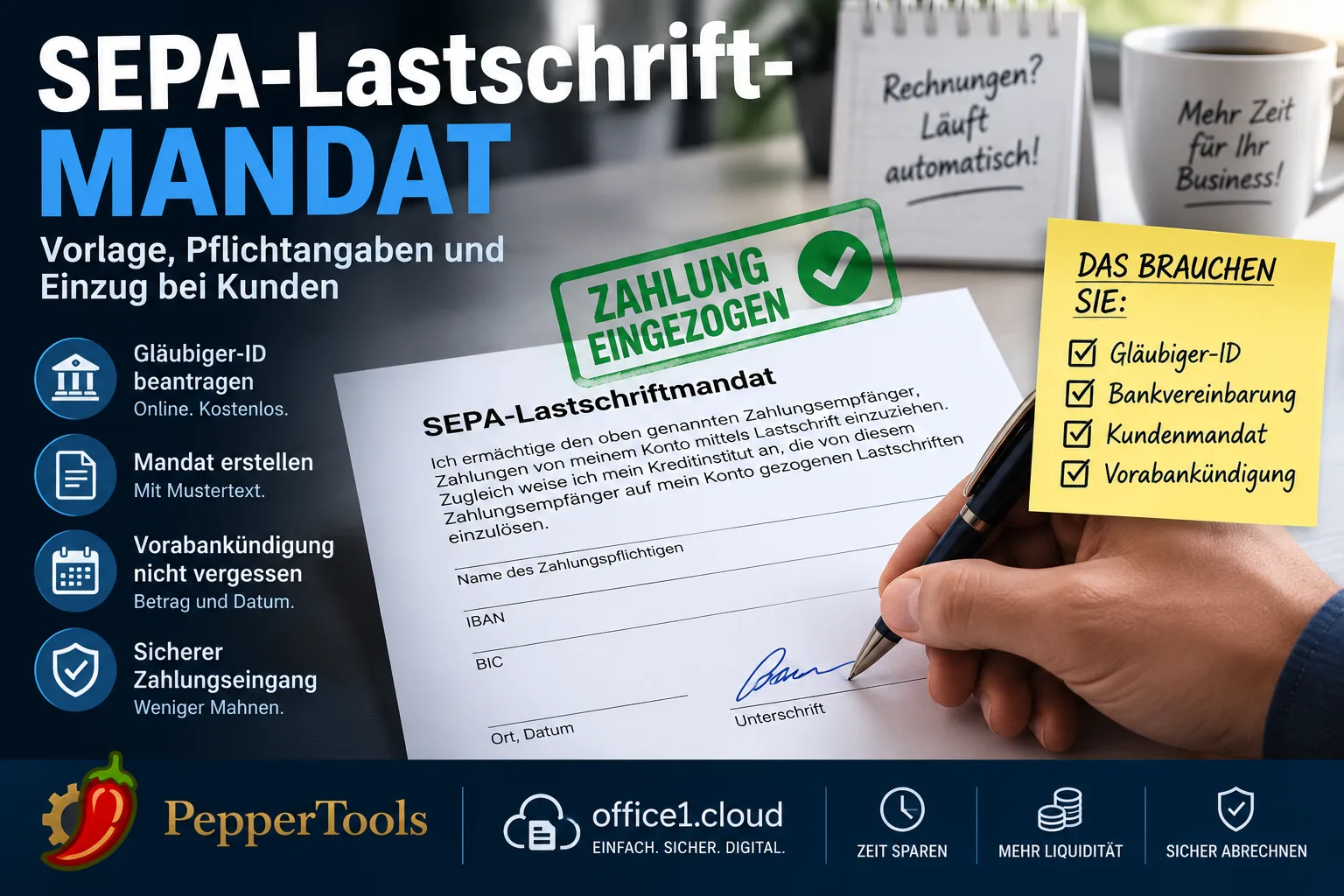
SEPA Direct Debit Mandate: Template, Required Details, Collection
Chasing 40 invoices every month? With direct debit, the money comes in by itself. What you need, what goes in the mandate and what the customer can claw back.