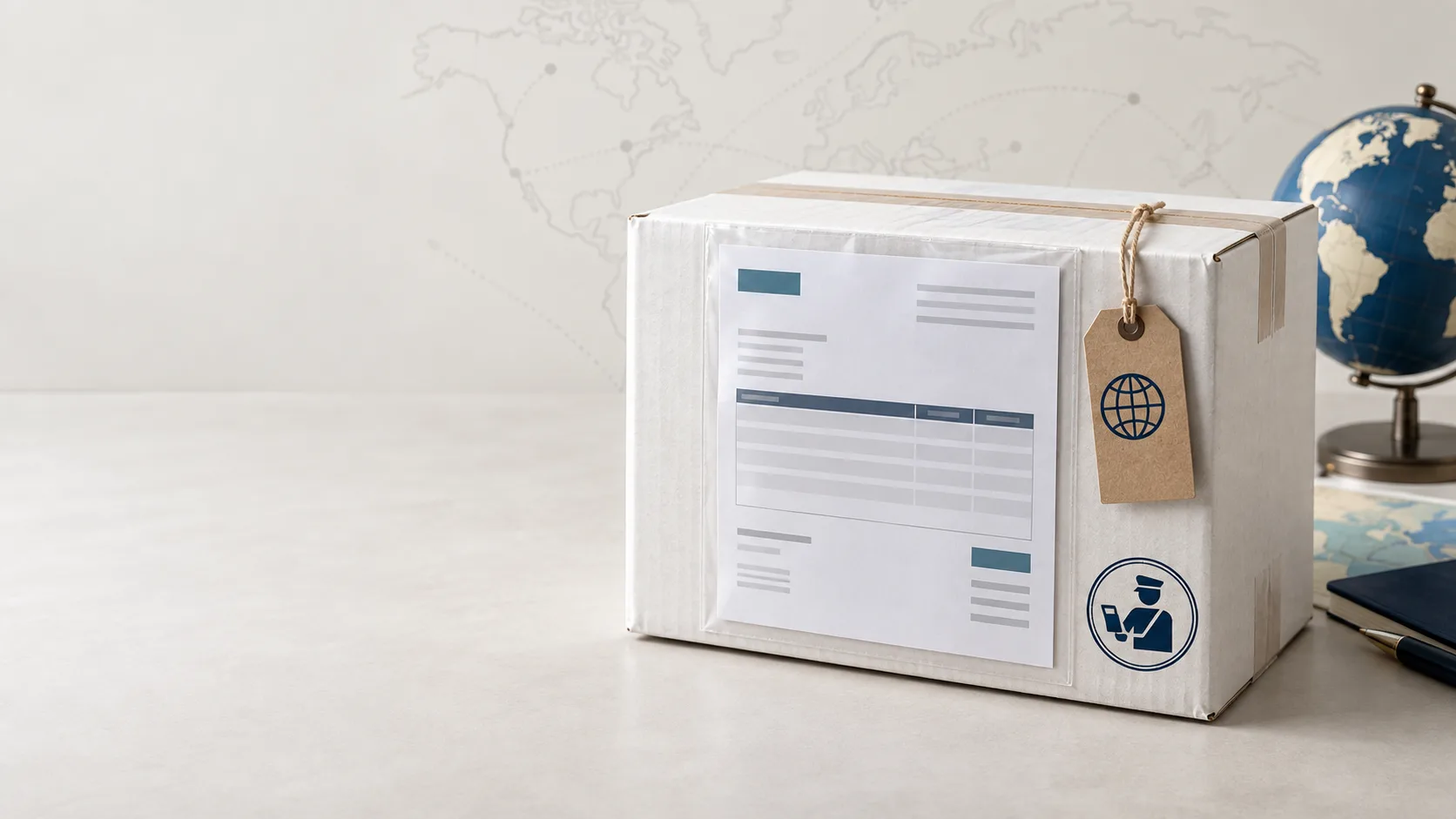
A pro forma invoice is an advance breakdown of a delivery that is not yet being settled. It creates no obligation to pay, and your customer cannot deduct input VAT from it. You mainly need one when goods cross a customs border without a sale — samples, warranty replacements or loaned equipment. What counts is not the word "pro forma" on the paper, but what the paper says: if you actually settle a supply in it, German VAT law treats the document like an invoice.
Contents
- What a pro forma invoice is
- When you need a pro forma invoice
- What belongs on the pro forma invoice
- VAT: the point where it gets expensive
- Does a pro forma invoice give your customer input VAT?
- The customer paid against the pro forma invoice — what now?
- Pro forma invoice for customs
- Pro forma invoice in English
- Booking and retention
- Template to copy
- Frequently asked questions
What a pro forma invoice is
Your customer owes nothing on a pro forma invoice. The document looks like an invoice, names goods, quantity and value, but demands no money. It informs: customs about the value of the shipment, the customer about the cost of a planned delivery, a bank about the content of a transaction.
The name is misleading. For VAT purposes, section 14 (1) sentence 1 of the German VAT Act (UStG) defines an invoice as "any document by which a supply of goods or services is settled, irrespective of how this document is designated in business dealings". So the heading does not protect you. The reverse also holds: as long as you settle nothing and merely announce, it stays pure information.
For the actual settlement you then need a second document. What a complete invoice looks like is covered in writing an invoice. If you regularly switch between quote, advance paper and final invoice, invoicing software takes the numbering and the allocation off your hands.
When you need a pro forma invoice
In four situations someone asks you for this paper, and none of them is about money.
| Case | Why a document is needed |
|---|---|
| Samples, promotional material, gifts to non-EU countries | Customs needs a value although nobody is buying |
| Warranty or goodwill replacements, free spare parts | The shipment has no sales price but does have a value |
| Loaned device, trade fair goods, goods sent for repair | The goods leave the country temporarily and come back |
| The customer wants to know in advance what to expect | They need a breakdown for their approval or their bank |
For pure services without any shipment of goods you do not need a pro forma invoice. There is nothing to clear through customs, and for advance information a quote is the more honest document.
For the fourth case there is often a better route: a binding quotation or an order confirmation. Both say plainly what they are. A paper that looks like an invoice but is not meant to be one regularly triggers questions at the receiving end.
If the customer really is supposed to pay before delivery, the pro forma invoice is the wrong tool. In that case you need an advance payment invoice showing VAT. The difference and the mandatory details are covered in advance payment and prepayment invoices.
What belongs on the pro forma invoice
Write down the same details as on a normal invoice, add the purpose and leave out the request for payment.
- Name and address of you and the recipient
- Date and a separate number that does not come from your invoice number range
- Goods or service, quantity, unit value, total value
- The designation "Pro forma invoice", clearly visible
- One sentence making clear that no payment is requested
- For shipments outside the EU also: country of origin, commodity code, weight, delivery terms
A separate number outside your invoice range is not a legal requirement, but it saves you from explaining why your invoice sequence contains a document without any turnover. How to keep your numbering clean is covered in assigning invoice numbers.
VAT: the point where it gets expensive
Better not to show VAT separately on a pro forma invoice. Anyone who states a tax amount without being entitled to do so owes that amount to the tax office under section 14c (2) UStG — regardless of whether any supply ever takes place.
Whether a breakdown labelled "pro forma" triggers this tax liability depends on whether the paper can be read as settling a supply. That is a question of the individual case, not one decided by the heading — section 14 (1) sentence 1 UStG expressly looks at the content, not the designation. The Federal Ministry of Finance restated the invoice definition in the VAT Application Decree in exactly this wording by circular of 15 October 2025.
In practice: state the value of the goods on the pro forma invoice as a gross amount or as a plain value without a tax line. You show the VAT later, in the real invoice.
Does a pro forma invoice give your customer input VAT?
No. Your customer may not deduct input VAT from a pro forma invoice. Section 15 (1) sentence 1 no. 1 sentence 2 UStG requires that the trader "holds an invoice issued in accordance with sections 14, 14a". A document that deliberately does not settle anything is not such an invoice.
This applies even if your customer has already paid. For payments made before delivery, section 15 (1) sentence 1 no. 1 sentence 3 UStG requires both: the invoice must exist and the payment must have been made. If the invoice is missing, the deduction moves back — the entitlement is not lost, but it arrives later.
So if your customer asks for a pro forma invoice in order to book it, they are asking for the wrong document. Send them an advance payment invoice.
The customer paid against the pro forma invoice — what now?
The VAT falls due anyway, even without an invoice. As soon as you receive the money, the tax arises under section 13 (1) no. 1 letter a UStG at the end of the pre-registration period in which you received it. The paper you sent beforehand changes nothing about that.
Two steps then need doing straight away:
- Include the amount in the VAT return for the month of payment. Deadlines and periods are covered in advance VAT returns.
- Send a real invoice afterwards — as an advance payment invoice if you have not yet delivered, otherwise as a normal invoice covering the entire supply.
Small businesses under section 19 UStG show no VAT in either step. For them the payment only changes the timing of the income, not the tax. What else applies to them is covered in invoices without VAT.
Pro forma invoice for customs
Without a stated value the shipment sits still. Customs needs a document showing the value of the goods — even when nobody is paying for them. German customs names as the application case goods without commercial value, for example goods not intended for resale, as well as gifts. In these cases a pro forma invoice stating the actual value of the goods must be presented.
Three practical rules follow from this:
- No zero invoice. Write down the value the goods would have if you sold them. "0 euros" or "free of charge" leads to a query or to an estimate by the customs office.
- State the purpose. A note such as "sample of no commercial value, for customs purposes only" explains why no purchase price exists. Use the English wording on international shipments: "No commercial value — for customs purposes only."
- Mark temporary exports. If the device goes to a trade fair or for repair and comes back, the purpose and the expected duration belong on the paper.
Switzerland, Norway and the United Kingdom are not EU members. Shipments there go through customs, so the rules above apply even when the recipient sits only a few kilometres beyond the border. Which additional documents the receiving country requires is a question for its customs administration, not for German customs.
For supplies within the EU you do not need a pro forma invoice; there is no customs clearance there. What to observe on invoices to other EU countries is covered in invoicing within the EU.
Pro forma invoice in English
Issue the paper in two languages as soon as it crosses a border. The customs officer in the receiving country does not read German, and a query costs days. German and English side by side on the same line is enough.
These are the terms you need:
| German | English |
|---|---|
| Proforma-Rechnung | Pro forma invoice |
| Warenmuster ohne Handelswert | Commercial sample of no commercial value |
| Nur für Zollzwecke | For customs purposes only |
| Es wird keine Zahlung verlangt | No payment is required |
| Ursprungsland | Country of origin |
| Zolltarifnummer | Commodity code / HS code |
| Vorübergehende Ausfuhr, Rücksendung erwartet | Temporary export, to be returned |
State the value in the currency you normally sell in, and name that currency explicitly. "90.00" on its own is not a statement of value, "90.00 EUR" is.
Booking and retention
You do not book a pro forma invoice. It is not an accounting document, because no business transaction underlies it: no turnover, no receivable, no payment. What gets booked is the real invoice or the incoming money.
You still have to keep it. As a dispatched business letter it falls under section 147 (1) no. 3 of the German Fiscal Code (AO) and must be retained for six years under section 147 (3) sentence 1 AO. Accounting documents are kept for eight years since the period was shortened, books and annual accounts for ten.
| Document | Retention period |
|---|---|
| Pro forma invoice (business letter) | 6 years |
| Invoice as an accounting document | 8 years |
| Books, annual accounts | 10 years |
Template to copy
This is what a complete paper for a sample shipment to Norway looks like:
PRO FORMA INVOICE
No. PF-2026-014 · Date: 18/09/2026Sender: Musterwerk GmbH, Hauptstraße 3, 34117 Kassel, Germany, VAT ID DE123456789
Recipient: Nordlys AS, Storgata 12, 0155 Oslo, Norway| Item | Goods | Quantity | Unit value | Total value |
|---|---|---|---|---|
| 1 | Sealing ring type B, country of origin Germany, commodity code 4016 93 00 | 20 pcs | 4.50 EUR | 90.00 EUR |Total value of the shipment: 90.00 EUR · Weight: 1.2 kg · Delivery terms: DAP Oslo
Commercial sample of no commercial value, for customs purposes only.
No commercial value — for customs purposes only.
This document is not an invoice. No payment is required.
The commodity code in the example stands in for yours; take the number for your goods from the electronic customs tariff.
Breakdowns like this repeat themselves. If you keep your articles in invoicing software anyway, you pull items and customer data from there and only change the header. Try Easy Invoice for free.
Frequently asked questions
What exactly does pro forma invoice mean?
"Pro forma" is Latin for "as a matter of form". The paper has the form of an invoice but not its effect: it demands no money and settles no supply.
Do I have to pay a pro forma invoice?
No. If you receive one, no obligation to pay arises from it. If the sender still demands money, ask for a proper invoice — only that one can you check and book.
May VAT appear on a pro forma invoice?
Better to leave it out. A tax amount stated without entitlement is owed under section 14c (2) UStG. State the value of the goods without a separate tax line instead.
Does the e-invoicing obligation also cover pro forma invoices?
The obligation to issue electronic invoices attaches to invoices for taxable supplies between domestic traders. A document that settles nothing does not fall under it. Once you write the real invoice, the rules covered in e-invoicing obligation apply.
Am I bound by the prices on the pro forma invoice?
A binding effect does not arise from the paper itself but from what you declare. If you want to commit to prices, use a quotation with a validity period. How long a quotation holds is covered in binding quotations.
Can I just send a normal invoice instead of a pro forma invoice?
Not for a free shipment. An invoice for goods nobody pays for creates a receivable in your books that will never be settled, and an expectation of payment at the other end. If you really are selling the goods, the normal invoice is exactly right — then you need no second document.
What is the difference from a commercial invoice?
The commercial invoice is the document on which the customs value of sold goods is declared. The pro forma invoice takes its place when there is no sale.
Sources
- Section 14 UStG — issuing invoices
- Section 14c UStG — incorrect or unauthorised tax statement
- Section 15 UStG — input VAT deduction
- Section 13 UStG — when the tax arises
- Section 147 AO — retention of records
- German customs — documents required for a customs declaration
- Federal Ministry of Finance circular of 15 October 2025 on mandatory e-invoicing
Handle invoices more easily
Easy Invoice combines quotes, invoices and customer management in the cloud.
Try Easy InvoiceRead next
 Invoicing & Accounting
Receipt lost? How to write an Eigenbeleg in Germany
No booking without a receipt – but there is a substitute. What belongs on a German Eigenbeleg, when the tax office accepts it, and why the VAT is gone anyway.
 Invoicing & Accounting
Late payment interest in Germany: rate, formula and example
A customer has not paid for weeks. You may charge interest without asking. Here is how much exactly, from which day it counts and how to work out the amount.
 Invoicing & Accounting
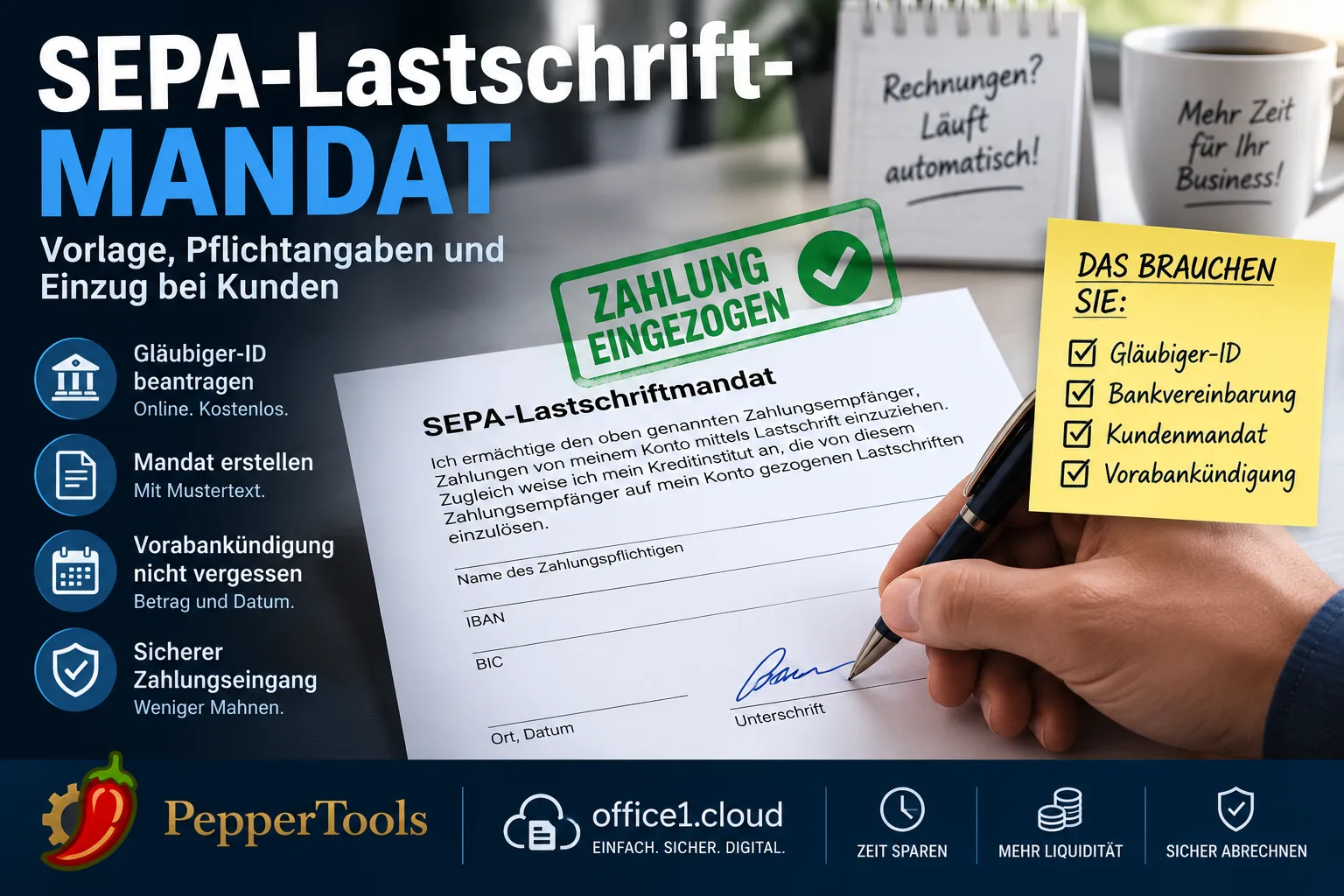
SEPA Direct Debit Mandate: Template, Required Details, Collection
Chasing 40 invoices every month? With direct debit, the money comes in by itself. What you need, what goes in the mandate and what the customer can claw back.