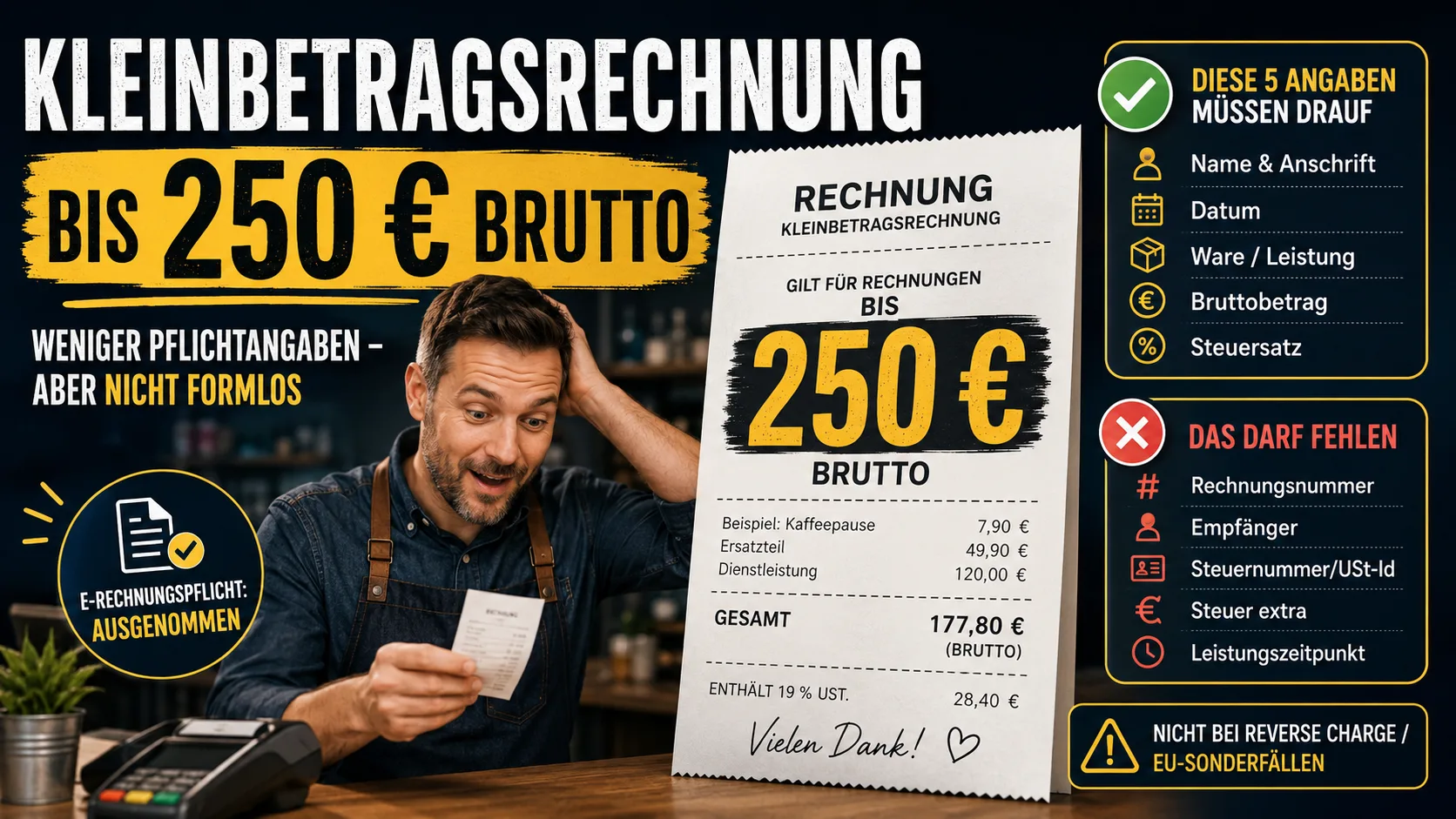
Anyone billing for a coffee, a spare part or a small service quickly asks: does it really need everything a large invoice carries – an invoice number, the recipient's address, separately stated tax? For small amounts, no. For invoices up to 250 euros, VAT law allows a simplified form, the so-called small-amount invoice (§ 33 UStDV – section 33 of the German VAT Implementing Ordinance).
Up to Which Amount Does This Apply?
The threshold is 250 euros gross – that is, including VAT, not net. If a service costs 210 euros net plus 19 percent, that comes to 249.90 euros gross: still a small-amount invoice. At 211 euros net it would be 251.09 euros – and then the full set of mandatory details applies.
A missing detail on a small-amount invoice is fixed with a correction document, a wrong amount with a cancellation invoice: the difference is explained in Correcting an invoice.
If you want to write invoices with all mandatory details in a few minutes, you can try the invoicing software Easy Invoice free for 10 days.
These Five Details Must Be on It
Instead of the roughly ten mandatory details of a normal invoice, five are enough for a small-amount invoice:
- Full name and address of the supplying business (that is, your own details).
- Date of issue of the invoice.
- Quantity and type of the goods supplied, or the extent and type of the service.
- Gross amount – the consideration and the tax amount may be shown as a single total.
- The tax rate (e.g. 19 % or 7 %) or, in the case of a tax exemption, a corresponding note.
What You May Leave Out
This is exactly where the simplification lies. On a small-amount invoice, the following can be dropped:
- the invoice number,
- the name and address of the recipient,
- your tax number or VAT identification number,
- the separately stated tax amount (net, tax rate, tax shown individually),
- the separate time of supply.
The supermarket till receipt is the best-known example: it names the retailer, the date, the items, the gross total and the tax rate – making it a complete small-amount invoice, one that even lets your customer claim the input VAT.
Where the 250-Euro Rule Does Not Apply
The simplification has limits. It does not apply to certain transactions – there you need a complete invoice regardless of the amount:
- distance selling to private customers in other EU countries,
- intra-Community supplies (tax-free supply to a business in another EU country),
- cases of reverse charge under § 13b UStG.
If one of these applies, the low amount does not help – then all mandatory details, including the invoice number and recipient data, belong on the invoice.
And the E-Invoicing Obligation?
One point that unsettles many in 2026: small-amount invoices up to 250 euros are exempt from the e-invoicing obligation. They may permanently be issued as an "other invoice" on paper or as a PDF. This is a deliberate exception in the law and not merely a transitional period. How the e-invoice applies otherwise is covered in our article E-invoicing obligation for small businesses.
Anyone using invoicing software hardly has to worry about the distinction anyway: programs like Easy Invoice on office1.cloud automatically apply the right form depending on the amount and the recipient. If a mandatory detail is missing, it shows up when you create the invoice – not first at the tax audit.
A Common Misunderstanding to Close
Small does not mean informal. A small-amount invoice is also a document that matters for tax purposes – without the tax rate or without your address, your customer cannot deduct input VAT, and in an audit the evidence is missing. The five details above are the minimum you should not go below.
_This article gives a general overview and is no substitute for tax advice. What matters is your specific individual case; when in doubt, your tax adviser can help._
Handle invoices more easily
Easy Invoice combines quotes, invoices and customer management in the cloud.
Try Easy InvoiceRead next
 Invoicing & Accounting
Instalment agreement with customers: template and rules
Your customer asks whether they can pay the invoice in three instalments. Before you agree, two things matter: the tax office will not wait, and your favour legally becomes a loan.
 Invoicing & Accounting
Cash Discount on an Invoice: Wording, Deadline and VAT
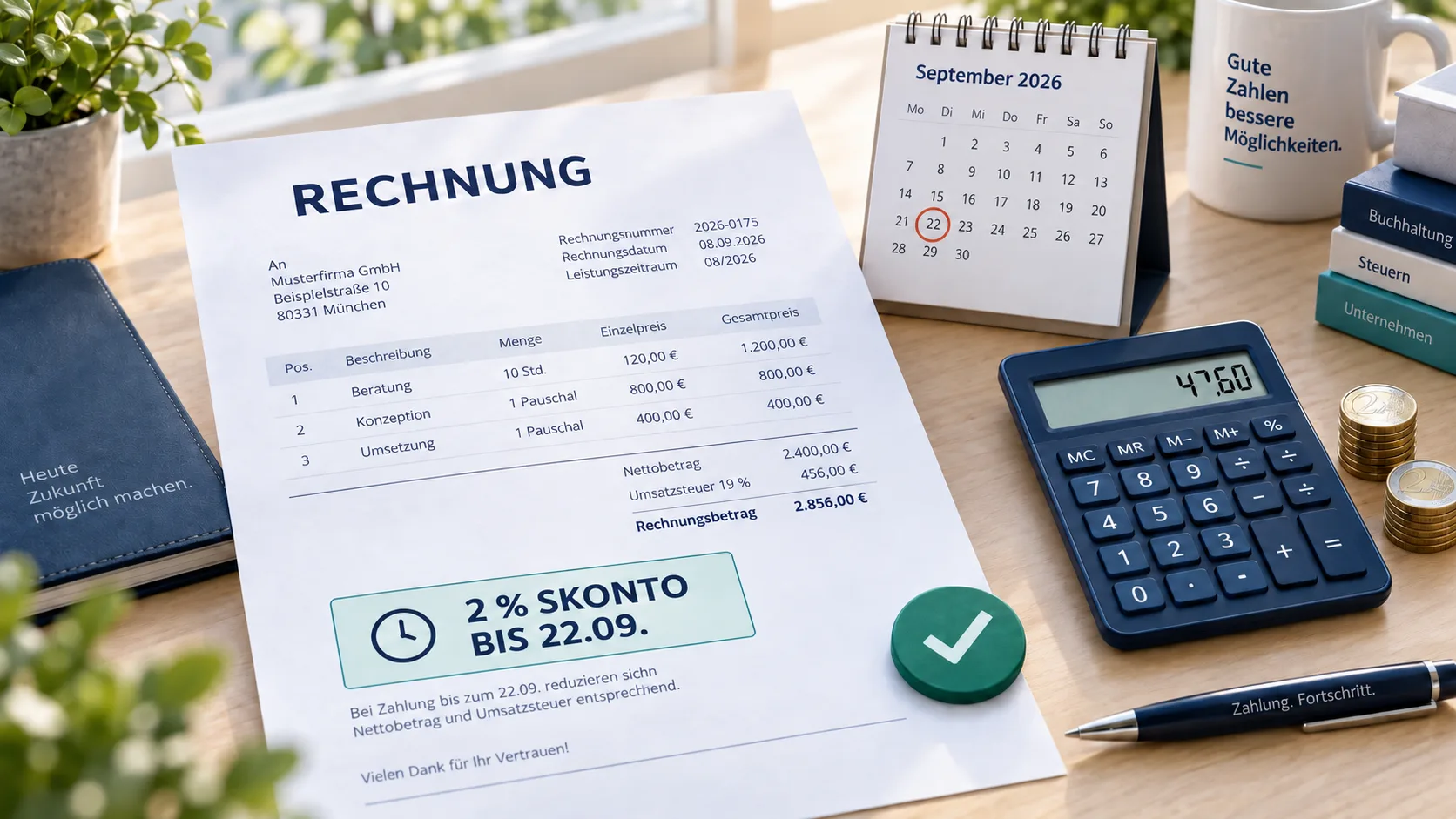
A client deducts a cash discount even though they paid far too late – and looking at your invoice, you realise your wording never settled the point.
 Invoicing & Accounting
Invoicing Without a Trade License in Germany: Allowed, With a Limit
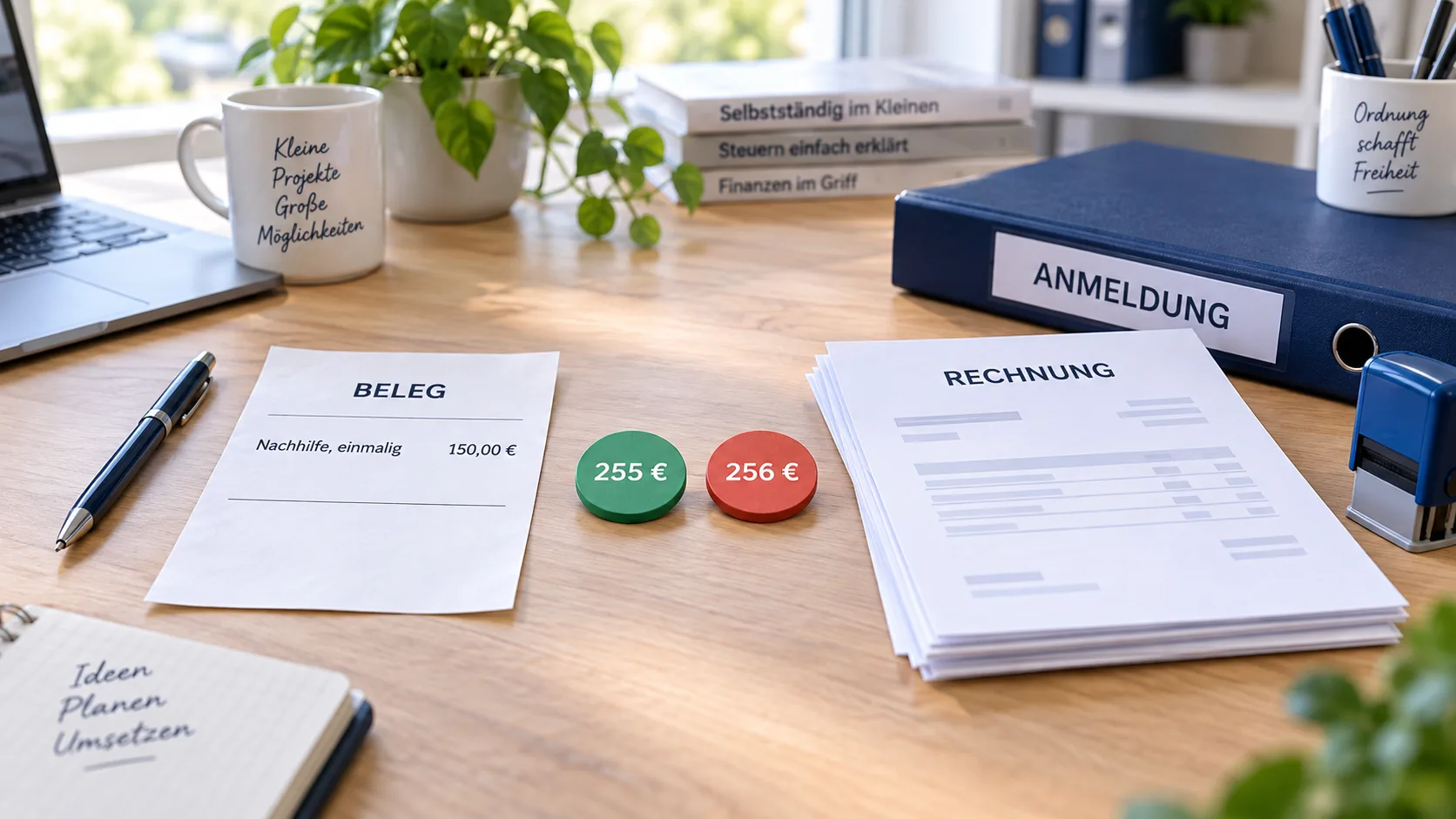
A client wants an invoice, but you haven't registered a trade. You may still write one – the real question is when a favor turns into an obligation.