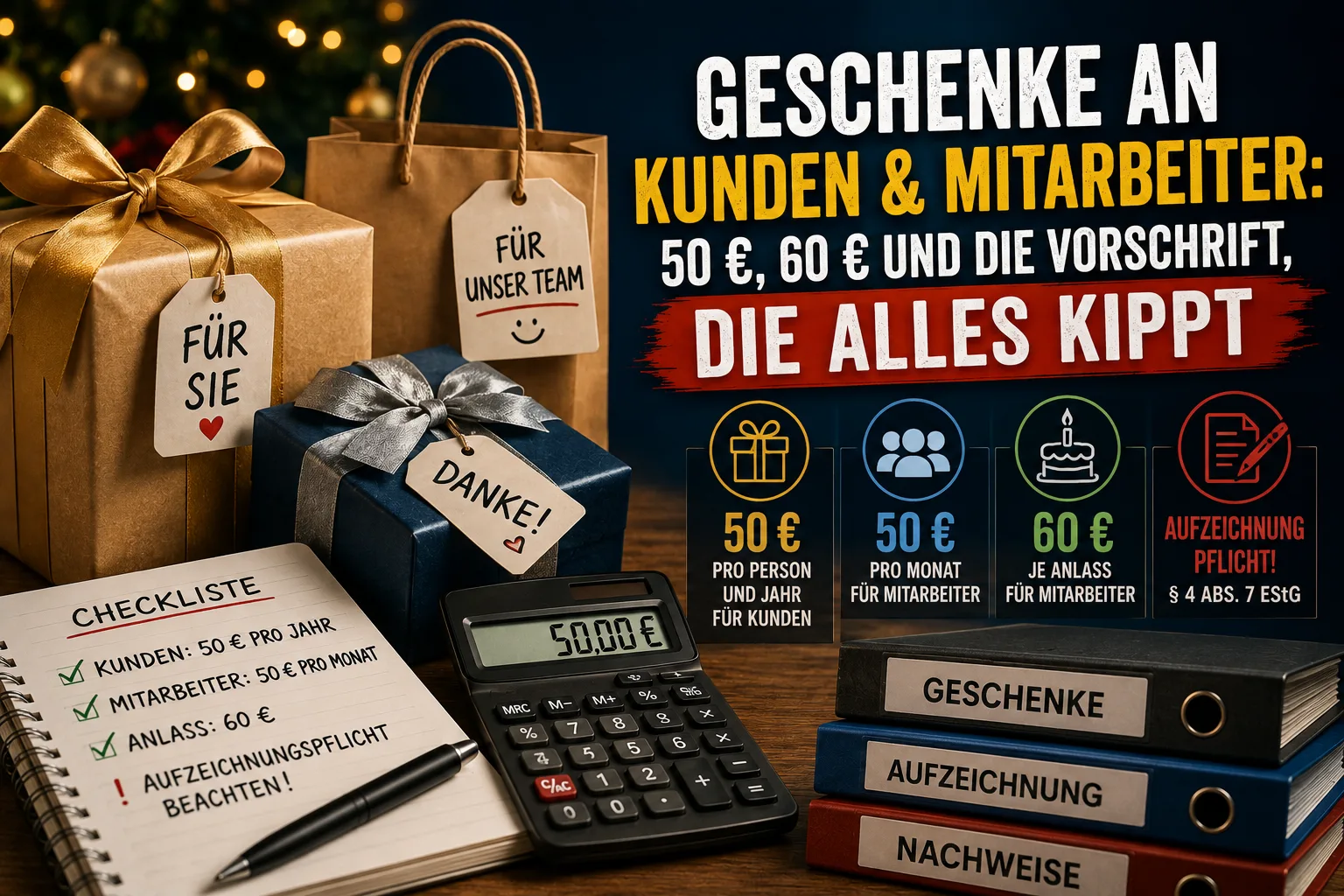
For clients and business partners, a limit of 50 euros per person and year applies. Stay below it and you deduct the cost as a business expense. One cent above, and the entire amount is gone – not just the excess.
For your own employees, this limit does not apply. Gifts to them are always a business expense for you. There, the limits decide something else: whether income tax and social security contributions arise for the employee. Two values matter – 50 euros per month and 60 euros for a personal occasion such as a birthday.
On top of that comes a rule that applies regardless of any amount: section 4 paragraph 7 of the German Income Tax Act (EStG) requires you to record gifts individually and separately from your other business expenses. Without that separation, the tax office denies the deduction – even for a present costing 18 euros.
This article provides general information and does not replace tax or legal advice.
Contents
- The four limits at a glance
- Why clients and employees are two different questions
- Gifts to clients: the 50-euro limit in detail
- 50 euros with or without VAT?
- Pens, calendars, lighters: the 10-euro matter
- Gifts to employees: 50 euros a month, 60 euros per occasion
- Cash and vouchers: the costliest mistake
- The Christmas party counts separately
- When it gets more expensive: the 30 percent under section 37b EStG
- Which account do you book this to?
- The record-keeping duty that voids the deduction
- Three cases calculated
- Frequently asked questions
The four limits at a glance
Four values come up with gifts. They govern different things, and three of them are exemption thresholds. The difference matters: with an exemption threshold, the entire amount is lost the moment you exceed it. With an allowance, the portion below stays protected and only the rest becomes taxable.
| Value | For whom | Governs | Threshold or allowance? | Source |
|---|---|---|---|---|
| €50 per year | clients, suppliers, business partners | whether you deduct the cost | threshold | § 4 (5) s. 1 no. 1 EStG |
| €50 per month | own employees | whether the employee receives taxable pay | threshold | § 8 (2) s. 11 EStG |
| €60 per occasion | own employees, personal occasions | whether the employee receives taxable pay | threshold | R 19.6 LStR |
| €110 per party | own employees, company event | whether the employee receives taxable pay | allowance | § 19 (1) s. 1 no. 1a EStG |
The 50 euros for clients have applied since 1 January 2024. Before that, the limit was 35 euros. If you find an older guide online, check the date first.
Why clients and employees are two different questions
Most texts lump the two together. That misleads, because the limits decide entirely different things.
For clients and business partners, it concerns your own tax. Section 4 paragraph 5 EStG lists expenses that may not reduce your profit. Gifts to persons who are not your employees come first on that list. The 50 euros are the exception to that ban. Stay below, and the gift counts as a business expense.
For your own employees, that ban does not apply. The statute expressly excludes employees. What you give your staff is staff cost for you and reduces your profit – with no upper limit. The question therefore shifts to the other side: at what point does the tax office treat the gift as taxable pay, subject to income tax and social security contributions?
Anyone who knows this difference reads the figures correctly. Anyone who does not will search for a deduction limit on employee gifts that simply does not exist there.
Gifts to clients: the 50-euro limit in detail
The limit applies per recipient and per financial year. The financial year is the period for which you determine your profit – for most small businesses that is simply the calendar year.
The key point: the limit does not apply per gift. If you send the same client a bouquet for 30 euros in May and a bottle of wine for 25 euros in December, you are at 55 euros. The limit is breached, and both items are no longer deductible.
Three points that matter in practice:
It is a threshold, not an allowance. At 50.00 euros you deduct. At 50.01 euros you deduct nothing. There is no partial deduction up to 50 euros. So if you want to give something more expensive, plan on the cost having no tax effect.
VAT is tied to it. Section 15 paragraph 1a of the German VAT Act excludes input VAT deduction for exactly those expenses covered by the ban in section 4 paragraph 5 sentence 1 number 1 EStG. Breach the limit and you lose not only the business expense but also the VAT you would otherwise have reclaimed from the tax office.
You need the name. The tax office must be able to see who received the gift – otherwise the annual limit per recipient cannot be checked. Note the recipient on the receipt. For small promotional items handed out in large numbers, the rules differ. More on that below.
50 euros with or without VAT?
That depends on whether you may reclaim the VAT you paid from the tax office. The technical term is input VAT deduction.
You reclaim the VAT. Then the 50 euros count net, that is without VAT. A wine gift for 50 euros plus 9.50 euros VAT stays within the limit. The reason is in section 9b paragraph 1 EStG: deductible input VAT is not part of the acquisition cost – and the acquisition cost, meaning what you spent on the gift, is the yardstick in the statute.
You do not reclaim the VAT – for example as a small business under section 19 of the VAT Act or because your turnover is VAT-exempt. Then you pay the VAT for good, and it forms part of your acquisition cost. For you, the gross amount counts, meaning what you actually transferred. The same wine gift costs you 59.50 euros and exceeds the limit.
This is a distinction that many guides miss. For small businesses it means: calculate with the figure on the receipt, not with the net value beneath it.
Pens, calendars, lighters: the 10-euro matter
Small promotional items handed out in quantity are treated separately by the tax authorities. Such promotional giveaways up to 10 euros stay outside the flat-rate taxation under section 37b EStG, and you do not have to keep a recipient list for them.
This means items that serve as advertising carriers and have no genuine gift character: pens with your logo, notepads, lighters, wall calendars. A bottle of wine without your company imprint does not qualify, even if it costs seven euros.
If you are unsure whether an item counts as a promotional giveaway, discuss it briefly with your tax adviser. The distinction is a case-by-case question.
Gifts to employees: 50 euros a month, 60 euros per occasion
Two values apply side by side here, and they do not exclude one another.
The 50 euros per month
Section 8 paragraph 2 sentence 11 EStG says: benefits in kind are disregarded if the advantages together do not exceed 50 euros in a calendar month. A benefit in kind is anything the employee receives instead of money – a present, a fuel voucher, a transit pass. These 50 euros are the classic route for a Christmas present without a special occasion.
This too is a threshold. At 51 euros the full amount becomes taxable pay, not just the one euro. And the limit covers all benefits in kind of that month together. If your employee already receives a fuel voucher worth 40 euros, only 10 euros remain in December.
The 60 euros for a personal occasion
For a special personal event – birthday, wedding, birth of a child, work anniversary – you may additionally give up to 60 euros without taxable pay arising. This is governed by R 19.6 of the German wage tax guidelines, an instruction from the tax authorities to their own offices. The value includes VAT.
Two things narrow this down. First, there must genuinely be a personal occasion for the employee. Christmas is not one – it affects everyone at the same time and is therefore not a personal event. Second, this too is a threshold: 61 euros make the full amount taxable pay.
Drinks and refreshments you provide for consumption on the premises – coffee, water, fruit – also count as courtesies and are not taxable pay.
Cash and vouchers: the costliest mistake
Money is always taxable pay. Even 20 euros in an envelope for a birthday. The courtesy rule and the 50-euro threshold apply exclusively to benefits in kind. The moment cash changes hands, income tax and social security contributions arise, regardless of the amount.
With vouchers, it depends on what the employee can do with them. A voucher he can have paid out or freely convert into cash is money. A voucher that entitles him to obtain a specific good or service can be a benefit in kind. The requirements for voucher cards are tricky in detail and depend on the card type. Clarify the specific card with your tax adviser or payroll office before you order a hundred of them.
The Christmas party counts separately
The company party runs in its own lane. Section 19 paragraph 1 sentence 1 number 1a EStG grants an allowance of 110 euros per company event and participating employee, for up to two events per year.
This is the only value in this article that is an allowance. If the party costs 130 euros per head, only the 20 euros above become taxable pay. The first 110 euros stay protected.
Important in practice: the allowance covers the party itself. A present you additionally send employees home with belongs in the 50-euro threshold assessment or in flat-rate taxation – not in the 110 euros.
When it gets more expensive: the 30 percent under section 37b EStG
Sometimes the gift is meant to be larger. Then a question arises that hardly anyone thinks of: a gift made for business reasons is in principle taxable for the recipient. Your client would have to declare the value as business income, your employee as taxable pay. That spoils the pleasure thoroughly – and in practice the recipient does not even know what the present cost.
Section 37b EStG therefore lets you assume that tax. You pay a flat 30 percent on the expenditure including VAT, plus solidarity surcharge and, where applicable, flat-rate church tax. The flat-rate tax counts as wage tax and is remitted via the wage tax return, no later than ten days after the end of the reporting period. The recipient then no longer has to declare the benefit.
Two restrictions are written into the statute: flat-rate taxation is excluded if the expenditure per recipient and financial year exceeds 10,000 euros, or if a single benefit exceeds 10,000 euros.
One point often overlooked: the flat-rate tax does not rescue your business expense deduction on client gifts. If the present costs more than 50 euros, it remains non-deductible for you – the 30 percent come on top and are themselves non-deductible. So you buy the client out of the taxation, not yourself into the deduction.
For gifts to your own employees the calculation differs, because the expense is deductible anyway. Note there, however, that the flat-rate taxed benefit generally remains subject to social security contributions. That is the difference from flat-rate taxation for third parties, and the reason why the route often does not pay off for employees.
Which account do you book this to?
The German standard charts of accounts SKR03 and SKR04 hold dedicated accounts for gifts – separated by whether the gift is deductible and whether you apply section 37b. You need exactly this separation anyway for the record-keeping duty in the next section.
| Situation | SKR03 | SKR04 |
|---|---|---|
| Gifts deductible, without § 37b EStG | 4630 | 6610 |
| Gifts deductible, with § 37b EStG | 4631 | 6611 |
| Flat-rate tax on gifts and benefits, deductible | 4632 | 6612 |
| Gifts non-deductible, without § 37b EStG | 4635 | 6620 |
| Gifts non-deductible, with § 37b EStG | 4636 | 6621 |
| Flat-rate tax on gifts and benefits, non-deductible | 4637 | 6622 |
| Gifts used exclusively for business purposes | 4638 | 6625 |
| Free add-ons with § 37b EStG | 4639 | 6629 |
| Courtesies (employees, personal occasion) | 4653 | 6643 |
| Gift vouchers issued | 1796 | 3786 |
Two rows need explaining. Free add-ons are extras thrown in with a purchase – the coffee mug the customer gets with the order. They are tied to a sale and are therefore not a gift within the meaning of the 50-euro limit. Used exclusively for business purposes means items the recipient can only use in his business, such as special tooling for a device he bought from you.
The account numbers come from the DATEV standard charts of accounts 2026. Which of the two you use depends on your bookkeeping – the difference is explained in our article on SKR03 or SKR04.
A note on courtesies: account 4653 or 6643 is intended for benefits to your own employees. Client gifts do not belong there, even small ones.
The record-keeping duty that voids the deduction
Now comes the point at which gifts fail even when they respect every amount limit.
Section 4 paragraph 7 EStG requires you to record the expenses under section 4 paragraph 5 – including gifts – individually and separately from your other business expenses. The second sentence draws the consequence: expenses not recorded that way may not be taken into account when determining profit.
In plain terms: a hamper for 40 euros sits comfortably below the limit. But if you book it under "other costs" or "advertising", the deduction is gone anyway. Respecting the limit is not enough – you must also visibly separate the item from your other expenses.
In practice this means:
- Use a dedicated account. Do not push it into the catch-all item.
- Note the recipient. Otherwise the annual limit per person cannot be traced.
- Record it promptly. Do not reconstruct it from memory in March of the following year.
How to file receipts sensibly and what the tax office actually looks at during an audit is covered in our articles on managing incoming invoices and on the GoBD-compliant invoice.
The same recording obligation applies to business entertainment, because it sits right next to gifts in Section 4 paragraph 5. What belongs on the receipt and how much of it remains deductible is covered in filling in the entertainment receipt.
How to reflect the separation in Easy Invoice
In Easy Invoice you record every expense with a category, and every category carries an SKR account. No category is preset for gifts – you create it yourself, for example "Gifts deductible" with account 4630 or 6610 and, alongside it, "Gifts non-deductible" with 4635 or 6620.
That way the items land in a pot of their own instead of the catch-all, and your tax adviser sees immediately on export what belongs where. You write the recipient's name into the description of the expense.
When scanning a receipt, the software suggests a matching category. The suggestion is only applied when you click it – nothing is pre-filled, because the assignment remains your decision.
Three cases calculated
Case 1: Ten regular clients each receive a bottle of wine. Price 32 euros net plus 6.08 euros VAT. You reclaim the VAT, so the 32 euros count. That is below 50 euros. Result: 320 euros business expense on account 4630 or 6610, 60.80 euros input VAT deductible. Note the recipient on each receipt. Had the same clients already received a bouquet for 25 euros in spring, the annual total would be 57 euros – and then nothing would be deductible.
Case 2: The same bottle, but you are a small business. You do not reclaim VAT. So 38.08 euros count. That is still below 50 euros, and the deduction stands. With a bottle at 45 euros net it would be 53.55 euros gross – above the limit, even though the net figure would still have fit.
Case 3: Five employees, a Christmas present of 45 euros each. Christmas is not a personal occasion, so the 60-euro rule does not apply. The 50-euro monthly threshold governs. The 45 euros fit – provided no other benefit in kind runs in December. For you, the 225 euros are a business expense in full, and no taxable pay arises for the employee. Had you spent 55 euros, the full 55 euros per head would be subject to wage tax and contributions.
Frequently asked questions
Does the 50-euro limit apply per gift or per year? Per recipient and year. All gifts to the same person are added together.
What if I exceed the limit by a few cents? Then the deduction is lost entirely, together with the input VAT. There is no partial deduction up to 50 euros.
Does the packaging count? Distinguishing packaging, labelling and shipping costs is a case-by-case question. If you are close to the limit, clarify your specific case with your tax adviser first.
May I give my employees money? You may, but not tax-free. Cash is taxable pay in any amount.
Can I combine the 50 euros a month with the 60 euros per occasion? Yes, they are two separate rules. A birthday present for 55 euros in May does not use up the monthly threshold.
How do non-deductible gifts affect my figures? They reduce your profit at first but are added back for tax purposes. In the BWA they therefore appear as a separate item. For the income surplus statement there is a dedicated line in the EÜR annex for limited-deductible business expenses.
Do I need an invoice for every gift? You need a receipt. Up to 250 euros a small-amount invoice with the shortened mandatory details is sufficient.
Legal status: All values in this article reflect the position as at 28 August 2026 and relate to German tax law. The basis is section 4 paragraph 5 sentence 1 number 1 and paragraph 7 EStG, section 8 paragraph 2 sentence 11 EStG, section 9b paragraph 1 EStG, section 19 paragraph 1 sentence 1 number 1a EStG, section 37b EStG, section 15 paragraph 1a of the VAT Act and R 19.6 of the wage tax guidelines. The account numbers come from the DATEV standard charts of accounts SKR03 and SKR04 in their 2026 version. Whether a benefit is deductible in your case or triggers taxable pay depends on circumstances that only your tax adviser can assess in full.
Handle invoices more easily
Easy Invoice combines quotes, invoices and customer management in the cloud.
Try Easy InvoiceRead next
 Invoicing & Accounting
Receipt lost? How to write an Eigenbeleg in Germany
No booking without a receipt – but there is a substitute. What belongs on a German Eigenbeleg, when the tax office accepts it, and why the VAT is gone anyway.
 Invoicing & Accounting
Pro forma invoice: meaning, template and when you need one
A pro forma invoice demands no money and gives no input VAT deduction. It serves customs and advance information. What belongs on it and where the traps are.
 Invoicing & Accounting
Late payment interest in Germany: rate, formula and example
A customer has not paid for weeks. You may charge interest without asking. Here is how much exactly, from which day it counts and how to work out the amount.