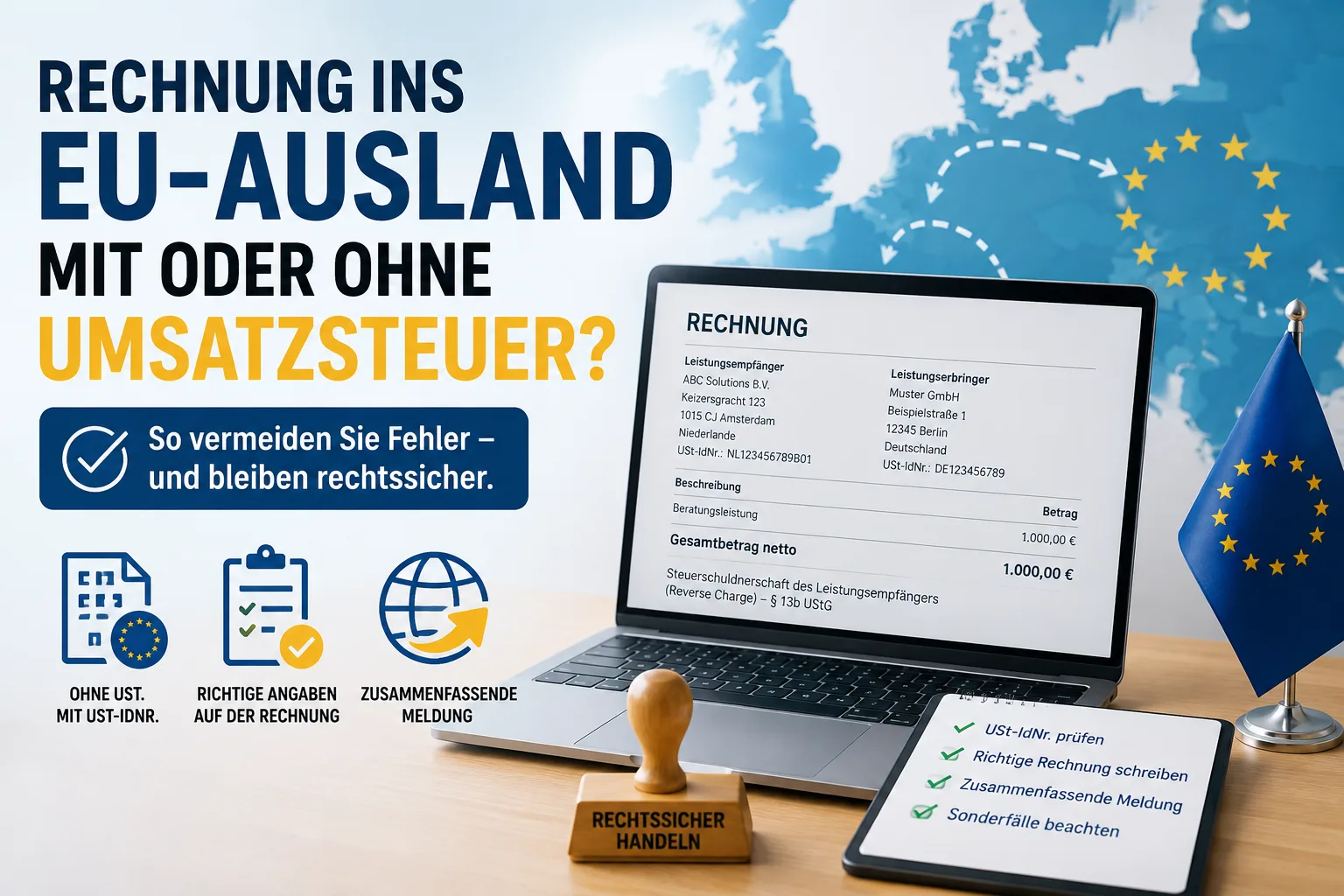
If your customer is a business in another EU country and gives you their VAT identification number, you write the invoice without German VAT. The invoice then shows both numbers – theirs and yours – and the sentence „Steuerschuldnerschaft des Leistungsempfängers" (reverse charge). Your customer accounts for the tax in their own country. Afterwards you still report the sale to the Federal Central Tax Office; that report is called the recapitulative statement.
Two situations work differently, and both are more common than people expect: private customers in the EU, and work carried out on a building on site. Each has its own section below.
Contents
- The normal case: a business customer in the EU
- Three questions and you know your case
- What has to be on the invoice
- The VAT ID: how to get one, how to check your customer's
- If the number is missing or wrong: who pays?
- After the invoice: the recapitulative statement
- Special case for trades: working on a building abroad
- Private customers in the EU
- Customers in Switzerland or another non-EU country
- If you use the small business scheme
- How this works in Easy Invoice
The normal case: a business customer in the EU
You provide a service for a company in Austria, the Netherlands, France. The rule is: the place of supply is where your customer is based – not where you are (§ 3a para. 2 German VAT Act, UStG). For you that has one simple consequence. The service is not taxed in Germany, so you do not charge German VAT.
The tax does not disappear. It simply moves to the customer. In their country they apply their own rate to your amount, report it to their tax office and deduct it again in the same return. On paper it nets out to zero for them. This switch is called reverse charge.
In practice: you show the net amount, no tax line, and a note stating that the customer owes the tax. What you do not do is calculate the Austrian rate. That is none of your business.
Do not confuse this with the rule for construction work inside Germany. There, too, you invoice without VAT and add a note, but it is a different case with different conditions – see reverse charge for construction services under § 13b UStG.
Three questions and you know your case
Before you write anything, settle three things. After that the answer is fixed.
Question 1: business or private individual? You recognise a business by the fact that it can give you a VAT identification number. If it cannot, treat the job like a private customer, with the consequences described further down.
Question 2: goods or a service? Are you selling an item that is transported across the border, or are you performing work? Both lead to an invoice without German VAT, but the conditions differ. For goods the law speaks of an intra-Community supply (§ 4 no. 1 letter b in conjunction with § 6a UStG); there you also need proof that the goods actually left the country – usually the so-called Gelangensbestätigung (entry certificate) or a freight document. Without that proof the exemption collapses, even if everything else is correct.
Question 3: are you working on a building or land? If so, the basic rule from question 1 no longer applies. This is the case most guides skip, so it has its own section below.
| Your customer | What you supply | Invoice | Reporting afterwards |
|---|---|---|---|
| Business in the EU, with VAT ID | service | no German VAT, reverse charge note | recapitulative statement |
| Business in the EU, with VAT ID | goods | no German VAT, plus proof of dispatch | recapitulative statement |
| Business in the EU, without VAT ID | either | with German VAT | – |
| Private individual in the EU | goods | see the section on private customers | possibly OSS |
| Business or private, work on a building | installation, construction, repair | separate rule, see below | usually no statement |
What has to be on the invoice
In addition to everything that belongs on any invoice (the mandatory details are listed in our guide to writing an invoice), you need three things:
- Your own VAT identification number. Not your tax number from the tax office – those are two different numbers.
- Your customer's VAT ID. In full, with the country prefix, for example
ATU12345678. - The note on the reversal of tax liability. The law requires the wording „Steuerschuldnerschaft des Leistungsempfängers" (§ 14a para. 1 UStG). You may add „Reverse charge" for your foreign customer, but the German wording is the one that counts.
And no tax line. No „0 % VAT", no „19 % = 0.00 EUR". Just the net amount as the invoice total.
There is also a deadline that almost nobody knows: for these transactions the invoice must be issued by the 15th day of the month following the supply (§ 14a para. 1 UStG). Domestically you have six months; here you do not.
This is what the bottom of such an invoice looks like:
Subtotal net                   4,200.00 EUR
Invoice total                  4,200.00 EUR

Steuerschuldnerschaft des Leistungsempfängers (reverse charge).
Your VAT ID: ATU12345678
Our VAT ID: DE123456789
The VAT ID: how to get one, how to check your customer's
The VAT identification number is a second number alongside your ordinary tax number. It exists only for cross-border business. You apply for it free of charge at the Federal Central Tax Office, online through the application form. If you do not have one yet, that is step one – without your own number none of this works.
Check your customer's number before you write the invoice. The Federal Central Tax Office does that too, also free of charge, under the heading confirmation of foreign VAT IDs (§ 18e UStG). There are two levels:
- The simple confirmation only tells you whether the number is valid.
- The qualified confirmation also checks whether the name and address match that number, and you receive written confirmation.
Use the qualified one and keep the result. It is your evidence that you acted carefully. For customers you work for regularly it pays to repeat the query from time to time – companies are wound up, numbers become invalid, and nobody tells you.
If the number is missing or wrong: who pays?
This is the real worry behind the whole question, so let us be clear: you pay.
If it later turns out that the conditions were not met – no valid number, no proof of where the goods went – then your supply was an ordinary domestic sale. The tax office then extracts the VAT from the amount you charged. 4,200 euros become 3,529.41 net plus 670.59 in tax. You owe those 670.59 euros. Your customer abroad has nothing to do with it, and the chance that they will voluntarily pay up six months later is slim.
So: check the number first, keep the proof. It costs five minutes and covers a risk of almost 16 percent of your invoice total.
If a business customer has no VAT ID or will not give you one, the safe route is to invoice with German VAT as usual. That is uncomfortable for the customer, but it is your money on the line.
After the invoice: the recapitulative statement
The invoice is not the end of it. Every sale you invoiced without VAT to an EU business customer has to be reported to the Federal Central Tax Office – with the customer's VAT ID and the amount. This is the recapitulative statement (§ 18a UStG).
The essentials in three sentences: you file it electronically, not on paper. The deadline is the 25th day after the end of the reporting period – so with quarterly filing that is 25 April, July, October and January. Whether you file quarterly or monthly depends on the volume of your goods deliveries; anyone invoicing services only is usually on the quarterly cycle.
The statement is not a second tax payment. It is the control report that lets the tax administrations check whether your customer declared the sale on their side. Forgetting it still costs you: late or missing statements can be treated as an administrative offence.
Special case for trades: working on a building abroad
Now the case that overrides the basic rule. If your work relates to a specific building or plot of land – you install a kitchen in a branch in Salzburg, lay cables, refurbish a bathroom – then what counts is not where the customer is based but where the building stands (§ 3a para. 3 no. 1 UStG). That applies even if your client happens to be in Germany while the building is abroad.
That has three consequences for you:
- The German tax office has no claim on this sale. The legal term is „not taxable" and it simply means Germany may not levy tax on that amount. So here, too, you do not charge German VAT.
- Whether the customer takes on the tax is decided by the country where the building stands. Austria, for example, has a broad reverse charge rule for foreign businesses. Other countries are narrower – there you may have to register for VAT locally. That is not a formality, and it is the point at which a call to your tax adviser pays for itself before you send the quote.
- These sales usually do not belong in the recapitulative statement. That statement covers intra-Community supplies and services under the basic rule – work on a building is not among them.
Anyone who regularly works across the border should clarify this once for their target countries. It is the difference between a job with a profit and a job with a back payment.
Private customers in the EU
With private customers there is nobody for the tax to shift to. So it stays with you – the only question is which country it belongs to.
As long as your sales to private individuals in the EU stay below 10,000 euros a year, you simply charge German VAT as you would for a customer in Hamburg. The threshold applies to all EU countries combined, not per country.
Above it, the sale is taxed in the customer's country at the local rate. So that you do not have to register in every country separately, there is the One-Stop-Shop procedure: you report everything together to the Federal Central Tax Office, which distributes it. You still have to register for it, and the report is a separate, additional return.
Honestly: that is a topic of its own, and anyone crossing that threshold should walk through it once with a tax adviser. For services to private individuals there are additional rules depending on the type of service – an online course is treated differently from an on-site repair.
Customers in Switzerland or another non-EU country
Outside the EU things get simpler, surprisingly, because the EU reporting duties fall away.
Service for a business: the place of supply is with the customer, and Germany may not levy tax on it. You invoice without German VAT and add a short note that the service is supplied and taxed abroad. Strictly speaking the term „reverse charge" does not apply here – that is an EU procedure – but many customers know it and will not stumble over it. No recapitulative statement.
Supply of goods: that is an export and is exempt (§ 4 no. 1 letter a in conjunction with § 6 UStG), but only with proof of export from customs. Without that document the same applies as above: the tax office extracts the VAT from your amount. If the goods cross the border without a sale, as samples, warranty replacements or loaned equipment, customs needs a pro forma invoice instead.
If you use the small business scheme
This is where it gets messy, so only the honest core: as a small business under § 19 UStG you do not charge VAT domestically – but that does not mean cross-border business is automatically without consequences for you. As soon as you work for an EU company and use a VAT ID in doing so, reporting and registration duties can arise that do not exist domestically. Conversely, buying from another EU country can mean you owe VAT to the tax office even though you never charge any yourself.
That is no reason to turn down foreign customers. It is a reason to go through the first case with a tax adviser before you write the invoice. What applies to you domestically is covered in our article on the small business invoice under § 19 UStG.
How this works in Easy Invoice
You store the country and the VAT ID with the customer. When you write the invoice, the software recognises the case from that, applies no VAT and prints the required note „Steuerschuldnerschaft des Leistungsempfängers (Reverse Charge)" on the document. The same applies to intra-Community supplies, exports and services to businesses in non-EU countries – each with the matching wording and reason. If you generate an XRechnung or ZUGFeRD invoice, the exemption reason is carried in the correct field there as well – many recipients check that automatically and reject the invoice otherwise.
For the recapitulative statement there is a separate report that compiles the relevant sales per customer and period and outputs them as a PDF. You submit the figures yourself at the Federal Central Tax Office; there you type them in. The software also does not replace checking the customer's number – you run the confirmation query at the Federal Central Tax Office.
This article explains the rules in general terms and is not tax advice. If you have your first foreign order in front of you, two things decide the outcome: check your customer's VAT ID before the invoice goes out, and clarify beforehand whether your work relates to a building. Those two points determine whether the invoice stays the way you wrote it. Try Easy Invoice for free.
Handle invoices more easily
Easy Invoice combines quotes, invoices and customer management in the cloud.
Try Easy InvoiceRead next
 Invoicing & Accounting
Booking private withdrawals in Germany: accounts, tax, contributions
A private withdrawal is not a salary and does not lower your profit. Which accounts apply, when VAT is due on goods and the car, and what goes into the Anlage EÜR.
 Invoicing & Accounting
Cost estimate in Germany (Kostenvoranschlag): template and what goes in
A German cost estimate (Kostenvoranschlag) is an estimate, not a fixed price. With a sample to copy: what goes in, which sentences protect you from disputes and when it may cost money.
 Invoicing & Accounting
Receipt lost? How to write an Eigenbeleg in Germany
No booking without a receipt – but there is a substitute. What belongs on a German Eigenbeleg, when the tax office accepts it, and why the VAT is gone anyway.