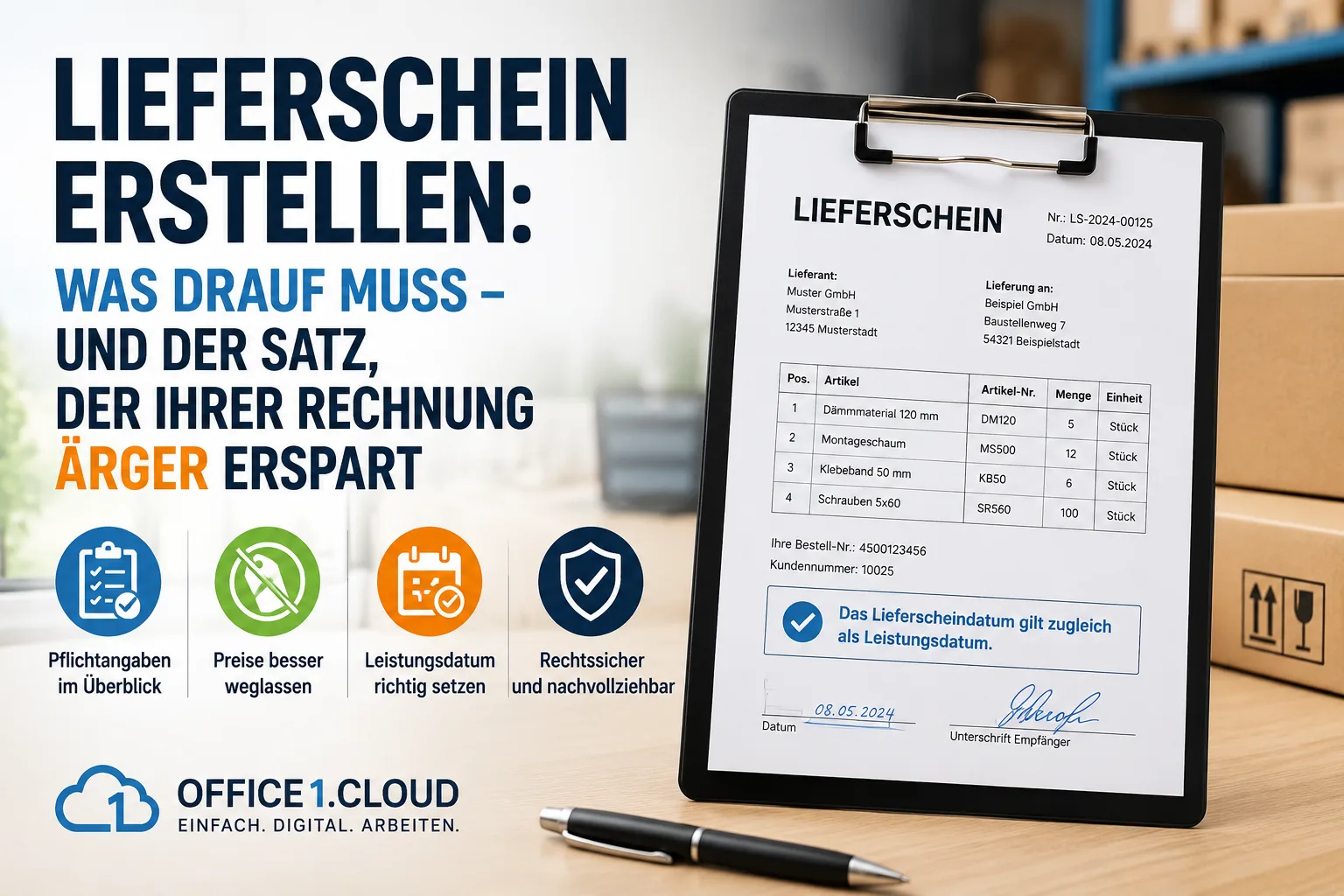
Writing a delivery note is, in most cases, not required by law. No rule demands one in general – unlike an invoice, whose contents are precisely defined by German VAT law. Even so, almost everyone who ships goods writes one: it is the record of who received what and when, for the moment three weeks later when someone claims two boxes were missing.
A delivery note should carry both addresses, the delivery date, a number you can find it by, and then, item by item, exactly what was handed over in what quantity. Prices are usually left off. And if your later invoice refers to this delivery note instead of stating the service date itself, the delivery note must explicitly say that the delivery note date is also the date the goods were supplied. Without that line, your invoice has a gap – and your customer runs into trouble reclaiming the VAT they paid you from the tax office. They will come back to you about it.
This article describes the rules that apply in Germany.
Contents
- Do I even have to write a delivery note?
- What belongs on a delivery note?
- Should prices appear on a delivery note?
- The line about the supply date
- Does a delivery note need a number?
- Partial deliveries: one note or several?
- Does the customer have to sign?
- How long do I have to keep delivery notes?
- From delivery note to invoice without retyping everything
- Does mandatory e-invoicing change anything?
Do I even have to write a delivery note?
For the normal case – you deliver goods to a customer – no rule requires a delivery note. You can hand over goods without any paperwork and simply send an invoice later.
The reason nearly everyone writes one anyway is practical: weeks often pass between handover and invoice. Without a delivery note it is your word against the customer's as to whether those two missing rolls of insulation ever reached the site. A signed delivery note ends that conversation in thirty seconds.
There is also this: the driver or fitter handing over the goods needs a list of what they have with them anyway. That list is the delivery note.
Some areas have their own documentation requirements, for instance dangerous goods or the food supply chain. If you work in one of those, clarify it separately – this article covers the general case and is not legal advice.
If you want to write invoices with all mandatory details in a few minutes, you can try the invoicing software Easy Invoice free for 10 days.
What belongs on a delivery note?
Because there is no statutory requirement, there is no official list either. Here is what has become standard practice, and what you need for the document to be worth something if it is ever disputed:
- Your full company address – who delivered
- The customer's address and, if different, the delivery address. This is more common than people think: invoice to head office, goods to the building site.
- A delivery note number
- The delivery date – the day the goods were actually handed over
- The line items: description, article number, quantity and unit. "5 pieces", not "several".
- Your customer number and the customer's order or purchase order number. Larger customers otherwise cannot match the note to anything and send it back.
- Space for the date and the recipient's signature
The more precise the line items, the less argument later. A line reading "material as agreed" is worth nothing to you in a dispute.
Should prices appear on a delivery note?
The usual answer is no. There are two reasons, and the second matters more.
The first is mundane: whoever accepts the goods – the warehouse worker, the site manager, sometimes a neighbour – does not need to know your prices.
The second concerns VAT. A document becomes delicate for VAT purposes once it looks like an invoice: showing the price and the VAT as a separate, stated line. If the tax appears that way on the delivery note and you later also write the actual invoice, the same tax can fall due a second time. Under section 14c of the German VAT Act, the liability follows from the fact that tax was stated – not from the goods having been delivered twice. It can be corrected, but it is work nobody needs.
The safe route: quantities on the delivery note, no amounts, and above all no stated VAT. If your customer wants prices on it, use plain net amounts with no tax line – and check with your tax adviser first if in doubt.
The line about the supply date
This is where most delivery notes fall short, and it costs time precisely when everything else is right.
An invoice has to state the date the goods were supplied. It may, however, consist of several documents: the required details can be spread across several papers, as long as one document summarises the price and the tax and clearly identifies the others (section 31(1) of the German VAT Implementing Regulation). That is what the common invoice phrase "delivery as per delivery note no. 30112" relies on.
The catch: the delivery note date is not automatically the supply date. The note may have been printed on Monday and the goods delivered on Wednesday. So if your invoice refers to the delivery note, the supply date must genuinely be derivable from that note – either as a separate entry or through a statement that both dates are the same.
In practice: put a fixed line on every delivery note, for example
The delivery note date is the same as the date of supply.
If that statement is missing and the invoice states no supply date either, the invoice lacks a mandatory detail. Your customer normally reclaims the VAT they paid you from the tax office – that is called input VAT deduction. In an audit, exactly that can be denied when the supply date appears nowhere. They will then ask you for a corrected invoice. Fixable, but avoidable.
Alternatively, state the supply date directly on the invoice and you need no reference at all. Incidentally, naming the calendar month in which delivery took place is also permitted (section 31(4) of the Implementing Regulation) – it does not have to be to the day.
Does a delivery note need a number?
A sequential number is only required for invoices. Nobody demands one for delivery notes.
Even so: without a number, the reference described above does not work. "Delivery as per delivery note" without a number identifies no particular document. And in a filing cabinet you will only find a specific delivery note by its number anyway.
The usual approach is a separate number range, kept apart from invoice numbers – something like DN2026-30001. That way every number tells you at a glance what kind of document it belongs to.
Partial deliveries: one note or several?
One delivery note per actual delivery. If you deliver an order in three stages, three delivery notes arise – each with the quantities genuinely handed over that day.
The reason is the supply date again: the three partial deliveries happened on three different days. A single combined note with a single date would misstate that.
It works well to carry the originally ordered quantity on each line as well: "delivered 40 of 100 m". Then the customer sees while unpacking that the rest is still coming, and does not call.
The invoice at the end may still be a single one covering all three deliveries – as long as it is clear which delivery notes belong to it.
Does the customer have to sign?
That is not required either. It is the whole point of the document.
A delivery note is a piece of evidence. Its value rises and falls with whether someone confirmed receipt. A signed copy with a date and a legible name is worth something in a dispute; one with an illegible scrawl considerably less; an unsigned one almost nothing.
Hence the usual setup with two copies: one stays with the customer, one comes back to you signed. When shipping by parcel service, the carrier's proof of delivery takes on that role – then you need no signature of your own, but you should keep the shipping record.
One point that is often missed: the signature confirms receipt, not that the goods are free of defects. If you want to be safe, add a short line stating that visible transport damage must be noted on the delivery note immediately.
How long do I have to keep delivery notes?
There is a special rule here that many people do not know, and it noticeably lightens your filing.
In principle, delivery notes count as ordinary business correspondence and would have to be kept for six years. Section 147(3) of the German Fiscal Code shortens that considerably, as long as the delivery note is not an accounting document – that is, as long as it is not itself the basis for an entry in your books:
- Delivery notes received: the retention period ends when the invoice is received.
- Delivery notes sent: the period ends when the invoice is sent.
In plain terms: once the matching invoice has gone out, your copy of the delivery note no longer has to be kept for tax purposes. Many businesses hold on to it anyway out of commercial caution – because of the signature, which is the only evidence in a dispute about a delivery that supposedly never arrived. That decision is yours, not the tax office's.
The shortcut does not apply where the delivery note becomes an accounting document. That is exactly what happens in the case described above: if the invoice refers to the delivery note for the supply date, the note is a piece of the invoice – and is kept like one. For accounting documents, section 147(3) now states eight years; books, annual accounts and inventories remain at ten.
How the filing works in the other direction – for the invoices that come in to you – is covered in the article on managing incoming invoices.
From delivery note to invoice without retyping everything
The biggest time sink is not the delivery note itself but what comes after it: in the evening, the same line items get typed a second time into the invoice. That is where the mistakes arise – swapped quantities, forgotten items, an invoice for goods that never went out.
Anyone still writing delivery notes on a carbon pad or in Word saves the most here: not because of a nicer layout, but because the line items are entered only once. In Easy Invoice Cloud the delivery note is its own document type with its own number range: a delivery note is created from a quote or order at the click of a button, and the invoice from the delivery note. The line items travel with it, and the document remembers what it came from – with staged deliveries, you can also see what has already gone out. What else the software covers is described on the office1.cloud home page.
If for now you only want a simple template, the article on the free invoice template shows the route via Word and Excel – and names its limits.
Does mandatory e-invoicing change anything?
No. The obligation to issue electronic invoices between businesses applies to invoices, not delivery notes. Your delivery note may still be a PDF, a printout on paper, or the carbon pad in the van.
There is a connection nonetheless, which is why it appears here: an electronic invoice carries the supply date in a dedicated data field. Anyone who has been working with "delivery as per delivery note" will have to fill that field properly from now on. Which stage applies when is set out in the overview of the e-invoicing obligation in 2027 and 2028.
If you are reorganising the whole process anyway, it pays to think it through from the start: writing quotes, order confirmation, delivery note, invoice. Each document grows out of the previous one – and no line item is typed twice.
This article provides general information and does not replace tax or legal advice. If in doubt in a specific case – particularly regarding stated VAT and the supply date – ask your tax adviser.
Handle invoices more easily
Easy Invoice combines quotes, invoices and customer management in the cloud.
Try Easy InvoiceRead next
 Invoicing & Accounting
Booking private withdrawals in Germany: accounts, tax, contributions
A private withdrawal is not a salary and does not lower your profit. Which accounts apply, when VAT is due on goods and the car, and what goes into the Anlage EÜR.
 Invoicing & Accounting
Cost estimate in Germany (Kostenvoranschlag): template and what goes in
A German cost estimate (Kostenvoranschlag) is an estimate, not a fixed price. With a sample to copy: what goes in, which sentences protect you from disputes and when it may cost money.
 Invoicing & Accounting
Receipt lost? How to write an Eigenbeleg in Germany
No booking without a receipt – but there is a substitute. What belongs on a German Eigenbeleg, when the tax office accepts it, and why the VAT is gone anyway.