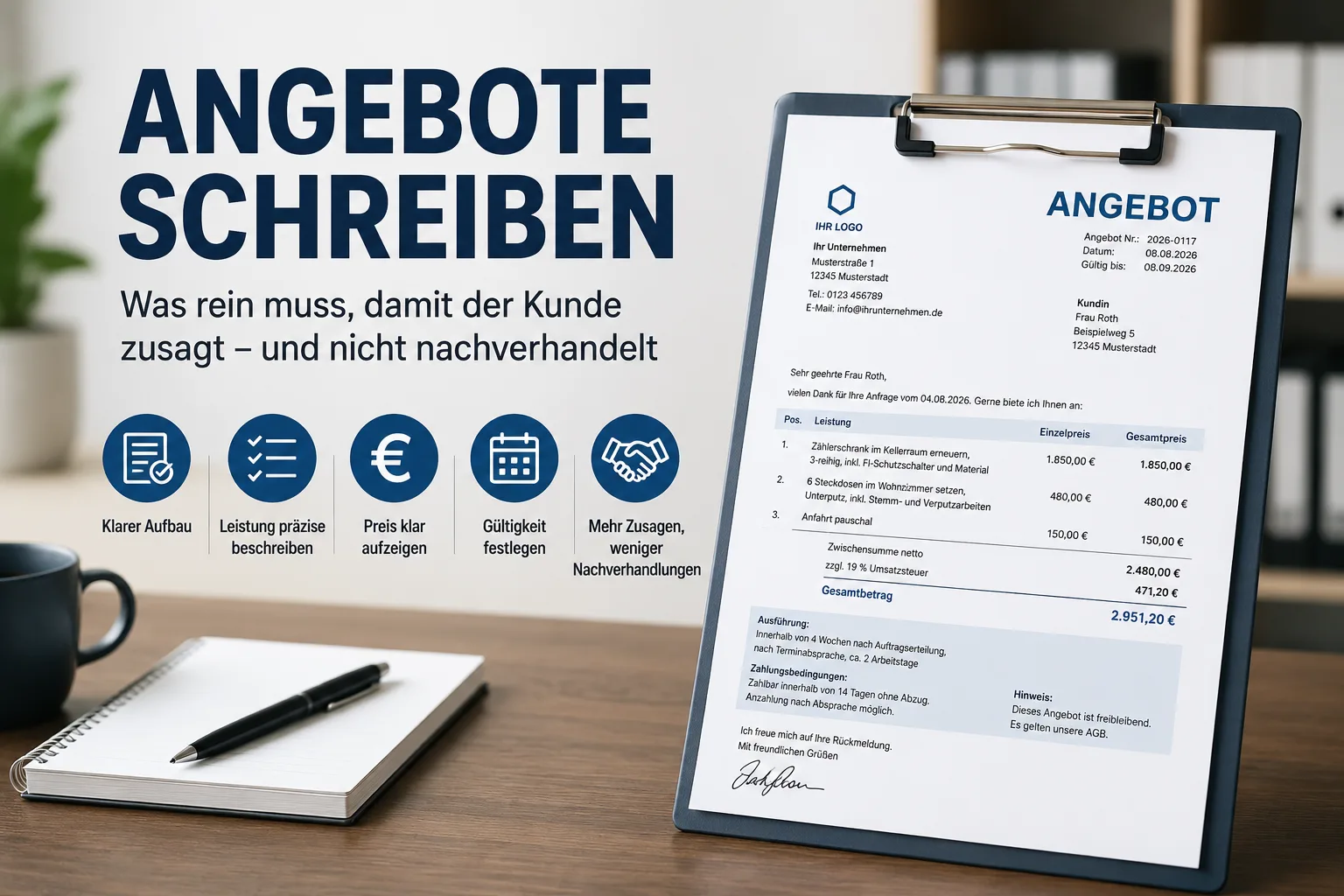
A quote needs five things: a description of the work with numbers instead of blanket terms, one sentence about what is not included, a clearly presented price, a validity date, and a statement about what happens next. Everything else is a matter of form – because unlike an invoice, where § 14 of the German VAT Act (UStG) lists exactly what must appear, no law prescribes mandatory details for quotes. So you decide the structure yourself. Only two questions matter: will the customer say yes? And in three months, will it still be possible to prove clearly what was agreed?
Contents
- What belongs in a quote?
- Template to copy
- The description of work decides whether anyone renegotiates
- Fixed price or time and materials?
- How to arrange the line items
- Net or gross? It depends who is in front of you
- Writing quotes as a small business under § 19 UStG
- How long should the quote be valid?
- The email that goes with the quote
- When the customer doesn't reply: following up
- Creating quotes online instead of using a Word template
What belongs in a quote?
A quote is not a tax document. The tax office isn't interested in it, and nobody checks it for completeness. It has only two jobs: the customer should say yes, and later nobody should argue about what was actually agreed. That gives you the list:
- The word „quote" and a number of its own. The number sounds like bureaucracy but saves time every single time a customer calls and you would otherwise have to ask which of the three quotes they mean.
- A date – without one, there is no way to establish later which version applies.
- Your full details and the customer's. For a company, the exact registered name, not the name of your contact. Anyone who addresses „Mr Müller" and later has to chase Müller GmbH has a problem.
- The work, described as concretely as possible – the most important point, more on that shortly.
- Unit prices and total price, and whether VAT is included or comes on top.
- How long the quote is valid.
- Payment terms: payment period, and where applicable interim payments or a deposit.
- Time frame for the work or delivery time – ideally with the addition „after the order is placed", so the date doesn't shift while the customer spends three weeks thinking it over.
Depending on your trade, add: travel and call-out costs (list them separately, otherwise it becomes a discussion later), materials the customer supplies themselves, and what you need in order to work at all – power supply, clear access, cleared rooms. That last point is forgotten most often and is the most common reason an appointment falls through and you have blocked out a day for nothing.
What does not belong in it: a demand for payment. A quote doesn't ask for money, it proposes something. And it shouldn't look like an invoice anywhere. Anyone who states VAT in a document in a way that could pass as an invoice may owe the tax office exactly that amount – even if nothing was ever delivered (§ 14c UStG).
From quote to invoice in one tool: the quote and invoice software Easy Invoice carries the line items over to the next document with one click.
Template to copy
That's all it takes. The text works as a PDF and, with adjusted formatting, as an email too:
Quote no. 2026-0117
Date: 08/08/2026
Valid until: 08/09/2026Dear Ms Roth,
thank you for your enquiry of 04/08/2026. I am pleased to offer you:
1. Replace consumer unit in the cellar room, 3 rows, incl. RCD and materials · €1,850.00
2. Install 6 sockets in the living room, flush-mounted, incl. chasing and plastering · €480.00
3. Call-out charge, flat rate · €150.00Subtotal net: €2,480.00
plus 19 % VAT: €471.20
Total: €2,951.20Optional, not included in the total:
4. Additional outdoor socket on the terrace, incl. wall penetration · €320.00 netExecution: within 4 weeks of the order being placed, by arrangement, approx. 2 working days
Payment: 14 days after receipt of invoice, no deductionsNot included are decorating works after the plastering, and any renewal of the main supply line that may prove necessary; whether it is required only becomes apparent once the unit is opened. In that case I will agree the additional costs with you in advance.
On the day of the work I need free access to the cellar room and the option to switch off the power for approx. 3 hours.
I look forward to hearing from you.
Kind regards
Elektro Sander · Owner Michael Sander · Ahornweg 12, 12345 Musterstadt · VAT ID DE123456789
The two paragraphs before the sign-off are the ones people leave out when writing in a hurry – and they make the biggest difference. The next section explains why.
For a delivery of goods rather than a trade service, replace „Execution" with „Delivery: expected week 38, shipped by freight forwarder to kerbside" and add retention of title where appropriate – the goods remain yours until paid for in full.
The description of work decides whether anyone renegotiates
„Electrical work on the ground floor – €2,480" is a quote you lose with. Not because the price is wrong, but because three months later that sentence can mean everything and nothing. The customer remembers four extra sockets, you remember six in total. Who prevails depends on who wrote it down.
Three things make the difference:
Numbers instead of blanket terms. Not „install sockets" but „6 sockets, flush-mounted". Not „paint walls" but „approx. 68 m², two coats, full coverage". Not „lay tiles" but „bathroom approx. 11 m², format 30 × 60, materials supplied by client".
Write down what is not included. This feels uncomfortable while writing, because you don't want to jeopardise the job with restrictions. In practice it works the other way round: whoever says up front „decorating is not included" sells it afterwards as a variation. Whoever says nothing ends up doing it for free, because the customer assumed it was a given.
Say what happens if things turn out differently. With older buildings, bathrooms and anything behind a wall, you don't know everything in advance. A sentence like „If it turns out on opening that the cable needs replacing, I will agree the additional costs with you in advance" costs nothing and prevents the discussion that otherwise starts with „nobody ever mentioned that".
Fixed price or time and materials?
This decision comes before the first sentence, and it changes the whole quote.
A fixed price means: you name a figure and stand by it. The customer knows where they are – which sells considerably better, especially to private customers. The risk sits with you: if it takes longer than calculated, you pay the difference. A fixed price makes sense when you genuinely have an overview of the scope – new builds, visible surfaces, standard installations, anything you have done a hundred times.
Time and materials means: hourly rate times hours plus materials. The risk sits with the customer, which is exactly why they are wary. It makes sense when the scope honestly cannot be foreseen: fault finding, older buildings, water damage, anything behind a closed wall. If you quote this way, four details belong in the quote, otherwise every invoice becomes a discussion:
- the hourly rate, split by qualification if the rates differ
- the billing increment – for example „each 15 minutes started"
- how travel and travel time are charged
- how materials are charged, with or without a mark-up
A combination is usually the best solution: a fixed price for the predictable part, time and materials for the unknown. In the example above that would be a fixed price for the consumer unit and sockets plus the sentence „Should the main supply line need replacing, I will charge this work at €68/hour plus materials, subject to prior agreement."
A quote is only as good as the calculation behind it – anyone who picks an hourly rate by gut feeling will eventually sell jobs that earn nothing. How to work it out properly is covered in calculating your hourly rate.
And one more distinction, because it constantly gets muddled: a cost estimate is legally not the same as a quote and may, under certain conditions, be exceeded. A sample with all the details is in Cost estimate in Germany: template and what goes in.
That leads to a question that mainly comes up with time-consuming site surveys: may I charge for the quote? In principle no – preparing it is part of initiating a contract, and for cost estimates German law even says so explicitly: „A cost estimate is in case of doubt not to be remunerated" (§ 632 (3) BGB). It is still possible, but only if you agree it beforehand and explicitly – ideally with the addition that you will offset the amount if the order is placed. Both are covered in detail in Is a quote binding?.
How to arrange the line items
Number them. Then you can say „item 3" on the phone instead of describing which line you mean. That pays off again with variations and in the later invoice.
In the order of the work, not by price. The customer reads the quote as a sequence: first strip out, then install, then plaster. Sorting by amount forces them to reconstruct the sequence themselves.
Not too granular. Anyone who lists every screw individually is supplying a shopping list to cut from – the customer goes through it looking for what can be dropped. Five to twelve items is usually the right resolution: detailed enough to show what the money is for, coarse enough that nothing looks individually negotiable.
Separate options visibly. Anything the customer can add belongs below the total and explicitly not inside it. The most common mistake is folding the extra into the main total: the customer sees a figure higher than expected and stops replying altogether. Placed underneath, the option reads as an offer – and is ordered surprisingly often.
Net or gross? It depends who is in front of you
Many people make the same mistake here and send everyone the same net quote. But the rule differs:
To a company you quote net. The business reclaims the VAT as input tax, so for them the net amount is the real figure. You still show the VAT, but the net presentation is the norm.
To a private customer the final price including VAT must be recognisable. § 3 of the German Price Indication Ordinance (PAngV) requires the total price to be stated in offers to consumers, and further: „If a price is broken down, the total price must be highlighted." So you may list net items – the gross amount simply has to stand out clearly at the end and must not be printed smaller than the net price.
The practical reason matters even more than the legal one: a private customer who reads „€2,480" and is then asked to pay €2,951.20 feels misled – even if you did nothing wrong formally. That costs you the job, or an awkward conversation.
If you don't know whether you are dealing with a consumer or a business – a landlord modernising a flat, for instance – state both amounts. That way you are right either way.
Writing quotes as a small business under § 19 UStG
As a small business under § 19 UStG you do not show VAT. In the quote, replace the price block with a single line plus a note:
Total: €2,480.00
The amount does not include VAT (small business scheme under § 19 UStG).
The note is not mandatory in a quote – on the later invoice it is. It still belongs there, for a practical reason: a commercial customer automatically assumes 19 % will be added to your price, which they reclaim from the tax office. Without the note they compare your quote with a competitor's and calculate yours wrongly. With it, they see immediately that €2,480 stays €2,480.
What the later invoice has to look like is covered in writing an invoice without VAT.
How long should the quote be valid?
Put a concrete date on it. Without one you are not free – you are bound by your offer for as long as you could expect an answer „under normal circumstances" (§ 147 (2) BGB). What that means in an individual case is decided, in case of dispute, by a court. With „Valid until 08/09/2026" you decide it yourself.
How long depends on your trade. Where prices are stable, four weeks is normal. If your price depends on material costs that move, two weeks is more honest than four – or you include a reservation for material price changes. Validity is also a management tool: a quote with an end date gets answered more often than one without, and it gives you a natural reason to follow up.
Whether you can still withdraw a quote, what „subject to change" and „without obligation" actually achieve, and what applies if you miscalculated and the customer has already accepted, is covered in detail in Is a quote binding?.
The email that goes with the quote
The best quote is worthless if the email around it looks like it was sent by accident. Four lines are enough:
Subject: Quote 2026-0117 – consumer unit and sockets, Ahornweg
Dear Ms Roth,
as discussed on Monday, I am sending you my quote as a PDF attachment. It covers the consumer unit, six sockets in the living room and the call-out; I have listed the outdoor socket as an option below.
The quote is valid until 08/09/2026. If you are happy with it, a short reply by email is enough – I will then get in touch about a date. If you have any questions, you can reach me on 01234 56789.
Kind regards
Three things make the difference: the subject line contains the number and a keyword, so the customer can find the email again in four weeks. The text says concretely what the next step is – „a short reply is enough" is a lower hurdle than „I look forward to your response". And the quote goes out as a PDF, not a Word file: a PDF looks the same for everyone and can't be changed accidentally (or deliberately).
When the customer doesn't reply: following up
No answer usually doesn't mean „no", it means „still on the pile". Even so, many people don't dare ask because it might seem pushy. The tone decides:
After about a week, a short message that asks a question instead of applying pressure:
Dear Ms Roth,
I just wanted to check whether my quote from last week was clear or whether anything is still open. If you need something different – a different scope, a different date – I'm happy to adjust it.
The difference from „Have you decided yet?" is bigger than it looks: one demands a decision, the other offers help – and incidentally tells you the real reason for the hesitation.
Shortly before the validity expires you have a second, entirely natural reason: „My quote expires on 08/09. Shall I extend it?" That isn't a threat, it's a service – and in practice it's the call where most acceptances come in.
If they decline, ask why. Price, timing, scope, or simply another firm – the answer costs the customer ten seconds and tells you whether you were too expensive or merely too late. Anyone who notes this down for a year calculates differently afterwards.
The customer doesn't have to sign, by the way. A quote is not a form to be countersigned – acceptance is not bound to any form, an email saying „that works" is enough and is easier to find later than a sheet of paper. The reverse also applies: silence is not a yes. Someone who doesn't reply has not agreed.
If the customer accepts, the next step is confirmation – particularly important if they accept with changes, wanting only two of three items or naming a different date. Legally that is not an acceptance but a new offer from the customer, which you have to agree to first. How that works is covered in order confirmation.
Creating quotes online instead of using a Word template
For your first quote, Word is fine. Anyone writing quotes regularly knows the problem from the twentieth onwards: you open the last quote, save it under a new name, overwrite the customer name, items and date – and miss the one line left over from the previous version. Usually it's the number or the validity date, sometimes the name of the previous customer. On top of that, every item gets retyped later: once into the order confirmation, once into the invoice. Every retyping can change a figure, and it only comes to light when the customer compares the invoice with the quote.
Creating quotes online solves exactly these two problems. In office1.cloud, customer details and items come from your master data, quote numbers are issued consecutively, and one click turns the quote into an order and then into the invoice – the items travel with it instead of being retyped.
For the quote itself Word is uncritical, by the way; it isn't a tax-relevant document. For the later invoice it's a different matter, and there it does get tricky: writing invoices with Word or Excel.
If you change only one thing about the way you write quotes, make it the description of work: numbers instead of blanket terms, and one sentence about what isn't included. That decides later whether you can charge for extra work or give it away. And if you want to change a second thing: follow up. Most quotes aren't rejected, they're forgotten. From quote to invoice, a quote and invoice software handles it without typing anything twice.
Handle invoices more easily
Easy Invoice combines quotes, invoices and customer management in the cloud.
Try Easy InvoiceRead next
 Invoicing & Accounting
Cost estimate in Germany (Kostenvoranschlag): template and what goes in
A German cost estimate (Kostenvoranschlag) is an estimate, not a fixed price. With a sample to copy: what goes in, which sentences protect you from disputes and when it may cost money.
 Invoicing & Accounting
Receipt lost? How to write an Eigenbeleg in Germany
No booking without a receipt – but there is a substitute. What belongs on a German Eigenbeleg, when the tax office accepts it, and why the VAT is gone anyway.
 Invoicing & Accounting
Pro forma invoice: meaning, template and when you need one
A pro forma invoice demands no money and gives no input VAT deduction. It serves customs and advance information. What belongs on it and where the traps are.