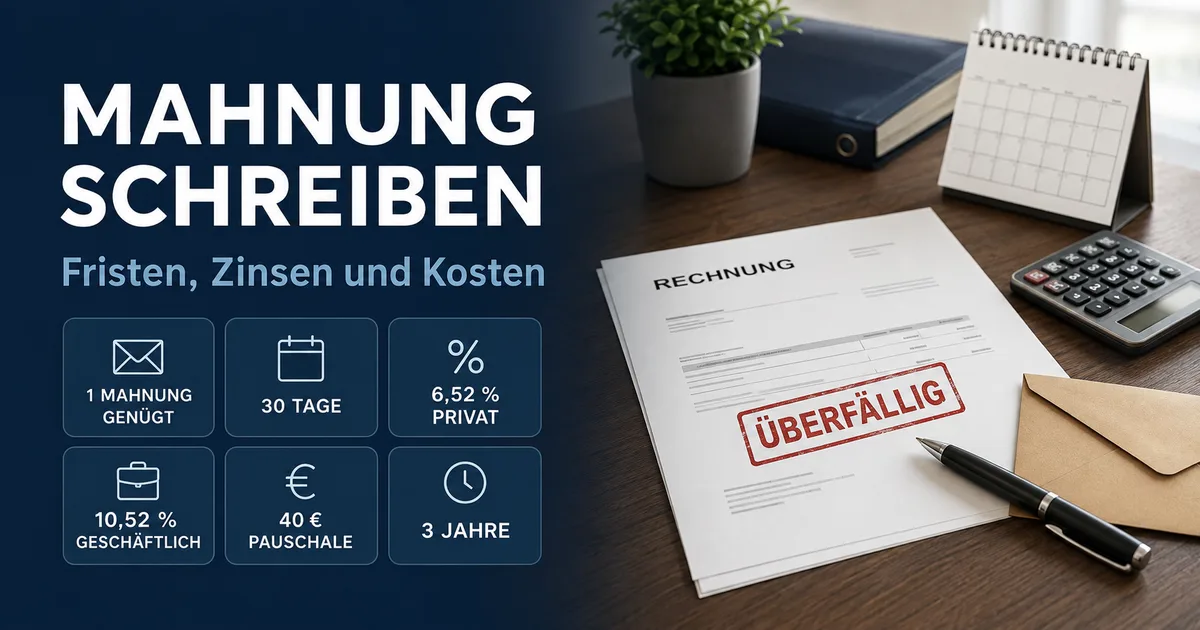
You may send a reminder the day after the due date, meaning as soon as the payment term on your invoice has passed. There is no waiting period, and three reminders are not required — one is enough (section 286(1) BGB). No particular form is prescribed either: the letter needs the invoice number, the outstanding amount, a clear request to pay and a new date instead of "immediately". Everything else below, including a text to copy.
Base rate as of: 1 July 2026 — the next change is possible on 1 January 2027.
Contents
- When may I send a reminder?
- Payment reminder template to copy
- What belongs in the reminder?
- What interest and costs may I claim?
- Why the first reminder usually earns you nothing
- May I send the reminder by email?
- What happens if nothing arrives?
- Frequently asked questions
When may I send a reminder?
The day after the due date. Your invoice falls due on the date you set as the payment term — "payable by 20 September" means you can chase it from 21 September. If you named no payment term, the invoice is due on receipt and you may chase it straight away.
A separate question is when your customer is in default. Default is the state from which you may additionally claim interest and costs. Three routes lead there — and therefore three deadlines to keep an eye on:
| Route into default | What has to happen | Legal basis |
|---|---|---|
| You send a reminder | A single reminder after the due date is enough. Default starts as soon as it reaches the customer. | Section 286(1) BGB |
| You agreed a fixed date | If the invoice or contract names a calendar date ("payable by 20 September"), the customer is automatically in default the next day — with no reminder at all. | Section 286(2) no. 1 BGB |
| 30 days have passed | Default sets in at the latest 30 days after the due date and receipt of the invoice. For private customers only if you pointed this out on the invoice. | Section 286(3) BGB |
The note for private customers is one sentence on the invoice, for example: "Consumers fall into default 30 days after receipt of this invoice at the latest." Without it, only a reminder helps. For business customers you do not need this note.
In practice this means you do not have to wait out the 30 days. Once your payment term has passed, send the reminder — that is the fastest route into default. If you would rather not track open items and reminders in a spreadsheet, you can create them straight from the invoice; that is what the dunning module in Easy Invoice is for.
Payment reminder template to copy
The template stays in German, because your customer in Germany will read it in German. It works for private and business customers alike. The placeholders in square brackets are explained underneath; the add-on block for interest and the flat fee follows below.
[Ihr Name / Ihre Firma]
[Straße Hausnummer]
[PLZ Ort]

[Name des Kunden]
[Straße Hausnummer]
[PLZ Ort]

[Ort], [Datum des Schreibens]


Zahlungserinnerung zu Rechnung [Rechnungsnummer]


Sehr geehrte Frau [Nachname], / Sehr geehrter Herr [Nachname],

am [Rechnungsdatum] habe ich Ihnen für [kurze Bezeichnung der Leistung]
die Rechnung [Rechnungsnummer] über [Betrag] Euro geschickt. Die Zahlung
ist bis heute nicht bei mir eingegangen.

Ich bitte Sie, den offenen Betrag von [Betrag] Euro bis zum
[neues Datum, üblich sind 7 bis 14 Tage] auf folgendes Konto zu
überweisen:

  Kontoinhaber:      [Name]
  IBAN:              [IBAN]
  BIC:               [BIC]
  Verwendungszweck:  [Rechnungsnummer]

Sollte sich Ihre Zahlung mit diesem Schreiben überschnitten haben,
betrachten Sie es bitte als gegenstandslos.

Mit freundlichen Grüßen

[Ihr Name]| Placeholder | What goes in |
|---|---|
[Ihr Name / Ihre Firma], [Straße Hausnummer], [PLZ Ort] | Your name or company, street with house number, postcode and town |
[Name des Kunden] | Name and address of the customer |
[Ort], [Datum des Schreibens] | Your town and the date of the letter |
[Rechnungsnummer], [Rechnungsdatum] | Invoice number and invoice date |
[kurze Bezeichnung der Leistung] | Short description of what you delivered |
[Betrag] | Outstanding amount in euros |
[neues Datum, üblich sind 7 bis 14 Tage] | The new deadline, 7 to 14 days is customary |
[Nachname] | Surname of the person addressed |
Add-on block once the customer is in default. Place it before the closing line. For private customers leave out the 40 euros, they do not apply there:
Da die Zahlungsfrist überschritten ist, berechne ich Ihnen ab dem
[erster Verzugstag] Verzugszinsen in Höhe von [10,52 bei Geschäftskunden,
6,52 bei Privatkunden] Prozent pro Jahr sowie die Pauschale von
40,00 Euro nach § 288 Abs. 5 BGB.

Offener Rechnungsbetrag:  [Betrag] Euro
Verzugszinsen:            [Betrag] Euro
Pauschale:                40,00 Euro
Gesamtbetrag:             [Summe] Euro
Whether you head the letter "Zahlungserinnerung" (payment reminder), "Mahnung" (formal reminder) or something similar makes no legal difference. What counts is that it unmistakably demands payment. If you want to keep the tone friendly, use "Zahlungserinnerung" the first time — the legal effect is the same.
What belongs in the reminder?
Unlike an invoice, a reminder has no prescribed form. Only one thing is legally required: the unambiguous request to pay. Everything else in the table is there because you may have to prove it later, if the customer denies ever having been chased.
| Item | Required? | Why it belongs there |
|---|---|---|
| Clear request to pay ("Ich bitte Sie, … zu überweisen") | by law | Without it the letter is not a reminder and does not trigger default. A bare account statement or a copy of the invoice is not enough. |
| Invoice number and invoice date | for proof | Ties the reminder to one specific claim. With several open invoices it is otherwise unclear which one you mean. |
| Outstanding amount in euros | for proof | The customer must know what to transfer without doing the maths. |
| Date of the letter | for proof | Evidence of when you chased — the starting point for interest. |
| New deadline with a concrete date | practice | "Immediately" or "shortly" cannot be checked. A date can. |
| Bank details and payment reference | practice | Removes the last excuse and speeds up matching the incoming payment. |
| For business customers: interest and the 40-euro flat fee | practice | They arise automatically, but they only have an effect once they are stated as figures in the letter. |
| Note about a possible overlap | practice | Costs one sentence and prevents friction if the money was already on its way. |
You do not have to set a deadline — default sets in without one. It still helps you, because it justifies your next step. Seven to fourteen days is customary.
If you are unsure whether the original invoice was complete: where mandatory details are missing, your customer may withhold payment and the reminder runs into nothing. What belongs on the invoice is set out in Writing an invoice: the ultimate guide.
What interest and costs may I claim?
Once default has set in, three items come into play. The basis is the base rate published by the Deutsche Bundesbank, which changes on 1 January and 1 July. Since 1 July 2026 it stands at 1.52 percent.
| Item | Private customer | Business customer | Legal basis |
|---|---|---|---|
| Default interest per year | 5 percentage points above the base rate = 6.52% | 9 percentage points above the base rate = 10.52% | Section 288(1) and (2) BGB |
| Flat fee | – | 40.00 euros per late claim | Section 288(5) BGB |
| Reminder costs | only real outlay, such as postage | only real outlay, such as postage | damages caused by default |
The 9 percentage points apply only where no consumer is involved on either side. As soon as a private customer is part of the deal, 5 percentage points remain.
Calculating default interest: the worked example
The formula is: amount × interest rate × days in default ÷ 365.
A workshop has invoiced a limited company 1,800 euros. Payment arrives 30 days late:
- 1,800 € × 10.52% × 30 ÷ 365 = 15.56 euros interest
- plus the flat fee: 40.00 euros
- total outstanding: 1,800 € + 55.56 € = 1,855.56 euros
The same invoice to a private customer, also 30 days late:
- 1,800 € × 6.52% × 30 ÷ 365 = 9.65 euros interest
- no flat fee
- total outstanding: 1,809.65 euros
On small amounts and short delays the interest is therefore modest. Its real value lies in appearing in the letter: many customers pay faster once they can see that waiting is getting expensive.
What you may not charge
Your own working time. The half hour you spend searching, writing and fuming is not recognised by the courts as recoverable damage — collecting your own receivables is part of normal business. Flat "processing fees" of 5 or 10 euros do not stand up either. Only what you actually spent is recoverable, which in essence means postage and registered mail.
For business customers, the 40-euro flat fee covers exactly that effort. You get it regardless of whether any costs arose at all. And if your business customer's purchasing terms say they pay neither interest nor the flat fee, that does not help them: such a clause is void. For the interest claim this applies without exception, for the flat fee in case of doubt as well (section 288(6) BGB).
Why the first reminder usually earns you nothing
One point that is easily missed: if it is your reminder that triggers default in the first place, you cannot claim the cost of that very reminder. Default only begins when it arrives — before that there was no claim to carry the cost. Postage and interest for the first reminder stay with you.
It is different where default had already set in, for example through a fixed payment date on the invoice or through the 30-day rule. Then your reminder is not the trigger but the enforcement of an existing claim — and interest, flat fee and postage count from the first day of default.
From this follows one simple measure that achieves more than any template: put a concrete due date on every invoice instead of "payable on receipt", and for private customers add the note about the 30 days. Your customers are then already in default before you chase them for the first time. How to word the payment term, and why a sentence on the invoice alone does not yet trigger default, is covered in Payment terms on an invoice. If you would rather pull payments forward than chase them later, you can also offer an early-payment discount – what it costs and how to make the deadline unambiguous is covered in Cash discount on an invoice.
May I send the reminder by email?
Yes. A reminder is not tied to any form; it can go by email, by post, by fax or even verbally over the phone. It takes legal effect as soon as it reaches the customer.
The problem is not validity but proof. If your customer later claims never to have received the email, you have to prove it arrived — and your outbox only proves that you sent it. For everyday business that is rarely critical: in the vast majority of cases people pay or reply, and nobody argues about delivery.
A workable approach is therefore: first reminder by email, because it is fast and free. If it goes unanswered and the amount is one you would take to court if you had to, send the second one by post as well. In Germany, a Einwurf-Einschreiben (recorded delivery to the letterbox) costs a few euros and gives you a receipt.
What happens if nothing arrives?
After the reminder, further routes are open to you — from the court order for payment to a debt collection agency. That is a topic of its own, described step by step in Customer not paying — what now?. How to organise dunning in stages over the long run is covered in Dunning 2026 for the self-employed.
One number is worth remembering now, though: three years. That is how long you can enforce your claim, counted from the end of the year in which it arose (sections 195, 199 BGB). An invoice from May 2026 therefore becomes time-barred on 31 December 2029. After that your customer can refuse to pay and you can do nothing about it. Important: reminder letters do not stop this clock. Anyone who spends three years merely chasing ends up empty-handed. The clock only stops with an application to the dunning court, a lawsuit or a part payment by the customer.
If you have been writing reminders by hand and losing track of which invoice was due when: Easy Invoice shows open items with their due dates and turns them into payment reminders. You can try it free for 10 days; the trial ends automatically.
Frequently asked questions
When may I send a reminder? The day after the due date. If you named a payment term, that is the day after it expires. Without a payment term, the invoice is due on receipt and you may chase it immediately. There is no statutory waiting period.
Do I need three reminders? No. The law knows no first, second or third reminder — a single reminder after the due date is enough to trigger default (section 286(1) BGB). Often you do not even need that, because default has already set in through a fixed payment date or the 30-day rule. Working in stages is pure custom and serves the business relationship, not the law.
What reminder fees may I charge? Only the costs you actually incurred, which in essence means postage. Your own working time and flat processing fees do not count. For business customers the flat fee of 40 euros under section 288(5) BGB is added, for private customers it is not. In both cases you may charge default interest on top.
What do I do if nothing arrives even after the reminder? Then you need a court document that allows the money to be collected through a bailiff if necessary. The usual route is the Mahnbescheid, an application to the dunning court that you can file online and that costs a few dozen euros for smaller amounts. Alternatively you hand the claim to a collection agency or a lawyer. Which route pays off when, and what it costs, is covered in Customer not paying — what now?.
Sources
- Section 286 BGB – Default of the debtor (gesetze-im-internet.de) — default through a reminder (subsection 1), no reminder needed where the time for performance is fixed by the calendar (subsection 2 no. 1), the 30-day rule and the duty to inform consumers (subsection 3)
- Section 288 BGB – Default interest and other damage caused by default (gesetze-im-internet.de) — 5 and 9 percentage points above the base rate (subsections 1 and 2), the 40-euro flat fee (subsection 5), invalidity of exclusion clauses (subsection 6)
- Section 195 BGB – Standard limitation period (gesetze-im-internet.de) — three years
- Section 199 BGB – Commencement of the standard limitation period (gesetze-im-internet.de) — the period starts at the end of the year in which the claim arose
- Base rate under section 247 BGB – Deutsche Bundesbank — 1.52 percent since 1 July 2026 An automatic dunning process keeps track of open items and deadlines.
Note: this article provides general information and does not replace legal advice on an individual case. Whether interest, flat fees or costs are due to you, and in what amount, depends on your contract and the circumstances.
Handle invoices more easily
Easy Invoice combines quotes, invoices and customer management in the cloud.
Try Easy InvoiceRead next
 Invoicing & Accounting
Instalment agreement with customers: template and rules
Your customer asks whether they can pay the invoice in three instalments. Before you agree, two things matter: the tax office will not wait, and your favour legally becomes a loan.
 Invoicing & Accounting
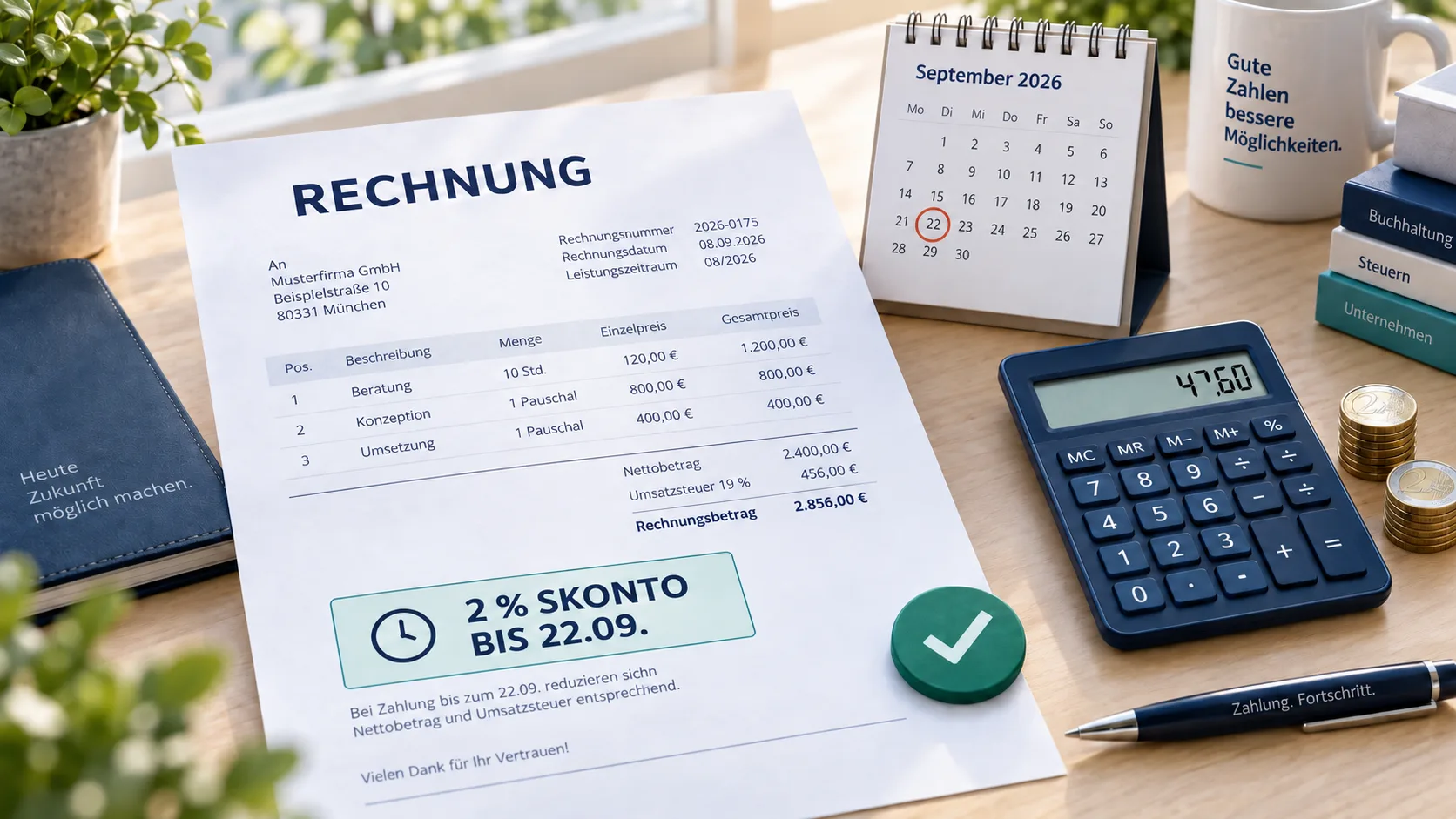
Cash Discount on an Invoice: Wording, Deadline and VAT
A client deducts a cash discount even though they paid far too late – and looking at your invoice, you realise your wording never settled the point.
 Invoicing & Accounting
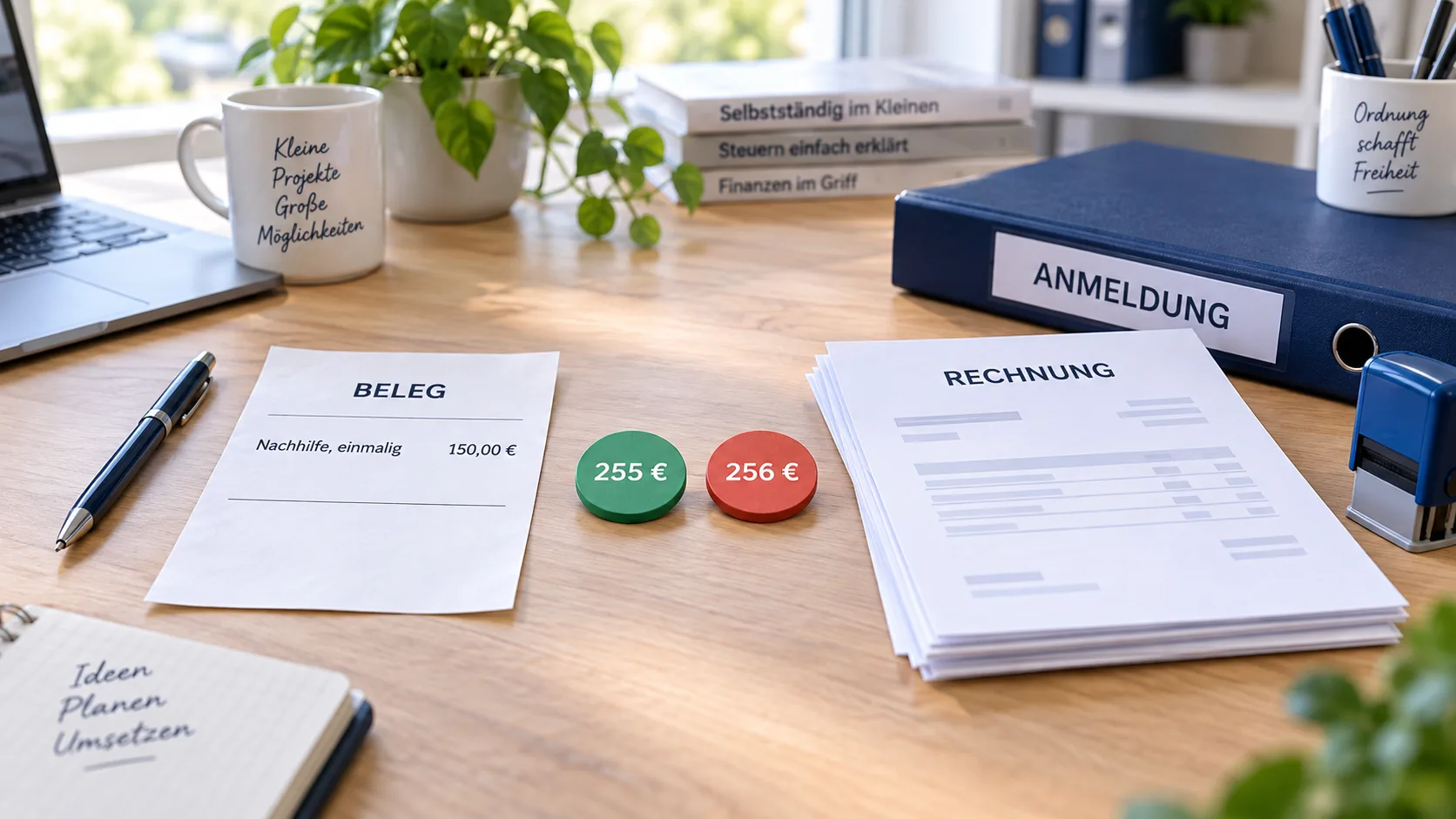
Invoicing Without a Trade License in Germany: Allowed, With a Limit
A client wants an invoice, but you haven't registered a trade. You may still write one – the real question is when a favor turns into an obligation.