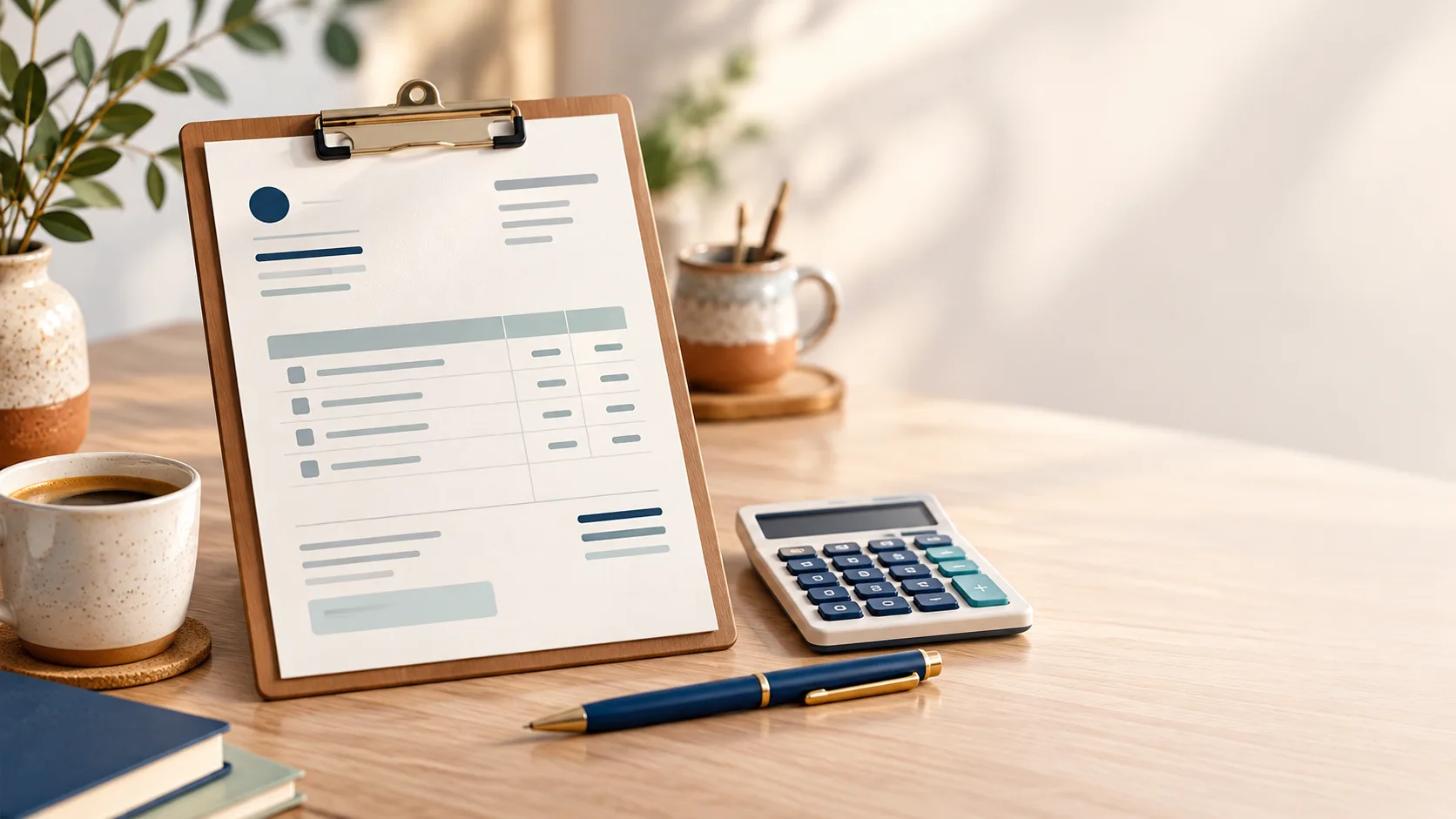
Whether VAT (Umsatzsteuer) goes on your invoice does not depend on the Kleingewerbe (small trade business), but on the small business scheme (Kleinunternehmerregelung). If you use it, the law requires only a few details: your name and the customer's name with address, your tax number (Steuernummer), the date, the service and a total amount with a notice that you do not charge VAT as a small business owner (Kleinunternehmer). In this case, § 34a UStDV does not require an invoice number. Without the small business scheme, the full mandatory details apply, with invoice number, date of service and VAT.
Contents
- What goes on the invoice?
- Kleingewerbe does not automatically mean no VAT
- Sample: invoice with a Kleingewerbe
- No Steuernummer yet: what now?
- Do you have to write an invoice at all?
- Paper, PDF or e-invoice?
- After the invoice: retention and bookkeeping
- Frequently asked questions
What goes on the invoice?
As a Kleinunternehmer, you need five details; with VAT, there are considerably more. The table shows both cases.
| Detail | As a Kleinunternehmer (§ 34a UStDV) | With VAT (§ 14 Abs. 4 UStG) |
|---|---|---|
| Your full name and address | yes | yes |
| Name and address of the customer | yes | yes |
| Steuernummer or USt-IdNr. (VAT ID) | yes | yes |
| Date of issue | yes | yes |
| Quantity and type of goods or type and scope of the service | yes | yes |
| Sequential invoice number | not required | yes |
| Date of delivery or service | not required | yes |
| Amount | one total amount | net amount, tax rate, tax amount |
| Notice | of the tax exemption for small business owners | only for tax-exempt services |
The Federal Ministry of Finance (Bundesfinanzministerium) confirms: small business owners may issue simplified invoices that contain only the details from § 34a UStDV (Abschnitt 14.7a Abs. 1 UStAE, the Umsatzsteuer-Anwendungserlass, the German VAT application decree). An invoice number still helps. Your customer states it when paying by bank transfer, and you see at once which invoice is paid. If you leave the small business scheme later, you need it anyway and then do not have to change anything. How to set up a number sequence is explained in the article Assigning invoice numbers.
For amounts up to 250 euros, even fewer details are enough, for example without a Steuernummer and without the customer's address (§ 33 UStDV). This invoice also needs the notice of the small business scheme. The details are in the article Small-amount invoice up to 250 euros. Special rules apply to customers abroad, see Invoicing customers in other EU countries. In that case, it is worth checking with your tax adviser (Steuerkanzlei) before the first invoice.
In the office1.cloud invoicing software, you select the small business option (Kleinunternehmer) once in your profile. After that, the software adds the notice to every invoice itself and shows no VAT.
Kleingewerbe does not automatically mean no VAT
Before the first invoice, it is worth asking whether you are a Kleinunternehmer. That is a different question from whether you run a Kleingewerbe. “Kleingewerbe” says something about the size of your business and your bookkeeping. “Kleinunternehmer” is a status under VAT law and decides whether VAT goes on the invoice. The article Kleingewerbe and Kleinunternehmer explains the difference.
The small business scheme applies if your turnover in the previous year was no more than 25,000 euros and does not exceed 100,000 euros in the current year (§ 19 Abs. 1 UStG). You can waive it and charge VAT. You are then bound by this waiver for at least five years (§ 19 Abs. 3 UStG). Which choice you made is usually stated in your tax registration questionnaire (Fragebogen zur steuerlichen Erfassung). Whether the scheme is better for you is explained in the article Kleinunternehmer: yes or no?.
A lower limit applies in the year you start. If you only start in the current year, the Federal Ministry of Finance considers you a Kleinunternehmer only if your turnover in the founding year does not exceed 25,000 euros (Abschnitt 19.1 Abs. 3 UStAE). The 100,000 euros only apply from the second year. If you exceed the limit in the founding year, the turnover above it is already subject to VAT (Abschnitt 19.7 Abs. 1 UStAE). From then on, you write invoices with VAT.
Do not show VAT by mistake. If a small business owner's invoice shows a tax amount, they owe this amount to the tax office (Finanzamt) (§ 14c Abs. 1 UStG, Abschnitt 14c.1 Abs. 2 UStAE). This happens easily with a template from the internet that already contains “19 % MwSt.” (19% VAT). How to avoid and correct this is explained in the article Writing an invoice without VAT.
The small business scheme only concerns VAT. From when income tax and trade tax apply is explained in Kleingewerbe: which taxes apply.
Sample: invoice with a Kleingewerbe
The sample shows an invoice from a small business owner to a business customer. Names, addresses and numbers are made up. The invoice number and delivery date are optional; the sample includes them anyway. The sample is in German because it shows a real invoice to a customer in Germany.
Lena Okoye · Handgemachte Keramik
Gartenstraße 9 · 04107 Leipzig
Steuernummer: 231/456/78901

Café Bohne und Blatt
Inhaber Murat Kaya
Karl-Liebknecht-Straße 52
04275 Leipzig

Rechnung Nr. 2026-007
Rechnungsdatum: 16. Oktober 2026
Lieferdatum: 14. Oktober 2026

Menge  Artikel                          Einzelpreis   Betrag
24     Kaffeebecher, glasiert, 300 ml       18,00 €  432,00 €
 6     Servierteller, rund, 28 cm           32,00 €  192,00 €

Gesamtbetrag                                         624,00 €

Steuerfreier Kleinunternehmer gemäß § 19 UStG.

Bitte überweisen Sie den Betrag bis zum 30. Oktober 2026
auf das Konto IBAN DE12 3456 1111 2222 3333 44.
The law does not prescribe fixed wording for the notice. According to the Federal Ministry of Finance, a statement in everyday language such as “steuerfreier Kleinunternehmer” (tax-exempt small business) is enough if it clearly identifies the tax exemption (Abschnitt 14.7a Abs. 1 UStAE). Another common wording is “Gemäß § 19 UStG wird keine Umsatzsteuer berechnet.” (No VAT is charged under § 19 UStG.)
If you charge VAT, replace the amount block. The invoice number and delivery date are then mandatory.
Summe netto                                          624,00 €
Umsatzsteuer 19 %                                    118,56 €
Gesamtbetrag                                         742,56 €
The law does not require a signature on either invoice. A handwritten invoice is also an invoice if it contains all the details (§ 14 Abs. 1 UStG).
No Steuernummer yet: what now?
For business customers, you have six months to issue the invoice (§ 14 Abs. 2 UStG). Waiting until the number arrives is therefore often the easiest way.
The Steuernummer also belongs on a small business owner's invoice (§ 34a Satz 1 Nr. 2 UStDV). Without it, the invoice is incomplete. We have not found an official rule for the time until the number arrives. Three options are possible:
- You wait with the invoice until the number arrives.
- You send the invoice right away and correct it later, as soon as the number arrives. An invoice with missing details can be corrected under § 31 Abs. 5 UStDV; this also applies to small business owners (§ 34a Satz 3 UStDV).
- For amounts up to 250 euros, you do not need a Steuernummer, see Small-amount invoice.
You receive the Steuernummer after you have sent the Fragebogen zur steuerlichen Erfassung to the Finanzamt. How this works via ELSTER, the online portal of the German tax authorities, is explained in the article Applying for a Steuernummer via ELSTER. Your personal, eleven-digit tax identification number (Steuer-Identifikationsnummer) is a different number and does not go on the invoice.
Do you have to write an invoice at all?
For business customers yes, for private customers usually not. For services to another business, the law requires an invoice within six months (§ 14 Abs. 2 Satz 2 Nr. 1 UStG). The same applies to associations and other legal entities that are not a business (Nr. 2).
If you sell to private individuals, you may write an invoice, but the German VAT Act (Umsatzsteuergesetz, UStG) as a rule does not oblige you to. The law names one exception: taxable services in connection with a property, such as craft work on a house (Nr. 3). Whether this exception also applies to small business owners whose turnover is tax-exempt under § 19 UStG is best clarified with your tax adviser.
Even without an obligation, a receipt for every income is worthwhile. It is your proof for the tax return.
Paper, PDF or e-invoice?
As a Kleinunternehmer, you may always send invoices on paper or as a PDF, including to business customers (§ 34a Satz 4 UStDV, Abschnitt 14.7a Abs. 3 UStAE). An e-invoice (E-Rechnung) is a file in a fixed format that software reads automatically. A PDF does not count.
If you charge VAT and your turnover in the previous year was no more than 800,000 euros, the law requires e-invoices to business customers in Germany for services from 1 January 2028 (§ 27 Abs. 38 UStG). For private customers, invoices on paper or as a PDF remain allowed. What to do until then is explained in the article E-invoicing obligation 2027 and 2028.
Receiving is a different question. If a supplier sends you an e-invoice, you should be able to open it, even as a Kleinunternehmer. What this means is explained in the article E-invoices as a Kleinunternehmer.
After the invoice: retention and bookkeeping
Retention. You keep a copy of every invoice you write for eight years. The period begins at the end of the year in which you issued the invoice (§ 14b Abs. 1 UStG). What applies to other documents is explained in the article Retention periods.
Bookkeeping. With a Kleingewerbe, you usually determine your profit with the cash-basis income statement (Einnahmenüberschussrechnung). There, an invoice only counts as income when the money is in your account (§ 11 Abs. 1 EStG). How this works is explained in the article Doing your Einnahmenüberschussrechnung yourself.
Correcting errors. If an invoice is already with the customer and contains an error, you correct it with a document that refers unambiguously to the old invoice (§ 31 Abs. 5 UStDV). How this works is explained in the article Correcting or cancelling an invoice.
Frequently asked questions
Do I need an invoice number with a Kleingewerbe?
As a Kleinunternehmer, the law does not require one (§ 34a UStDV). It still helps you match payments. If you charge VAT, a sequential number is mandatory (§ 14 Abs. 4 Nr. 4 UStG).
Is a receipt enough instead of an invoice with a Kleingewerbe?
Yes, if the receipt contains the details of an invoice. The law counts every document you use to bill a service as an invoice, whatever it is called (§ 14 Abs. 1 UStG). A receipt that only confirms “Betrag erhalten” (amount received) is not an invoice. Up to 250 euros, the details of a small-amount invoice are enough.
Does this also apply to a Nebengewerbe (side business)?
Yes. For invoices, the VAT Act does not distinguish between a main business and a side business. For the limit of the small business scheme, the turnover from all your self-employed activities counts together, because the business covers the entire commercial or professional activity (§ 2 Abs. 1 Satz 2, § 19 Abs. 2 UStG). Your salary as an employee does not count.
What do I write to make clear that no VAT is included?
A sentence such as “Steuerfreier Kleinunternehmer gemäß § 19 UStG” (tax-exempt small business under § 19 UStG) or “Gemäß § 19 UStG wird keine Umsatzsteuer berechnet” (no VAT is charged under § 19 UStG). There is no fixed wording. The tax rate and tax amount do not appear on the invoice.
As a Kleinunternehmer, do I write gross or net amounts on the invoice?
Neither. The law requires the amount as a single total (§ 34a Satz 1 Nr. 5 UStDV). Lines such as “netto” (net) or “MwSt. 0 %” (VAT 0%) are not needed; they tend to confuse customers.
Try Easy Invoice free for 10 days — no payment details, the trial ends by itself.
Sources
- § 2 UStG, entrepreneur, business (Unternehmer, Unternehmen), in German
- § 14 UStG, issuing invoices (Ausstellung von Rechnungen), in German
- § 14b UStG, retention of invoices (Aufbewahrung von Rechnungen), in German
- § 14c UStG, incorrect or unauthorised tax statement (Unrichtiger oder unberechtigter Steuerausweis), in German
- § 19 UStG, taxation of small business owners (Besteuerung der Kleinunternehmer), in German
- § 27 UStG, general transitional provisions (Allgemeine Übergangsvorschriften), in German
- § 31 UStDV, details in the invoice (Angaben in der Rechnung), in German
- § 33 UStDV, invoices for small amounts (Rechnungen über Kleinbeträge), in German
- § 34a UStDV, invoices for small business owners (Rechnungen für Kleinunternehmer), in German
- § 11 EStG, receipt and payment (Vereinnahmung und Verausgabung), in German
- Federal Ministry of Finance letter of 18 March 2025: special scheme for small businesses (Sonderregelung für Kleinunternehmer), in German
Handle invoices more easily
Easy Invoice combines quotes, invoices and customer management in the cloud.
Try Easy InvoiceRead next
 Invoicing & Accounting
Showing a discount on an invoice in Germany: template, VAT, example
A discount is deducted from the net amount, and VAT is calculated afterwards. Here are two templates to copy, the rules for discount codes and vouchers, and what applies if you grant the reduction only after the invoice.
 Invoicing & Accounting
Freelancer invoices in Germany: template, required details, VAT
As a freelancer (Freiberufler) in Germany, you write invoices without registering a trade, but with the same mandatory details as any business. One question decides: do you add VAT or not? Here you find the answer for your case and a template for each of the three cases.
 Invoicing & Accounting
Retention periods 2026: invoices, receipts and what may go in 2027
Since 2025, eight instead of ten years have applied to invoices and other accounting vouchers (Buchungsbelege). The table shows all periods, when they start, when they run longer and which folders you may clear out at the start of 2027.