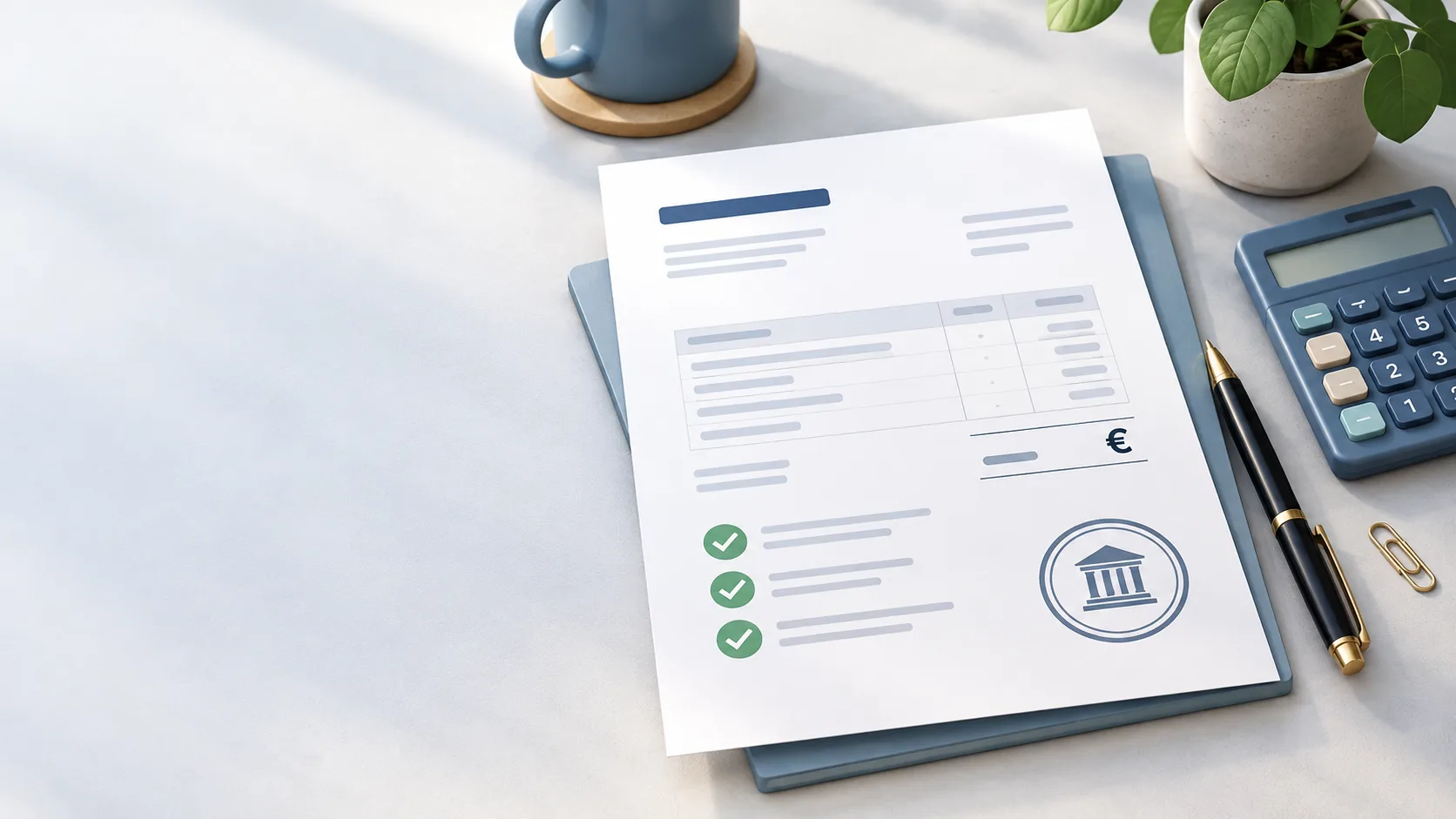
As a freelancer in one of the liberal professions (Freiberufler), you write invoices like any other business; you do not need to register a trade (Gewerbe) for this. The invoice must contain the mandatory details from the German VAT Act (Umsatzsteuergesetz, UStG), including your tax number (Steuernummer) and a clear description of your service. Two questions decide whether you add VAT (Umsatzsteuer): Do you use the small business scheme (Kleinunternehmerregelung), and is your service exempt from VAT, for example as a healthcare profession? You find a template for each of the three cases further down.
Contents
- What goes on the invoice?
- With or without VAT: which case are you?
- Template: invoice as a freelancer
- Without a Gewerbe, without a Steuernummer: is that possible?
- When you have to write an invoice
- Do freelancers have to issue e-invoices?
- Customers abroad
- After the invoice: number, retention, VAT
- Frequently asked questions
What goes on the invoice?
Which details the law requires depends on whether you charge VAT. As a small business owner (Kleinunternehmer), there are fewer. The table shows both cases side by side.
| Detail | With VAT (§ 14 Abs. 4 UStG) | As a Kleinunternehmer (§ 34a UStDV) |
|---|---|---|
| Your full name and address | yes | yes |
| Name and address of the customer | yes | yes |
| Your Steuernummer or USt-IdNr. | yes | yes |
| Date of issue | yes | yes |
| Sequential invoice number | yes | not required |
| Type and scope of the service | yes | yes |
| Time of the service | yes | not required |
| Net amount, tax rate and tax amount | yes | no, one amount as a single total |
| Notice of a tax exemption | only for tax-exempt services | yes, notice of the small business scheme |
| Discounts or early payment discounts agreed in advance | yes, if agreed | not required |
The invoice number and the date of the service are not listed in § 34a UStDV. The Federal Ministry of Finance (Bundesfinanzministerium) confirms that invoices from small business owners only need the details listed there (section 14.7a Abs. 1 UStAE, the Umsatzsteuer-Anwendungserlass, the German VAT application decree). Both still help: with a number, your customer finds the invoice again when paying, and you keep track yourself. As soon as you leave the small business scheme, both are mandatory. If you number your invoices from the start, you do not have to change anything then. How to set up a number sequence is explained in the article Assigning invoice numbers. How to state the service period, for example for a whole month of consulting, is explained in the article Date of service on the invoice.
One detail is missing from the table because the law does not require it: the payment term. Without a date, your customer does not know by when to pay. In the office1.cloud invoicing software, you set up your payment terms once as a template. The software calculates the due date from it and puts it on the invoice. If the customer does not pay on time, the templates in the article Writing a payment reminder help.
For small amounts up to 250 euros gross, the law allows fewer details, for example without a Steuernummer and without the customer's address. What is enough in that case is explained in the article Small-amount invoice up to 250 euros.
With or without VAT: which case are you?
Most freelancers fall into one of three cases. The case determines what goes in the amount line.
| Your case | What goes on the invoice | Legal basis |
|---|---|---|
| You charge VAT (standard taxation, Regelbesteuerung) | Net amount, tax rate, tax amount, total amount. The standard tax rate is 19 percent | § 14 Abs. 4 Nr. 7 und 8, § 12 Abs. 1 UStG |
| You use the small business scheme | A total amount without VAT and a notice, for example “Steuerfreier Kleinunternehmer” (tax-exempt small business) | § 19 UStG, § 34a UStDV |
| Your service is exempt from VAT | The amount without VAT and a notice of the tax exemption | § 4 UStG, § 14 Abs. 4 Nr. 8 UStG |
Small business owners. The scheme applies if your turnover in the previous year was no more than 25,000 euros and does not exceed 100,000 euros in the current year (§ 19 Abs. 1 UStG). According to the Federal Ministry of Finance, a notice in everyday language such as “steuerfreier Kleinunternehmer” (tax-exempt small business) is enough (section 14.7a Abs. 1 UStAE). Whether the scheme is the better choice for you is explained in the article Kleinunternehmer: yes or no?.
Tax-exempt services. Some liberal professions are exempt from VAT regardless of the amount of turnover. The law names, for example, medical treatment by doctors, dentists, alternative practitioners (Heilpraktiker), physiotherapists and midwives (§ 4 Nr. 14 Buchst. a UStG) as well as certain teaching services by self-employed teachers (§ 4 Nr. 21 UStG). Whether your activity falls under this depends on the individual case. It is best to clarify this with your tax adviser (Steuerkanzlei) before you write your first invoice without VAT.
The costly mix-up. If you put VAT on the invoice although you are not allowed to charge it, you still owe the amount shown under § 14c Abs. 2 UStG. This can happen, for example, when a small business owner uses a template intended for standard taxation. How to avoid and correct this is explained in the article Writing an invoice without VAT.
Template: invoice as a freelancer
The template shows an invoice with VAT. For the two other cases, you only swap the block with the amounts. Names, addresses and numbers are made up.
Aylin Demir · Translations
Lindenstraße 14 · 50674 Köln
Tax number: 214/5678/1234

Muster GmbH
Mr Max Mustermann
Hafenweg 3
20457 Hamburg

Invoice no. 2026-014
Invoice date: 9 October 2026
Service period: 1 to 30 September 2026

Service                                           Amount
Translation of user manual English–German,
42 standard pages at EUR 38.00 each           €1,596.00

Net amount                                    €1,596.00
VAT 19%                                         €303.24
Total amount                                  €1,899.24

Please transfer the amount by 23 October 2026
to the account IBAN DE12 3456 1111 11111 1111 11.
As a Kleinunternehmer, replace the amount block with:
Total amount                                  €1,596.00

Steuerfreier Kleinunternehmer gemäß § 19 UStG.
The notice stays in German because the invoice goes to a customer in Germany. In English, it reads: “Tax-exempt small business under § 19 UStG.”
For a tax-exempt service, here using the example of a physiotherapist:
Total amount                                    €360.00

Steuerfreie Heilbehandlung gemäß § 4 Nr. 14 Buchst. a UStG.
In English, the notice reads: “Tax-exempt medical treatment under § 4 Nr. 14 Buchst. a UStG.”
The VAT Act does not require a signature in § 14 Abs. 4. An invoice as a PDF by email is possible if your customer agrees (§ 14 Abs. 1 UStG). For business customers, the e-invoice comes into play from 2027, see Do freelancers have to issue e-invoices?
Without a Gewerbe, without a Steuernummer: is that possible?
Without a Gewerbe: yes. As a freelancer, you do not register a trade; instead, you notify the tax office (Finanzamt) that you are starting the activity (§ 138 Abs. 1 Satz 3 AO). You do this with the tax registration questionnaire (Fragebogen zur steuerlichen Erfassung) in ELSTER, the online portal of the German tax authorities. Whether your activity counts as a liberal profession or as a Gewerbe after all is explained in the article Freiberufler or Gewerbe?. If you only invoice something occasionally without being registered with the tax office, you find the limits in the article Writing an invoice without a Gewerbe.
Without a Steuernummer: the invoice is then incomplete. § 14 Abs. 4 Nr. 2 UStG requires the Steuernummer or the USt-IdNr. (Umsatzsteuer-Identifikationsnummer, the German EU VAT identification number). A business customer can as a rule not deduct input tax (Vorsteuer) from an incomplete invoice, because for that they need an invoice under § 14 UStG (§ 15 Abs. 1 Satz 1 Nr. 1 UStG).
If the number is still in the post, you have two options:
- You wait with the invoice until the number arrives. The deadline for this is six months, see When you have to write an invoice.
- You send the invoice right away and add the number later. An invoice that lacks mandatory details can be corrected under § 31 Abs. 5 UStDV.
How to get the number faster via ELSTER is explained in the article Applying for a Steuernummer via ELSTER. Your personal tax ID (Steuer-ID) from wage tax is not the same number. Which number is which is shown in the article Applying for and checking a USt-IdNr..
When you have to write an invoice
If you work for a business in Germany, the law requires an invoice within six months of the service (§ 14 Abs. 2 Satz 2 Nr. 1 UStG). A shorter deadline applies to business customers in other EU countries, see Customers abroad. The same applies to associations and other legal entities that are not a business (Nr. 2).
For private customers, you may write an invoice, but the VAT Act as a rule does not oblige you to. The exception is services in connection with a property, such as architectural services for a specific building (Nr. 3, section 3a.3 Abs. 8 UStAE). For your own bookkeeping, a receipt for every income is still helpful, including for private customers.
For tax-exempt services under § 4 Nr. 8 to 29 UStG, which also includes medical treatment and exempt teaching, the obligation from § 14 Abs. 2 does not apply. Professional rules, such as fee schedules, may still require an invoice.
Do freelancers have to issue e-invoices?
Not until the end of 2026. Not to private customers and not as a Kleinunternehmer, even later. The e-invoice (E-Rechnung) is a file in a fixed format that software can read automatically. A PDF does not count.
| Your situation | E-invoice to business customers in Germany for services from |
|---|---|
| You charge VAT, previous year's turnover no more than 800,000 euros | 1 January 2028 |
| You charge VAT, previous year's turnover over 800,000 euros | 1 January 2027 |
| You are a Kleinunternehmer | no obligation, paper and PDF remain possible (§ 34a Satz 4 UStDV, section 14.7a Abs. 3 UStAE) |
| Your customers are private individuals | no obligation |
The basis is § 14 Abs. 2 Satz 2 Nr. 1 and the transitional rule in § 27 Abs. 38 UStG. What to prepare until then is explained in the article E-invoicing obligation 2027 and 2028. Regardless of this, suppliers can already send you e-invoices now. What this means for small business owners is explained in the article E-invoices as a Kleinunternehmer.
Customers abroad
If you work for a company in another EU country, you as a rule write an invoice without German VAT, and your customer pays the tax on the service in their country. For this, your own USt-IdNr. and that of your customer go on the invoice, plus the wording “Steuerschuldnerschaft des Leistungsempfängers” (reverse charge, the recipient of the service is liable for the tax). The deadline is shorter than in Germany: the invoice must be issued by the 15th of the month following the month of the service (§ 14a Abs. 1 UStG). The details are in the article Invoicing customers in other EU countries. How to get a USt-IdNr. and check your customer's number is explained in the article Applying for and checking a USt-IdNr..
Special rules apply to small business owners: among other things, § 19 Abs. 1 Satz 2 UStG exempts you from the obligation to state the USt-IdNr. on certain invoices abroad. For orders from abroad, a quick check with your tax adviser is therefore worthwhile.
After the invoice: number, retention, VAT
Number. Under § 14 Abs. 4 Nr. 4 UStG, each invoice number is assigned only once. If an invoice is already with the customer and contains an error, it is corrected with a document that refers to it unambiguously (§ 31 Abs. 5 UStDV). How this works is explained in the article Correcting or cancelling an invoice.
Retention. You keep a copy of every invoice you write for eight years. The period begins at the end of the year in which you issued the invoice (§ 14b Abs. 1 UStG). What applies to other documents is explained in the article Retention periods 2026.
VAT only after payment. If you charge VAT, you as a freelancer can apply to the tax office to pay the tax only once your customer has paid (§ 20 Satz 1 Nr. 3 UStG). This is called cash accounting (Ist-Versteuerung). Without it, the tax arises for the period in which you provided the service, even if the money is still outstanding (§ 13 Abs. 1 Nr. 1 Buchst. a UStG).
Profit. If you determine your profit with the cash-basis income statement (Einnahmenüberschussrechnung), an invoice only counts as income when the money reaches you (§ 4 Abs. 3, § 11 Abs. 1 EStG). How this works is explained in the article Doing your Einnahmenüberschussrechnung yourself.
Frequently asked questions
Can I write an invoice as a freelancer without a Gewerbe?
Yes. Freiberufler do not register a trade. For the invoice, you need the Steuernummer that the tax office assigns to you after the Fragebogen zur steuerlichen Erfassung.
What do I write on the invoice as a Kleinunternehmer?
A total amount without VAT and a notice of the small business scheme, for example “Steuerfreier Kleinunternehmer gemäß § 19 UStG” (tax-exempt small business under § 19 UStG). The tax rate and tax amount do not appear on the invoice.
Do I have to issue e-invoices as a freelancer?
Not until the end of 2026. After that, it depends on your turnover and your customers: from 2027 with more than 800,000 euros in turnover in the previous year, otherwise from 2028, in each case only to businesses in Germany. Small business owners and invoices to private customers are exempt.
Does this also apply to freelancers?
“Freelancer” is not a term in German tax law. The same mandatory details apply to the invoice. Whether you are a Freiberufler for tax purposes or run a Gewerbe depends on your activity (§ 18 Abs. 1 Nr. 1 EStG). This determines whether you register a trade.
Do I have to write invoices for private customers?
Under the VAT Act, as a rule not, except for services in connection with a property. For your bookkeeping, a receipt for every income still helps.
Try Easy Invoice free for 10 days — no payment details, the trial ends by itself.
Sources
- § 14 UStG, issuing invoices (Ausstellung von Rechnungen), in German
- § 14b UStG, retention of invoices (Aufbewahrung von Rechnungen), in German
- § 15 UStG, input tax deduction (Vorsteuerabzug), in German
- § 19 UStG, taxation of small business owners (Besteuerung der Kleinunternehmer), in German
- § 20 UStG, calculation of the tax based on payments received (Berechnung der Steuer nach vereinnahmten Entgelten), in German
- § 4 UStG, tax exemptions (Steuerbefreiungen), in German
- § 12 UStG, tax rates (Steuersätze), in German
- § 27 UStG, general transitional provisions (Allgemeine Übergangsvorschriften), in German
- § 31 UStDV, details in the invoice (Angaben in der Rechnung), in German
- § 33 UStDV, invoices for small amounts (Rechnungen über Kleinbeträge), in German
- § 34a UStDV, invoices for small business owners (Rechnungen für Kleinunternehmer), in German
- § 138 AO, notifications of gainful activity (Anzeigen über die Erwerbstätigkeit), in German
- § 13 UStG, when the tax arises (Entstehung der Steuer), in German
- § 14c UStG, incorrect or unauthorised tax statement (Unrichtiger oder unberechtigter Steuerausweis), in German
- § 4 EStG, concept of profit in general (Gewinnbegriff im Allgemeinen), in German
- § 11 EStG, receipt and payment (Vereinnahmung und Verausgabung), in German
- § 18 EStG, self-employment (Selbständige Arbeit), in German
- § 14a UStG, additional obligations when issuing invoices in special cases (Zusätzliche Pflichten bei der Ausstellung von Rechnungen in besonderen Fällen), in German
- § 3a UStG, place of supply of services (Ort der sonstigen Leistung), in German
- Federal Ministry of Finance letter of 18 March 2025: special scheme for small businesses (Sonderregelung für Kleinunternehmer), in German
- VAT application decree (Umsatzsteuer-Anwendungserlass), as of 31 December 2025, in German
Handle invoices more easily
Easy Invoice combines quotes, invoices and customer management in the cloud.
Try Easy InvoiceRead next
 Invoicing & Accounting
Showing a discount on an invoice in Germany: template, VAT, example
A discount is deducted from the net amount, and VAT is calculated afterwards. Here are two templates to copy, the rules for discount codes and vouchers, and what applies if you grant the reduction only after the invoice.
 Invoicing & Accounting
Retention periods 2026: invoices, receipts and what may go in 2027
Since 2025, eight instead of ten years have applied to invoices and other accounting vouchers (Buchungsbelege). The table shows all periods, when they start, when they run longer and which folders you may clear out at the start of 2027.
 Invoicing & Accounting
OPOS list: reading open items, debit and credit, plus a template
The open items list shows who still owes you money and whom you still owe money. How to read debit and credit on the OPOS list from your tax adviser (Steuerkanzlei), find items that were paid long ago, and keep your own list with a template.