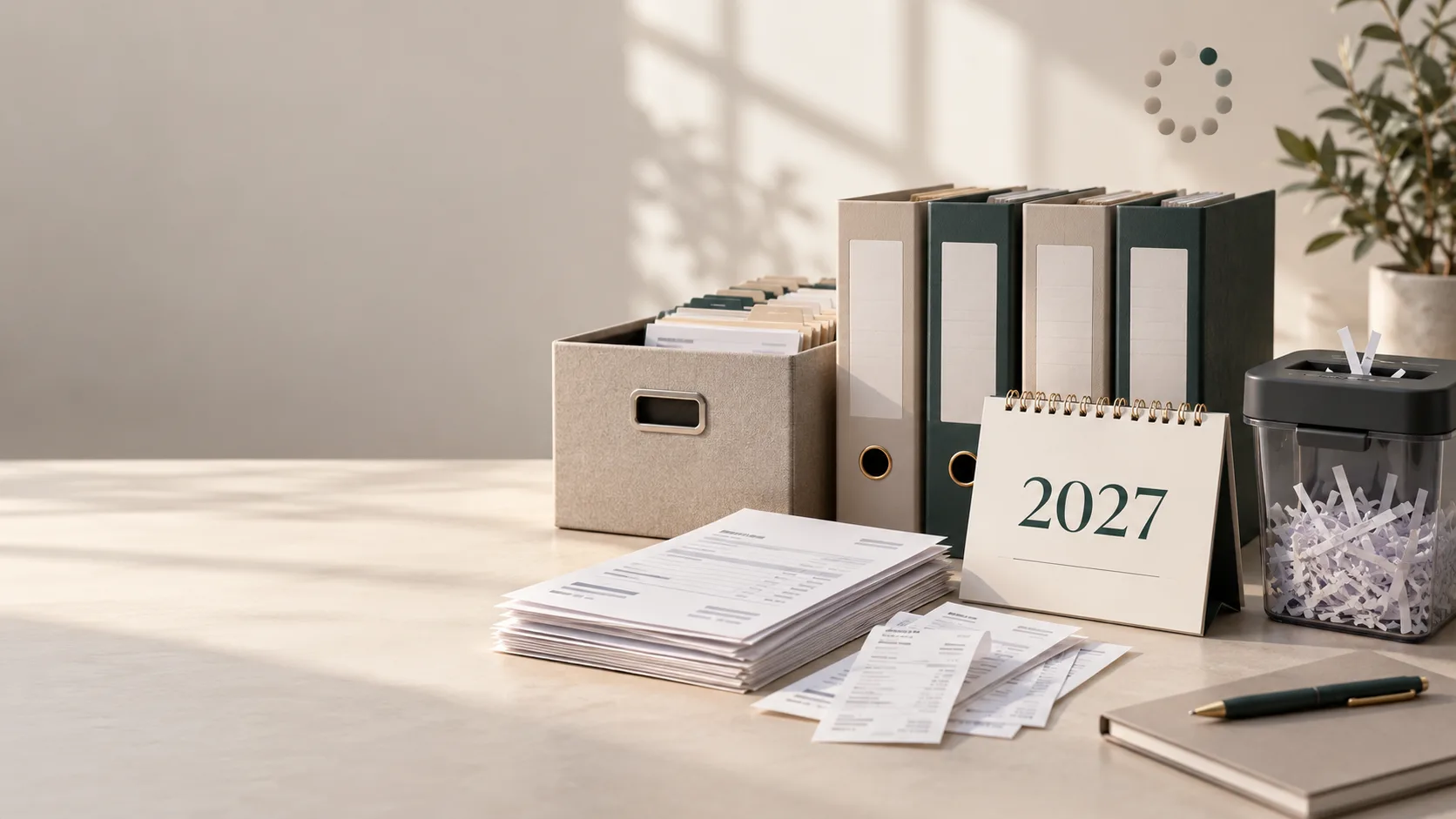
Since 2025, the law has required invoices, receipts, bank statements and other accounting vouchers (Buchungsbelege) to be kept for eight years, no longer ten. Ten years still apply to books, records and annual financial statements (Jahresabschlüsse), six years to business letters (Geschäftsbriefe). The periods only begin at the end of the year in which the document was created. From 1 January 2027, you may therefore as a rule discard all accounting vouchers from 2018 and earlier, provided they are not needed for a tax assessment (Steuerfestsetzung) that is still open.
Contents
- Which period applies to which document?
- When does the period start?
- What may go on 1 January 2027?
- 8 or 10 years: what changed in 2025
- When does the period run longer?
- Paper, PDF, e-invoice: in what form?
- What happens if a voucher is missing?
- Frequently asked questions
Which period applies to which document?
Almost everything a small business has in its folders or on its hard drive falls under one of three periods: eight, ten or six years. The law sorts by the type of document, not by whether it exists on paper or as a file (§ 147(1) and (3) of the German Fiscal Code (Abgabenordnung, AO)).
| Document | Period | Examples | Legal basis |
|---|---|---|---|
| Accounting vouchers | 8 years | outgoing and incoming invoices, receipts, credit notes, business bank statements | § 147(3) AO, for invoices § 14b(1) of the German VAT Act (Umsatzsteuergesetz, UStG) |
| Books and records, inventories, annual financial statements, opening balance sheet | 10 years | bookkeeping; with the cash-basis income statement (Einnahmenüberschussrechnung), as a rule the ongoing records of income and expenses | § 147(3) AO |
| Business letters received and copies of those sent | 6 years | correspondence about an order, such as an order confirmation or a complaint, including by email | § 147(3) AO |
| Other documents relevant for taxation | 6 years | § 147(3) AO | |
| Delivery notes that are not accounting vouchers | until the invoice | received: until the invoice arrives; sent: until the invoice has been sent | § 147(3) sentences 3 and 4 AO |
An accounting voucher is anything you use to support a booking entry. The tax authorities (Finanzverwaltung) set out their view in the GoBD, the Federal Ministry of Finance's principles for the proper keeping and retention of books, records and documents in electronic form. There they list as types of voucher, among others, invoices, credit notes, cash receipts, payment records, contracts and business bank statements (GoBD, marginal number (Randziffer) 62). Bank statements for your business account therefore as a rule belong in the eight-year group.
A quote or another business letter becomes an accounting voucher as soon as a booking entry is made on its basis (GoBD, marginal number 63). Then eight years apply instead of six. The same goes for a delivery note that forms part of the invoice because the invoice refers to it for a mandatory detail (§ 31(1) of the German VAT Implementing Ordinance (Umsatzsteuer-Durchführungsverordnung, UStDV)). When that happens is shown in the article Creating a delivery note.
With emails, the content counts, not the medium. The tax authorities treat an email that merely delivers an invoice as an attachment like an envelope: it is the attachment that has to be kept, not the email. If the email itself serves as a business letter or accounting voucher, it has to be kept (GoBD, marginal number 121).
If you write invoices with software, a large part of this is already digital. In the office1.cloud invoicing software, outgoing documents and e-invoices are archived in a form that cannot be altered, and you record incoming invoices in the same program.
When does the period start?
The period does not begin with the date on the document but at the end of the calendar year in which it was created (§ 147(4) AO, for invoices § 14b(1) sentence 3 UStG). An invoice dated 15 March 2026 therefore counts from 31 December 2026. The eight years end on 31 December 2034; from 1 January 2035, it may go.
This gives you a simple calculation: year of the document + period + 1 gives the first year in which it may go. For a voucher from 2018: 2018 + 8 + 1 = 2027.
For books and records, the year of the last entry counts; for annual financial statements, the year in which they were prepared. Annual financial statements for 2016 that the tax adviser (Steuerkanzlei) prepared in 2017 therefore have to be kept until the end of 2027, not just until the end of 2026.
What may go on 1 January 2027?
From 1 January 2027, accounting vouchers from 2018, books from 2016 and business letters from 2020 may go, each together with all older years. This applies as long as they are not needed for a tax assessment that is still open (see When does the period run longer?):
| Document | Period | May go from 1 January 2027 if … |
|---|---|---|
| Accounting vouchers: invoices, receipts, bank statements | 8 years | created in 2018 or earlier |
| Books and records | 10 years | last entry in 2016 or earlier |
| Inventories, annual financial statements | 10 years | prepared in 2016 or earlier |
| Business letters, other documents | 6 years | received, sent or created in 2020 or earlier |
If you have not cleared out in the last two years: accounting vouchers from 2015 and 2016 have been allowed to go since 1 January 2025, vouchers from 2017 and business letters from 2019 since 1 January 2026. Why two years were released at once is explained in the section 8 or 10 years.
8 or 10 years: what changed in 2025
If a list gives ten years for invoices, it is out of date. That applied until the end of 2024. With the Fourth Bureaucracy Relief Act (Viertes Bürokratieentlastungsgesetz), the legislator shortened the period for accounting vouchers to eight years: in tax law (§ 147(3) AO), in commercial law (§ 257(4) of the German Commercial Code (Handelsgesetzbuch, HGB)) and, for invoices, in VAT law (§ 14b(1) UStG). According to the explanatory memorandum to the act, invoices are always accounting vouchers.
The shorter period also applies to older vouchers. What matters is whether their old ten-year period had already expired on 31 December 2024 (Art. 97 § 19a(2) of the Introductory Act to the Fiscal Code (Einführungsgesetz zur Abgabenordnung, EGAO), Art. 95 of the Introductory Act to the Commercial Code (Einführungsgesetz zum Handelsgesetzbuch, EGHGB)). If it had not, the new eight-year period applies. For vouchers from 2015 and 2016, the period was therefore over immediately, which is why two years were released at once on 1 January 2025.
Books, records, inventories and annual financial statements have stayed at ten years. In addition, ten years still apply to accounting vouchers for banks, insurance companies and investment firms (Wertpapierinstitute) (§ 257(4) sentence 2 HGB, Art. 97 § 19a(3) EGAO).
When does the period run longer?
Even after eight years, the period for a voucher does not expire as long as it is relevant for a tax whose assessment period (Festsetzungsfrist) has not yet expired (§ 147(3) sentence 5 AO). The assessment period is the time during which the tax office (Finanzamt) may issue or amend a tax assessment notice. As a rule, it is four years (§ 169(2) AO). If a tax return has to be filed, it begins at the end of the year in which you filed the return, at the latest at the end of the third year after the tax year (§ 170(2) no. 1 AO).
Typical cases in which the assessment period runs longer:
- Objection or court action against a tax assessment notice. The assessment period does not end before a final, non-appealable decision has been made on the objection (Einspruch) or the court action (§ 171(3a) AO).
- Tax audit (Betriebsprüfung). Once an external audit (Außenprüfung) has begun, the period for the audited taxes does not expire before the notices resulting from the audit have become final and non-appealable (§ 171(4) AO).
- Vouchers that have an effect on later years. This can be, for example, the purchase invoice for a company car that you are still depreciating. If in doubt, your tax adviser can clarify whether a voucher still counts for an open year.
Before a larger clear-out, it therefore helps to ask your tax adviser briefly whether any proceedings are still open for a given year.
Paper, PDF, e-invoice: in what form?
You may scan or photograph paper vouchers and, as a rule, destroy the paper afterwards. Vouchers received electronically stay in the format in which they arrived.
Scanning paper and throwing it away. The law allows retention as an image or file if the reproduction matches the original visually and is available, legible and machine-evaluable throughout the entire period (§ 147(2) AO). In the view of the tax authorities, a smartphone is also permissible for this if the other requirements are met (GoBD, marginal number 130). After that, the paper may go, unless a provision requires the original (marginal number 140). The tax authorities require the procedure to be documented: who captures the documents, when, and how legibility and completeness are checked (marginal number 136). How detailed this has to be depends, according to the GoBD, on the size and structure of the business.
Exception: Annual financial statements and the opening balance sheet cannot be replaced by scans; they stay in the original (§ 147(2) AO). In addition, the tax authorities leave it to you to decide whether to also keep in the original those documents whose evidential value would be lost as a scan (marginal number 140).
PDF invoices and bank statements as files stay in the format in which they were received (GoBD, marginal number 131). A printout therefore does not replace the file.
E-invoices (XRechnung, ZUGFeRD). What matters is the structured part, i.e. the XML file. It is enough to keep this part. The readable PDF part of a ZUGFeRD invoice is only needed if it contains additional information relevant for tax purposes, such as booking notes (GoBD, marginal numbers 119 and 131 in the version of 14 July 2025). The XML file must not be lost through conversion into another format (marginal number 125). The difference between the two formats is explained in the article XRechnung or ZUGFeRD.
Authentic, unaltered, legible. For invoices, the law requires origin, content and legibility to be secured throughout the period (§ 14b(1) sentence 2 in conjunction with § 14(3) UStG). An email inbox in which anything can be deleted at any time is not a good place for this. And because the documents have to be available throughout the period (§ 147(2) no. 2 AO), a second copy in another location is worthwhile: otherwise a broken computer takes eight years of vouchers with it. What filing for incoming invoices can look like is shown in the article Managing incoming invoices.
Software cancelled or changed. The obligation to keep invoices lies with the business owner (Unternehmer) themselves (§ 14b(1) UStG), not with the provider of a program. If you cancel a program, you therefore take your data with you and keep it yourself until the end of the period. With Easy Invoice, everything stays archived as long as you are a customer. After cancellation, you receive your data; after a certain period, the platform removes it, and from then on you are responsible for further retention yourself.
Storage location. Books and records are in principle to be kept and retained in Germany (§ 146(2) AO). In electronic form, they may also be stored in another EU member state if the tax office has full data access (§ 146(2a) AO, for invoices § 14b(2) UStG). A storage location outside the EU requires approval from the tax office (§ 146(2b) AO).
What happens if a voucher is missing?
If a business cannot present books or records or cannot adequately explain its information, the tax office makes an estimate (§ 162(2) AO). With a single missing voucher, two things are at stake: the expense and the input tax (Vorsteuer).
- The expense can be proven with a self-issued receipt (Eigenbeleg) if no third-party voucher is available (GoBD, marginal number 61). How to do this is explained in the article Writing an Eigenbeleg.
- The input tax deduction requires, under the law, that you hold a proper invoice (§ 15(1) sentence 1 no. 1 sentence 2 UStG). A self-issued receipt is not such an invoice. Whether a lost invoice can be proven in another way is also covered in the article on the Eigenbeleg.
Frequently asked questions
How long do I have to keep bank statements?
Business bank statements as a rule count as accounting vouchers (GoBD, marginal number 62): eight years from the end of the year in which they were issued. If you receive them as PDFs, they are kept as PDFs (marginal number 131). This article covers business documents, not private accounts.
Does this also apply to small business owners (Kleinunternehmer) and small trades (Kleingewerbe)?
Yes. In the view of the tax authorities, those who determine their profit with a cash-basis income statement also keep records and documents in accordance with § 147(1) AO (GoBD, marginal number 115). The obligation for invoices in § 14b UStG applies to every business owner; the small business scheme (Kleinunternehmerregelung) in § 19 UStG does not exempt them from it. What small business owners need to know about e-invoicing is shown in the article E-invoicing as a small business owner.
How long do I have to keep payroll records?
The payroll account (Lohnkonto) of each employee has to be kept until the end of the sixth year after the last wage payment entered (§ 41(1) sentence 9 of the German Income Tax Act (Einkommensteuergesetz, EStG)). The tax authorities list wage and salary statements as a type of voucher (GoBD, marginal number 62); in their view, eight years as a rule apply to them as accounting vouchers. If you use a payroll service, it is best to agree on the filing with them.
Does this also apply to private invoices?
The periods in this article concern business documents. For private individuals there is a special rule that tradespeople should also know: if you, as a private individual, receive an invoice for a supply of work (Werklieferung) or other service in connection with a property, you keep the invoice, a payment record or another conclusive document for two years (§ 14b(1) sentence 5 UStG). If you write such invoices to private customers, a note on this obligation belongs on the invoice (§ 14(4) sentence 1 no. 9 UStG).
Do I have to delete documents after the period has expired?
If the documents contain personal data, such as names and addresses of customers, data protection comes into play. Personal data are to be erased when they are no longer necessary for their purpose (Article 17(1)(a) of the General Data Protection Regulation (GDPR, Datenschutz-Grundverordnung)). As long as a legal retention obligation exists, this right to erasure does not apply (Article 17(3)(b) GDPR). Once the period has expired, this reason as a rule no longer applies. If in doubt, your data protection adviser can clarify how to put this into practice in your business.
Try Easy Invoice free for 10 days — no payment details, the trial ends by itself.
Sources
- § 147 AO, rules on the retention of documents (Ordnungsvorschriften für die Aufbewahrung von Unterlagen)
- § 146 AO, rules on bookkeeping and records (Ordnungsvorschriften für die Buchführung und für Aufzeichnungen)
- § 162 AO, estimation of the tax base (Schätzung von Besteuerungsgrundlagen)
- § 169 AO, assessment period (Festsetzungsfrist)
- § 170 AO, start of the assessment period (Beginn der Festsetzungsfrist)
- § 171 AO, suspension of expiry (Ablaufhemmung)
- Art. 97 § 19a EGAO, retention periods (Aufbewahrungsfristen)
- § 257 HGB, retention of documents, retention periods (Aufbewahrung von Unterlagen, Aufbewahrungsfristen)
- Art. 95 EGHGB, transitional provision on the retention period (Übergangsvorschrift zur Aufbewahrungsfrist)
- § 14 UStG, issuing invoices (Ausstellung von Rechnungen)
- § 14b UStG, retention of invoices (Aufbewahrung von Rechnungen)
- § 15 UStG, input tax deduction (Vorsteuerabzug)
- § 19 UStG, tax exemption for small business owners (Steuerbefreiung für Kleinunternehmer)
- § 31 UStDV, details in the invoice (Angaben in der Rechnung)
- § 41 EStG, record-keeping obligations for wage tax deduction (Aufzeichnungspflichten beim Lohnsteuerabzug)
- Federal Ministry of Finance: principles for the proper keeping and retention of books, records and documents in electronic form and for data access (Grundsätze zur ordnungsmäßigen Führung und Aufbewahrung von Büchern, Aufzeichnungen und Unterlagen in elektronischer Form sowie zum Datenzugriff, GoBD), letter of 28 November 2019, Federal Tax Gazette (BStBl) I p. 1269, marginal numbers 61 to 63, 115, 121, 130, 136, 140
- Federal Ministry of Finance: GoBD, second amendment, letter of 14 July 2025 (GoBD, 2. Änderung), marginal numbers 119, 125, 131
- German Bundestag, printed paper 20/11306: draft of a Fourth Bureaucracy Relief Act, explanatory memorandum (Drucksache 20/11306: Entwurf eines Vierten Bürokratieentlastungsgesetzes, Begründung)
- General Data Protection Regulation (EU) 2016/679, Article 17 (Datenschutz-Grundverordnung)
- Händlerbund: FAQ on the obligation to retain documents (FAQ Pflicht zur Aufbewahrung), as of 11 February 2026
Handle invoices more easily
Easy Invoice combines quotes, invoices and customer management in the cloud.
Try Easy InvoiceRead next
 Invoicing & Accounting
Showing a discount on an invoice in Germany: template, VAT, example
A discount is deducted from the net amount, and VAT is calculated afterwards. Here are two templates to copy, the rules for discount codes and vouchers, and what applies if you grant the reduction only after the invoice.
 Invoicing & Accounting
Freelancer invoices in Germany: template, required details, VAT
As a freelancer (Freiberufler) in Germany, you write invoices without registering a trade, but with the same mandatory details as any business. One question decides: do you add VAT or not? Here you find the answer for your case and a template for each of the three cases.
 Invoicing & Accounting
OPOS list: reading open items, debit and credit, plus a template
The open items list shows who still owes you money and whom you still owe money. How to read debit and credit on the OPOS list from your tax adviser (Steuerkanzlei), find items that were paid long ago, and keep your own list with a template.