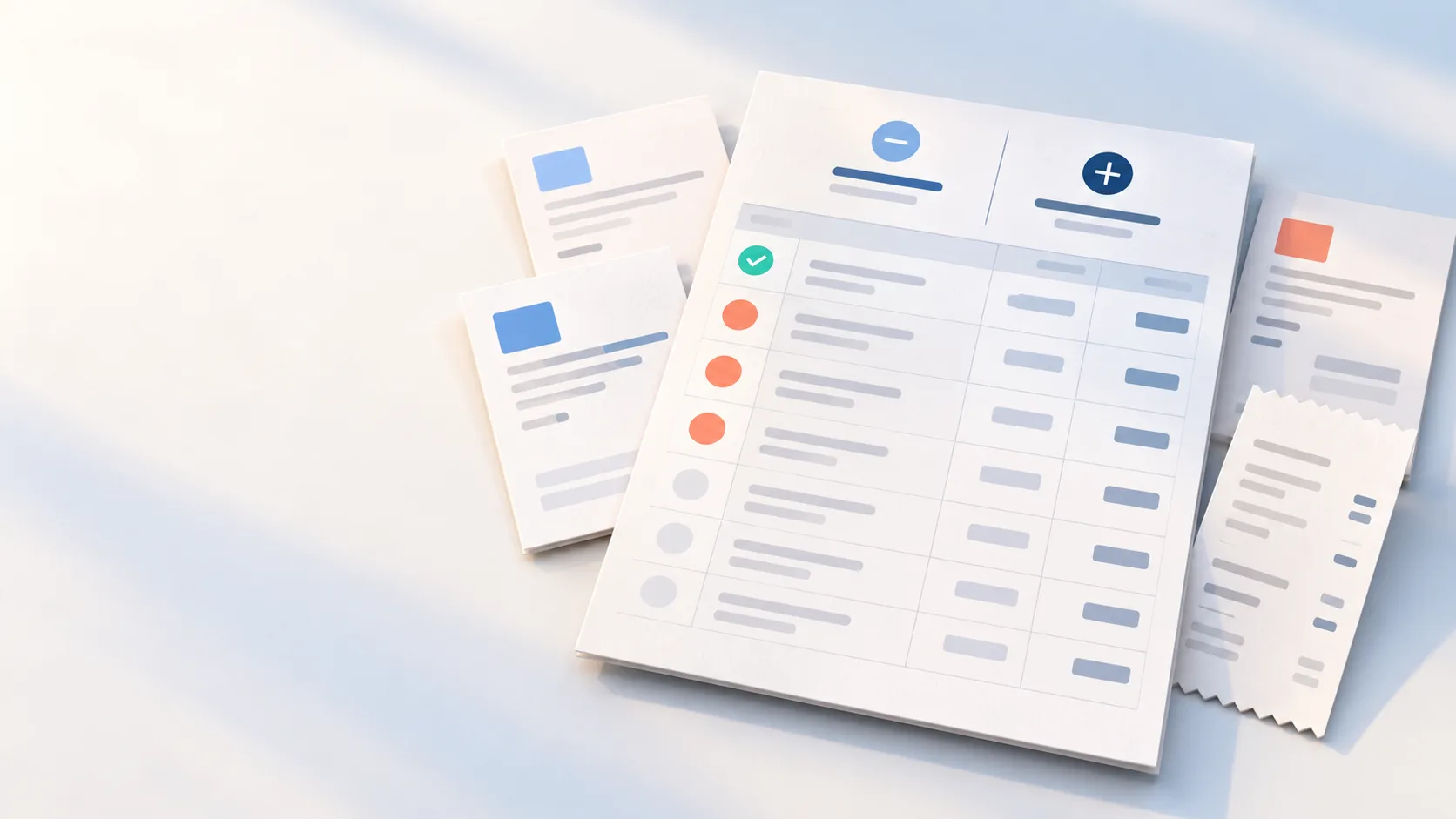
An open items list (Offene-Posten-Liste), OPOS or OP list for short, shows all invoices that have not yet been paid: your invoices to customers and your suppliers' invoices to you. On a customer's account, an open amount on the debit side (Soll) as a rule stands for money they still owe you. An open amount on the credit side (Haben) there points to an overpayment, a credit note or a payment that has not yet been allocated to an invoice. On a supplier's account, it is the other way round. If you receive the list from your tax adviser (Steuerkanzlei), check each item: really open, already paid or wrongly allocated.
Contents
- What is on an open items list?
- Debit and credit: how to read the OPOS list
- Why is an item open even though it was paid?
- Do you have to keep an open items list?
- Template: keeping your own open items list
- What to do with items that have been open for months?
- VAT on invoices that are still open
- The OPOS list at the year-end closing
- Frequently asked questions
What is on an open items list?
The list answers two questions: who still owes you money, and whom do you still owe money? An "item" (Posten) is a single invoice, credit note or payment that has not yet been settled.
In accounting, the two sides are called debtors (Debitoren) and creditors (Kreditoren):
| Term | Who is that? | What is open? |
|---|---|---|
| Debtor (Debitor) | your customer | an invoice you have written and they have not yet paid, i.e. your receivable |
| Creditor (Kreditor) | your supplier or service provider | an invoice you have received and not yet paid, i.e. your liability |
In the DATEV charts of accounts (Kontenrahmen) SKR 03 and SKR 04 for 2026, construction and trades edition (Bau und Handwerk), the numbers 10000 to 69999 are intended for customer accounts (debtors) and the numbers 70000 to 99999 for supplier accounts (creditors). If your tax adviser works with these ranges, an account number such as 10010 stands for a customer and a number such as 70010 for a supplier. If in doubt, ask your tax adviser which numbers they use.
The tax authorities (Finanzverwaltung) recognise open-item accounting (Offene-Posten-Buchhaltung) as a form of bookkeeping. Under the German Income Tax Guidelines (Einkommensteuer-Richtlinien, EStR), non-cash transactions, broken down by business partner, can be kept either in separate accounts for each customer and supplier or by "an orderly filing of the unsettled invoices (open-item accounting)" (R 5.2(1) sentences 5 and 6 EStR). The law expressly allows bookkeeping in the form of an orderly filing of documents if it complies with the principles of proper bookkeeping (Grundsätze ordnungsmäßiger Buchführung) (§ 239(4) of the German Commercial Code (Handelsgesetzbuch, HGB), § 146(5) of the German Fiscal Code (Abgabenordnung, AO)).
In the office1.cloud dunning module, Easy Invoice shows all unpaid invoices with due date and days overdue. The bank import matches the payments, and paid invoices disappear from the overview.
Debit and credit: how to read the OPOS list
If there is an open amount on the debit side of a customer's account, they as a rule owe you money. If there is an open amount on the credit side of a supplier's account, you as a rule owe them money. The two other cases as a rule point to an overpayment, a credit note or a payment that has not been allocated to an invoice.
| Account | Amount on the debit side (Soll) | Amount on the credit side (Haben) |
|---|---|---|
| Customer (debtor) | your invoice is open, the customer owes you money | the customer has paid too much, a credit note for them is open or their payment has not been allocated to an invoice |
| Supplier (creditor) | you have paid too much, a credit note from the supplier is open or your payment has not been allocated to an invoice | the supplier's invoice is open, you owe them money |
The background: in double-entry bookkeeping, your invoice to a customer is usually posted to the debit side of their account, and their payment to the credit side. For a supplier, their invoice usually appears on the credit side and your payment on the debit side. When invoice and payment offset each other, the item disappears from the list. The balance (Saldo) is the difference between all debit and credit amounts of an account.
An example of what an extract can look like:
| Account | Name | Document | Date | Debit | Credit |
|---|---|---|---|---|---|
| 10010 | Schreinerei Yilmaz | Invoice RE-2026-0412 | 8 Sep 2026 | 1,190.00 | |
| 10010 | Schreinerei Yilmaz | Payment | 18 Sep 2026 | 1,166.20 | |
| 10020 | Praxis Dr. Nowak | Payment without invoice number | 24 Sep 2026 | 250.00 | |
| 70010 | Druckerei Okafor | Invoice 5531 | 15 Sep 2026 | 595.00 |
How to read the four lines:
- Schreinerei Yilmaz: 23.80 euros remain open on the debit side. That is exactly 2 percent of the invoice. If your invoice offered a 2 percent cash discount (Skonto) and the customer paid within the period, they were allowed to deduct the amount. In that case, let your tax adviser know so that they post the remainder as a cash discount. More on this in the article Cash discount on an invoice.
- Praxis Dr. Nowak: 250 euros on the credit side without an invoice. Money has come in here that has not been allocated to any invoice. Look up the matching invoice and give your tax adviser the invoice number.
- Druckerei Okafor: 595 euros on the credit side of a supplier account. You have not yet paid this invoice, or your payment has not yet been posted.
The list looks different depending on the software and the tax adviser. For each item, look out for these details: customer or supplier, invoice number, date, amount and whether it is on the debit or the credit side.
Why is an item open even though it was paid?
Then the payment has not been allocated to its invoice, or a remaining amount is rightly missing. Before you send a customer a formal reminder, it is worth looking at these reasons:
| Possible reason | What you see on the list | What helps |
|---|---|---|
| Payment without an invoice number or with the wrong one in the payment reference | invoice on the debit side and a payment on the credit side, both open | tell your tax adviser how to allocate it |
| A customer pays several invoices with one transfer | several invoices open, one larger payment on the credit side | name the invoices that belong to the payment |
| Customer has deducted a cash discount | small remaining amount on the debit side | check whether the deduction was justified, then have it written off |
| Partial payment or payment in instalments | remaining amount on the debit side | keep following up the remainder; if there is an agreement, count the instalments |
| Credit note or cancellation not posted | invoice on the debit side although the order has been cancelled | send your tax adviser the credit note or cancellation invoice (Stornorechnung) |
| Payment in cash or to a different account | invoice on the debit side, no payment received | give your tax adviser proof of the payment |
Duplicate or wrong invoice numbers make allocation more difficult. How to assign numbers that remain unique is explained in the article Assigning invoice numbers. How to cancel an invoice correctly is explained in the article Correcting an invoice.
Do you have to keep an open items list?
If you keep books and regularly prepare financial statements, the Income Tax Guidelines require your transactions on account to be shown in accounts for each business partner. An orderly filing of the unpaid invoices is a recognised way of doing this. The guidelines do not set out these rules for the cash-basis income statement (Einnahmenüberschussrechnung). Your own list is useful all the same.
If you keep books and prepare financial statements. In double-entry bookkeeping, according to the Income Tax Guidelines, "as a rule a current account (Kontokorrentkonto), subdivided by debtors and creditors, is to be kept" for transactions on account (R 5.2(1) sentence 2 EStR). The requirement to show transactions for each business partner can be met by separate accounts for each customer and supplier or by an orderly filing of the unsettled invoices (R 5.2(1) sentences 5 and 6 EStR). If you have engaged a tax adviser to do your bookkeeping, they keep these accounts in their software.
Who has to keep books and prepare financial statements is set out in the German Commercial Code and the German Fiscal Code:
| Who | Books and financial statements | Reference |
|---|---|---|
| Merchants (Kaufleute), including commercial companies such as the GmbH | yes | §§ 238, 242 HGB, § 6 HGB, § 13(3) GmbHG |
| Sole traders (Einzelkaufleute) with no more than 800,000 euros in turnover and 80,000 euros in net income for the year on two consecutive balance sheet dates | not obliged under commercial law | § 241a HGB, § 242(4) HGB |
| Commercial businesses (gewerbliche Unternehmer) with more than 800,000 euros in turnover in the calendar year or more than 80,000 euros in profit in the financial year | yes, from the financial year following the tax office's notification | § 141 AO |
Your tax adviser can clarify whether the thresholds apply to you. § 141 AO does not mention the liberal professions (freie Berufe); it refers to commercial businesses and to farmers and foresters.
If you prepare a cash-basis income statement. R 5.2 EStR belongs to § 5 of the German Income Tax Act (EStG). This provision concerns commercial businesses (Gewerbetreibende) that keep books and regularly prepare financial statements (§ 5(1) sentence 1 EStG). With a cash-basis income statement, income in principle only counts for income tax when the money reaches you (§ 11(1) EStG). For VAT, the law requires records of the agreed consideration (vereinbarte Entgelte), or, if you pay tax based on payments received, of the consideration received (vereinnahmte Entgelte) (§ 22(2) no. 1 of the German VAT Act (UStG)). If in doubt, your tax adviser can clarify how exactly you keep these records.
Your own list helps even without an obligation: you see which customer is overdue before the money is missing from your account. And if you pay VAT based on agreed consideration, you see for which invoices the VAT has already arisen, even though the money is still missing. More on this in the section VAT.
Template: keeping your own open items list
For your own list, a table with eight columns is enough, in Excel, in another spreadsheet program or on paper. Each row stands for one invoice. As soon as an invoice has been paid in full, mark the row as done or move it to a second sheet.
| Column | What goes in it | Example |
|---|---|---|
| Invoice number | the number of your invoice | RE-2026-0412 |
| Invoice date | date of the invoice | 8 Sep 2026 |
| Customer | name of the customer | Schreinerei Yilmaz |
| Amount | gross invoice amount | 1,190.00 |
| Due on | date from your payment term | 22 Sep 2026 |
| Paid on | date the payment was received | 18 Sep 2026 |
| Paid | amount received | 1,166.20 |
| Open | amount minus paid | 23.80 |
Two additional columns help if you send reminders: "Days overdue" and "Reminder or formal reminder sent on". In Excel, the formula =TODAY()-E2 (in a German-language Excel: =HEUTE()-E2) calculates the days since the due date if the due date is in column E. A filter on "Open greater than 0" shows only the invoices you should take care of.
For supplier invoices, create a second sheet with the same columns, with "Supplier" instead of "Customer". This way you also see which invoice you should still pay yourself, for example to take advantage of a cash discount.
When an invoice is due depends on your payment term. How to word it is explained in the article Payment terms on an invoice.
What to do with items that have been open for months?
The longer an item is open, the closer it gets to the limitation period running out (Verjährung). Tackle it in this order:
- Check whether it really is open. Go through the reasons in the section Why is an item open? before you contact the customer.
- Send a friendly reminder. Templates are in the article Writing a friendly payment reminder.
- Send a formal reminder. If the customer does not respond, the formal reminder (Mahnung) follows, see Writing a formal payment reminder. How to calculate interest for the delay is explained in the article Calculating late payment interest.
- Keep an eye on the limitation period. Claims as a rule become time-barred after three years (§ 195 of the German Civil Code (BGB)). The period in principle begins at the end of the year in which the claim arose (§ 199(1) BGB). A claim from 2023 therefore as a rule becomes time-barred at the end of 31 December 2026. The limitation period can be halted, for example, by service of a court order for payment (gerichtlicher Mahnbescheid) (§ 204(1) no. 3 BGB). More on this in the article Dunning for the self-employed.
- Write it off if nothing more is coming. If the customer is insolvent or the claim cannot be enforced in the foreseeable future, pass this on to your tax adviser. For VAT, there is then a correction, see the next section.
VAT on invoices that are still open
If, as in the normal case, you pay VAT based on agreed consideration, the VAT arises for the period in which you performed the supply, even if your customer has not yet paid. If, with the tax office's permission, you pay VAT based on payments received, it only arises for the period in which the money comes in. If your sales are tax-exempt as a small business owner (Kleinunternehmer), the question does not arise.
| Your situation | When the VAT on an open invoice arises | Reference |
|---|---|---|
| Taxation based on agreed consideration, the normal case | at the end of the advance return period (Voranmeldungszeitraum) in which you performed the supply, paid or not | § 13(1) no. 1 letter a UStG |
| Taxation based on payments received, on application | at the end of the advance return period in which the money comes in | § 13(1) no. 1 letter b UStG, § 20 UStG |
| Small business owner | your sales are tax-exempt | § 19(1) UStG |
You may pay tax based on payments received if the tax office permits you to do so on application. Among other things, the law names a total turnover of no more than 800,000 euros in the previous year or working as a freelancer (§ 20 sentence 1 UStG). When you report the tax is explained in the article on the advance VAT return (Umsatzsteuer-Voranmeldung).
If a customer ultimately does not pay. If the agreed consideration has become uncollectible (uneinbringlich), the law requires the VAT owed on it to be corrected (§ 17(1) sentence 1 and (2) no. 1 UStG). In the view of the tax authorities, a claim is uncollectible in particular if the customer is insolvent or if, on an objective view, it must be expected that you will not be able to enforce the claim in the foreseeable future. A correction may also be considered if the customer disputes the existence or amount of the claim in a substantiated manner (section 17.1(5) sentences 2 and 4 UStAE).
Three points on this from the same passage of the German VAT application decree (Umsatzsteuer-Anwendungserlass, UStAE):
- An agreed payment in instalments does not make a claim uncollectible (sentence 6).
- You do not have to inform your customer if you treat a claim as uncollectible (sentence 10).
- If the customer pays after all, the law requires a further correction (§ 17(2) no. 1 sentence 2 UStG).
Whether one of your claims is already uncollectible is best decided together with your tax adviser.
The OPOS list at the year-end closing
At the year-end closing (Jahresabschluss), what counts is which items are really open on the reporting date. Merchants draw up an inventory (Inventar) for the end of each financial year in which they record, among other things, their receivables and debts precisely (§ 240(1) and (2) HGB). This does not apply to sole traders who are exempt under § 241a HGB. For commercial businesses that keep books under § 141 AO, § 240 HGB applies accordingly (§ 141(1) sentence 2 AO).
If you receive the list for this from your tax adviser, go through it like this:
- Tick off every item that was really open on the reporting date.
- Mark items that have been paid and attach the payment receipt or bank statement.
- For items you do not recognise, note a short question for your tax adviser.
- Name claims for which you no longer expect any money so that your tax adviser can value them.
Frequently asked questions
What does OPOS mean?
OPOS stands for "offene Posten" (open items). The OPOS list is the overview of all items that have not yet been settled.
What is "offene Posten" called in English?
The English translation of the German Commercial Code provided by the language service of the Federal Ministry of Justice calls Forderungen aus Lieferungen und Leistungen "trade receivables" and Verbindlichkeiten aus Lieferungen und Leistungen "trade payables" (§ 266 HGB). For the list itself, "open items list" is the literal translation.
Does every invoice have to go on the list, even if it is paid immediately?
For your suppliers' invoices, the tax authorities allow a simplification: they do not object if invoices for goods and expenses (Waren- und Kostenrechnungen) that are paid within eight days of receipt of the invoice or within the time they normally take to pass through the business are not recorded in the current account, i.e. not in a separate account for each supplier (R 5.2(1) sentence 3 EStR). Cash sales that are paid immediately never become an open item in the first place.
How often should I check the open items?
For bookkeeping, the tax authorities allow the transactions on account of one month to be recorded by the end of the following month, provided no documents can be lost (R 5.2(1) sentence 4 EStR). For your own list, a fixed date helps, for example once a week or before each advance VAT return. Then an overdue invoice stands out while a friendly reminder is still enough.
Try Easy Invoice free for 10 days — no payment details, the trial ends by itself.
Sources
- German Income Tax Guidelines (Einkommensteuer-Richtlinien), R 5.2(1): proper bookkeeping, credit transactions and their recording by period (Ordnungsmäßige Buchführung, Kreditgeschäfte und ihre periodenweise Erfassung) (official income tax handbook of the Federal Ministry of Finance, Amtliches Einkommensteuer-Handbuch)
- § 5 EStG, profit of merchants and of certain other commercial businesses (Gewinn bei Kaufleuten und bei bestimmten anderen Gewerbetreibenden)
- § 6 HGB, commercial companies (Handelsgesellschaften)
- § 13 GmbHG, legal entity, commercial company (Juristische Person, Handelsgesellschaft)
- § 238 HGB, obligation to keep books (Buchführungspflicht)
- § 239 HGB, keeping the commercial books (Führung der Handelsbücher)
- § 240 HGB, inventory (Inventar)
- § 241a HGB, exemption from the obligation to keep books (Befreiung von der Pflicht zur Buchführung)
- § 242 HGB, obligation to prepare financial statements (Pflicht zur Aufstellung)
- § 266 HGB, structure of the balance sheet (Gliederung der Bilanz)
- German Commercial Code, English translation by the language service of the Federal Ministry of Justice, Section 266 (Handelsgesetzbuch, englische Übersetzung)
- § 141 AO, obligation of certain taxpayers to keep books (Buchführungspflicht bestimmter Steuerpflichtiger)
- § 146 AO, rules on bookkeeping (Ordnungsvorschriften für die Buchführung)
- § 11 EStG, receipts and expenditure (Vereinnahmung und Verausgabung)
- § 13 UStG, when the tax arises (Entstehung der Steuer)
- § 17 UStG, change in the taxable amount (Änderung der Bemessungsgrundlage)
- § 19 UStG, taxation of small business owners (Besteuerung der Kleinunternehmer)
- § 20 UStG, calculation of tax based on payments received (Berechnung der Steuer nach vereinnahmten Entgelten)
- § 22 UStG, record-keeping obligations (Aufzeichnungspflichten)
- § 195 BGB, standard limitation period (Regelmäßige Verjährungsfrist)
- § 199 BGB, commencement of the standard limitation period (Beginn der regelmäßigen Verjährungsfrist)
- § 204 BGB, suspension of limitation by prosecution of rights (Hemmung der Verjährung durch Rechtsverfolgung)
- Federal Ministry of Finance: German VAT application decree (Umsatzsteuer-Anwendungserlass), as of 2 June 2026, section 17.1
- DATEV: chart of accounts SKR 03 for construction and trades (Kontenrahmen SKR 03 Bau und Handwerk), valid for 2026, personal accounts (Personenkonten)
- DATEV: chart of accounts SKR 04 for construction and trades (Kontenrahmen SKR 04 Bau und Handwerk), valid for 2026, personal accounts (Personenkonten)
- Händlerbund: receivables management (Forderungsmanagement), as of 13 July 2026
Handle invoices more easily
Easy Invoice combines quotes, invoices and customer management in the cloud.
Try Easy InvoiceRead next
 Invoicing & Accounting
Showing a discount on an invoice in Germany: template, VAT, example
A discount is deducted from the net amount, and VAT is calculated afterwards. Here are two templates to copy, the rules for discount codes and vouchers, and what applies if you grant the reduction only after the invoice.
 Invoicing & Accounting
Freelancer invoices in Germany: template, required details, VAT
As a freelancer (Freiberufler) in Germany, you write invoices without registering a trade, but with the same mandatory details as any business. One question decides: do you add VAT or not? Here you find the answer for your case and a template for each of the three cases.
 Invoicing & Accounting
Retention periods 2026: invoices, receipts and what may go in 2027
Since 2025, eight instead of ten years have applied to invoices and other accounting vouchers (Buchungsbelege). The table shows all periods, when they start, when they run longer and which folders you may clear out at the start of 2027.