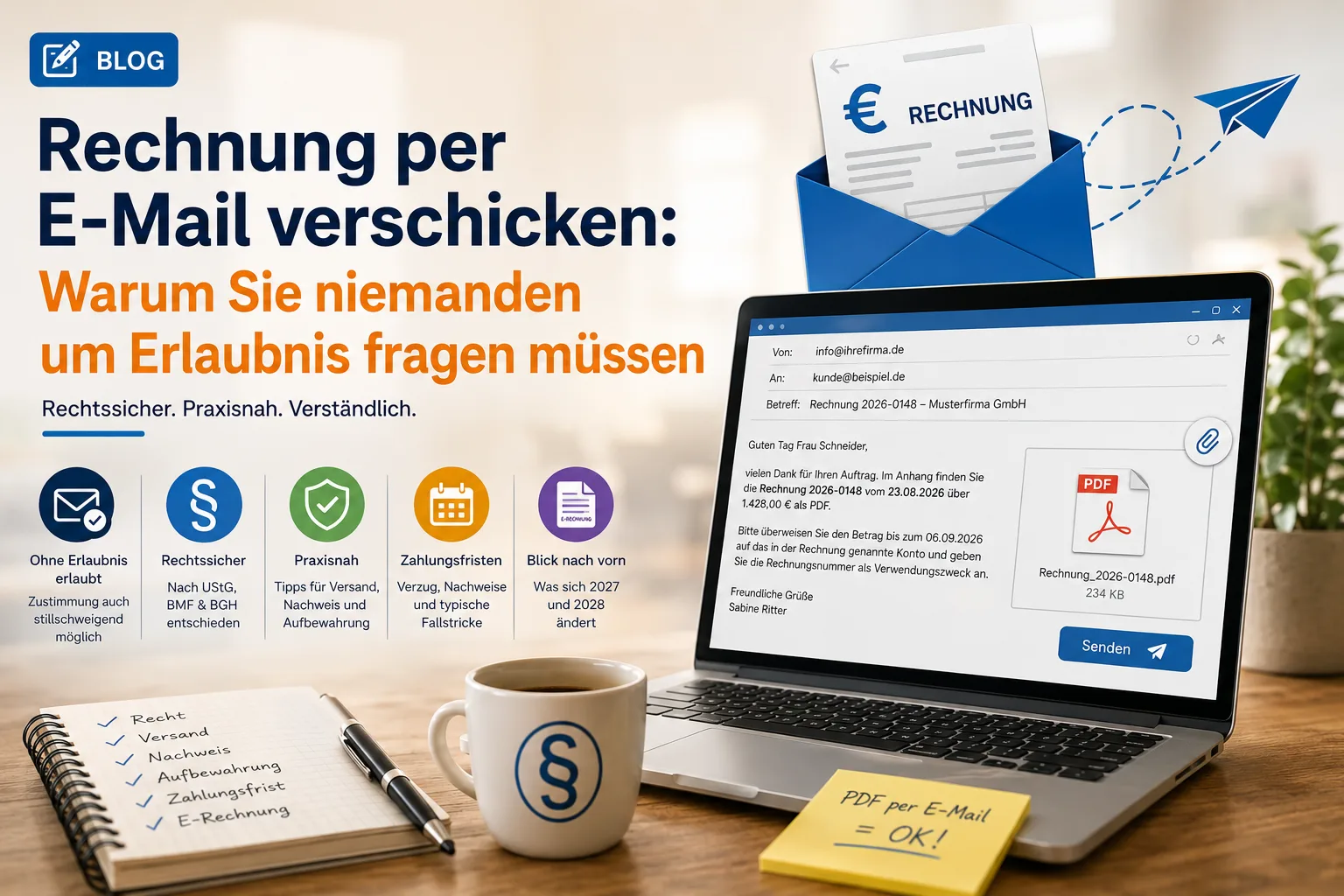
You may send your invoice as a PDF by email – to private customers permanently, to business customers in Germany until the end of 2026, and as a smaller business until the end of 2027 – and you do not have to ask anyone for permission first. The invoice does not need a signature either. German law does say the recipient must agree to electronic delivery, but that agreement arises by itself as soon as someone accepts your emailed invoice and pays it. That is exactly why no customer has ever asked you, and why you do not have to ask either. Only two situations really matter: a customer explicitly insists on paper – then paper it is. Or a customer claims they never received an invoice – then you have to prove the mail reached them. That is where emailing invoices can actually hurt.
This article provides general information and does not replace legal or tax advice. If you are unsure about your specific case, ask your tax adviser.
Contents
- Why does nobody ever ask me for permission?
- Three cases where you should ask anyway
- Can I charge a fee for a paper invoice?
- Does the invoice need a signature or a digital certificate?
- What do I write in the email? With a sample text
- „I never got anything" – who has to prove what?
- When does the payment deadline start for an emailed invoice?
- May I email invoices to private customers?
- Do I have to encrypt the email?
- How long do I keep the emailed invoice – and the mail itself?
- Sending invoices from office1.cloud
- What changes in 2027 and 2028
Why does nobody ever ask me for permission?
Because nobody has to. German VAT law says that sending an invoice electronically requires „the consent of the recipient" (section 14 (1) UStG). That sounds like a form to sign, but it is the opposite: the consent is bound to no particular form. It also arises tacitly – simply because both sides do it that way.
In everyday practice it looks like this:
- Your customer gives you their email address for the job.
- You send the invoice there.
- They do not object and they pay.
That is consent. You need no checkbox, no confirmation, no clause in a contract. This is why the rule has never been noticed in daily business: it is fulfilled millions of times a day without anyone saying a word about it.
The delivery route itself is free anyway. In its questions and answers on e-invoicing, the German Federal Ministry of Finance explicitly names email as a permitted route, alongside a download portal, an interface or a USB stick.
The rule only bites in one place: it collapses when the customer objects. If someone says „I want the invoice on paper", they have not consented – and then they get paper, at no extra charge. Why a paper fee is risky is explained further down. That is the entire substance of the provision. It protects recipients from being forced onto an electronic route against their will.
To check an XRechnung or ZUGFeRD file, use the free e-invoice viewer by Office1, which displays the file readably without signing up.
Three cases where you should ask anyway
Tacit consent works as long as everything runs smoothly. In three situations one sentence up front is still wise:
- The customer never gave you an email address. Anyone sending an invoice to an address they found themselves has no consent – and often the wrong recipient.
- The customer once asked for paper. An objection stays valid until the customer says otherwise.
- Larger companies and public authorities often have a dedicated address for invoices, for example
invoice@…. If your invoice ends up in an employee's personal inbox instead, it tends to stay there.
One sentence in your quote or in the order confirmation covers all three cases at once: „You will receive the invoice as a PDF by email. Please tell us which address it should go to." Note the answer in the customer's master data – then it is already there for the next job.
And one detail that often causes unease: the consent applies to the format, not to the individual invoice. Once settled, it covers every further invoice to that customer.
Can I charge a fee for a paper invoice?
The obvious thought: whoever wants paper pays the postage. It is still not advisable – at least not if the fee sits in the small print.
In 2014 the German Federal Court of Justice struck down a mobile provider's clause charging extra for a paper invoice while the electronic version was free (judgment of 09/10/2014, case III ZR 32/14). The core of the reasoning applies to small businesses too: billing for the service provided and giving the customer an invoice is an obligation of the business. Costs incurred in fulfilling your own obligation may not be passed on to the customer by a standard clause (section 307 BGB). The court left open only the special case of a provider selling exclusively online – anyone who, like most tradespeople and service providers, also wins jobs in person, by phone or on site does not fall under that.
With private customers there is a second hurdle: any amount beyond the agreed price must be agreed expressly, and in online orders it may not come about through a pre-ticked box (section 312a (3) BGB). A flat fee that silently hits every paper customer is therefore risky.
What works in practice:
- Build the postage into your prices. With a handful of paper customers this is a few euros a year – a cost item like envelopes, not a matter to argue about.
- Hand the invoice over instead of posting it. If you are at the customer's place anyway, leave it there. That does not even cost postage.
- Say clearly what the standard is when taking the job. „You will receive the invoice as a PDF by email" heads off the question without any talk of fees.
What to stay away from: a line in your terms or on the invoice saying the paper version costs a flat 2.50 euros. That is exactly the construction that failed in court. If you still want to price in the effort, raise it before the job as part of the price, get it confirmed – and when in doubt have your legal adviser look at it.
Does the invoice need a signature or a digital certificate?
No, neither. An invoice must contain the mandatory details under section 14 (4) UStG – a signature is not among them. That applies to paper and PDF alike.
The qualified electronic signature that used to be required has not been mandatory since 2011. That is a particularly secured digital signature with an officially checked certificate; when it is still needed today is explained in signing contracts digitally. For invoices, the law only requires three things to be guaranteed throughout the retention period (section 14 (3) UStG):
- Authenticity of origin – the invoice really comes from you.
- Integrity of content – the mandatory details were not altered in transit.
- Legibility – people and auditors can read it.
How you ensure that is up to you. The law calls it an „internal control procedure" and in a small business it means nothing complicated: you match invoice, order and payment against each other. Anyone doing that anyway meets the requirement. How far that matching goes is explained in the article on why a GoBD-compliant invoice does not exist as a single document.
What you should avoid: printing the invoice, signing it and scanning it back in. Legally it achieves nothing and turns a clean PDF into a less legible image file.
What do I write in the email? With a sample text
The mail is the envelope, the invoice is the content. Keep the envelope short and put everything essential into the PDF. The reason is practical: if something relevant for tax purposes appears only in the mail and not in the attachment, you have to keep the mail for eight years as well.
This structure has proven itself:
Subject: Invoice 2026-0148 – Sample Company Ltd
Text:
Dear Ms Schneider,
thank you for your order. Attached you will find invoice 2026-0148 of 23 August 2026 for 1,428.00 euros as a PDF.
Please transfer the amount by 6 September 2026 to the account stated on the invoice and quote the invoice number as the reference.
If you have any questions about the invoice, you can reach me on 0511 1234567.
Kind regards
Sabine Ritter
Four things make the difference:
- Invoice number in the subject line. Your customer finds the mail again later, and in their bookkeeping it lands with the right transaction.
- State the amount and the deadline. Not as a substitute for the invoice, but so nobody has to open the PDF just to see what it is about.
- No unnecessary attachments. The more files travel along, the greater the risk that the spam filter strikes.
- Sender address from your own domain. Invoices from free webmail addresses land in the spam folder more often – and look less binding to business customers.
Requesting a read receipt achieves little: the recipient can switch it off or simply refuse it. Why it is worth almost nothing as evidence is covered in the next section.
„I never got anything" – who has to prove what?
This is where emailing invoices hurts in a dispute: the sender bears the burden of proof. If you rely on the invoice – because you want to send a reminder or claim interest – you have to show that the mail reached the customer.
The Federal Court of Justice did at least clarify in 2022 when a mail between businesses counts as received (judgment of 06/10/2022, case VII ZR 895/21): it is received as soon as it is retrievable on the recipient's mail server during normal business hours. Whether they actually read it is irrelevant. The prerequisite is that the recipient gave that address for business correspondence.
That answers the question „when", not the question „whether". A send log from your mailbox only shows that you sent it, not that it arrived. So in daily practice:
- Document the dispatch. Record when which invoice went to which address. Software that logs the dispatch on the document itself saves you the paper trail.
- Take the address from the master data, not from memory. A typo in the address is the most common reason an invoice never arrives – and the error message does not always reach you.
- Use post as well when deadlines matter. For reminders, terminations and anything tied to a deadline, a letter is still the safer route. What escalation looks like afterwards is explained in customer not paying the invoice.
- Stay friendly when someone says they never got it. Send the invoice again and ask for a short confirmation by reply. That reply is worth more as evidence than any read receipt.
And the reverse case, which happens just as often: the invoice went to the wrong recipient. One character mistyped in the address and your invoice sits with a stranger – with a name, an address and what your customer bought. Ask the wrong recipient to delete it, note the incident briefly in writing and send the invoice to the correct address. For a single invoice that is usually the end of it; if it happens repeatedly or particularly sensitive details are involved, the case belongs in a report to the data protection authority. The best protection is mundane: take the address from the master data, not from memory.
When does the payment deadline start for an emailed invoice?
What counts is the day the invoice reached your customer – not the date printed on it. Without a special agreement they are officially late at the latest 30 days after that, legally „in default" (section 286 (3) BGB). From then on you may charge default interest and reminder costs. With a private customer, however, this 30-day rule only applies if you expressly pointed it out on the invoice.
It gets simpler if you state a concrete payment date on the invoice, for example „payable by 6 September 2026". Then it is clear from the outset what is being discussed – and you spare yourself the argument about when the 30 days began.
May I email invoices to private customers?
Yes, and just as informally as with business customers. Anyone who gives you their email address and accepts the invoice there has agreed. A pensioner who never gave you an email address gets paper instead – not because of the law, but because otherwise they never see the invoice.
Two points come on top with private customers:
- The e-invoicing obligation does not apply to them. Invoices to private consumers remain exempt from the new rules. For private customers the PDF stays permanently possible.
- Tradesperson services need the note on the retention obligation and – so your customer can save tax – the labour share shown separately. What to watch out for is explained in writing a tradesperson's invoice.
An invoice contains a name, an address and often enough conclusions about what someone bought or had done. So never send it to a collective address and never to several recipients at once who can all see each other's addresses. Every invoice goes to exactly one recipient.
Do I have to encrypt the email?
There is no legal obligation to encrypt every invoice. Data protection authorities do expect the transport to be secured, though. In its guidance on protecting personal data in email transmission of 16 June 2021, the German data protection conference describes transport encryption as the minimum measure. What is meant is the encrypted connection between the mail servers involved – not the encryption of the message itself.
In practice this means: in your mail account settings the connection must say SSL/TLS or STARTTLS. With any reputable provider that is the default. Additional measures such as a password-protected PDF are worthwhile when particularly sensitive details are involved, for instance in health professions or therapy services. For an ordinary trade or service invoice, encrypted transmission is enough.
How long do I keep the emailed invoice – and the mail itself?
You must keep your own copy of every invoice you have issued for eight years (section 14b (1) UStG). The period starts at the end of the year in which you issued the invoice. Many guides still say ten years – that has been outdated since 1 January 2025.
Two rules that get bent most often in daily practice:
- Electronic stays electronic. An invoice sent or received by email must be kept in the form in which it arose. Printing it out and then deleting the PDF is not enough.
- The mail itself usually does not have to be kept. It is the envelope. Only if the mail contains details relevant for tax that are not also in the attachment does it become a document subject to retention. That is exactly why the advice above: everything essential belongs in the PDF.
How to organise this on the other side, when invoices land in your own inbox, is explained in managing incoming invoices. And if you currently write your invoices in Word and turn them into a PDF, it is worth reading writing invoices with Word or Excel – it deals with the question of why the fact that such files can be changed afterwards is the actual problem.
Sending invoices from office1.cloud
In office1.cloud you send the invoice straight from the document, via your own mailbox – so your address appears as the sender. Subject and text come from a template in which placeholders such as invoice number, amount and payment date are filled in automatically. The PDF is attached, and you can add further files.
Two points that fit the topic of this article: the dispatch is counted on the document, so you can see whether and how often an invoice has gone out. And a draft is finalised when it is sent – it receives its final number and can no longer be changed quietly afterwards. If you do need to correct something, that runs via a cancellation or correction invoice.
What changes in 2027 and 2028
Here things do get serious once – but not about the delivery route, about the file format. For that you need to keep two similar-sounding words apart:
- Your PDF is a picture of the invoice. A person can read it, a program cannot. Since 2025 German law calls this a „other invoice" – even when you send it by email.
- An e-invoice is a data set that the recipient's accounting software can read by itself, without anyone retyping. This includes XRechnung and ZUGFeRD. What sets the two apart is explained in XRechnung or ZUGFeRD?
The emailed PDF is therefore a discontinued model – but only between businesses in Germany, and not immediately:
| Period | What you may send to business customers in Germany |
|---|---|
| until 31/12/2026 | PDF or paper as before |
| 2027 | PDF only if your previous year's turnover was at most 800,000 euros |
| from 2028 | e-invoice, regardless of turnover |
The transitional rule is in section 27 (38) UStG. Nothing changes for invoices to private customers – the PDF stays permanently permitted there.
Can a business customer already demand an e-invoice from me? They cannot force one. During the transition period the issuer decides whether to issue an e-invoice or another invoice – that is you. What they certainly can do is object to the PDF. Then the paper invoice remains, because paper is always permitted during the transition. It rarely becomes a dispute: anyone explicitly asking for an e-invoice has software meant to read the data – and by 2027 or 2028 there is no way around it for you anyway.
One duty does exist today: since 1 January 2025 every business in Germany must be able to receive e-invoices. The Ministry of Finance makes clear that an email inbox is already enough for that. So you do not need to run a portal – but you also cannot refuse receipt because the format does not suit you. What that means concretely is explained in the e-invoicing obligation for 2027 and 2028 and, if you use the small business scheme, in e-invoices as a small business.
Making the switch early means having it behind you before the deadline presses. One piece of good news to close with: none of this changes the delivery route. An e-invoice also goes out by email – just with a file the recipient can read in instead of retype.
Sources: section 14 UStG · section 14b UStG · section 27 UStG · section 286 BGB · section 307 BGB · section 312a BGB · section 130 BGB · German Ministry of Finance: questions and answers on e-invoicing · Data protection conference: guidance on email transmission of 16 June 2021 · Federal Court of Justice, judgment of 06/10/2022, case VII ZR 895/21 · Federal Court of Justice, judgment of 09/10/2014, case III ZR 32/14
Handle invoices more easily
Easy Invoice combines quotes, invoices and customer management in the cloud.
Try Easy InvoiceRead next
 Invoicing & Accounting
Showing a discount on an invoice in Germany: template, VAT, example
A discount is deducted from the net amount, and VAT is calculated afterwards. Here are two templates to copy, the rules for discount codes and vouchers, and what applies if you grant the reduction only after the invoice.
 Invoicing & Accounting
Freelancer invoices in Germany: template, required details, VAT
As a freelancer (Freiberufler) in Germany, you write invoices without registering a trade, but with the same mandatory details as any business. One question decides: do you add VAT or not? Here you find the answer for your case and a template for each of the three cases.
 Invoicing & Accounting
Retention periods 2026: invoices, receipts and what may go in 2027
Since 2025, eight instead of ten years have applied to invoices and other accounting vouchers (Buchungsbelege). The table shows all periods, when they start, when they run longer and which folders you may clear out at the start of 2027.